The Israeli Flag
by Alec Mishory
At the ceremony for the Declaration
of the Establishment of the State of Israel, the dais was decorated
with a picture of Theodor Herzl,
flanked on either side by the flag of the World
Zionist Organization (WZO). This flag, adopted by the first Zionist
Congress in Basle in 1897, had become accepted by Jewish communities
throughout the world as the emblem of Zionism and it was thus natural to use it at the official proclamation of statehood.
Five-and-half months earlier - on November 29, 1947 - when the Jews of
Israel had poured into the streets to celebrate the United Nations partition resolution, they
too had hoisted the flag of the WZO and used it as a unifying symbol.
In May 1948, however, only a few days after the Zionist dream had become
reality, the question was raised as to whether the Zionist banner should
be the flag of the state or should be replaced.
The dilemma continued
for about six months, until the following notice was published in the
Official Gazette:
The Provisional Council of State
Proclamation of the Flag of the State of Israel
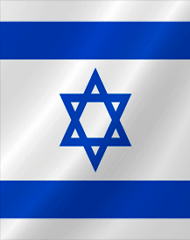
The Provisional Council of State hereby proclaims that the flag of
the State of Israel shall be as illustrated and described below: The
flag is 220 cm. long and 160 cm. wide. The background is white and
on it are two stripes of dark sky-blue, 25 cm. broad, over the whole
length of the flag, at a distance of 15 cm. from the top and from
the bottom of the flag. In the middle of the white background, between
the two blue stripes and at equal distance from each stripe is a Star
of David, composed of six dark sky-blue stripes, 5.5 cm. broad, which
form two equilateral triangles, the bases of which are parallel to
the two horizontal stripes.
25 Tishrei 5709 (28 October 1948)
Provisional Council of State
Joseph Sprinzak, Speaker |
 |
This decision to adopt the Zionist flag to be the
flag of the State of Israel reflects its power as a symbol of the spirit
of the Zionist movement. In order to examine the reasons that led to
this decision, let us look for the symbolism and consider the motives
which prompted the members of the Provisional Council of State first
to consider replacing it and then to decide against doing so.
Zionist
tradition credits the design of the Zionist flag to David
Wolffsohn. Legend even tells precisely when Wolffsohn had his brainstorm,
namely, that during a meeting in Basel Herzl raised the question of
the Zionist flag. When his proposal of a white banner with seven gold
stars failed to marshal a consensus, Wolffsohn stood up and said: "Why
do we have to search? Here is our national flag." Upon which he
displayed his prayer shawl and showed everyone the national flag: a
white field with blue stripes along the margin.
“At the behest
of our leader Herzl, I came to Basle to make preparations for
the Zionist Congress. Among many other problems that occupied
me then was one which contained something of the essence of the
Jewish problem. What flag would we hang in the Congress Hall?
Then an idea struck me. We have a flag — and it is blue and
white. The talith (prayer ahawl) with which we wrap ouselves
when we pray: that is our symbol. Let us take this Talith from
its bag and unroll it before the eyes of Israel and the eyes of
all nations. So I ordered a blue and white flag with the Shield
of David painted upon it. That is how the national flag, that
flew over Congress Hall, came into being.”
— David
Wolffsohn
|
In our attempt to uncover
the message conveyed by the Zionist flag, we should therefore address
each of its components separately — the Magen David (Star
of David), the blue stripes and the white background.
The Star of David
Unlike the menora (candelabrum), the Lion of Judah, the shofar (ram's horn) and the lulav (palm frond), the Star
of David was never a uniquely Jewish symbol. The standard name for
the geometric shape is a hexagram or six-pointed star, composed of two
interlocking equilateral triangles. In a classic article, Gershom Sholem
shed light on the history of the "Star of David" and its connection
with Judaism and tried to answer the question whether it was appropriate
to include it in the national flag or state emblem.*
One of the first Jewish uses of the Star of David was as part of a
colophon, the special emblem printed on the title page of a book. Sometimes
the printer included his family name in the colophon; or chose an illustration
that alluded to his name, ancestry, or the local prince, or a symbol
of success and blessing. The idea was to differentiate this printer's
books from those of his competitors and to embellish the title page.
Colophons are as old as the printing press itself.
According to Sholem, the motive for the widespread use of the Star
of David was a wish to imitate Christianity. During the Emancipation,
Jews needed a symbol of Judaism parallel to the cross, the universal
symbol of Christianity. In particular, they wanted something to adorn
the walls of the modern Jewish house of worship that would be symbolic
like the cross. This is why the Star of David became prominent in the
nineteenth century and why it was later used on ritual objects and in
synagogues and eventually reached Poland and Russia. The pursuit of
imitation, in Sholem's opinion, led to the dissemination of an emblem
that was not really Jewish and conveyed no Jewish message. In his opinion,
it was also the reason why the Star of David satisfied Zionism: it was
a symbol which had already attained wide circulation among the Jewish
communities but at the same time evoked no clear-cut religious associations.
The Star of David became the emblem of Zionist Jews everywhere. Non-Jews
regarded it as representing not only the Zionist current in Judaism,
but Jewry as a whole.
The Blue Stripes
The blue stripes on the Zionist flag were inspired
by the stripes on the tallit (prayer shawl). The tallit has two separate symbolic aspects: the light
blue hue and the stripes. Some say that the stripes are meant to recall
the one dyed strand of the ritual fringes (tzitzit). This leads
to the significance of the hue itself. According to the Torah,
one strand in the tzitzit should be light blue. To judge from references
in the Talmud, it
was a shade between green and blue. Many symbolic meanings were attributed
to it. Rabbi Meir said that it recalls the color of the sky; Rabbi Judah
ben Illai maintained that the color of Aaron's staff was light blue,
as were the Tablets of the Law, and this is why God commanded the Jews
to include it on their prayer shawls: "As long as the people of
Israel are looking at this tehelet, they are reminded of {the words}
written on the tablets and observe them." In other words, the sight
of the color tehelet leads to observance of the commandments. White
and tehelet, along with gold and purple, were the colors of the High
Priest's raiment (Exodus 28: 4,43)
and of the curtains of the Tabernacle (Exodus
26). They were considered to be the colors of purity symbolizing
the spirituality of the Jewish people.
The first person in modern times who voiced the idea that blue and
white are the national colors of the Jewish people, was the Austrian
Jewish poet Ludwig August Frankl (1810-1894). More than three decades
before the First Zionist Congress, Frankl published a poem entitled
"Judah's Colors":
When sublime feelings his heart fill,
He is mantled in the colors of his country
He stands in prayer, wrapped
In a sparkling robe of white.
The hems of the white robe
Are crowned with broad stripes of blue;
Like the robe of the High Priest,
Adorned with bands of blue threads.
These are the colors of the beloved country,
Blue and white are the borders of Judah;
White is the radiance of the priesthood,
And blue, the splendors of the firmament.
A. L. Frankl, "Juda's Farben," in Ahnenbilder (Leipzig,
1864), p. 127
Frankl's poem was translated into flowery Hebrew and
appeared in the periodical Hahavatzelet (The Rose of Sharon)
in 1878. We do not know if the founders of Zionism knew the poem, but
it is a fact that the flags of almost all the early Zionist associations
borrowed the blue stripes of the tallit. A blue-and-white flag
was raised over the agricultural village of Rishon Lezion in 1885 to
celebrate the third anniversary of its founding. Independently of the
Rishon Lezion event, a blue-and-white flag was raised in 1891 in Boston
at the dedication of the meeting hall of the Bnai Zion Educational Society.
That flag had blue stripes above and below a Star of David that had
the Hebrew word "Maccabee" inscribed in its center. Bnai Zion
first displayed their banner publicly in October 1892, during festivities
to mark the fourth centenary of the discovery of America. This time
the word "Zion" replaced "Maccabee."
Flag
of the Bnai Zion Educational Society in Boston, 1892 The blue stripes
of the Zionist flag serve as a counterweight to the message of the Star
of David. They give the flag the religious and ritual aspect totally
absent from the latter. Whether the symbolic meaning of the blue stripes
was perceived consciously or not, their origin in the tallit reminds onlookers of the Torah commandments. The Zionist flag uses the
Star of David to express Jewish unity, which is in turn guided by the
precepts of the Torah, as represented by the blue stripes and white
background.
Dual Loyalty
After nearly 50 years during which the flag served
the Zionist movement worldwide, including the Yishuv (the Jewish community) in the Land of Israel, an ad-hoc committee of
the Provisional Council of State in 1948 decided to "introduce
a conspicuous difference - to the extent possible - between the flag
of the State and the Zionist flag." Minister of Foreign Affairs Moshe Shertok (Sharett) explained
that this was desirable "so as to avoid complications for Jewish
communities when they raise the international flag of the Jewish people,
namely the Zionist flag, and misunderstandings may occur, or the impression
might be that they are flying the flag of a state of which they are
not citizens." So that Diaspora Jewry would not be exposed to charges of dual loyalty, it was decided
to organize a competition for new designs for the flag of the State
of Israel, which would be different from the Zionist flag.
 Flag Proposed by Nissim Sabbah
 |
The
proposal of Mr. Nissim Sabbah of Tel
Aviv, included components that recurred in most of the proposed
designs: two blue stripes, a white background, a Star of David in the
middle and seven gold stars.
Another proposal endeavored to reconcile the traditional
with the modern. It attempted to create a sophisticated symbolism based
on the number seven. The seven candles of the Sabbath lamp are crowned
by seven flames, shaped like Stars of David; thus Shabat Shalom ("Sabbath peace") is blended with the seven hours of daily
labor proposed by Herzl. Another interesting detail is the shape of
the proposed flag, which is reminiscent of the Star of David: jutting
from the bottom is the lower half of the Star of David, while the same
part of the star is cut out of the upper edge of the banner.
In July 1948, Mordechai Nimtza-bi, an expert on heraldry,
published a book entitled The Flag, in which he sought to determine
the appropriate design for the national flag. Nimtza-bi agreed with
Sharett that the Zionist flag should be adopted by the State of Israel
but also - that this was not possible.
"Even after the establishment
of the State, many Jews will continue to live in the Diaspora, and were
the Zionist flag to become the state flag, these Jews, who are nationals
of their countries of residence, would be flying the flag of a foreign
country," he wrote. Nimtza-bi was well versed in the rules of heraldry,
especially of the British Empire. The flags of some members of the British
Commonwealth incorporated the Union Jack either in the corner, or the
center. In his various proposals for the Israeli flag, Nimtza-bi wished
to impart to the State of Israel spiritual authority vis-à-vis
the Zionist organizations worldwide, similar to the relationship between
Great Britain and the dominions. He created many variations on the Zionist
flag. The Provisional Council of State did not accept any of his proposals,
nor those submitted by the public at large.
 Flag Proposed by Oteh Walisch
 |
At the tenth meeting of the Provisional Council of
State, Moshe Sharett submitted another proposal, that of graphic artist
Oteh Walisch.
In
Walisch's design, the flag is divided crosswise into three equal sections:
blue stripes at top and bottom, with a single row of seven gold stars
emblazoned on the white section in the middle. This division differs
from that of the Zionist flag, which had five stripes - two blue and
three white. The relative widths are different, too. Walisch's design
represents a deliberate departure from the Zionist flag. As noted, the
blue stripes on the latter were taken from the prayer shawl. When Walisch
moved them to the upper and lower edges of the banner and made them
wider, the design was no longer an obvious reminder of the tallit. The
disappearance of the blue stripes gives his proposal a more "secular"
character.
In the meantime, Moshe Sharett decided to inquire into
Diaspora Jewry's thoughts about the flag of the State of Israel. On
July 20, 1948, he sent cables to Dr.
Chaim Weizmann, who was in Switzerland at the time; to Rabbi
Abba Hillel Silver, in New York; to Prof. Zelig Brodetsky, in London;
and to the Zionist General Council, in Johannesburg. Rabbi Silver replied
that "we would prefer to leave the Zionist flag as the national
flag of Israel, with a minimum of changes. We feel that the fear of
complications as a result of use of the flag at Zionist gatherings overseas
has been somewhat exaggerated." The other Zionist leaders responded
similarly. After the fears of "dual loyalty" had been alleviated,
the Provisional Council of State voted unanimously on October 28, 1948
to adopt the Zionist flag as that of the State of Israel. The resolution
came into effect two weeks later, after publication in the Official
Gazette.
The Tablets of the Law, the Lion of Judah, and Herzl's
"Seven Stars," advanced as possible replacements for the Star
of David during the discussions about the flag, were incorporated in
other official emblems: the Lion of Judah is the emblem of the Municipality
of Jerusalem; Herzl's seven stars are prominently featured in the emblems
of Tel Aviv and Herzliya; and the Tablets of the
Law appear on the emblem of the Chief Rabbinate of Israel.
The Star of David is an outstanding example of the
variable significance of symbols. The power of the message they convey
stems less from the original use in history. At first the Star of David
had no religious, political, or social connotations whatsoever. It gained
a very powerful connotation precisely as a result of its terrible abuse
by the Nazis.
The blue and white stripes which symbolize a life of purity, guided
by the precepts of the Torah, and the Star of David, which symbolizes
rebirth and new life for the Jewish people, tie the State of Israel,
through its flag, to the past, present and future. This is evidently
why the Zionist flag prevailed over the political considerations that
had prompted the leaders of the new state to propose substitutes for
it.
Sources: Israeli
Foreign Ministry; The author is an art histroian, art critic and a lecturer
at the Open University of Israel.
*- G. Sholem, "The Curious History of the Six Pointed
Star; How the 'Magen David' Became the Jewish Symbol," Commentary,
8 (1949) pp. 243-351.
|