Paratroopers Infantry Brigade
History & Overview
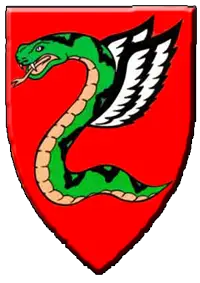
Paratrooper Brigade Logo |
The antecedent of the paratroopers group was a group of
Palestinian Jewish volunteers who parachuted into Nazi-Europe in
1943, five years prior to the establishment of the State of Israel.
These soldiers, who fought in the ranks of the British
army, helped organize Jewish resistance in Europe. Of the initial
32, twelve were captured and did not return. The most celebrated of
this group were Hannah Senesh, who was captured and
executed in Nazi-occupied Hungary, and Yoel Palgi, who escaped
from Nazi captivity and returned to lead resistance in Budapest.
Five years later, in the midst of Israel's War of
Independence, Prime Minister David Ben-Gurion summoned Palgi to
form the first Paratroop unit. At his disposal were an unsuitable
commando aircraft and 4,000 second-hand parachutes purchased as scrap
material. Palgi's unit
consisted of an assortment of Israeli
veterans of the British army and Palmach,
graduates of the jump group in Czechoslovakia, resistance
veterans, ghetto survivors and a number of plain adventurers. The unit
improvised equipment and training was inadequate - jumps were regularly made
without reserve chutes and often ended in tragedy. Though a
number of operational plans called for paratroop drops, the war
ended without the unit actually seeing action. In the summer of 1949,
Yehuda Harari took command of the paratroop unit and set to work
reorganizing it and infusing new blood. He weeded out the unfit,
moved the paratroopers to a more suitable base, acquired proper
equipment, and organized the first jumpmasters course.
The IDF paratroopers have earned a hard-won reputation for
strict discipline, courage, initiative, dedication to duty and
the highest standards of performance. They have consistently been
at the forefront of the IDF and have set behavioral and
operational norms for others to emulate.
Infantry, and paratroopers in particular, provide flexibility
and maneuverability to the modern battlefield. They are capable
of operating under any field and weather conditions, day or
night, combining rapid movement and firepower.
IDF paratroopers are trained to overcome obstacles and
minefields, to fight alone, or jointly with other forces and
services in integrated combat. They can be transported by
helicopter or dropped behind enemy lines, or be landed from
amphibious landing craft. They can fight mounted on jeeps, or on
APC's and can operate against armor, attack helicopters and
infantry. IDF paratroopers are a major component in maintaining
Israel's security, and have played important roles in special and
regular operations in Israel's war against terrorism.
The Paratroop Brigade is one of the
four regular brigades of the Infantry Corps. The Brigade is composed of
infantry battalions, as well as reconnaissance, engineering,
signals and anti-tank companies. The Infantry Corps
is responsible for training and coordinating infantry operations
with other forces. The corps is overseen by the Ground Corps
Command which is responsible for unifying and streamlining
infantry, armor, artillery and engineering forces, training
doctrine matters, planning and R&D.
The history of this elite unit is replete with operations
which have made front-page headlines over the world. The daring
reprisal raids of the 50's, the Mitla Pass jump and battles of
the 1956 Sinai Campaign, the Conquest of Rafah and the historic
unification of Jerusalem in the 1967 Six Day War, the airlifting
of a Soviet radar station out of Egypt in 1969, the 1972 rescue,
the 1973 commando raid against terrorist headquarters in the
heart of Beirut, the bridgehead over the Suez and the bloody
battle of the Chinese Farm during the Yom Kippur War, the
unprecedented rescue of the passengers and crew of the hijacked
Air France Airbus in “Operation Jonathan” at Entebbe.
These are just a few of the operations which have made this unit
legendary.
Paratroop officers and enlisted men have indeed become
legends in their time. Many have acceded to the highest-level
military positions and have gone on to make distinguished
contributions to Israeli political life.
Training and Spirit
Every year, the Paratrooper Brigade receives as many as five
times as many applicants as it can accept. Most candidates are
screened out by rigorous acceptance criteria and the arduous
training regimen that follows. Paratroop training, which is tough
and unrelenting, reflects the versatile role which this force
will have to play on present and future battlefields. This
includes massive doses of physical fitness, topography, mastery
of a wide array of weapons as well as training in mobile,
airborne, heliborne and amphibious operations, as well as
integrated operations with armor and artillery, day and night
assaults against different types of objectives, and the famous
IDF Jump School. All paratroopers go through NCO school before
being trained in a military specialty. Those destined to become
platoon leaders are sent to Officers' School. Personal qualities
required of an IDF Paratrooper are courage, professional
knowledge, ability to decide, capacity to improvise solutions
when faced with difficult or unexpected situations, and
leadership ability. Officers must serve as personal examples to
their men. Ties between officers and enlisted men are direct and
long-lasting, with no artificial barrier separating them.
Women serve in the Infantry and Paratroop Corps as
instructors (in such fields as marksmanship, anti-tank missiles,
etc.), educators, administrative and technical personnel. At the
Paratrooper Training Base, women likewise serve as parachute
riggers and inspectors. They undergo a jump course to increase
their identification with the paratroopers whose lives are
literally in their hands.
IDF paratroopers are a family, whose members (both living and
deceased) are bound together by a bond of shared experiences and
blood shed in battle. A union cemented by camaraderie, which
transcends and blurs formal distinctions: an aristocracy of
individual merit. Paratroopers continue to serve in their units
after their discharge from compulsory service, either in the
career army or the reserves (retaining their red berets). They
remain part of the paratrooper family, even after they pass
beyond the stringently observed cut-off age for reserve duty, and
are transferred to other units.
The "101st Airborne"
The 1950's were marked by infiltration of Arab terrorists across
Israel's borders. The infiltrators would carry out acts of
murder, pillage, and sabotage. In the year 1952 alone there were
3,000 infiltrations. In order to curb these attacks it was
decided to form a small unit of superlative fighting men who
would carry out reprisal operations. This unit called itself the
“101st.”
The 101St. took on many difficult assignments behind enemy lines.
The 101St. gained quick recognition for being able to accomplish
the “impossible,” for dedication to the mission, and
for exemplary courage and daring. Among the outstanding members
of the unit were the legendary Meir Har-Zion, known for his
initiative, knowledge of the countryside and courage, and Ariel
Sharon.
Moshe Dayan, Chief of Operations and later Chief of Staff,
envisaged the need for a large-scale Paratroop force. The merger
of the 101St. with the paratroopers became inevitable. The 101St.
breathed new life into the paratroopers. Performance standards
rose.
In the mean time, Arab Fedayoun (terror units) were
established as adjuncts to the Egyptian army in April 1955, and
soon similar units were organized in Jordan, Syria, and Lebanon.
Reprisal operations took the form of actions against regular
enemy forces. In one such assault against a 200-man Egyptian
brigade headquarters and security complex in Khan-Yunis,
Mordechai “Motta” Gur was badly wounded. In operation
Kinneret, (11 December 1955), undertaken after continued Syrian
shelling of Israeli fishing vessels, a brigade-strength force of
Paratroopers augmented by other elements, crossed the Sea of
Galilee and destroyed Syrian positions. Casualties in the
operation included Rafael Eitan (wounded in his stomach) and
Yitzhak Ben Menachem (surnamed “Gulliver” because of
his height), an Independence War hero who had replaced Motta Gur
as Company Commander.
The paratroopers were expanded to brigade strength and placed
under the command of “Arik” Sharon. “Raful”
Eitan commanded a veteran battalion. Retaliation operations
against enemy fortifications succeeded one another: Rahwa,
Jarandal, Husan, Kalkilya. During 1955-56 there were 10 major
reprisal operations which brought temporary remissions in
terrorist activity and gave valuable combat experience to the
young brigade. Lessons drawn from each operation were promptly
incorporated into the unit's doctrine.
Battles & Operations
The Sinai Campaign (1956):
The operational advantage of a large-scale paratroop force was
demonstrated in the Sinai Campaign. The war began with a drop of
an entire paratroop battalion (under Raful's command) over the
eastern approaches to the Mitla Pass. The remaining members of
the brigade force were to travel along a 300 km route (200 km.
within enemy territory) and link up with the battalion. This
break-through took 28 hours, during which the column swept
through the deserted Kuntilla and fought two short but fierce
battles against Egyptian forces in Thamad and Nakhl. The major
Paratroop action during the campaign was the battle for Mitla
Pass. A paratroop reconnaissance patrol entering the pass found
itself trapped by an overwhelming enemy force. The Egyptians
enjoyed topographical advantage, fighting from positions and
niches in superior terrain. Outnumbered reinforcements who
entered the fray fought desperately with great personal sacrifice
to rescue their comrades. After nightfall, the Egyptians were
finally routed but at a tremendous cost: 38 paratroopers dead and
over 100 wounded. Enemy losses were 260.
The paratroopers jumped once again during the Sinai Campaign—at At-Tur, on the south-eastern shore of the Gulf of Suez. The
rest of the brigade proceeded by land to conquer Ras Sudar and
link up with their comrades at At-Tur. They then moved
southeastward to Sharm-el-Sheik at the southern tip of the Sinai
Peninsula—which they conquered in a classic pincers move in
coordination with the 9th brigade which had been moving
southwestward.
After the war's end, the paratroopers concentrated on
reorganization and training (with emphasis on helicopter
operations). (Commanders succeeded one another: Menachem Aviran,
Eliyahu Zeira, Yithak Hufi, Rafael Eitan). When Fatah terrorist
activities began in 1965, the Paratroopers became the chief
retaliatory force, reinstituting the policy of reprisal raids
most notably in the Samua operation against the Jordan legion and
Fatah. (When, during this operation, the senior commander of one
of the paratroop forces was killed or wounded, junior officers
took over and successfully completed the mission).
The Six Day War (1967):
During the Six Day War, the paratroopers, whose ORBAT had now
increased greatly, fought on all fronts: the Sinai peninsula,
Judea, Samaria, and the Golan Heights. paratroopers and armor
under Raful's command broke through the Rafah positions (heavily
defended by the crack Egyptian 7th Division) from behind.
However, in doing so the unit suffered heavy losses. Many troops
were killed in the process of evacuating comrades. The following
day, the unit entered Gaza. Paratroop forces under the command of
Danny Matt (who later attained the rank of Major General) made a
helicopter landing at the Um Katef artillery positions in the
enemy's rear line. Raful's battalion raced against the 7th
(Israeli) Armored Division for the honor of being the first to
reach the Suez Canal. Though Raful was wounded 25 kilometers from
the canal, his men under the command of veteran paratrooper
Aharon Davidi arrived first at the banks of the Suez. During the Six Day War, paratroopers reached Sharm-el-Sheikh and likewise
participated in the attack on the Golan. Perhaps, the
Paratroopers' finest hour came on June 7, when a paratroop force
under Col. Motta Gur captured the Old City of Jerusalem and
restored the Western Wall, the holiest of Judaism's shrines, to
Jewish control after almost 2,000 years. During the conquest of
Jerusalem, considerable care was taken to protect and avoid
damaging the holy places of the three religions. For this the
Paratroopers paid a heavy price in dead and wounded.
After the war, paratroopers participated in pursuit and
retaliation operations against terrorist infiltration and were
caught up in the War of Attrition on the Egyptian front. On
December 23, 1969, paratroopers airlifted an entire Soviet radar
station out of Egypt and transported it back to Israel.
War of Attrition (1968-73):
On March 21, 1968, paratroopers and armor raided terrorist
headquarters in Karame, Jordan, killing 250 enemy troops. On December 12, 1968, a heliborne paratroop force raided
Beirut Airport and destroyed Arab aircraft, taking precautions to
avoid physically harming anyone. The raid came in response to
repeated terrorist attacks on Israeli aircraft. When, on 12 May 1972, a hijacked Sabena airliner landed at
Israel's Lod Airport, oaratroopers disguised as El-Al flight
technicians broke in and rescued the passengers.
On the night of April 10, 1973, a select force of paratroopers
headed by current Chief of Staff Lt. Gen. Amnon Lipkin-Shahak
landed in different sites in and around Beirut, where according
to published foreign reports, they linked up with waiting cars
hired by Mossad agents. According to these sources, the soldiers
drove through Beirut with utmost precision and without arousing
suspicion. They simultaneously attacked the Popular Front for the
Liberation of Palestine's headquarters and the residences of
three high-ranking terrorist leaders (among them the man
responsible for the Fatah-Black September foreign terrorist
operations including the 1972 massacre of the 9 Israeli sportsmen
at the Munich Olympics). Surprise was total, and despite
resistance in the headquarters, all teams succeeded in carrying
out their missions and making a clean getaway.
The Yom Kippur War (1973):
The Yom Kippur War saw the paratroopers fighting in some of
the most difficult battles. In the Sinai, paratroopers assigned
to armored units rescued the beleaguered 'Budapest' outpost and
destroyed the Egyptian commando forces. Paratroopers armed with
LAW missiles helped contain an Egyptian armored thrust.
Paratroopers of Danny Matt's brigade crossed the canal, as the
spearhead of General Sharon's divisions, and established a
bridgehead. Others, attempting to break open a route for them,
ran up against the massive “Chinese Farm”
fortifications. For three days, paratroopers and armored corps of
General Sharon's and General Adan's divisions made repeated
attempts until they finally succeeded in making the break-through
and rescuing their comrades. During the bitter fighting, IDF
soldiers ran over open ground to evacuate fallen comrades, and
often fell victim to enemy fire in the process. The battles for
the “Chinese Farm” prevented the Egyptians from closing
in on the bridgehead and eventually succeeded in opening an
access to it. On the West Bank of the Suez, paratroopers fought
in the city of Suez and advanced on the city of Ismailia. On the
Syrian front, paratroopers captured the peaks of Mt. Hermon in a
heliborne operation. Others conquered Kuneitra and Tel Shams and
acted as armored infantry in the thrust into Syrian territory.
After the The Yom Kippur War the paratroopers and other infantry
units were placed under the command of a chief Paratroop and
Infantry Officer.
Entebbe Rescue Operation (1974):
On the morning of the fourth of July 1976, a team of crack
Israeli troops headed by Chief Infantry and Paratroop Officer Dan
Shomron succeeded in rescuing the 87 passengers and crew of a
hijacked Air France airbus at Entebbe, Uganda. The force,
transported in four Hercules aircraft, succeeded in landing
undetected at Entebbe's airport, and in taking the 13 terrorists
and their Ugandan collaborators by surprise. In the operation,
Lt. Col. “Yoni” Netanyahu was killed by a Ugandan
sniper bullet.
Operation Litani (1978):
Paratroopers have played an active role in Israel's protracted
war against terror, undertaken to keep Israel's northern towns
and villages safe from terrorist attacks. In this context,
paratroopers participated in the 1978 Operation Litani (executed
after the infamous “Coastal Road Massacre” in which
terrorists murdered 37 civilians and wounded a further 80) which
temporarily purged Southern Lebanon of terrorists.
After the IDF withdrawal and the return of sporadic terrorist
attacks, the Paratroopers participated in preventive raids
against terrorist bases in Lebanon. These raids are designed to
keep the terrorists off balance and “on the run,”
thereby preventing them from carrying out their murderous
operations within Israel.
First Lebanon War (1982):
The paratroopers were an important component of the Lebanon War. The war in Lebanon proved the IDF's fighting ability and
tested Paratroop combat doctrine, which had been revised as a
result of the lessons of the Yom Kippur War, Operation Litani and
other operations.
Paratroopers fought in every sector of the war against Syrian
troops and paratroops, and against terrorist concentrations in
both built-up and mountainous areas. They operated efficiently
and in full coordination with other corps, the Navy and the Air
Force.
One of the better known operations was the amphibious landing
at the mouth of the Awali river, north of Sidon, from where the
paratroopers advanced to the outskirts of Beirut through the
mountains. In their advance, they engaged terrorist and Syrian
commando forces.
Following the IDF withdrawal from Lebanon, the paratroopers
were integral in the ongoing security operations conducted in the
Territories, along Israel's northern border in the Lebanese
Security Zone, and have made invaluable contributions to Israel's
war against terror.
Sources: Israel
Defense Forces |