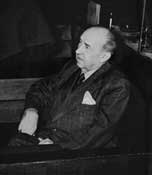
Walter Funk was born into a merchant family in Königsberg, East Prussia. He
studied at university in Berlin,
covering a number of subjects. In World War I he joined the infantry
but was discharged as unfit for service in 1916. Following the war he
worked as a journalist and in 1922 he became the editor of the center-right
financial newspaper the Berliner Börsenzeitung.
Funk resigned from the newspaper in 1931 and joined
the Nazi Party, becoming
closer to Gregor Strasser who arranged his first meeting with Adolf
Hitler. Partially due to his interest in economic policy, he was
elected a Reichstag deputy in July 1932 and, within the party, he was made chairman of the Committee on Economic
Policy in December, 1932; a post that he did not hold for long. After
the Nazi Party came to power he stepped down from his Reichstag position
and was made Chief Press Officer of the Third Reich.
In March, 1933, Funk was appointed as a State Secretary
at the Ministry of Propaganda.
In 1938, he assumed the title of Chief Plenipotentiary
for Economics (Wirtschaftsbeauftragter).
He also became Minister of Economics in February of
that year, replacing Hjalmar
Schacht who had been dropped in November 1937.
Schacht had been dismissed in a power struggle with Reichsmarchall Hermann
Göring, who was quick to tie the Ministry more closely to his
Four Year Plan Office.
In January 1939,
Funk gained another credit to his name when he assumed the post of President
of the Reichsbank, again replacing Schacht.
He was appointed to the Central Planning Board in
September, 1943.
Despite poor health Funk was tried with other Nazi
leaders at the Nuremberg
Trials. Accused of conspiracy to commit crimes against peace; planning,
initiating and waging wars of aggression; war-crimes and crimes against
humanity, he argued that, despite his titles, he had very little power
in the regime. Göring described Funk as "an insignificant
subordinate," but documentary evidence and his wartime biography Walter Funk, A Life for Economy were used against him during
the trial, leading to his conviction on counts 2, 3 and 4 of the indictment and his sentence of life imprisonment.
Funk was held at Spandau Prison along with other senior
Nazis. Released in 1957 due to ill health, he died three years later.