
A Growth Industry
Born Of Necessity
Industry Players
The Government Sector
The Private Sector
Civilian Markets
Chariot of Fire
U.S. Permission
A Growth Industry
Israel produces a wide range of products, from ammunition, small arms, and artillery pieces to sophisticated electronic systems and the world’s most advanced tank.
Having to fight five major wars in its first four decades, Israel built a comprehensive standing army – the Israel Defense Forces (IDF) - and furnished it with an arsenal of highly advanced military hardware. The government, which owns three major defense firms, also encouraged the formation of private companies to equip the IDF. The development of a sophisticated defense industry has inevitably led to exports, which today account for the majority of its revenues and enable the country’s defense industry to compete with some of the largest companies in the world for foreign contracts, while also producing many of the arms needed for Israel’s own defense.
Faced with a shrinking market for military hardware prior to the signing of the Abraham Accords, Israeli defense firms made a concerted effort to deploy their research and development teams to develop products for non-military markets and, more frequently, to adapt defense technology for civilian applications. Indeed, many of the most innovative products developed by Israel’s civilian high-tech industry, especially in telecommunications, trace their origins to military technology.
The Israel Defense Industry experienced declining exports from 2012 to 2015 due to increased international competition, which led to higher foreign defense spending and domestic defense spending cuts. The “crisis” passed, and in 2016 Israeli defense exports grew to $6.5 billion, an $800 million increase over the previous year and the largest since 2013.
Exports in 2022 reached a new high, growing by 10% to $12.5 billion. Of that, $3 billion represented deals with Abraham Accords countries, increasing their share of the total from 7% in 2021 to 24%. The Asia-Pacific region accounted for 30% of the total, and Europe 29%. UAV and drone systems accounted for 25% of the value of defense export contracts, 19% for radar and electronic warfare systems, 13% for manned aircraft and avionics, 10% for firing and launching systems, 6% for intelligence, cyber systems, and ammunition, 5% for observation and optronics equipment, vehicles, and communications systems, and 4% for marine systems.
Minister of Defense Yoav Gallant said, “The unprecedented figures the defense establishment has presented, led by a new record in the value of defense exports, clearly demonstrate the State of Israel’s security strength and technological superiority.” Thanks to the creativity and innovation of the defense industry and the Ministry of Defense, we have maintained our qualitative advantage over our adversaries. The citizens of Israel have great cause for pride, both in the exceptional numbers and, even more so, in those behind them.
One reason for the increase in sales is the Russia-Ukraine war, which has prompted European countries to increase their defense budgets.
Israeli defense exports continued to reach new highs after 2022. In 2023, exports rose to $13.1 billion, driven largely by missile, rocket, and air-defense systems. In 2024, they climbed again to nearly $15 billion, with Europe accounting for more than half of all sales and air-defense systems becoming the dominant export category. In 2025, Israel’s weapons exports reached more than $19 billion, more than doubling over five years, as demand grew for combat-tested systems amid wars in Gaza, Lebanon, and Iran.
Israeli Defense Exports
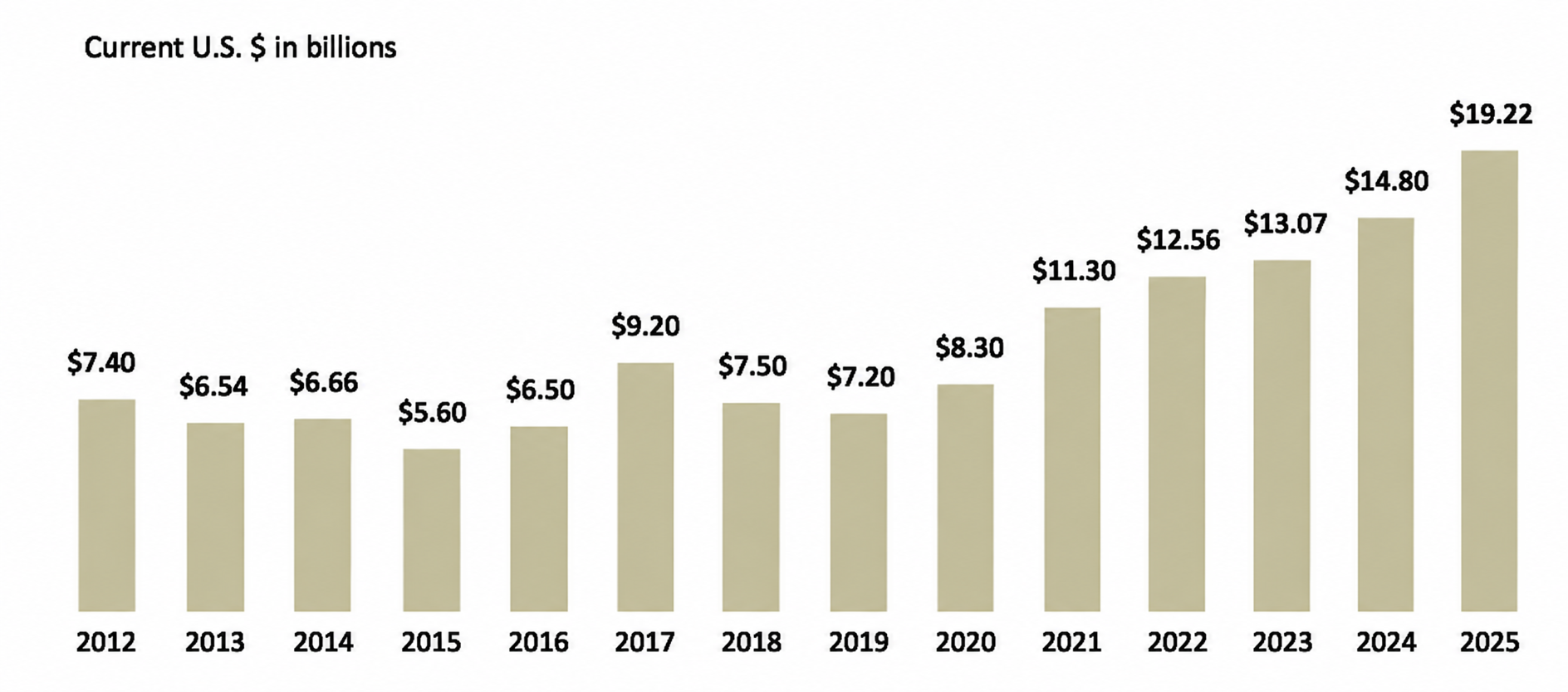
Source: Congressional Research Service
Born Of Necessity
The modern defense industry in Israel was established in the early 1920s. Faced with an increasingly hostile Arab population, the Jewish community began to manufacture homemade hand grenades and explosives. In the early 1930s, members of the Haganah (the pre-state Jewish underground defense organization) set up clandestine small arms factories, which became the Israel Military Industries (IMI) in 1948. In the first two decades after independence, IMI produced many of the IDF's basic weapons, including the Uzi submachine gun (invented by Uziel Gal and first publicly demonstrated on April 27, 1955). The more costly aircraft and other advanced weapons were procured from foreign suppliers, principally France.
The major catalyst for Israel’s metamorphosis from a small-arms manufacturer to a producer of sophisticated military systems came after the 1967 Six-Day War. During the war, France imposed an embargo on arms sales to Israel, including the Mirage planes already on order from the Dassault aircraft factory. When the United States became the primary supplier of combat aircraft, Israel began to develop its own production capability. The government-owned Israel Aircraft Industries (IAI), founded as a maintenance facility in 1953, soon began developing and assembling a variety of its own aircraft, including the Kfir – a replacement for the Mirage – as well as the Arava and Nesher planes. At the same time, IAI’s relationships with U.S. suppliers evolved from subcontracting to joint ventures with Boeing and Lockheed Martin. As a result, IAI's employment grew rapidly from 4,000 to 14,000 in the late 1980s.
The growing sophistication of Israel’s defense industry gave it the confidence to develop an all-Israeli military aircraft, the Lavi. During the first half of the 1980s, IAI developed avionics, electronics, and weapons systems for the aircraft, and by 1986, the first prototype had flown. However, the government concluded it could not finance such an ambitious undertaking, and the project was canceled a year later. Shorn of the Lavi, IAI began to develop a variety of products in the military and civilian spheres - such as advanced radar systems, precision weapon systems, unmanned air vehicles (UAVs), and commercial and military aircraft conversion - many of which were based on the technology developed during the Lavi project.
In 2006, IAI changed its corporate name from Israel Aircraft Industries Ltd. to Israel Aerospace Industries Ltd. to more accurately reflect the scope of the firm’s business activities.
The war that began with the Hamas attack on October 7, 2023, reinforced the original logic behind Israel’s defense industry: reducing dependence on foreign suppliers and ensuring rapid wartime production. Israel expanded domestic procurement and production capacity for munitions, air-defense interceptors, and other critical systems while continuing to meet foreign demand.
Industry Players
There are approximately 150 defense firms in Israel. The three largest entities are the government-owned IAI, IMI, and the Rafael Arms Development Authority, all of which produce a wide range of conventional arms and advanced defense electronics. The medium-sized privately owned companies include Elbit Systems and the Tadiran Group, which focus mainly on defense electronics. The smaller firms produce a narrower range of products. In total, the industry employs 100,000 people, all of whom share a commitment to high levels of research and development and to leveraging the IDF’s combat experience.
Israel’s defense exports are coordinated and regulated through SIBAT - the Foreign Defense Assistance and Defense Export Organization - which is run by the Ministry of Defense. SIBAT’s tasks include licensing all defense exports and marketing products developed for the IDF, ranging from electronic components to missile boats and tanks. Each year, SIBAT publishes a defense sales directory, an authoritative guide to the industry's offerings.
Despite their far-reaching client base, even the biggest local firms are relatively small players in the global defense market. With increasing competition from major global aerospace players, Israeli companies tend to specialize in niche markets or seek to combine forces through mergers or joint marketing efforts. In addition, declining global defense spending has created new opportunities for them, as foreign governments seek to upgrade their existing arsenals rather than purchase new equipment. This policy is typified by the Phantom 2000, a sweeping modernization of the F-4 aircraft that Israel acquired from the U.S. in the early 1970s.
Despite their relatively small size, Elbit Systems ($5.5 billion), Israel Aerospace ($5 billion), and Rafael ($2.8b) had a combined revenue of more than $13 billion in 2022, placing them in the top 50 defense and aerospace companies.
Israel’s leading defense firms grew sharply after October 2023. Elbit Systems, Israel Aerospace Industries, and Rafael remained the core of the industry, benefiting from both Israeli wartime demand and foreign orders. In 2024, the three Israeli firms listed in SIPRI’s Top 100 arms producers increased their combined arms revenues to $16.2 billion. By 2025, Elbit reported revenues of $7.9 billion and a $28.1 billion order backlog, IAI reported sales of $7.38 billion, and Rafael reported record sales of $6.28 billion.
The Government Sector
In the wake of the Lavi’s cancellation, IAI diversified and expanded with funding from the United States, developing the Amos and Ofeq satellites and the world’s first operational anti-missile missile system, the Arrow. IAI’s unmanned air vehicle (UAV, or pilotless aircraft) systems, including the Hunter, have become standard across military establishments worldwide. The company is also engaged in the repair and maintenance of aircraft and helicopters, as well as the upgrade of aircraft with state-of-the-art avionics. It also designs, develops, and manufactures naval and ground systems, electronic warfare, radar equipment, and missiles. Company sales in 2000 amounted to $2.18 billion, of which exports accounted for $1.7 billion. In the same year, IAI signed some 1,600 new contracts worth approximately $2.6 billion.
Israel Military Industries (IMI) was founded in 1933 as a secret small-arms plant. After the establishment of the State in 1948, it was operated by the Ministry of Defense, developing and manufacturing assault weapons - from the classic Uzi sub-machine gun to the Tavor assault rifle - heavy ammunition, aircraft, and rocket systems, armored vehicles like the Merkava tank, and integrated security systems. In 1990, IMI was converted into a government-owned company. Altogether, IMI manufactures some 350 products and employs over 4,000 people. In addition to Israel and the US, IMI has distributors in Norway, Belgium, the Philippines, and Greece. Approximately 60% of its revenues, totaling $550 million, come from exports.
The third government-owned defense firm, the Rafael Arms Development Authority, developed and now manufactures Python and Popeye "smart" airborne missiles, both of which have co-production agreements with major US aerospace companies. In addition, its products include categories such as passive armor, naval decoys, observation balloon systems, acoustic torpedo countermeasures, ceramic armor, air-breathing propulsion, and air-to-air, air-to-surface, and surface-to-surface missiles.
IAI continued to expand its role in missile defense and aerospace systems. In 2025, the company reported sales of approximately $7.38 billion, up from $6.11 billion in 2024, and net income of about $712 million. IAI also deepened its role in European missile defense through Germany’s procurement of the Arrow 3 system, including a 2026 contract expansion valued at approximately $3.1 billion.
Rafael also reached major milestones after 2023. In November 2023, Rafael finalized the sale of David’s Sling to Finland, and in 2025 it delivered the first operational Iron Beam high-power laser system to the IDF, adding a directed-energy layer to Israel’s air-defense network.
The Private Sector
Elbit Systems, based in Haifa, develops, manufactures, and integrates advanced, high-performance defense electronics systems, with a focus on upgrade programs for aircraft and armored vehicles. The company also manufactures command, control, and communication (C3) systems and upgrades in weapons platforms and electronic systems and products for both Western and former Eastern Bloc countries. In 2000, Elbit Systems merged with another major private-sector defense concern, El-Op Electro-Optics Industries Ltd, and combined sales reached $591 million, up from $436 million the previous year.
The second major private sector defense firm is the Tadiran-Elisra Group, whose subsidiaries specialize in defense electronics. The group’s Elisra Electronics offers a range of electronic warfare systems for the military, including radar warning systems, active countermeasure systems, comprehensive self-protection systems, ESM and ELINT systems, and sophisticated communication links complemented by extremely lightweight components and super components. It employs over 800 staff, two-thirds of whom are engineers. Tadiran Electronic Systems designs and manufactures a wide range of military systems for intelligence, reconnaissance, and electronic warfare, as well as specialized naval communication systems, all tailored to customer specifications. Tadiran Spectralink specializes in pilot-rescue electronic equipment, while BVR Systems develops innovative flight simulators for fighter pilots. The group, controlled by Koor Industries, reported sales of $284 million in 2000.
In addition to Elbit and Tadiran-Elisra, there are scores of smaller, more specialized defense firms in the private sector, including: Cyclone Aviation, which upgrades helicopters and makes aircraft components; Urdan Industries, which through its Associated Steel Foundries makes many of the components of the Merkava tank; Magal Security Systems, whose products include sensors for security perimeter fences and explosive-detection devices for airports and other public facilities; BVR Technologies, which produces airborne collision-avoidance security systems, trainers for pilots and for the use of "smart" weapons, and a variety of simulators for combat training and pilot debriefing; the Elul Group, a complex of companies which specialize in development and coordination of defense business for Israeli firms abroad, and for international firms in Israel; RSL Electronics, which produces both airborne electronics systems for airplanes and helicopters and muzzle-velocity radar for field artillery; and Soltam, which makes both mortars and heavy artillery pieces as well as Israel’s most popular line of stainless steel kitchen equipment.
Elbit Systems expanded significantly during the war period, with demand rising from both the Israeli Ministry of Defense and foreign customers. Its 2024 revenue reached $6.8 billion, with an order backlog of $22.6 billion. In 2025, revenues rose to $7.9 billion, and the backlog reached $28.1 billion, with most orders coming from outside Israel.
Civilian Markets
Since the end of the Cold War, the global defense industry, including the IDF, has faced declining military spending. In response, many private companies have either merged, reduced staff, or diversified into civilian markets, with some fully spinning off their civilian activities into separate businesses. Many high-tech products designed by Israeli companies for areas such as the Internet, medical electronics, and robotics are based on technology originally developed by the IDF or the defense industry. Friendly Robotics is a notable high-tech startup that traces its origins to the military. Its top executives worked in army technology units, and the company’s robot lawnmowers are based on advanced missile guidance technology, providing accurate positioning and navigation functions to perform their tasks. Among the few private-sector defense firms with civilian activities, Elisra designs, develops, and manufactures electronic and microwave systems for the commercial market.
In 1968, IAI acquired the rights to manufacture the Jet Commander executive aircraft from the U.S. company Rockwell, which eventually evolved into IAI’s Astra. In the 1990s, IAI began producing the Galaxy executive jet in partnership with the Pritzker family of Chicago. In April 2001, the international aerospace firm General Dynamics contracted to purchase the Galaxy firm for approximately $600 million. In addition, in the late 1970s, Bedek, a division of IAI specializing in aircraft maintenance, began overhauling and refitting Boeing 707 airliners, and today the upgrade of commercial aircraft has become a major business for IAI. The civilian content of the new contracts signed in 2000 was $1.1 billion, representing 42% of the total value of new contracts. IMI has fewer civilian businesses but has developed technology for electronic wallets and computerized payment systems.
Rafael develops military technologies for civilian use through its Rafael Development Corp., a joint venture with the private sector Discount Investment Group. One of these projects used miniaturization and guidance techniques to produce a transmitter and camera the size of a vitamin capsule. The capsule is swallowed by a patient and pictures of the gastrointestinal tract are then taken by the camera for use by diagnosticians, substituting for invasive diagnostic procedures. The system, developed by Given Imaging, was conceived by a missile guidance expert.
Israel’s defense-to-civilian technology pipeline continued to evolve after 2023, particularly in robotics, electro-optics, artificial intelligence, cyber systems, and dual-use aerospace technologies. The wartime demand for sensors, autonomous systems, drones, counter-drone capabilities, and secure communications further blurred the line between military and civilian high-tech applications.
Chariot of Fire
During the 1973 Yom Kippur War, Israeli armor suffered heavy losses from Egyptian and Syrian wire-guided anti-tank missiles. The high casualty rate prompted the IDF, which had previously relied on U.S.-made Patton and British Centurion tanks, to develop the Merkava (Heb., chariot), widely regarded as one of the world’s most effective and safest battle tanks.
Development of the Merkava was headed by Gen. Israel Tal, a former Armored Corps commander. Tal’s team sought to design a tank that provided maximum protection to the tank’s crew. One element of that defense is the placement of the tank’s engine at the front of the vehicle, where it serves as a shield for the personnel compartment. This, in turn, provided more space in the vehicle’s rear, which could be used to carry up to six extra soldiers. In addition, a special "canopy" protects the commander from indirect fire; the turret and the hull are fitted with a modular armor system that can be changed in the field; and the forward section of the turret is fitted with additional blocks of armor that provide extra protection against the latest generation of anti-tank missiles. A "skirt" of chains with ball weights is attached to the lower half of the turret, causing incoming projectiles to detonate on impact with the chains instead of penetrating the turret ring.
The tank became operative in 1979 and was first employed in the 1982 Operation Peace for Galilee. The Mark I model was succeeded by the Mark II in 1983, which was replaced by the Mark III in 1990. Among the features of the Mark III are a new suspension system, a 1200-horsepower engine, a new transmission, a more powerful main gun, and ballistic protection provided by special armor modules. The main 120-mm gun, developed by Israel Military Industries, is enclosed in a thermal sleeve that increases accuracy by preventing heat distortion.
Mark II and Mark III tanks are in service with the IDF; a Mark IV model with additional safety and fire-control features is under development. It will include a new compressed-gas recoil system and a thermal sleeve for the 120-mm gun, enabling the firing of enhanced-kinetic-energy ammunition. With the exception of the engine, all systems and assemblies of the Merkava tanks are of Israeli design and manufacture.
In September 2023, Israel unveiled the Merkava Barak, also known as the fifth-generation Merkava tank, and began delivering the first vehicles to the Armored Corps. The Barak incorporates artificial intelligence, advanced sensors, radar, cameras, and a helmet-mounted display designed to give commanders improved situational awareness outside the tank.
U.S. Permission
One obstacle to Israeli defense sales is U.S. opposition to transfers to certain countries, most notably China. In 2000, Israel was pressured to cancel a contract worth $1-2 billion for the Phalcon Airborne Early Warning System. In addition to losing the sale, Israel had to return $200 million China had paid in advance and an additional $150 million in compensation.
In addition, all sales of weapons containing major U.S. components or that are jointly developed require U.S. approval. In 2023, the U.S. approved the largest arms sale in Israeli history, a $3.5 billion contract to supply the Arrow 3 missile defense system to Germany. Israel also won approval for the $350 million sale of the David’s Sling air defense system to Finland.
U.S. approval remained central to major Israeli defense exports. After the United States approved Israel’s sale of Arrow 3 to Germany in August 2023, the deal advanced into implementation, with Germany beginning to receive components in 2025. In January 2026, IAI announced an additional $3.1 billion contract connected to Germany’s Arrow 3 procurement, bringing the program to a new stage in what remained Israel’s largest defense-export relationship.
Sources: Israeli Ministry of Foreign Affairs.
Jonathan Adelman, “The Phalcon Sale To China: The Lessons For Israel,” Jerusalem Center for Public Affairs, (March 1, 2002).
Barbara Opall-Rome, “Israeli Executives Warn of Industrial Crisis,” Defense News (November 12, 2015).
Gili Coren, Ora/Cohen, Record Europe Sales Push Israeli Defense Exports to $6.5 Billion in 2016, Haaretz, (March 29, 2017).
Yaniv Kubovich, “Israel’s Arms Exports Spike, Hitting Record $9 Billion,” Haaretz, (May 2, 2018).
Anna Ahronheim, “Israel’s arms exports over past four years at highest ever,” Jerusalem Post, (March 11, 2020).
Yaniv Kubovich, “Israeli Arms Exports Spiked by 15 Percent in 2020, State Data Shows,” Haaretz, (June 1, 2021).
Yaniv Kubovich, “Israel’s arms exports hit record high in 2021,” Haaretz, (April 12, 2022).
Dean Shmuel Elmas, “Three Israeli defense cos in ‘Defense News’ top 50,” Globes, (August 10, 2022).
“Israeli defense firms lead explosive growth in Mideast arms sales — study,” Times of Israel, (December 5, 2022).
“IAI’s Annual Financial Statements for 2022 – the Best Year Since the Company's Inception,” IAI, (March 8, 2023).
“With 44% in net income, IAI calls 2022 “best year since company’s inception,” IsraelDefense, (March 9, 2023).
“Elbit Systems reports revenues of over $5.5 billion for 2022,” IsraelDefense, (March 28, 2023).
Dean Shmuel Elmas, “Israeli defense exports reach new peak,” Globes, (June 14, 2023).
Yonah Jeremy Bob, “US approves €316 million sale of Israel's David's Sling missiles to Finland,” Jerusalem Post, (August 2, 2023).
Jeremy Sharp, “U.S. Foreign Aid to Israel,” Congressional Research Service, (August 15, 2023).
Yoav Zitun, “Largest arms deal in Israel's history: US approves sale of Arrow 3 to Germany,” Ynet, (August 17, 2023).
Emanuel Fabian, “Advanced sensors, high-tech helmet: Israel’s 5th-generation battle tank revealed,” Times of Israel, (September 19, 2023).
“Germany signs deal to buy Israel’s Arrow 3 missile defense system,” Associated Press, (September 28, 2023).
“Rafael Completes Sale of David’s Sling to Finland,” Rafael Advanced Defense Systems, (November 13, 2023).
“Israel defence exports hit record $13.1 billion in 2023,” Reuters, (June 17, 2024).
“Elbit Systems Reports Fourth Quarter and Full Year 2024 Results,” Elbit Systems, (March 18, 2025).
“Israel Sets New Record in Defense Exports: Over $14.7 Billion in 2024,” Israeli Ministry of Defense, (June 3, 2025).
“Amid Gaza war, Israel defence exports jump 13% in 2024 to record $15 bln,” Reuters, (June 4, 2025).
Tzally Greenberg, “Israel announces defense export record: $15 billion in 2024,” Defense News, (June 5, 2025).
“IAI signs contract expansion for Arrow 3 program with Germany,” Israel Aerospace Industries, (January 11, 2026).
“IAI Annual Financial Results for 2025,” Israel Aerospace Industries, (March 11, 2026).
“Elbit Systems Reports Fourth Quarter and Full Year 2025 Results,” PR Newswire, (March 17, 2026).
“Israel’s weapons exports reach a record high with sales doubling in the past 5 years,” Associated Press, (June 2, 2026).