
fThe King David Hotel was the site of the British military command and the British Criminal Investigation Division (CID). The Irgun chose it as a target after British troops raided the Jewish Agency headquarters as part of Operation Agatha on June 29, 1946 (Black Sabbath) and confiscated large quantities of documents. The British seized arms, imposed curfews, and arrested more than 2,700 Jews from all over Palestine, including Moshe Sharett, head of the Jewish Agency’s Political Department and future prime minister; David Remez, chairman of the Jewish National Council; Yitzhak Gruenbaum, director of the Jewish Agency’s Labor Department; and Dov Yosef, a prominent Jewish Agency member and future minister.
Information about Jewish Agency operations, including intelligence activities in Arab countries, was taken to the King David Hotel, where the British had set up their headquarters on two floors and in its southern wing. Only 62 rooms were left for public use.
 |
A week later, news of a massacre of 40 Jews in a pogrom in Kielce, Poland, reminded the Jews of Palestine how Britain's restrictive immigration policy had condemned thousands to death.
On July 22, 1946, two Irgun members held up the kitchen staff at gunpoint, while four other Irgun fighters delivered seven milk churns with 100 pounds of explosives labeled “Mines - Do not touch” in Hebrew, English, and Arabic to the King David’s basement. A British officer engaged the Irgunists while switchboard operators called the military police. One Irgun fighter was killed, and the rest escaped when the police arrived.6
The Irgun carried out a diversionary bombing minutes after the bombs were planted in the King David Hotel, in which a wagon with explosives was blown outside shops next to the hotel. The Criminal Investigation Division’s (CID) assessment was that this second bombing (which broke windows but did not hurt anyone) was intended to cause panic and encourage evacuation of the building.
Irgun leader Menachem Begin stressed his desire to avoid civilian casualties and said three telephone calls were placed calling for the building to be evacuated.1
Adina Hai-Nisan said she called the hotel switchboard at 12:22 p.m., 30 minutes before the explosion. In English and Hebrew, she warned, “This is the Jewish Resistance Movement; we have planted bombs in the hotel. Please vacate it immediately. You have been warned.” That call was apparently received and ignored. Hai-Nisan went to another phone booth and gave the same warning to the French Consulate at 12;27 p.m. She then called The Palestine Post and told them to warn the hotel, which they did.
Six minutes later, at 12:37 p.m., the bombs detonated.
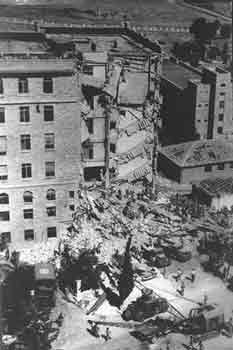
When the bombs exploded, the casualty toll was high: a total of 91 killed and 45 injured. Among the casualties were 17 Jews, 41 Arabs, and 28 Britons. Few people in the hotel proper were injured by the blast, which collapsed the southern wing.2
In contrast to Arab attacks against Jews, which were widely hailed as heroic actions, the Jewish National Council denounced the bombing of the King David.3
Begin said Sir John Shaw, chief secretary of the British Mandatory government, refused to evacuate the building, saying: We don't take orders from the Jews.1 Shaw denied he received the warning, as did others, for decades. In 1979, however, a member of the British Parliament introduced evidence that the Irgun had indeed issued the warning. He offered the testimony of a British officer who heard other officers in the King David Hotel bar joking about a Zionist threat to the headquarters. The officer who overheard the conversation immediately left the hotel and survived.
According to Lord Greville Janner, Brigadier Dudley Sheridan Skelton was head of a hospital near Jerusalem and a frequent visitor to the King David Hotel. He was there on the day of the explosion and wrote a letter to a colleague in which he said: “‘a warning’ was passed on to the officers in the bar in rather jocular terms, implying it was ‘Jewish terrorist bluff.’ But despite advice to “ignore the bluff” he decided to leave and thus was out of the hotel when the explosion took place.”4
Author Thurston Clarke, in By Blood and Fire: The Attack on Jerusalem’s King David Hotel, said the hotel’s assistant manager believed the warnings were a hoax and never passed them on to Shaw.6
Citing Eldad Harouvi’s book, Palestine Investigated: The Criminal Investigation Department of the Palestine Police Force, 1920-1948, the Israel State Archives noted the CID had intelligence showing the Hotel as a possible target for attack by the Irgun in December 1945 – 6 months prior to the attack. The CID asked to increase security at the hotel, including deploying armed soldiers at the ‘Regence’ restaurant at the hotel entrance. The Chief Secretary [Sir John Shaw] refused to consider these suggestions, with the justification that there were not many places for recreation and fun in Palestine, and he did not want to foreclose another. He continued to refuse to take action (or even pass on the information to the High Commissioner of Palestine) when the CID approached him again with updated information on the attack plan (the CID had the plan but did not know exactly when it would be carried out).5 Shaw was blamed by one former CID officer interviewed by Harouvi for the failure to evacuate the building.
Historian Benny Morris is among those who believe the bombing contributed to the British decision to leave Palestine. “The whole campaign by Irgun and Lehi, and the cumulative losses in British life in Palestine, eventually led to their decision in February 1947 to leave. This was probably one of the most important events. It’s probably the most because so many people died there,” he told the Jerusalem Post.6
Sources: Israeli Government National Photo Collection.
1. Menachem Begin, The Revolt, (NY: Nash Publishing, 1977), p. 224; Shlomo Maital, “Megilat Ha’atzmaut: The Real Story,” Jerusalem Report, (August 21, 2023).
2. J. Bowyer Bell, Terror Out Of Zion, (NY: St. Martin's Press), p. 172.
3. Anne Sinai and I. Robert Sinai, Israel and the Arabs: Prelude to the Jewish State, (NY: Facts on File, 1972), p. 83.
4. Lord Greville Janner, Address In Reply To Her Majesty's Most Gracious Speech, House of Lords, (May 22, 1979).
5. Israel State Archives.
6. Alan Rosenbaum, “The blast that still echoes: The King David Hotel bombing, 80 years on,” Jerusalem Post, (July 26, 2026).