|
[By: Ariel Scheib]
Jews have lived in the Slovakian region since the
11th century. Today, the Jewish population of Slovakia is approximately 2,600 people.
- Early History
- 19th-Early 20th Century
- World War II & the Holocaust
- Contemporary History
- Major Cities
- Jewish Sites & Contacts
Early History
Jews have lived in the Slovakian region since the
11th century. In the 14th century, nearly 800 Jews resided in Bratislava.
The majority of Jews engaged in commerce and money lending. Two notorious blood libels occurred
in Slovakia; in 1494, Jews were burned at
the stake in Trnava, and in 1529, in Pezinok
30 Jews were accused of wrongdoings and burnt
at the stake. After the battle of Mohács
in 1526, Jews were expelled from all major
towns in Slovakia.
During the late 17th century and early 18th century,
Jews began to return to their original cities in Slovakia, and establish
well defined communities. Nevertheless, Jews were in constant conflict
with locals and barred from many trading industries. The first Jewish
cemetery in Slovakia was set aside in the early 15th century in Tisinec
(the cemetery was utilized until 1892). Under the rule of Joseph II,
Jews received many civil liberties and much of their livelihoods were
expanded in aptitude.
In 1683, hundreds of Moravian Jewish fled to Slovakia
seeking refuge from the Kurucz riots and the living restrictions of
Moravia. Most of these immigrants settled in western Slovakia, bordering
Moravia. In 1700, the leading yeshiva in Slovakia was established in
Bratislava. This institution was recognized by the government for the
education of rabbis.
19th to Early 20th Century
In 1867, the dual monarch of Austro-Hungary was established
and Slovakia became a part of Hungary,
often considered “Northern Hungary.” For more than a millennium,
Slovakian Jewry was closely linked with that of Hungarian Jews. The
Hungarian parliament passed the Emancipation Law to promote assimilation
among minorities, especially Jews. Government officials supported Jewish
cooperation in industry and finance. The Jewish population grew exponentially,
especially in small, secluded towns in Eastern Slovakia. Nevertheless,
much anti-Semitism existed in Slovakia
and nationalists refused to allow Jews to assimilate into their culture.
In 1882 and 1883, anti-Jewish riots occurred in several
towns in Slovakia. With the introduction of the “Reception Law”
(1896), which placed Judaism and
Christianity on the same equal level, the Slovak Clerical People’s
Party was formed. The Party’s main interests were anti-Liberalism
and limiting Jewish influence in the country.
 Hashomer Hadati religious
Zionist youth group in Bratislava, 1934 Hashomer Hadati religious
Zionist youth group in Bratislava, 1934
|
The 19th century also gave rise to the Zionist movement. In Slovakia, eight local Zionist organizations were formed.
In 1903, Bratislava held the first Hungarian Zionist Convention; the
first World Mizrachi Congress was convened in 1904.
After World War I and the creation of Czechoslovakia
(1918), Jews were given the right to be considered a separate nationality
in the country. Jews prospered not only in industry but cultural life.
Jews held more than one-third of all industrial investments in country.
In 1919, the National Federation of Slovak Jews was established in Piestany
and the Jewish Party (Židovská strana) was created.
On August 2, 1919, Juedische Volkszeitung (“Jewish People’s
Paper”) was first published in Bratislava. This paper played a
crucial role in advancing the rights of the Jews in Czechoslovakia.
In the first national census in Czechoslovakia (February 15, 1921),
135,918 people registered as practicing Jews (4.5 percent of the population);
70,522 of them declared themselves of Jewish nationality.
Before World War II, 217 congregations existed in Slovakia:
165 Orthodox congregations
and the remaining 52 congregations split between Neology and Status
Quo Ante (the later two affiliations later unified under the title “Jeshurun”).
During this period, Judaism in this
region was also caught in the struggle between the Reform (Neolog and Status Quo Ante) and Orthodox movements.
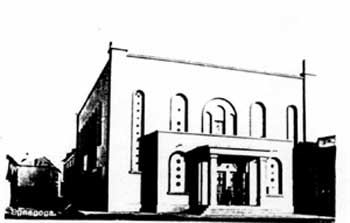 The Main Humenne Synagogue The Main Humenne Synagogue
|
It was because of this religious strife that the Jewish
Party was split by such factions as the Conservative Jewish Party and
the Jewish Economic Party in the nation’s first two
elections (1920, 1925). Ultimately, the party failed
to receive enough votes to maintain any seats in the parliament in Prague.
In 1929, during the third election, Ludvik Singer and Julius Reisz of
Bratislava were elected to parliament through the Jewish Party.
Under the influence of the Slovak Peoples’ party,
many Slovakians were incited against the Jews. In the late 1930s, numerous
anti-Jewish demonstrations were held in Slovakia led by the Nationalist
Youth Movement (Om Iadina) and the Volksdeutsche students.
World War II & The Holocaust
Before World
War II, 135,000 Jews lived in Slovakia; 5,000 of whom immigrated
before the war. Under the protection of Nazi
Germany, Slovakia proclaimed its independence in March 1939.
The country came under the control of an extremely religious and right-wing
party, the Hlinka (Slovak) Peoples’ party, under the leadership
of Father Jozef Tiso, a Catholic priest. After its establishment, the
Slovakian government approached the “Jewish Question” as
one of their first public issues.
 Group of students at a Jewish
school in Bratislava, 1938 Group of students at a Jewish
school in Bratislava, 1938
|
The first anti-Jewish law was passed in Slovakia on
April 18, 1939.
A few days later, on April 24, Jews were excluded from all government
positions and service. On September 19, 1939,
all Jews were expelled from the military. Many more discrimination laws
followed, including children being ousted from school and Jews being
excluded from public recreational facilities. By 1940,
more than 6,000 Jews emigrated both legally and illegally. The Slovakian
government passed a law that permitted it to take over control of all
major Jewish businesses. These laws were supported by the majority of
Slovakians.
In a 1940 meeting between German and Slovakian officials, Germany dictated new
changes within the Slovakian government to make the country more dependent.
During this period, Jews lost many more privileges, including the right
to a car or gun. In August 1940 another decree was issued that required
every Jew to register with the government and state their financial
status.
 Deportation
of Slovak Jews (c 1942) Deportation
of Slovak Jews (c 1942)
|
On September 9, 1941,
Jews were met with a proclamation of 270 articles, which included the
wearing of a Yellow Star of
David and forced labor.
Soon after, Hungary and the Slovakian government began deporting the
Jews to concentration camps,
specifically
Auschwitz.
By 1942, nearly
three-fourths of the Slovakian Jewry had been exterminated. In April 1944, after several
months of calm, deportations resumed during the Slovakian resistance,
in which numerous Jews partook.
Following the Holocaust,
only 25,000 Jews survived and many survivors decided to emigrate. Those
Jews who did remain worked diligently to rebuild the devastated Jewish
community.
Contemporary
History
The Communist Party controlled politics of Czechoslovakia
from February 1948 to 1989. During that time, little or no organized
Jewish life existed in Slovakia. Many Jews left for Israel or the United States to retain their freedom of religion. In July 1991,
Soviet forces pull out of the region, initiating the fall of Communism.
By 1992, with the collapse of the Soviet Union, the Communist Party
lost its hold on the government.
After the peaceful division of Czechoslovakia in 1992,
Slovakia gained its independence on January 1, 1993. Since Slovakia’s
independence, such organizations as Maccabi and B’nai B’rith
have become active in the communities.
The major communal organization which maintains Jewish
life is the Federation of Jewish Communities in Slovakia. In both Bratislava
and Kosice there exist kosher restaurants and community centers. Synagogues are located in Bratislava, Galanta, Kosice, Piestany, Presov and Trnava.
The only rabbis, however, are located in Kosice (Rabbi Goldstein from
Israel) and Bratislava (Rabbi Baruch Myers from the U.S.).
Both the Jewish Distribution
Committee and the Lauder Foundation are active in promoting religious
awareness among young Jews through communal activities. On December
14, 1990, the Czechoslovak Union of Jewish Youth (CSUJY) was established
to help preserve Jewish culture and tradition among Jewish youth in
the region. Since 1993, CSUJY has been publishing the Chochmes magazine.
In 1999, the American Jewish Committee surveyed Slovaks
and found that a majority favored keeping and recalling the Holocaust,
but few actually knew the details of the annihilation of Jews during World War II. On September
9, 2002, Slovakia marked its first Holocaust remembrance day. In March
2003, the country commemorated the 60 years since the first transport
to Auschwitz (March 25,
1942).
 Old Jewish tombstone in
Humenne Cemetery Old Jewish tombstone in
Humenne Cemetery
|
Today, approximately 3,000 Jews live in Slovakia, predominately
in the capital city of Bratislava. Most of the residents, however, are over 70 years old and the population is quickly dwindling with many
young Jews assimilating through intermarriage.
There are more than 100 synagogue buildings and nearly 700 Jewish cemeteries scattered across Slovakia. There are also numerous Jewish cultural places in Slovakia
to visit, including the Underground Mausoleum. This museum contains
the graves of 18 famous rabbis together with Chatam Sofer, who founded a rabbinical seminary. About
200 synagogues and 620 Jewish cemeteries remain in Slovakia, symbolizing
the once thriving community that flourished in the area.
In 2002, both the Jewish cemeteries in Levice and Zvolen were damaged
and historic tombstones smashed. Since 2003, there has been a rise in
popularity among Slovaks for right-wing extremism, incorporating neo-Nazism
and fascism. In April 2003, the Jewish cemetery in Kosice was vandalized
causing $35,000 in damage.
In 2007, Slovakia's foremost Jewish scholar Maros Borsky formally launched the Slovak Jewish Heritage Route, a tourist and educational trail that links two dozen key sites in all eight regions of the country. Included on the Heritage Route are synagogues, Jewish cemeteries, Jewish museums and Holocaust memorials. "The only way to preserve these buildings is to find a different use for them, predominantly and preferably for cultural purposes," says Borsky. Sites on the trail include places within day-trip distance from Bratislava: Malacky, Stupava, Trnava, Samorin, Trencin, Nitra, Komarno, Zvolen, Sahy, Kosice, Presov, Bardejov and Spisske Nova Ves.
A neo-Nazi party won seats in Slovakia's parliament during the March 2016 elections, much to the dismay of Slovakian leaders. The neo-Nazi “People's Party - Our Slovakia,” received 8% of the total vote, enough to grant the party 14 seats in the Slovak National Council, the country's parliamentary body. Marian Kotleba, the chairman of the People's Party - Our Slovakia, had previously led another neo-Nazi political party named Slovak Togetherness - National Party, that has been banned from participation in the Slovak political system. Slovakia's Foreign Minister, Miroslav Lajcak, stated after the election that “we have elected a fascist to Parliament.”
Major Cities
Bardejov
Bardejov is located near the northern border with Poland.
Previous to World War II, more than 5,000 Jews lived in Bardejov, however no lives live in the town today. Nearly
the entire community was destroyed during the Holocaust.
The entire town center, including the old Jewish compund on Mlynska Street, is listed on UNESCO's roster of World Heritage Sites. The Jewish compound comprises the massive Old Synagogue, built in 1836 and now undergoing a restoration that will build a beit midrash and a mikva.
Bratislava
Bratislava is located near the Austrian border on the
Danube River. Jews first settled in the city in the late 13th century.
Over the years, the Jewish community was expelled from the city on several
occasions, specifically in 1360 and 1526.
By the 18th century, 120 families resided in Bratislava.
During this period, the Jewish population continued to thrive, especially
with Jews arriving from Moravia. The city became a center of European Judaism with the arrival of Rabbi
Moses Schreiber. Prior to the Holocaust, 15,000 Jews lived in Bratislava,
which also had numerous magnificent Jewish synagogues and buildings,
including the Grand Orthodox Synagogue built in 1863.
Today, Bratislava has about 1,000 Jews living within
the city. The community is led by Rabbi Baruch Myers from Brooklyn,
New York. One synagogue, built in 1923 for the Orthodox community, remains
in Bratislava.
Giraltovce
Jews first settled in Giraltovce in 1750 from Poland.
By 1786, 21 Jews lived in Giraltovce. The first Jewish cemetery of the
community was sanctified in 1800. By 1848, 137 Jews lived in the town.
In 1890, the first Jewish school was established and a decade later
the first synagogue was consecrated. The majority of the community was Ashkenazic Orthodox.
Prior to the world wars most of the Jews were involved
in trading in commerce; following World War I, many Jews became tailors
and carpenters. Many men from this community fought in World War I,
with only a few recorded deaths. In April 1920, 475 of the Jews from
Giraltovce voted for the Jewish parties. By 1930, the Jewish population
had declined to only 220 people. Simultaneously, Zionist movements began to thrive in Giraltovce through the local activity of
Bnei Akiba and Betar.
Prior to the Holocaust, 345 Jews (58 families) lived
in Giraltovce. Most of the community was transported to concentration
camps; 452 Jews from Giraltovce and the surrounding area were deported.
On January 18, 1945,
the Russian military liberated the town. Only 58 of the 351 Jews from
Giraltovce survived the Holocaust, and most of them immigrated to Israel and the United States.
 Old cemetery in Humenne Old cemetery in Humenne
|
Hmenne
Humenne is located in eastern Slovakia. While Jews
had been living in Humenne, it was not until 1780 that the Jewish community
was officially recognized. During this period, the community organized
a chevra kaddisha,
founded in 1787, and constructed a synagogue. Rabbi Spira Jakab was
the first rabbi of the congregation, followed by Rabbi Fischel Horovitz.
In 1835, a Talmud Torah was established to aid in the education of poor
children. An old Jewish cemetery is located in Humenne with 500-5000
tombstones in the gravesite, dating back to the early 19th century.
During World War II, more than 2,200 Jews from Humenne were murdered.
Košice
Košice is considered the capital of eastern Slovakia and is the country's second largest city.
During the Holocaust, the majority of the Jewish community was deported
to concentration camps and annihilated. Today, approximately 800 Jews
live in Košice, which makes it the second largest Jewish community in Slovakia. A synagogue remains from the early 19th century.
The building maintains a mikveh, kosher market, and a community
center.
Lipany
Jews first arrived in Lipany in the early 18th century.
By 1848, 130 Jews lived in the town and, in 1859, the community built
its first synagogue. In the early 20th century, a Beit Midrash and a
Talmud Torah were established. After World War I, Zionist activities
and organizations began to thrive in the town. In 1929, a new, larger
synagogue was consecrated. In March 1942,
nearly 400 Jews from Lipany were transported to various Polish ghettos and concentration camps. There exists a cemetery from the 19th-20th
century, incorporating 100-500 tombstones.
Nove Zamky
 Old
Orthodox Cemetery in Prešov Old
Orthodox Cemetery in Prešov
|
Jews first arrived in the early 19th century in Nove
Zamky and formed a religious community, establishing a school and Chevra
Kadisha. Originally, the community was led by the chief rabbi of Nagysurany
(Surany). The local population accepted the Jewish immigrants because
it expanded the trading area and commerce. From 1849 to 1895, Rabbi
Ignac Kramer directed the services and communal life. By the 1860s,
the first synagogue was established in Nove Zamky following the neolog-congressional
style of a synagogue in Budapest (destroyed in March 1945). A few Orthodox Jews did not like the “untraditional” style of the synagogue
and, in 1870, established another congregation. This congregation came
under the leadership of Chief Rabbi Josef Richter and Rabbi Samuel Klein
in 1913. The first elected rabbi of the Orthodox congregation was Benjamin
Zeev Wolf, followed by his son in law, Henrik Sonnenklar in 1882. In
1880, the Orthodox congregation built a separate synagogue that still
exists today. The most recent renovation of the synagogue occurred between
1991 and 1995. In 1991, the Slovakian government declared the building
a nationally protected monument. The Orthodox community also opened
a five-year elementary school. In 1927, the neolog congregation founded
a middle school, which placed emphasis on industrial and commercial
subjects rather than religion (this building was destroyed in 1945).
The first Jewish weekly newspaper covering in Nove Zamky and the surrounding
area, Szombat.
Prešov
Located near Kosice, the Jewish community compound in Presov is anchored by a magnificent synagogue built in the late 19th century. The synagogue's interior features strikingly elaborate ornamentation on walls and vaulted ceiling, and a valuable collection of Judaica and other items are on display in the gallery.
Prior to World War II, Prešov was an important
center of Judaism and Jewish life, with more than 6,000 Jews residing
in the city. Today, fewer than 100 Jews remain in Prešov. Also tombstones from the old Orthodox and Reform cemeteries
can be found near the Catholic gravesite. A memorial to those lost during the Holocaust can be found in the courtyard of the main synagogue.
Stropkov
Jews first settled in Stropkov, located on the Ondava
River, in 1648 fleeing the Chmielnicki
pogroms in Poland. Jews soon led the economy of Stropkov; although
many Jews lived in poverty. Jews owned all the taverns and shops in
Stropkov. Possibly because of their economic success, the Jews of Stropkov
were expelled to Tisinec in 1700. In 1800, many Jews returned to Stropkov
and reclaimed their position in the local community. Stropkov grew to
become the largest Jewish community in the area. Rabbi Moshe Schonfeld
was the first rabbi of Stropkov and led the community until 1820. The
community maintained a synagogue, rabbinical court, and mikveh.
Many famous rabbis practiced
in Stropkov and the town became the center of Torah study in Greater
Hungary.
 Deportation of Slovak Jews.
Stropkov, Czechoslovakia, May 21, 1942. Deportation of Slovak Jews.
Stropkov, Czechoslovakia, May 21, 1942.
|
From 1400-1892, Jews were not permitted to bury their
dead inside Stropkov and therefore established a cemetery in Tisinec,
4 miles away from Stropkov. Hundreds
of Jews were buried from Stropkov in this massive gravesite.
From 1892 to 1942, the Jewish community of Stropkov established a second
cemetery on the outskirts of the town, which was utilized until World
War II.
Prior to the Holocaust, approximately 2,000 Jews lived
in Stropkov. By 1939, influenced by the rise of Nazism,
more and more anti-Semitic laws were imposed on the Jewish community
of Stropkov. The first transport left Stopkov on March 24, 1942,
carrying hundreds of Jews to Auschwitz . By 1945, only
100 Stropkov Jews remained. Today, no Jews remain in Stropkov.
Trencín
Prior to World War II, 1,300 Jews lived in Trencín;
most of whom were exterminated in Nazi concentration camps. Today only a handful of Jews live in the town.
A domed synagogue, built in 1913, just off the the main square that now serves as a municipal art gallery is the only Jewish structure remaining in the city. Some of the buildings original decorations, including stained-glass windows and painted cupola, remain intact. The building includes a resotered small prayer room still in use.
Ziar nad Hronom
The Jewish community of Ziar nad Hronom, located in
central Slovakia, was established in the early 19th century, and the
rabbinate was founded in 1848. The town synagogue was completed in 1889
and became the focus of the community. In 1919, 36 Jews were recorded
living in Ziar nad Hronom. In World War II, the Jews of Ziar nad Hronom
survived because they hid in the surrounding mountains. Following the
war, all the congregants left Slovakia.
Jewish Sites & Contacts
Rabbi Baruch Myers
Chabad-Lubavitch
Partizanska St. 12
81103 Bratislava
Tel. 421-7-531-4112 |
Bed & Breakfast- Chez David/ Mikvaot
Zamocka 13
Bratislava 81101
Tel. 7-544-13-824; 544-16-943
Fax: 7-544-12-642 |
The Museum of Jewish Culture
Zidovska St.
Bratislava 81101
Tel. 7593-49-142/3/4
Fax: 7-593-49-145
Prof. PhDr. Pavol Mest’an Dr. Sc |
Central Union of Slovak Jewish Communities
Kozia ul. 21
Bratislava 81447
Tel. 7-5449-2167
Fax: 7-5449-1106
Email: [email protected] |
Restaurant- Chez David
Zamocka 13
Bratislava 81101
Tel. 7-544-13-824
Fax: 7-544-12-642 |
Project Synagoga Slovaca
Slovak National Museum-Museum of Jewish Culture
Vajanského nábrežie 2, P. O. BOX 13
810 06 Bratislava 16
Slovak Republic |
CSÚZM
Kozia 21/II
814 47 Bratislava
Tel: ++421-7-5318 714
++421-7-5314 018
Fax: ++421-7-5318 714
ICO: 17315379 |
Beth Hamidrash Synagogue/Restaurant
Zvonarska Ul 5, Kosice
Kaschau 04001
Tel. 95-622-1047 |
Synagogue/Community Center/Museum
Sverthova 32, Presov
Tel. 91-31271
Fax: 91-31271 |
Institute of Jewish Studies
Panenska 4, 811 03 Bratislava, Slovak Republic
Phone: +421 2 54416867, +421 2 54416873
Fax: +421 2 54416867
E-mail: [email protected] |
|
Sources: JTA. “In first, neo-Nazi group wins seat in Slovak parliament,” Canadian Jewish News (March 7, 2016);
World
Jewish Congress;
“Slovakia.” Encyclopaedia
Judaica;
“Jews
in Slovakia”;
Zaidner, Michael. Jewish
Travel Guide 2000. Intl Specialized Book Service, 2000;
Ruth Ellen Gruber, "Slovak Jewish Heritage Route," Hadassah Magazine, (April/May 2003);
American
Jewish Committee;
Institute
of Jewish Studies at Comenius University in Brastilava;
“Paintings
Discovered in Slovak Synagogue”;
“Nove
Zamky”;
Singer, David and Lawrence Grossman, Eds. American
Jewish Year Book 2002. NY: American Jewish Committee, 2002;
Singer, David and Lawrence Grossman, Eds. American
Jewish Year Book 2003. NY: American Jewish Committee, 2003;
“Stropkov,
Slovakia”;
The
Cultural Guide to Jewish Europe;
“Giraltovce”;
The
Czecho Slovak Union of Jewish Youth;
Maps: CIA;
Pictures of Humenne courtesy of Cherie
Korer in memory of Regina Salamon Fox;
All other pictures courtesy of USHMM; |