|
Bulgaria, an east Balkan republic located along the Black Sea, can trace its Jewish community back to the time of Caligula in the first century CE. Today, the Jewish population of Bulgaria is approximately 2,000 people.
- Ancient Period
- Turkish Rule
- Independence
- Pre-World War II
- Organization of the Jewish Community
- World War II & the Holocaust
- Abolishment of Anti-Jewish Policies
- Postwar Period
- Contemporary Life
- 1970's-1990's
- Relations with Israel
- Anti-Semitism
- Jewish Tourist Sites & Contacts
Ancient
Period: Byzantine
& Bulgar Rule
A Jewish settlement is known to have existed in Macedonia
in the time of Caligula (37–41 C.E.; Philo, Embassy to Gaius, par.
281). A late-second century Latin inscription found at the village of
Gigen on the shore of the Danube (near Nikopol, the site of the ancient
Roman settlement Oescus) bearing a menorah testifies to the existence of a Jewish community. The Latin inscription
mentions the archisynagogos Joseph. Theodosius I's decree to the governors
of Thrace and Illyria in 379 shows that Jews were persecuted in these
areas and synagogues destroyed.
When the Byzantine emperor Leo III (718–41) persecuted
the Jews, a number of them may have fled to Bulgaria. There, during
the reign of the Bulgar czar Boris I (852–89), the Jews are said
to have tried to exploit the religious unrest among the Bulgars, then
heathens, by converting them to Judaism,
but Christian emissaries were more successful. The faith of the early
Bulgarian Christians was, however, a syncretistic mixture of Christian,
Jewish, and pagan beliefs. A curious insight of the contemporary religious
situation is afforded by the 106 questions submitted by Bulgarian representatives
to Pope Nicholas I (858–67). Among the questions on which guidance
was requested were the proper regulations for offering the first fruits;
the law concerning amulets; which day is the day
of rest—Saturday or Sunday; which animals and poultry may be
eaten; whether it is wrong to eat the flesh of an animal that has not
been slaughtered; should burial rituals be performed for suicides;
how many days must a husband abstain from intercourse with his wife
after she has given birth; should a fast be observed during a drought;
should women cover their heads in houses of prayer; and so on. The names
of the Bulgarian princes at this time—David, Moses, Aaron, and
Samuel—may also show Jewish influence.
The monks Cyril (Constantine) and Methodius from Salonika,
who were sent to Greater Moravia in 863 by the Byzantine emperor Michael
III (840–67) to convert the Moravians, had mixed with Jews in their
native town and studied with Jewish teachers. Cyril invented a new script
called Glagolitic (later Cyrillic) in which to write Slavonic. The script
was based on the Greek alphabet, but used the Hebrew
alphabet as well in order to represent sounds which did not exist
in the Greek alphabet, e.g., Sh and Ts. It is believed that Cyril made
his translations of parts of the Bible from the Hebrew original.
There is evidence of Jewish settlement in Nikopol in
967. In the early 12th century Leo Mung, born a Jew and later a pupil
of the 11th-century Bulgarian talmudist Tobiah b. Eliezer, became archbishop of the diocese of Ochrida and Primate
of Bulgaria. The Bogomil movement, a Christian sect that spread through
Bulgaria in the 11th century, rejected most books of the Old
Testament, but awakened interest in Judaism as the source of certain Christian theological doctrines. The Bulgarian
attitude to Jews at the time was generally favorable; Jewish merchants
from Italy and Ragusa (Dubrovnik)
who settled in Bulgaria received royal privileges. Also during the Crusades
many Jews may have found refuge in Bulgaria. Jacob b. Elijah in his
polemical letter to the apostate Pablo Christiani mentions two Jews
who were thrown from a mountaintop for refusing to obey the order of
Czar John Asen II (1218–41) to put out the eyes of Theodore I Angelus,
Greek ruler of Salonika in 1230. Czar Ivan Alexander (1331–71)
married a Jewish woman named Sarah, who took the name Theodora on her
baptism; her influence on state affairs was considerable. The church's
struggle with heresy in Bulgaria also affected the Jews. The Church
Council of 1352 excommunicated Jews and heretics. Three Jews were condemned
to death on a false charge of blaspheming saints. Although the verdict
was repealed by the czar, the mob took vengeance on the accused.
The largest part of the Bulgarian Jewish community
before the 15th century belonged to the Byzantine (Romaniot) Jewish
rite. Only a minority spoke Bulgarian. The Romaniots had their own special
prayer book, which eventually was replaced by the Sephardi prayer book. They regarded the sending of gifts from the groom to the
bride as part of the marriage ceremony, and if the bride did not later marry the sender of the gifts,
she had, in their opinion, to receive a divorce (get) before she could marry another man . The bride's dowry
was guarded and the husband was forbidden to negotiate with it. Furthermore,
according to their custom a husband could not inherit from his wife.
The Romaniots did not accept the decree of R.
Gershom b. Judah in the 11th century forbidding bigamy. Among the
rabbis of the Romaniot synagogue was Abraham Semo (15th century) who
befriended the new Ashkenazi community that settled in Sofia (1470). Another famous rabbi of the
Romaniots was Joseph b. Isaac ibn Ezra (late 16th–early 17th centuries),
who wrote the book Massa Melekh (1601).
Many Jews went to Bulgaria from Hungary after the expulsion of 1376. These Hungarian Jews kept their own particular
customs, but later adopted the customs of the other Ashkenazim,
and eventually all of them adopted Sephardi customs and spoke Ladino.
A famous contemporary sage was Rabbi Shalom Ashkenazi of Neustadt, who
founded a yeshivah at Vidin. His pupil Rabbi Dosa the Greek wrote in
1430 Perush ve-Tosafot, a supercommentary to Rashi on the Pentateuch.
Turkish
Rule
At the time of the final Turkish conquest of Bulgaria
(1396), Jews were living in Vidin, Nikopol, Silistra, Pleven, Sofia,
Yambol, Philippopolis (now Plovdiv), and Stara Zagora. Jewish refugees
came to Bulgaria from Bavaria, which had banished them in 1470, and,
according to various travelers, Judeo-German was heard for a long time in the streets of Sofia. Despite their adoption
of Sephardi customs, language,
and names, the Ashkenazi Jews maintained separate synagogues for a long time and followed the medieval German rite. The Ashkenazi
prayer book was printed in 1548–50 in Salonika by R. Benjamin ha-Levi
Ashkenazi of Nuremberg who was also the rabbi of the Sofia Ashkenazi community.
Spanish Jews reached Bulgaria apparently after 1494,
settling in the trading towns in which Jews were then living. They came
to Bulgaria from Salonika, through Macedonia, and from Italy,
through Ragusa and Bosnia. Until 1640 Sofia had three separate Jewish
communities—the Romaniots, the Ashkenazim,
and the Sephardim. Then
a single rabbi was appointed
for all three communities. R. Levi b. Habib lived for a short time in
Pleven and R. Joseph Caro lived in Nikopol for 13 years (1523–36).
Caro founded a yeshivah there and continued to write his great work Beit Yosef. In the 17th century Bulgarian Jewry was caught up
in the whirlwind of the pseudo-messianic movement of Shabbetai
Zevi; Samuel Primo and Nathan of Gaza, proponents of Shabbateanism,
were active in Sofia in 1673.
Jews conducted trade with Turkey,
Walachia, Moldavia, Ragusa, and Venice.
Jewish traders were granted firmans giving them various privileges.
One of the most important trading towns in the 16th century was Tatar-Pazardzhik,
to which the Jewish merchants of Salonika turned after the wars with Venice (1571–73). They established
commercial relations with Sofia merchants and some of them settled there
as well. Merchants from Skoplje (Turkish >skcb) bought clothing in
Salonika and sold it in Sofia and neighboring towns. In 1593 Sinan Pasha
founded an annual fair at Ozundzhovo in the district of Khaskovo, southern
Bulgaria. It was attended by Jews from European Turkey and Western Europe. Some Jews
also farmed the taxes on European merchandise. The Jewish merchants
were able to extend their commercial activities when the Ragusa merchants,
who had taken part in the Bulgarian rising of 1688 against the Ottoman
rule, had to give up their businesses. In Samokov some Jews owned quarries
and leather tanneries. Jewish government officials of that period are
also known. In the early 19th century a Jew, Bakish, of Tatar-Pazardzhik,
held an important position in the court of the sultan, and proposed
the introduction of a uniform system of Turkish coinage.
Independence
General rioting, robbery, and arson broke out in Sofia
in 1878 when the Turks retreated from the town; the Jews formed their
own militia and a fire brigade to prevent the Turks from setting fire
to the town; the fire brigade was retained after independence. Among
those who welcomed Russian General Gurko were the rabbi of Sofia. Gabriel
Mercado Almosnino, and three other Jews. During the war Jewish property
was looted and in Vidin, Kazanlik, and Svishtov, where the local population
regarded them as supporters of the Turks, Jewish property was plundered,
and Jews were expelled in atrocious circumstances; most of them fled
to Adrianople and Constantinople. Before the Congress of Berlin in 1878,
the major Jewish organizations of Western
Europe had tried to secure equal rights for Bulgarian (as well as
Serbian and Rumanian) Jewry; the Berlin Treaty included a clause obliging
the Balkan countries to give equal rights to Jews. Chief Rabbi Gabriel Almosnino
attended the Bulgarian Constituent Assembly (Sobranie) in 1879, as the
Jewish delegate ex-officio cosigned the constitution.
In 1880 an official code to regulate the organization of Jewish
communities was formulated. Jews also participated as advisers in town
councils. However, the Bulgarian population displayed signs of resentment
against the Jews. Most Bulgarian political parties were steeped in anti-Semitism.
The Bulgarian peasantry did all in their power to prevent Jews from
acquiring land, and from time to time there were blood libels.
In 1885, during the war between Serbia and Bulgaria,
Jews were drafted into the Bulgarian Army for the first time. The principle
of equality concerning the defense of minority groups was emphasized
after World War I in the Treaty of Neuilly (1919). However, despite
all declarations, the principle of equal rights had no genuine value
for Jews; in practice the various Bulgarian governments discriminated
against Jews. Anti-Jewish legislation was introduced indirectly in internal
clauses and in secret memoranda. Jews were not accepted at the military
academy, the state bank, or in government or municipal service. The
national uprising in 1923 prepared the ground for the spread of anti-Semitism and its intensification. In the difficult years that followed the Bulgarian
people's wrath was channeled toward the minority groups, especially
the Jews, whom they held responsible for their hardships. Anti-Semitic
nationalist associations sprang up. In 1936 the Ratnik ("Warrior")
anti-Semitic association was founded; it was structured on the lines
of Hitlerite organizations, accepting their theory of race and adapting
it to its own ideological concepts.
Pre-World War
II
In the decades preceding World War II, the relative
percentage of Jews within the Bulgarian population declined steadily,
indicating a lower birth rate than the national average. In 1920, there were 16,000 Jews, .9 percent of the total population. In 1926, the made up .85 percent. The 1934 census
showed 48,565 Jews, constituting 0.8% of the total population. In the mid-1930s, more than half of Bulgaria's Jews resided in Sofia.
Most Jews were engaged in commerce, and the majority were self-employed.
In the prewar years, the number of wage earners showed a certain upward
trend. A growing identification with Jewish national ideals characterized
the intellectual development of the Bulgarian Jewish community. In the
interwar period the Zionist
movement completely dominated all Jewish communal organization,
including the highest elected body, the Jewish Consistory. The younger
generation spoke Bulgarian rather than the Ladino of their fathers.
Bulgarian Jewry joined the movement for national revival
as early as the days of Hovevei
Zion (founded in 1882). Three Bulgarian delegates attended the First
Zionist Congress in 1897 at Basle—Zvi Belkovsky, Karl Herbst,
and Yehoshu'a (Joshua) Kalef. Before the congress, in 1895, Bulgarian
Jews had founded the settlement Har-Tuv in Erez Israel. However, there
was also considerable emigration to other countries. In 1900 several
Jews settled on the land at Kefken in Turkey,
on the shores of the Black Sea. Other Bulgarian Jews took up farming
in Adarpazari (in the Kocaeli district near Istanbul). Among the pioneers
of Zionism in Bulgaria, the most noteworthy was Joseph Marco Baruch.
Between 1919 and 1948, during the British
Mandate, 7,057 Bulgarian Jews emigrated to Palestine.
Organization
of the Jewish Community
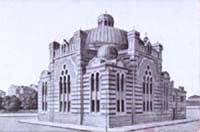
The Sephardic synagogue in Sofia,
the capital of Bulgaria
 |
After 1878, a chief rabbinate was created, headed by a chief rabbi. In
1900, a conference of Jewish communities assembled and passed a new constitution,
though the Bulgarian governemnt refused to recognize it. The constitution
dealt with elections to synagogue, community, and school committees. The community committees chose a central
council (Consistory) of Bulgarian Jewry from among their members. The
council functioned independently of the chief rabbi, who was also head
of the central rabbinical court. The central rabbinical court exercised
authority over the rabbinical courts of Sofia, Plovdiv, and Rushchuk (now
Ruse).
Education
Bulgarian Jewish education passed through three periods:
(1) the period of the meldar, the Sephardi religious school, equivalent to the Ashkenazi heder, which flourished in Bulgaria before national independence;
(2) the period after independence during which the
Alliance IsraMlite Universelle maintained many schools; and
(3) the period of modern, national education. Jewish
schools were maintained at the expense of the community. Many Jewish
children, especially in large cities, attended schools of other denominations.
Rabbis and
Scholars of Bulgaria
Rabbi Isaac b. Moses of Beja (16th century), who lived
in Nikopol after the Turko-Walachian war (1598), wrote the book Bayit
Ne'eman (1621). Rabbi Isaiah Morenzi (d. after 1593), who also lived
in Nikopol, introduced new customs into the yeshivah founded by Joseph
Caro. Another rabbi of Nikopol was Abraham b. Aziz Borgil, author of
the book Lehem Abbirim (1605). Moses Alfalas of Sofia, a famous
preacher, published Va-Yakhel Moshe (Venice, 1597). In the 18th
century Solomon Shalem of Adrianopolis and Issachar Abulafia were among
the famous rabbis. Chief rabbis after Bulgarian independence (1878)
were Gabriel Almosnino, Moses Tadjer, Simon Dankowitz from Czechoslovakia,
Mordecai Gruenwald, and Marcus Ehrenpreis. Zemah Rabbiner was chief
preacher to the Bulgarian communities. David Pipano, author of Hagor
ha-Efod (1925) and other books, was head of the rabbinical court.
Other scholars of Bulgaria include Solomon Rosanes, author of Divrei
Yemei Yisrael be-Togarmah, the standard history of Turkish Jewry.
Mention may be made also of Saul MMzan, author of Les Juifs espagnols
en Bulgarie.
Journalism
In 1899 the Bulgarian-language newspaper Chelovecheski
prava ("Human Rights") was published to repudiate the
libels of anti-Semitic newspapers.
The first Ladino newspaper, La Alborada ("The Dawn"),
was launched in 1884. Later, Ladino publications ceased publication
and were replaced by Bulgarian-language periodicals.
World War
II & the Holocaust
Comprehensive anti-Jewish legislation in Bulgaria
was introduced after the outbreak of World War II. The regime's main
motivation in its anti-Semitic pursuits
could be explained by its determination to conform to the orientation
of Nazi Germany, with which Bulgaria was allied. The turning point in
events came on Feb. 15, 1940, with the appointment of Bogdan Filov,
a noted scientist and a determined Germanophile, to the premiership.
In July 1940 the government announced its decision to curb the freedom
of the Jewish minority. In August of the same year the cabinet approved
the anti-Jewish “Law for the Protection of the Nation,” patterned
after Nazi regulations.
The Salvador Disaster
As the situation became more grim, a Bulgarian-Jewish philanthropist, Baruch Konfino, decided to help Jews escape to Palestine. He and a partner, Max Davidow, purchased an old wooden boat they dubbed the Salvador (“Savior” in Ladino). The ship was not very seaworthy, lacking an engine (it was wind powered), life jackets, and navigational equipment. It was made to hold a maximum of 40 passengers and Bulgarian authorities and Jewish leaders opposed using it to transport refugees.
Konfino, however, foresaw the coming danger and went ahead anyway, working with Aliyah Bet, he ssold tickets for $500-$600 to 352 Jewish passengers. It set sail from the Black Sea port of Varna on December 3, 1940. A few days later, it was towed to Istanbul and then, on December 11, taken back out to the Sea of Marmara. On December 12, a severe storm developed and the ship did not have the means to return to port and ran aground on the coast west of Istanbul and sank. Most of the passengers, 223, including 66 children, drowned or died of exposure.
The 123 survivors were taken to Istanbul where about half were sent back to Bulgaria. The rest were allowed to board another Aliyah Bet ship, the Darien II, which reached Haifa on March 19, 1941. The British authorities arrested the 792 passengers and interned them in the Atlit prison campu until May 1942 when they were released. In 1964, the bones of the victims of the Salvador were brought to Israel and buried in the national cemetery on Mt. Herzl. Since they could not be identified, they were each buried in an unmarked grave and a memorial wall was erected with the names of all the victims.
Bulgaria Declares War
On Dec. 24, 1940, Parliament approved the proposed legislation, which
was officially promulgated on Jan. 23, 1941. On March 1, Bulgaria joined
the Tripartite Pact and the German Army entered the country. A declaration
of war on the western Allies followed; yet Bulgaria did not enter the
war against the Soviet Union, mainly because of Slavophile sentiments.
In June 1942 Minister of Interior Gabrovski, the architect of the anti-Jewish
legislation, demanded and received from Parliament a blank authorization
empowering the government with absolute prerogatives on all questions
pertaining to the Jews. Protests against this measure, coming from such
well-known democrats as Nikola Mushanov, were of no avail. At the end
of August the government promulgated new restrictive regulations and
provided for the establishment of a Commissariat for Jewish Affairs.
On Sept. 3, 1942, the lawyer Alexander Belev, a German-trained anti-Semite,
became the head of this Commissariat.
In January 1943 Adolf Beckerle, the German minister
to Sofia, was joined by SS-Obergruppenfuehrer Theodor Dannecker, an
associate of Eichmann,
who came to Bulgaria in order to arrange for the deportation of Bulgarian
Jews to the eastern territories. By the summer of 1942, the Bulgarian
government had already surrendered into German hands Bulgarian Jews
residing in countries occupied by Germany. On Feb. 2, 1943, Gabrovski
and Dannecker agreed that all Jews living in Greek and Yugoslav Macedonia
and in Thrace, administered by Bulgaria since the spring of 1941, would
also be surrendered to the Germans for deportation. On Feb. 22, Belev
and Dannecker signed a formal agreement to deport 20,000 Jews. As the
total number of Jews living in Bulgarian-held Thrace and Macedonia was
only slightly over 10,000, Dannecker informed Eichmann that Jews from Bulgaria proper, mainly from the capital and other large
towns, would also be deported.
On March 2, the government approved the
surrender of 20,000 Jews into German hands, but the fiction that only
Jews from Macedonia and Thrace were to be deported continued to be maintained.
The collection of Macedonian and Thracian Jews into special transit
camps began immediately. Preparations were also begun for the concentration
of those Jews from Bulgaria proper who were to make up the agreed figure
of 20,000.
Rumors of the forthcoming deportations aroused unexpected
opposition. An action group headed by the vice-president of the Bulgarian
Parliament, Dimiter Peshev, was organized in the town of Kustendil.
Peshev appeared before the minister of interior on March 9, and insisted
that the deportation orders be altered forthwith. Both humanitarian
and political considerations motivated the protest movement. In the
aftermath of the German debacle at Stalingrad, it was thought that Bulgaria
should not endanger her chances of an eventual disengagement from the
German alliance by giving her hand to so monstrous an act.
Opposition to Deportations
The initiative
of Dimiter Peshev developed into a minor revolt within the government's
own majority in Parliament. On March 17, Peshev presented the prime minister
with a petition against the deportations signed by 42 deputies. Political
figures outside Parliament and prominent figures from the Greek Orthodox
Church hierarchy joined in the effort. Under the pressure, the government
of Bogdan Filov decided on a compromise. It ordered all deportations
of Bulgarian Jews to be stopped. The surrender of Macedonian and Thracian
Jews, however, was carried out. Transported in part by railroad and
in part by river boats on the Danube, a total of 11,384 Jews from the
"new territories" were taken to the death
camps in the east (Poland), where the overwhelming majority perished.
Unlike the Italians, the Bulgarians treated the Jews with exceptional
cruelty and strictly applied the racial restrictions: the Jews were
prohibited from using the main thoroughfares, were not allowed
to move from one town to another or to engage in commerce, had to wear
the yellow badge, and were
issued special yellow identity cards. Jewish houses were identified
as such by a special sign.
In the summer of 1942, several hundred young
Jews were sent to forced labor, and in January 1943, young conscripts
were sent to Bulgaria to work on road construction. Every town with
a Jewish population had its commissioner for Jewish affairs, whose task
it was to ensure that the anti-Jewish orders were properly carried out.
Any jewelry and gold currency in the possession of Jews was confiscated
and handed over to the Bulgarian national bank. Later, the government
justified its action by contending that since Macedonia and Thrace were
never formally annexed to Bulgaria, and since Thracian and Macedonian
Jews were not given Bulgarian citizenship, the regime could not effectively
withstand German pressures.
On March 26, Dimiter Peshev was reprimanded
by Parliament and removed from the vice-presidency. His bold intervention
on behalf of the Jews of Bulgaria later helped save his life at the
People's Trials held in the winter of 1945. The Nazi representatives
in Sofia continued to press for the deportation of the Bulgarian Jewish
community during April and May of 1943. In the light of the parliamentary
upheavals of March, the government showed signs of vacillation. At the
end of May, it ordered the resettlement of the Jews of Sofia in the provinces
as a first step toward their eventual dispatch to the death camps in
the east. Neither an abortive mass demonstration attempted by the Jews
of Sofia on May 24, nor several protestations by pro-Jewish public figures
prevented the execution of the order. Furthermore, several hundred prominent
Jewish families were sent to the Somovit concentration camp established
on the banks of the Danube.
Throughout the war Jewish males ontinued to
work in forced labor camps, employed in various public construction
projects. With these programs, the summit of anti-Jewish persecution
was reached, and the gravest danger of deportation to the German-occupied
eastern territories passed. On Aug. 28, 1943, King Boris III died under
somewhat mysterious circumstances. According to N. Oren, Boris showed
no special affection for the Jews of his country, nor did he exhibit
any particular humanitarian inclinations. The contention that Boris'
own act of benevolence had prevented the deportation of the Jews from
Bulgaria proper is without firm foundation, but, in common with his
government, Boris responded to the pressures from below generated by
Peshev and his friends. According to Nuremberg Document No. NG-062,
although Boris had agreed to the deportation of Jews from Macedonia
and Thrace, he was unwilling to deport Jews from Bulgaria proper, with
the exception of "Bolshevist-Communist elements." The other
Bulgarian Jews were to be sent to forced-labor camps to work on road
construction.
Abolishment
of Anti-Jewish Policies
In September a Regency Council and a new government
headed by Dobri Bozhilov were established. Minister of Interior Gabrovski
was not included in the new cabinet. Belev, the head of the Commissariat
for Jewish Affairs, was also fired and replaced by the more moderate
Khristo Stomaniakov. In December the resettled Jews of Sofia were allowed
to return to the capital for brief periods in order to attend to private
affairs. Early in 1944 a small number of Jewish families were permitted
to leave the country for Palestine. These and other signs of relaxation
were aimed at establishing Bulgaria's greater independence in foreign
affairs, and the Bozhilov regime's effort to appear more reasonable
in the eyes of the western Allies. Representatives on behalf of the
Bulgarian Jewish community by Jewish organizations to both Washington
and London produced a number of Allied protests, communicated to the
Bulgarian government throughout 1943 and 1944. At the end of May 1944,
the cabinet of Bozhilov was replaced by a new cabinet headed by Ivan
Bagrianov. Determined to extricate Bulgaria from her war involvement,
the Bagrianov regime opened truce negotiations with the western Allies.
Earlier, secret talks were held between Nikola Balabanov, Bulgaria's
minister to Turkey, and Ira
Hirschmann, representative of the United States War Refugee Board. In
August Hirschmann was informed of the decision of the Sofia government
to abolish all anti-Jewish measures. On Aug. 24, the minister of interior
told representatives of the Bulgarian Jewish community that the Commissariat
for Jewish Affairs had been abolished. All anti-Jewish legislation was
officially abrogated on Aug. 29. The decrees of abolition were published
on Sept. 5, 1944, by which time a new government, headed by the democratically
oriented agrarian leader Kosta Muraviev, had come to power.
On Sept. 5, 1944, while truce talks were being held
between Bulgarian and Anglo-American representatives in Cairo, the Soviet
Union declared war on Bulgaria. On Sept. 8, the Soviet Army entered
the country and, on the following day, the Muraviev government was overthrown
and replaced by a coalition government of the Fatherland Front, which
was dominated by the Bulgarian Communist Party. Following an armistice
agreement, signed in Moscow on Oct. 28, 1944, Bulgaria was placed under
the surveillance of a Soviet-controlled Allied Control Commission, which
governed the country until the ratification of a peace treaty in 1947.
With the institution of the Fatherland Front regime, organized Jewish
life was reestablished. After September 1944, 34 Jewish
communities headed by a Central Jewish Consistory were in existence, as were a Jewish
weekly, Yevreyski vesti ("Jewish News") and an anti-Fascist
Jewish society named Ilya Ehrenburg. According to Consistory
figures, 49,172 Jews lived in the country in the autumn
of 1945. More than three-quarters lived in seven urban communities:
Sofia, 27,700; Plovdiv, 5,800; Ruse, 1,927; Varna, 1,223; Kustendil,
1,100; Yambol, 1,076; Dupnitsa, 1,050.
The Postwar
Period
From the beginning of the Fatherland Front's rule,
Jewish communal life fell under the control of the Communists and their
sympathizers. Jewish communities were controlled by the Central Jewish
Committee of the Fatherland Front, which was, in turn, subordinate to
the Front's Commission for National Minorities. The Communists supervised
the Central Jewish Consistory, and, as a rule, policy statements were
signed jointly by the Central Jewish Committee and the Consistory. In
January 1945, the official Jewish Communist leaders announced Bulgarian
Jewry's severance from all international Jewish organizations, Zionist or otherwise. Bulgarian Jews were to be considered Bulgarians of Jewish
origin, having nothing in common with other communities around the world.
The Zionist organization
was called bourgeois and chauvinist. The majority of Bulgarian Jews,
however, continued to support the Zionist organization. In 1946, its
president, Vitali Haimov, claimed 13,000 active members. Zionist organizations
continued to function in the face of continuous harassment. Independent
weeklies were published until 1948 by the General
Zionists and Po'alei Zion. The majority of Jewish youth were
organized by He-Halutz ha-Za'ir and Ha-shomer
Ha-Za'ir.
Since political power resided with the Jewish Communists,
whereas rank-and-file support was given to the Zionist groups, the Communists, under the leadership of Zhak Natan, undertook
to absorb the Zionists by way of "unification" in the common
"struggle against anti-Semitism and Fascism." In May 1946 the Zionist groups joined the Communists
in a formal agreement providing equal representation in the Consistory,
the Central Jewish Committee of the Fatherland Front, and all other
Jewish communal organizations. An effective Communist majority was assured,
however, since the balance of power was in favor of pro-Communist Jewish
Social Democrats and pro-Communist "non-partisans."
The economic condition of Bulgarian Jews was desperate.
Immediate restitution of property lost during the war was essential
if the Jewish population was to recover from the deep poverty to which
it had been reduced. In March 1945 the government passed the Law of
Restitution, providing for the return of all Jewish rights and property,
but many months passed before the law began to be enforced. Determined
to achieve the eventual socialization of all property, the Fatherland
Front regime actually prevented the execution of its own laws. Throughout
the existence of the Front, there continued to be a huge discrepancy
between the letter of the Law of Restitution and its implementation.
Only a small part of Jewish losses were actually recovered, and these
were further reduced by the postwar inflation. Thanks to relief measures
from international Jewish organizations, a large number of Bulgarian
Jews were able to carry on until their eventual emigration. The regime
exhibited greater interest in punishing those guilty of anti-Jewish
persecutions during the war. A special section of the People's Court,
set up at the end of 1944, dealt with crimes against the Jews, and the
sentences it issued were among the most severe in postwar Europe.
During the first two years of its tenure, the Fatherland
Front regime expressed open hostility to Jewish emigration, particularly
to Palestine.
The first signs of change in this attitude came in 1946. The reversal
of Soviet policy on Palestine was reflected in Bulgaria and reinforced
by local conditions that showed the Zionist movement to be much more influential in the Jewish population than expected.
Upon assuming the premiership in December 1946, the veteran Communist
leader Georgi Dimitrov told a group of Jewish leaders that, in principle,
resettlement in Palestine would be allowed. The real turn in events
came with Gromyko's UN speech in favor of the partition
of Palestine and the establishment of an independent Jewish state.
Although they supported the Jewish efforts in Palestine, the Communist
Jewish leaders continued their assault on all Zionist manifestations at home. Ironically, the campaign against local Zionists
was intensified alongside growing Jewish Communist support for the Haganah and Israel's War of Independence.
Throughout the postwar period "illegal" movement from Bulgaria
to Palestine was considered a crime. On several occasions frontier guards
shot and killed Jewish youth attempting to leave the country clandestinely,
though groups of children whose aliyah certificates had been
issued within the framework of the Youth Aliyah movement during the
wartime regime were allowed to leave legally. Only after the United
Nations' Partition Plan was voted upon did the regime permit the emigration
of able-bodied young men and women, who were to join in the "fight
against imperialism."
Between September 1944 and October 1948, 7,000 Bulgarian
Jews left for Palestine.
The exodus was due to deep-rooted Zionist sentiments, a relative alienation from Bulgarian intellectual and political
life, and depressed economic conditions. Humanitarian considerations
and a general feeling of goodwill on the part of the Bulgarian people
helped to ease the process of resettlement. The Bulgarian Communist
Party was not weakened by the exodus because few Communist Jews held
central positions of power. Bulgarian policies toward national minorities
were also a factor that motivated emigration. In the late 1940s Bulgaria
was anxious to rid itself of national minority groups, such as Armenians
and Turks, and thus make its population more homogeneous. Further numbers
were allowed to depart in the winter of 1948 and the spring of 1949.
The mass exodus continued (between 1949 and 1951, 44,267 Jews emigrated
to Israel) until only a few thousand
Jews remained in the country. Their estimated number in the late 1960s
was 7,000, half of whom reside in Sofia, 1,000 in Plovdiv, and the remainder
in other cities.
Contemporary
Life
The organized religious life of the community has
steadily declined, and there are no recognized rabbis to provide leadership or religious schools to perpetuate Jewish education.
The rate of intermarriage is on the increase. Religious affairs are
directed by the Jewish Religious Council, which is affiliated with the
Cultural and Educational Society of Jews in Bulgaria, a non-religious,
Communist-dominated organization that replaced the Consistory in 1957,
and is responsible for conducting Jewish affairs and officially representing
the Jewish community. It conducts lectures, supports a theater group,
and has presented programs and exhibitions honoring Jewish anti-Nazi
resistance. The Bulgarian Academy of Sciences published a number of
works on Jewish subjects, among them an authoritative collection of
responsa pertinent to the economic history of the Balkan Jews. The Hebrew
Scientific Institute was founded in 1947; since 1952, it has been part of
the Bulgarian Academy of Sciences. The Jewish Religious Council also
continues to publish Yevreyski Vesti, which incorporates news
from the Jewish press in other countries—including news on Israel.
The Bulgarian government looks with disfavor on ties with other Jewish
communities, but the remnant of Bulgarian Jews lives free from persecution.
1970s - 1990's
The Jewish population of Bulgaria stands at approximately
5,000, but Jewish life is practically in a state of standstill if not
of stagnation, although the Society for the Culture and Education of
the Jews of Bulgaria, headed by Professor Salvator Israel still maintains
a nominal existence, and a bi-weekly bulletin, Yevreski Vesti,
still appears, and an annual collection of historical studies, Godishnik.
There is no rabbi in Bulgaria; there is only one synagogue
in Sofia, attended by a handful of elderly people with a quorum on Sabbath.
The only other synagogue is in Plovdiv where services are held only
on Yom Kippur. The synagogue
in Burgas has been transformed into an art gallery and that in Pazardzik
into a museum.
There are no educational facilities for Jewish youth,
and in only one marriage in three are both partners Jewish.
A film, "The Transports for the Death Camps Have
Not Yet Departed," which shows Nazi preparations for the deportation
of Bulgarian Jews during the German occupation in World War II, won
its producer, Naim Oliver, the "National Front Prize" at the
third festival of short films held at Plovdiv in January 1978.
Professor Isaac Asherov Samouilov was awarded the Order
of the People's Republic of Bulgaria, second class, by the Council of
State, to mark his sixtieth birthday, in February 1978.
The first post-war generation of Jewish communal leaders
and outstanding personalities in the public life of the country has
almost entirely disappeared following the deaths of Dr. Salvator Israel,
who used to participate, with observer status, in meetings of the World
Jewish Congress, even when held in Jerusalem, and of the international
lawyer, Dr. Nissim Mevorah. Very little is left of the new leadership
which emerged after the Liberation.
Until the upheavals in Sofia in February and March
1990, the foreign relations of the Bulgarian Jewish community remained
very limited. Knowledge about its activities is derived from its annual, Godishnik, still appearing regularly, which incorporates an English
summary. This publication continues to deal with Jewish resistance
to the Fascist-oriented Bulgarian authorities of the Nazi-era, praising
acts of devotion, underground work, and heroism.
Bulgarian Jewish patriotism is hailed not only in more
recent events, but also in the Balkan Wars of 1885, 1912–13, and
1915–18. This subject is treated by Colonel Joseph Ilel in the
1986 issue. Another article deals with the Jewish role in the development
of Bulgarian theatrical endeavors.
Prof. Tsvetkov publishes in the same issue some interesting
observations on a Judaizing sect in medieval times in the Balkan peninsula.
Still on the Middle Ages, a note advises the reader that one of the
students at the 11th-century yeshivah of R. Tuviyyah ben Eliezer, nicknamed
“the Greek,” was a certain Judah Lev Mong (or Ming), who later
converted to Christianity and eventually became the Orthodox archbishop
of Ohrida.
Two articles are devoted to the resistance fighter
Emil Sherkerdiisky, while the editor, David Beneveniste, writes on Jewish
cultural work in Bulgaria. In the historical section, it is stated that
the now Albanian town of Durrez (Durazzo, in Italian; Drach in Slavonic
languages) had a sizable Jewish population in ancient times and that
a Jewish-Christian disputation took place there.
The 1986 and 1987 issues contain data on Bulgarian
Jewish history, featuring some details on Jewish life in the township
of Kazanluk (Kazanlik) in Eastern Rumelia, as well as information on
an unfinished Ladino dictionary
(Aa to Ag) in which more than 740 Ladino (Judeo-Spanish) words are rendered
into the Bulgarian language.
In the 1988 edition, Eli Ashkenazi deals with a manuscript
entitled Mishlei Sindabar (“The Proverbs of Sinbad”),
which is ascribed, perhaps erroneously to Isaac Penias of Constantinople.
Nearly all of Bulgaria's Jews are Sephardim and live
in Sofia. Jews make up only 3,000 of Sofia's 1.2 million inhabitants. After the fall of communism in 1989, the community was reconstituted. Shalom, the Organization of Jews in Bulgaria is working to restore communal Jewish knowledge. As a result of emigration
and assimilation, the elderly account for a large share of the population.
There is a high intermarriage rate but children of mixed marriages come
back to Judaism. Jewish organizations such as Maccabi, WIZO, World Jewry, and B'nai B'rith, as well as the State of Israel contribute greatly to the reestablishment of the Bulgarian Jewish community in Sofia. Among the Jewish activities is the Hebrew and English elementary school made up of 650 students, grades one through seven, thirty percent of whom are Jewish. They study Hebrew, Jewish customs, religious holidays, and history. There is also a "summer camp on Sunday" for children, BBYO, Hashomer Hatza'ir, leadership training for teenagers, a cafe and cinema club for college students, and welfare and activities for the elderly. The community publishes a bulletin and an annual yearbook. The American Jewish Joint Distribution Committee and American Jewish federations support a number of these communal activities, alieviating Bulgarian Jews' economic hardship. Efforts are under way to complete the
renovation of the monumental synagogue in Sofia, but await further funding. The 1,170-seat Moorish-style construction was designed by Viennese architect Friedrich Gruenanger. Erected in 1909, the synagogue has been declared a Bulgarian cultural monument. and to preserve houses
of worship in other cities no longer in use. Kosher meat is available, as is a mikve in the courtyard of the synagogue. The active synagogues are
in Sofia and Plovdiv, but there is no resident rabbi. Instead, rabbi-in-training Itzik Samuilov leads services. Some of the Jewish
community's properties confiscated during the War have been restored
and Bulgaria is one of the few countries which have enacted full restitution
legislation.
Relations
with Israel
Bulgaria was the twentieth country to recognize the State of Israel upon its establishment when it did so on December 4, 1948. The two countries quickly formed diplomatic ties and also developed trade
relations.
Over the years, however, Bulgaria grew closer and closer
to the official Soviet line on relations with Israel. In the process
of deteriorating relations, a Bulgarian Air Force plane shot down an El Al passenger plane that had mistakenly crossed the Bulgarian border in August 1955, killing all the passengers aboard.
Following the Six-Day War in 1967, Bulgaria - together with the other members of the former Warsaw Treaty - severed diplomatic relations and discontinued
trade relations with Israel. By doing so, Bulgaria cut out an expected turnover of about $10 million in trade for 1967. In addition, Bulgarian representatives in the UN were conspicuous in the sharpness of their attacks against Israel.
In the beginning of 1968, however, Bulgaria resumed trade relations
with Israel. The two countries restored their full diplomatic relations on May 3, 1990 in the Bulgarian capital of Sofia with a joint declaration signed by the foreign ministers. Just over three years later, in December 1993, Bulgarian President Zhelyu Zhelev spoke before the Knesset plenum about the continuation of relations between the two countries.
On July 7, 2011, Bulgarian Prime Minister Boiko Borissov and Israeli Prime Minister Benjamin Netanyahu signed a declaration pledging cooperation between the two countries’ governments in a wide range of areas including, but not limited to, foreign affairs, national security and emergency preparedness, tourism, energy, and agriculture. Israel noted with appreciation the decision by Bulgaria to examine the possibility to join the working group on international cooperation to preserve memory, learning, and research on the Holocaust.
This cooperation has been solidified by actions from both nations. In the summer of 2010, Bulgaria dispatched ninety firefighters to Israel to join the efforts to put out a massive wild-fire that raged outside of Haifa. Two years later, in the summer of 2012, Israel sent two 'Air Tractor' planes to Bulgaria to help that nation fight a wild-fire in the Vitosha Mountains near Sofia.
In January 2012, Israel and Bulgaria signed two additional memoranda of understanding, one for joint military training exercises and one for cooperation in the military industry. The two agreements were signed by Israeli Defense Minister Ehud Barak and Bulgarian Defense Minister Anyu Angelov. Minister Angelov said the two agreements, in addition to their economic and defense benefits, also "bring a political message – Bulgaria and Israel are a step closer towards stronger cooperation and a strategic dialogue."
On July 18, 2012, a terrorist attack on an Israeli tourist bus outside the international airport in the Bulgarian coastal city of Burgas killed seven Israeli's and injured at least twenty others. Israeli PM Netanyahu placed the blame and responsibility for the attack on Iran who had tried to commit similar terror attacks against Israeli civilians around the world in the twelve months prior to this attack.
Anti-Semitism
Anti-Semitism is not a prevelent problem, but does still exist. In December, 2001, Mein Kampf was translated into Bulgarian and prompted the appearance of 500 posters of Hitler in the center of Sofia. The book became a best seller in Bulgaria and can be found in the outdoor marketplaces alongside other anti-Semitic and Anti-Zionist literature.
Tourist Sites & Contacts
Beit Ha'am
50 Stambolijski
telephone: 001-359-2-926-5301
fax: 359-2-981-1139
The Beit Ha'am is the center of the Jewish community of Sophia, housing many Jewish organizations. (359-2-981-4332)
Jewish Old Age Home
18 Kojuh Planina
telephone: 359-2-865-0513
Sofia's central synagogue and museum
16 Exarkh Yosif
telephone: 359-2-983-1273
At the intersection of Todor Alexandrov and Hristo Botev Boulevards is located the Tel Aviv-Yafo Square. Dedicated in October 2002, it serves as a symbol of the friendship between Israel and Bulgaria, and the close ties maintained between the Bulgarian Jews who fled the country for Jaffa during World War II and their homeland.
Next to Bulgaria's parliament building in Sofia lies a trapezoidal bronze plaque on a granite base that serves to commemorate the non-Jewish Bulgarians and parliamentarians who worked to stop the deportation of 8,500 Bulgarian Jews to Nazi concentration camps.
Sources: Heritage
Films
Hecht, Esther. "The Jewish Traveler: Sofia." Hadassah Magazine, (April 2004).
Photo Credit: Judaica
Philatelic Resources
The Knesset
The Sofia Echo, (July 7, 2011).
PR Newswire, (January 16, 2012).
Times of Israel, (July 18, 2012).
David B. Green, “This Day in Jewish History/ Bulgarian Jews fleeing the Nazis drown in Sea of Marmara,” Haaretz, (December 12, 2014). |