
To ensure Israel’s reliable and unhindered access to critical defense supplies, the Department of Defense entered into a bilateral Security of Supply Arrangement (SOSA) in 2023 to guarantee the timely provision of defense-related goods and services during peacetime, emergencies, and armed conflict. SOSAs enable the DOD to request priority fulfillment of contracts from companies in partner countries and, reciprocally, allow those partners—Israel included—to seek prioritized performance from U.S. defense firms.
History
Meeting Israel’s Special Needs
Regular Economic and Military Assistance
Refugee Assistance
Bush Agrees to 10-Year Military Aid Agreement
Obama Signs Largest Aid Agreement
U.S.-Israel Scientific and Business Cooperation
Implementing the Obama-Netanyahu MOU
The Biden Era Begins
Qualitative Military Edge
Trump 2.0
Total Aid
History
“It is my responsibility to see that our policy in Israel fits in with our policy throughout the world; second, it is my desire to help build in Palestine a strong, prosperous, free and independent democratic state. It must be large enough, free enough, and strong enough to make its people self-supporting and secure,” President Truman said in a speech on October 28, 1948.
Truman’s commitment was quickly tested after Israel’s victory in its War of Independence when the new government applied to the U.S. for economic aid to help absorb immigrants. President Truman responded by approving a $135 million Export-Import Bank loan and the sale of surplus commodities to Israel. In those early years of Israel’s statehood (also today), U.S. aid was seen as a means of promoting peace.
In 1951, Congress voted to help Israel cope with the economic burdens imposed by the influx of Jewish refugees from the Arab countries. Arab leaders then complained that the U.S. was neglecting them, although they had no interest in or use for American aid at the time. In 1951, Syria rejected U.S. aid offers. Oil-rich Iraq and Saudi Arabia did not require U.S. economic assistance, and Jordan remained, until the late 1950s, a British ward. After 1957, when the United States assumed responsibility for supporting Jordan and resumed economic aid to Egypt, assistance to the Arab states soared. Also, the United States was by far the biggest contributor of aid to the Palestinians through the United Nations Relief and Works Agency (UNRWA), a status that continues to the present.
U.S. economic grants to Israel ended in 1959. U.S. aid to Israel from then until 1985 consisted largely of loans, which Israel repaid, and surplus commodities that Israel purchased. Israel began buying arms from the United States in 1962 but did not receive any grant military assistance until after the 1973 Yom Kippur War. As a result, Israel incurred significant debt to finance its economic development and arms procurement. The decision to convert military aid to grants that year was based on the prevailing view in Congress that without a strong Israel, a war in the Middle East was more likely and that the U.S. would face higher direct expenditures in such an eventuality.
Israel has received more direct aid from the United States since World War II than any other country, but the amounts for the first half of this period were relatively small. Between 1949 and 1973, the U.S. provided Israel with an average of about $122 million a year, a total of $3.1 billion (and actually more than $1 billion of that was loaned for military equipment in 1971-73). Before 1971, Israel received only $277 million in military aid, all in the form of loans as credit sales. The bulk of the economic aid was also lent to Israel. By comparison, the Arab states received nearly three times as much aid before 1971, $4.4 billion, or $170 million per year. Moreover, unlike Israel, which receives nearly all its aid from the United States, Arab nations have gotten assistance from Asia, Eastern Europe, the Soviet Union, and the European Community. Congress first designated a specific amount of aid for Israel (an earmark) in 1971.
Meeting Israel’s Special Needs
Since 1973, Israel has received more than $120 billion in assistance, including three special aid packages. The first followed the signing of the Israel-Egypt peace treaty and Israel’s withdrawal from the Sinai. The redeployment of Israeli forces and rebuilding of air bases in the Negev cost $5 billion. To partially compensate for this sacrifice, Israel received $3 billion ($2.2 billion in high-interest loans) in U.S. aid in 1979.
The second special package was approved in 1985, following a severe economic crisis in Israel that drove inflation to as high as 445%. The $1.5 billion in emergency assistance—disbursed in two installments, in 1985 and 198—was provided as part of Israel’s economic stabilization program, which was implemented under the guidance of the U.S.-Israel Joint Economic Development Group (JEDG).
An extraordinary package was approved in 1996 to help Israel fight terrorism. Israel was to receive $100 million, divided equally between the fiscal years 1996 and 1997.
Regular Economic and Military Assistance
In 1979, Israel’s economic aid changed from the Commodity Import Program (CIP), which provided funds to foreign nations to purchase U.S. commodities, to a direct cash transfer. In return, Israel assured the Agency for International Development that the dollar level of Israel’s non-defense imports from the U.S. would exceed the economic assistance granted to Israel in any given year. Thus, Israel guaranteed that U.S. suppliers would not be disadvantaged by the termination of Israel’s CIP Program.
In 1982, Israel began receiving all its economic aid in a lump sum at the beginning of the fiscal year, rather than in quarterly installments, as is the case for other countries. From fiscal year 1987 through 1999, Israel received $1.2 billion annually in economic aid and $1.8 billion annually in military assistance. In 1998, Israel offered to voluntarily reduce its dependence on U.S. economic aid. Under an agreement reached with the Clinton Administration and Congress, the $1.2 billion economic aid package will be reduced by $120 million annually, with the reduction phased out over 10 years. Half of the annual savings in economic assistance each year ($60 million) will be added to Israel’s military aid package in recognition of its increased security needs. In 2005, Israel received $360 million in economic aid and $2.22 billion in military aid. In 2006, economic aid was scheduled to be reduced to $240 million, while military aid was scheduled to increase to $2.28 billion.
For several years, most of Israel’s economic aid was allocated to repay outstanding debts. In 1984, foreign aid legislation included the Cranston Amendment (named after its Senate sponsor), which required the U.S. to provide Israel with economic assistance not less than the amount Israel owes the U.S. in annual debt service payments. The Cranston Amendment was omitted from the FY1999 and subsequent appropriations bills. At that time, Israel received $1.2 billion in ESF and owed only $328 million in debt service, so the amendment was no longer needed.
In 1998, Israel was designated as a “major non-NATO ally,” which allows it to receive outdated military equipment the U.S. military wishes to sell or give away.
For several years, approximately 26% of the Foreign Military Financing (FMF) that Israel received could be spent in Israel for military procurement. From FY 1988 to FY 1990, Israel was allowed to use $400 million in aid. From FY 1991 to FY 1998, the amount increased to $475 million. As U.S. military aid to Israel increased, in accordance with the agreement to cut economic aid, the amount set aside for defense purchases in Israel has increased (though the percentage has remained roughly the same). In 2009, the figure was $671 million. The remaining 74 percent of FMF was spent in the United States to generate profits and jobs. More than 1,000 companies in 47 states, the District of Columbia, and Puerto Rico have signed contracts worth billions of dollars through this program.
At the end of 1998, Israel requested an additional $1.2 billion in aid to move troops and military installations out of the disputed territories, as called for in the October 23, 1998, Wye agreement. Israel received $600 million in military aid in FY 1999 and $300 million in each of fiscal years 2000 and 2001 (see Wye funding table).
In February 2003, for the first time, Congress voted to cut aid to Israel against the wishes of the pro-Israel lobby and the government of Israel. The 0.65% deduction was not aimed at Israel, but rather an across-the-board cut to all foreign aid programs for fiscal year 2003. The lobby and government also suffered a defeat when Congress deleted an administration request for an extra $200 million to help Israel fight terrorism. Even while cutting aid to Israel (which still was budgeted at $2.1 billion for military aid and $600 million for economic assistance), Congress included a number of provisions in the aid bill viewed as favorable to Israel, including a provision that bars federal assistance to a future Palestinian state until the current Palestinian leadership is replaced, and that state demonstrates a commitment to peaceful coexistence with Israel, and takes measures to combat terrorism.
The setbacks were also temporary, as the Administration approved a supplementary aid request in 2003 that included $1 billion in FMF and $9 billion in loan guarantees to support Israel’s economic recovery and offset the costs associated with military preparations for the war in Iraq. One-quarter of the FMF is a cash grant, and three-quarters will be spent in the United States. The loan guarantees are spread over three years and must be spent within Israel’s pre-June 1967 borders. Each year, an amount equal to the funds Israel allocates to settlements in the territories will be deducted from the loan balance, along with all fees and subsidies. As of 2025, Israel had issued $4.1 billion in U.S.-backed bonds. After deducting the amounts for settlements, Israel might still be authorized to issue up to $3.814 billion in U.S.-backed bonds. The program has been authorized through the end of FY2030.
Refugee Assistance
Since 1973, Israel has received more than $1.7 billion in grants from the State Department’s Migration and Refugee Assistance account to assist in the resettlement of migrants to Israel. Initially, the funds were intended for the resettlement of refugees from the Soviet Union in Israel. Starting in 1985, funding was made available to “refugees resettling in Israel” to ensure it would cover Ethiopian Jews.
Funds are paid to the United Israel Appeal, which, in turn, transfers them to the Jewish Agency for Israel. Annual amounts have ranged from $5 million to $80 million, with the level at least partly determined by the number of Jewish refugees. According to the Congressional Research Service, “little differentiation is made between Jewish ‘refugees’ and other Jewish immigrants, and the funds are used to support the absorption of all immigrants.” CRS also noted that annual grants have decreased because of the declining number of Jews leaving the former Soviet Union and other areas for Israel.
Bush Agrees To 10-Year Military Aid Agreement
In August 2007, the Bush Administration agreed to increase U.S. military assistance to Israel by $6 billion over the following decade. Israel is to receive annual increases of $150 million, starting at $2.55 billion in FY2009 and reaching $3.15 billion in FY2013-2018.
| 2009 | $2.55 billion |
| 2010 | $2.70 billion |
| 2011 | $2.85 billion |
| 2012 | $3.00 billion |
| 2013-2018 | $3.15 billion per year |
In 1991, Israel began receiving its FMF in a lump sum at the start of the fiscal year. Israel also benefits from cash flow financing, which enables it to negotiate major arms purchases with U.S. defense suppliers, with payments scheduled over a longer time horizon.
In addition to FMF, Israel also receives money for the joint development of missile defense systems. These amounts have been increasing over the years, with the majority of the funding allocated to the Arrow program.
Obama Signs Largest Aid Agreement
In September 2016, the two governments signed a new ten-year Memorandum of Understanding (MOU) on military aid, covering fiscal years 2019 to 2028. Although Prime Minister Benjamin Netanyahu sought a larger package, the MOU provides Israel with a record $38 billion in military aid ($33 billion in Foreign Military Financing (FMF) grants plus $5 billion in missile defense appropriations). According to the Congressional Record Service, This new MOU replaces the $30 billion 10-year agreement expiring in FY2018. The terms of this MOU differ from previous U.S.-Israel aid agreements. For example, under the terms of the new MOU, Israel’s ability to convert 26.3% of annual FMF grants from dollars to shekels for use in Israel will remain until FY2024 but will then be gradually phased out, ending entirely in FY2028. Israel also will no longer be permitted to use a portion of its FMF to purchase fuel from the United States.
In addition, under the terms of the new MOU, the Administration pledges to request $500 million in annual combined funding for joint U.S.-Israeli missile defense programs such as Iron Dome, Arrow II and Arrow III, and David’s Sling. Previous MOUs did not include missile defense funding. Finally, as part of the new MOU, it has been reported that Israel pledged to reimburse the U.S. government if Israel receives more congressional assistance for FMF or missile defense in the last years of the current MOU (2017-2018). Israel also may have pledged not to request that Congress appropriate regular or supplemental military aid to Israel above the agreed-upon annual amounts in the 2019-2028 MOU except in emergency circumstances, such as a regional war. In response, many Members of Congress have reiterated that funds pledged by the executive branch in any MOU are always subject to Congressional approval and that Congress may appropriate funds as it sees fit (Jeremy M. Sharp, U.S. Foreign Aid to Israel, Congressional Research Service, December 22, 2016).
Before embarking on his first international trip in May 2017, where he visited Saudi Arabia, Israel, and various European nations, the Trump administration announced it was adding an additional $75 million to the MOU signed in September 2016 for Israel’s missile defense programs.
The $1.3 trillion budget passed by Congress in March 2018 contained $3.1 billion in military aid for Israel, along with $705.8 million for U.S.-Israel missile defense cooperation and $47.5 million for U.S.-Israel anti-tunnel cooperation to research and develop, test, and evaluate anti-tunnel capabilities that detect, map, and neutralize underground tunnels. That’s a record package of nearly $3.9 billion. The military aid was the first installment of the MOU approved by the Obama administration. While the amount of that agreement was hailed as being a record amount, Obama added several conditions aimed at weakening AIPAC’s influence and preventing Israel from seeking additional aid from Congress. The MOUs are not legally binding; their terms do not bind Congress. Hence, Congress increased the appropriation for Israel’s missile defense program by $105 million and anti-tunneling technologies by $5 million over the previous year’s budget.
In addition, for the first time, the U.S. defense budget for FY2019 included a provision for cooperation with Israel in countering unmanned aerial systems. Specifically, the two countries will identify the capability gaps, identify cooperative projects to address them, assess the costs of research and development, and evaluate the costs of procuring and fielding the resulting capabilities.
The 10-year security assistance MOU signed by Obama went into effect under the Trump administration in October 2018.
U.S.-Israeli Scientific & Business Cooperation
In the early 1970s, Israeli academics and businessmen began looking for ways to expand investment in Israel’s technology sector. At the time, Israel’s nascent technology sector, which would later become the driving force in the country’s economy, was in need of private capital for research and development. The United States and Israel launched several programs to stimulate Israeli industrial and scientific research, and Congress has on several occasions authorized and appropriated funds for this purpose to the Israel-U.S. Binational Research & Development Foundation (BIRD), U.S.-Israel Binational Science Foundation (BSF), Binational Agriculture and Research and Development Fund (BARD) and the U.S.-Israel Science and Technology Foundation (USISTF).
In 2005, Congress began considering legislation to expand U.S.-Israeli scientific cooperation in renewable energy. In 2007, language from earlier proposed legislation, the United States-Israel Energy Cooperation Act, was incorporated into the Renewable Fuels, Consumer Protection, and Energy Efficiency Act of 2007. The law established a seven-year grant program to support the research, development, and commercialization of renewable energy or energy efficiency technologies. In December 2014, President Obama signed the United States-Israel Strategic Partnership Act of 2014, which reauthorized the U.S.-Israeli Energy Cooperation program for an additional ten years until September 30, 2024. In 2021, BIRD Energy awarded $5.48 million in grants to six clean energy projects to advance “vehicle technologies, batteries, energy efficiency measures, energy storage, and the water-energy nexus.” Through FY2024, Congress and the Administration have provided a total of $29.7 million for BIRD Energy. As of 2023, total combined U.S. and Israeli investment in BIRD Energy for 61 signed projects stood at $53.7 million.
The BIRD Foundation also manages the BIRD Homeland Security Program, a cooperative undertaking between the U.S. Department of Homeland Security (DHS) and the Israel Ministry of Public Security (MOPS) to further joint research of advanced Homeland Security technologies. DHS’s Science and Technology Directorate (S&T) is working with Israeli counterparts to develop technologies for first responders. As of FY2021, Congress has allocated $11 million in funding for BIRD HLS.
The Partnership Act of 2014 also called on the Secretary of Energy to establish a joint United States-Israel Energy Center in the United States, leveraging the experience, knowledge, and expertise of institutions of higher education and entities in the private sector, among others, in offshore energy development to further dialogue and collaboration to develop more robust academic cooperation in energy innovation technology and engineering, water science, technology transfer, and analysis of emerging geopolitical implications, crises and threats from foreign natural resource and energy acquisitions, and the development of domestic resources as a response.
In 2018, the U.S. Department of Energy and the Israeli Energy Ministry agreed to establish the U.S.-Israel Center of Excellence in Energy, Engineering, and Water Technology. As of FY2024, Congress has appropriated $28 million for the center, and the Israeli government and private sector partners have matched those funds. Potential research areas identified by the Energy Center include energy cybersecurity in critical infrastructure, energy storage, and the production and utilization of natural gas. To date, 61 signed projects and a total government funding of $53.7 million for the Center.
Since 1978, medical and health researchers from the U.S. Army and Israel Defense Forces have held the biennial Shoresh conference to share information on military operational medicine, infectious disease, and combat care. Congress appropriated $2 million in FY2021 funding “for the development of health technologies, including but not limited to the following: artificial intelligence, biofeedback, sensors, monitoring devices, and kidney care.” An additional $4 million was authorized for bilateral cooperation between the U.S. Department of Health and Human Services and the Government of Israel, focusing on health technologies to address the challenges posed by the COVID-19 pandemic.
Implementing the Obama-Netanyahu MOU
In December 2019, Congress passed the 2020 budget, which included $3.8 billion in U.S. security assistance to Israel and $500 million for U.S.-Israel missile defense cooperation, as outlined in the 2016 U.S.-Israel Memorandum of Understanding. The legislation included several significant provisions, including:
- $13 million for U.S.-Israel counter-unmanned aerial systems cooperation to develop technologies to counter drone warfare.
- $6 million is included for energy, water, homeland security, and cybersecurity cooperation.
- The agreement for emergency weapons stockpiles in Israel was extended for two years.
- Withholding 5% of U.S. funding to any UN specialized agency that acts against the national security interest of the U.S. or an ally of the U.S., including Israel. No funding is provided to UN bodies with a history of anti-Israel bias, including UNRWA, UNESCO, and the Human Rights Council.
- Adding new reporting requirements related to the UN Interim Force in Lebanon (UNIFIL) and expressing concerns regarding Hezbollah’s violations of UN Security Council Resolution 1701.
- Incorporating the Eastern Mediterranean Security and Energy Partnership Act of 2019 provides expanded energy and security cooperation between the U.S., Greece, Cyprus, and Israel.
- Funding for the construction of a permanent compound for the U.S. Embassy in Jerusalem.
- Continuing dollar-for-dollar reductions in aid for any prisoner- or terrorist-related payments by the Palestinian Authority (referred to as “pay-to-slay”).
- Funding Israeli-Palestinian security cooperation, people-to-people initiatives, and joint research cooperation between Israel and its neighbors.
In March 2020, the Department of Defense announced plans to sell Israel new KC-46 Pegasus aerial refueling aircraft. In July, the Trump administration agreed to provide Israel with 990 million gallons of diesel and gasoline for ground vehicles and jet fuel for aircraft at a cost of $3 billion. The fuel expense will be covered by U.S. aid money.
The coronavirus relief bill passed in December 2020 included $250 million over a five-year period for the Nita M. Lowey Middle East Partnership for Peace Act, which would expand peacebuilding measures between Israel and the Palestinians and support projects to bolster the Palestinian economy.
The Biden Era Begins
In February 2021, the Israeli cabinet agreed to use roughly $2.74 billion in military assistance to purchase F-35 and F-15 fighter jets, heavy transport helicopters, refueling planes, interceptor missiles, advanced bombs for aircraft, and other equipment deemed critical by the military.
In May 2021, the administration agreed to a $735 million weapons transfer, mainly consisting of Joint Direct Attack Munitions, or JDAMS, kits that transform so-called “dumb” bombs into precision-guided missiles. Boeing will provide the weapons.
In August 2021, the State Department approved the sale of 18 CH-53 King Stallion heavy lift helicopters to Israel for $3.4 billion. The choppers will enhance the IAF’s capability to transport armored vehicles, personnel, and equipment to support military operations.
President Biden also pledged to provide $1 billion to replenish Iron Dome stocks depleted during Operation Guardian of the Walls. In September, the House voted 420-9 to approve the aid; however, Senator Rand Paul (R-KY) blocked a unanimous consent resolution to approve the funding in the Senate. It was ultimately approved in the final aid bill signed in 2022.
In December 2021, the defense authorization for FY2022 was passed. It includes authorization of $500 million in funding for Israel – $200 million in procurements for missile defense ($108 million for Iron Dome, up to $30 million for David’s Sling, up to $62 million for the Arrow 3 Upper Tier Interceptor), $300 million for “U.S.-Israel Cooperative Programs” under the category of “Research, Development, Test, and Evaluation.” It also includes authorization for an additional $30 million (or more) over five years to fund U.S.-Israel cybersecurity cooperation.
In the same month, the U.S. and Israel signed a $2 billion deal to purchase 12 Lockheed Martin-Sikorsky helicopters to replace Israel’s older Yasur helicopters. Under a second agreement worth $1 billion, Israel will acquire two Boeing KC-46 refueling aircraft.
In March 2022, Congress approved the largest funding package for Israel in history. It included:
- $1 billion in emergency Iron Dome funding.
- $3.3 billion in security assistance.
- $500 million in missile defense cooperation.
- The Israel Relations Normalization Act supports and expands peace and normalization agreements between Israel and the UAE, Bahrain, Sudan, and Morocco.
- $47.5 million for anti-tunneling technology.
- $25 million to combat drone terrorism.
- $4 million for U.S.-Israel healthcare cooperation.
- $1 million for U.S.-Israel agriculture cooperation.
- $6 million for U.S.-Israel energy cooperation.
- $2 million for U.S.-Israel homeland security cooperation.
- $2 million for U.S.-Israel international development cooperation.
- $50 million for the Nita M. Lowey Middle East Partnership for Peace Act to foster economic cooperation and people-to-people peacebuilding programs between Israelis, Palestinians, and Americans.
- $6 million for the Middle East Regional Cooperation program to facilitate research collaboration between Israel and other countries in the region.
- $5 million for refugee resettlement in Israel.
The legislation also condemned the UN Commission of Inquiry against Israel and called on the administration to publicly denounce and work to reverse the anti-Israel bias at the UN Human Rights Council. It also condemned Iran’s aggressive and destabilizing activities.
Also, in 2022, the U.S. government signed a contract with Boeing to supply Israel with four KC-46A aerial refueling planes for $927 million of FMF. Eight of the planes were purchased in 2020. The new contract has an expected delivery date of 2025 or 2026.
In August 2023, the U.S. Navy awarded Lockheed Martin-owned Sikorsky a contract worth $2.7 billion to deliver 35 CH-53K heavy-lift helicopters, including eight bound for Israel through foreign military sales. “The multi-mission CH-53K will support Israeli special operations programs, as well as provide the Israeli Defense Forces with a platform that has the speed, safety, survivability and gross weight capability to support all of its missions, including troop and cargo transport, and search and rescue,” according to Sikorsky.
In October 2023, following the Hamas invasion of Israel, Biden proposed an aid package of $14.3 billion for Israel as emergency assistance for the conduct of operations in the Gaza War. The package became hostage to internal fighting in the Republican Party, whose most extreme members objected to the inclusion of aid to Ukraine and wanted more money for securing the U.S. border. In April 2024, the Speaker of the House decided to ignore the critics and work with Democrats to pass the bill. The Senate quickly did the same. The package includes
- $4 billion for Iron Dome and David’s Sling.
- $1.2 billion for Iron Beam.
- $3.5 billion in vital security assistance.
- $4.4 billion in U.S. weapons.
The bill also included legislation to increase the economic pressure on Iran, including:
- The Stop Harboring Iranian Petroleum Act sanctions foreign ports and refineries that process petroleum exported from Iran in violation of U.S. sanctions.
- The Hamas and Other Palestinian Terrorist Groups International Financing Prevention Act targets financial supporters of Hamas, including countries like Qatar.
- The Iran-China Energy Sanctions Act to tighten existing sanctions on Chinese institutions purchasing petroleum products from Iran.
- The Fight and Combat Rampant Iranian Missile Exports Act to help constrain Iran’s ballistic missile production capabilities and seek the extension of U.N. sanctions on the program.
- The Mahsa Amini Human Rights and Security Accountability Act imposes penalties on the Iranian regime for its abhorrent human rights abuses.
The administration proposed additional arms deliveries, bringing the total for the year to some $20 billion. In October, Israel was warned that an embargo would be imposed if it did not take steps within 30 days to increase the amount of humanitarian aid allowed into Gaza. Though it fell short of the required benchmarks, Biden was satisfied Israel was moving in the right direction and said providing arms would not violate U.S. law regarding their misuse.
Nevertheless, a group of Democratic senators, led by Bernie Sanders (I-VT), tried unsuccessfully to block the sale of certain weapons in the Senate. Resolutions were defeated to block tank munitions (79-18), mortar ammunition (78-19), and bomb guidance systems (80-17).
In January 2025, just before leaving office, the Biden administration announced an $8 billion arms sale to Israel, including medium-range air-to-air missiles, 155 mm projectile artillery shells for long-range targeting, Hellfire AGM-114 missiles, and 500-pound bombs.
Examples of Major Arms Sales to Israel
Amount/Description | Cong. Notice | Primary Contractor(s) | Estimated Cost |
75 F-35A Joint Strike Fighter (Lightning II) Aircraft | 2008 | Lockheed Martin | $15.2 billion |
JP-8 aviation fuel, diesel fuel, and unleaded gasoline | 2013 | N/A | $2 billion |
600 AIM-9X-2 Sidewinder Block II Air- air missiles and associated equipment | 2014 | Raytheon | $544 million |
14,500 Joint Direct Attack Munitions (JDAM) and associated equipment | 2015 | Various | $1.879 billion |
Equipment to support Excess Defense Articles sale of 8 SH-60F Sea Hawk Helicopters | 2016 | Science and Engineering Services and General Electric | $300 million |
13 76mm naval guns and technical support | 2017 | DRS North America | $440 million |
240 Namer armored personal carrier power packs and associated equipment | 2019 | MTU America | $238 million |
KC-46A aerial refueling aircraft | 2020 | Boeing Corporation | $2.4 billion |
JP-8 aviation fuel, diesel fuel, and unleaded gasoline | 2020 | N/A | $3 billion |
18 CH-53K Heavy Lift Helicopters (with support equipment) | 2021 | Lockheed Martin (parent company of Sikorsky) and General Electric Company | $3.4 billion |
The U.S. provided Israel with over $20 billion during the first two years of the war started by the Hamas invasion of Israel on October 7, 2023. Most of that was distributed during the Biden administration.
Qualitative Military Edge
Up until 1968, the United States sought to balance any arms sales to Israel with similar transfers to Arab allies. That changed when Egyptian President Gamal Abdel Nasser continued to defy the West and then provoked the Six-Day War; the Russians refused to limit their shipments to the region; and third countries — France and West Germany — that the U.S. had relied upon to arm Israel stopped the flow of weapons. At that point, President Lyndon Johnson recognized that the United States' interest no longer lay in maintaining a balance of power in the region, but rather in ensuring that Israel enjoyed qualitative military superiority. The sale of Israel Phantom jets, the first sophisticated offensive weapons the United States ever provided Israel, established the precedent for ensuring Israel’s Qualitative Military Edge (QME) over its adversaries.
Congress passed legislation requiring the administration to “carry out an empirical and qualitative assessment on an ongoing basis of the extent to which Israel possesses a qualitative military edge over military threats.” The Arms Export Control Act was also amended to require a determination for any export of a U.S. defense article to any country in the Middle East other than Israel that such a sale would not adversely affect Israel’s QME.
Israel’s QME has been maintained over the years by offering Israel first regional access to U.S. defense technology, providing Israel with a more advanced version of platforms sold to Arab states or the ability to customize the U.S. system, placing conditions on the usage and transfer of weapons sold to Arab states; and compensating Israel with additional military aid or a weapons package to offset the sale of arms to Arab states.
Even as tensions were high over Israel’s conduct of its war in Gaza, the United States approved the transfer of 1,800 MK-84 2,000-pound bombs and 500 MK-82 500-pound bombs, along with 25 F-35s that were initially approved as part of a larger package by Congress in 2008. The bombs were scheduled for delivery within months, but the aircraft would take longer. Israel requested an additional 25 F-35s in July 2023, which, when delivered, would bring its fleet to 75.
Biden was angry at Israel’s decision to send troops into Rafah and embargoed the delivery of 2,000-pound bombs out of concern they would significantly increase the number of civilian casualties. Netanyahu subsequently publicly complained about that and the administration’s slow delivery of other necessary weapons.
Even as tensions between the leaders remained, and Biden refused to lift an embargo on the delivery of 2,000-pound bombs, the administration announced a $20 billion arms package for Israel in August 2024 that included more than 50 F-15 fighter jets, Advanced Medium Range Air-to-Air Missiles, or AMRAAMs, 120 mm tank ammunition, and high-explosive mortars and tactical vehicles. The bad news was that most of the weapons would not be delivered before 2026 and would, therefore, be of no use in Israel’s war with Hamas and Hezbollah.
In September 2024, Biden approved the sale of heavy-duty tank trailers, spare and repair parts, tool kits, and technical and logistics support to Israel for $165 million. The delivery date is expected to be 2027.
On November 6, 2024, the Israeli Ministry of Defense and Boeing signed a procurement contract in which Israel will acquire 25 advanced F-15IA fighter jets for more than $5 billion.
In early January 2025, the Administration notified Congress of several additional possible munitions sales totaling $8 billion, including guidance kits for MK-84 2,000-pound and MK-82 500-pound bombs, BLU-109 bunker-buster bombs, AMRAAM and Hellfire missiles, and 155mm artillery rounds. At least $6.75 billion would fund two different kinds of precision kits—one for small diameter bombs, and one for 2,000-pound bombs—unnamed officials said
Trump 2.0
The second Trump administration approved nearly $12 billion in foreign military sales to Israel in its first 40 days. On February 28, 2025, the Administration declared that an “emergency exists,” which required the sale to Israel of various weapons systems. Worth nearly $4 billion, the sale included general-purpose bombs, JDAMs, and Caterpillar D9 bulldozers. In late 2024, these items had been reported as awaiting export approval by the Biden Administration, alongside speculation that the Biden Administration may have delayed approval because of its apparent opposition to Israeli use of bulldozers to raze Palestinian homes. Secretary of State Marco Rubio said he approved the deliveries “to reverse the Biden Administration’s partial arms embargo, which wrongly withheld a number of weapons and ammunition from Israel.” He added, “This important decision coincides with President Trump's repeal of a Biden-era memorandum which had imposed baseless and politicized conditions on military assistance to Israel at a time when our close ally was fighting a war of survival on multiple fronts against Iran and terror proxies.”
A week later, the administration approved export licenses for automatic rifles to the Israeli national police, as requested by Israel before the Hamas attacks of October 7, 2023. The Biden Administration had not approved the export licenses, reportedly due to congressional concern that the weapons could be used in the West Bank against Palestinians in "acts of unjustified violence" by Israeli forces or could fall into the hands of settler militias.
The White House also directed the Pentagon to lift a hold placed by the Biden administration on the supply of 1,800 MK-84 2,000-pound bombs to Israel.
Rubio declared that the U.S. “will continue to use all available tools to fulfill America’s long-standing commitment to Israel’s security, including means to counter security threats.”
The administration also rescinded a Biden-era order requiring it to report potential violations of international law involving U.S.-supplied weapons by Israel and other allies. This had been the basis for some State Department officials’ unsuccessful efforts to suspend arms deliveries to Israel.
In March 2025, Congress passed a continuing resolution to fund the government through the end of fiscal year 2025 with nearly $4 billion in assistance for Israel and cooperative programs. The legislation contained most of the now routine appropriations for Israel:
- $3.3 billion in security assistance.
- $500 million for missile defense cooperation.
- $40 million for counter-drone cooperation (an increase of $15 million)
- $47.5 million for anti-tunnel cooperation.
- $50 million for the Middle East Partnership for Peace Act, which promotes economic cooperation and peace-building programs between Israelis, Palestinians, and Americans.
- $20 million for a new program to enhance collaboration on emerging technologies such as artificial intelligence, cybersecurity, robotics, automation, and space.
- $6 million for cooperation in energy and water technology.
- $3 million for Binational Agricultural Research and Development.
- $4 million for health care cooperation.
The legislation also continues support for homeland security and cyber cooperation, prohibits funding for the UN Commission of Inquiry, and prohibits funding to UNRWA.
Grants to Israel worth at least $13 million were canceled after Trump shut down the U.S. Agency for International Development (USAID) and cut other State Department programs. Jewish Insider reported that dozens of agricultural, environmental, and health projects were affected. Also cut were peace-building projects funded through the Middle East Partnership for Peace Act. MEPPA was approved by a bipartisan majority in Congress and signed into law by Trump in 2020. USAID also funded top Israeli medical institutions, including Shaare Zedek Medical Center (which received nearly $2 million), Sheba Medical Center, and Hadassah hospitals. Although Israel has not received any funds since 2017, more than $177 million had been provided through the American Schools and Hospitals Abroad (ASHA) program up to that point; the program was also eliminated. Universities such as Ben-Gurion and the Weizmann Institute have also received USAID funding.
In June 2025, the administration approved a $510 million sale to Israel of bomb guidance kits and related support after Israel expended significant munitions in the war with Iran.
Haaretz later reported that the U.S. Army Corps of Engineers is overseeing a multi-billion-dollar military infrastructure program in Israel, funded entirely through U.S. military aid. The projects will particularly benefit the Air Force and Navy and are designed to accommodate new aircraft (such as the KC-46 Pegasus and CH-53K helicopters) and to enhance key military installations.
Key Details:
- Total Program Scope: Over 20 projects worth approximately $1.5 billion, with ongoing work valued above $250 million and future tenders projected to exceed $1 billion.
- Examples of Projects:
- New headquarters for the Shayetet 13 naval commando unit in Atlit.
- Renovation of airbases (e.g., Tel Nof, Nevatim) for new aircraft.
- Construction of clinics, ammunition depots, naval piers, and maintenance centers.
- A tender valued at $900 million is under development to support newly acquired F-35 and F-15IA squadrons.
In a powerful display of bipartisan backing, the House voted 422–6 in July 2025 to reject an effort to cut $500 million in U.S.-Israel missile defense cooperation. Despite polls suggesting Democratic support for Israel is waning, only three Democrats supported the measure—underscoring their party’s enduring, if quiet, commitment to the alliance.
The Trump administration has accelerated the delivery of military aid to Israel, including lifting a suspension on the delivery of Mark 84 and BLU-109 2000-pound bombs. The Trump administration notified Congress of sales totaling over $19 billion. That includes the $3.8 billion sale for 30 AH-64 Apache helicopters, nearly doubling Israel’s current fleet, a $1.9 billion sale for 3,200 infantry assault vehicles, and $660 million worth of Hellfire missiles.
The annual defense bill was passed in December 2025 and contained:
- $500 million for missile defense cooperation.
- $70 million for counter-drone cooperation (an increase of $15 million).
- $80 million for anti-tunnel cooperation (an increase of $32.5 million).
- $35 million for emerging technology cooperation (an increase of $15 million).
It also established a U.S.-Israel Defense Industrial Base Working Group to assess opportunities for deeper integration of the defense industrial bases and to explore potential entry into the National Technology and Industrial Base. That group:
- Directs the Department of Defense to avoid participating in international defense exhibitions and forums that prohibit participation by Israel as part of the BDS campaign.
- Requires continuous assessments on the impact of international arms embargoes on Israel’s defense capabilities, and directs the Department of Defense to identify how the U.S. can help Israel mitigate any potential vulnerabilities.
- Requires the Secretary of Defense to submit reports on joint U.S.-Israel military exercises to Congress.
- Authorizes additional counter-terrorism support for Israel and other regional partners in the Middle East to combat the threats posed by Hezbollah and Hamas.
- Restricts defense funding to Iraq until the Government of Iraq has taken credible and verifiable steps to reduce the influence of Iran in its security and political institutions.
- Improves the requirements for monitoring the Iranian regime’s uranium enrichment.
In January 2026, the State Department approved more than $6.5 billion in potential military sales to Israel. This included Joint Light Tactical Vehicle and related equipment at an estimated cost of $1.98 billion, AH-64E Apache helicopters at $3.8 billion, and a third contract for unspecified equipment at $740 million.
In February, Congress passed an appropriations bill providing more than $4 billion in aid to Israel, an increase of over $65 million from the previous year. The breakdown included:
- $3.3 billion in security assistance.
- $500 for U.S.-Israel missile defense cooperation.
- $80 million for anti-tunneling cooperation.
- $75 million for cooperation to counter unmanned systems (drones).
- $47.5 million for emerging defense technology cooperation.
- $37.5 million for the Middle East Partnership for Peace Act.
- $3 million for international development cooperation.
- $6.5 million for refugee resettlement in Israel.
- $5 million for cultural initiatives.
The legislation also banned funding to UNRWA, required that Iran’s Islamic Revolutionary Guards Corps remain designated as a terrorist group, and prohibited funding to the ICC, ICJ, and U.N. COI.
The Trump administration invoked emergency authority to bypass congressional review and approve the sale of more than 20,000 bombs to Israel valued at about $650 million. Secretary of State Rubio said on March 6 that an emergency justified the immediate transfer amid the ongoing U.S.–Israeli air campaign against Iran. The package includes 12,000 BLU-110A/B 1,000-pound bomb bodies requested by Israel and additional BLU-111 500-pound bombs as part of an amended weapons sale. In addition, Israel will purchase another $298 million in critical munitions through direct commercial sales.
Between the beginning of the joint U.S.-Israeli war with Iran on February 28, 2026, and the end of April 2026, the U.S. shipped more than 115,600 tons of military equipment to Israel on 403 flights and 10 ships.
Total Aid
Altogether, since 1949, Israel has received more than $176 billion in assistance. This does not include the $10 billion in loan guarantees (spread over five years) approved in 1992 or the $9 billion in guarantees offered in 2003. It does include a variety of smaller assistance-related accounts, such as refugee resettlement ($1.7 billion overall since 1973), the American Schools and Hospitals Abroad Program (ASHA), which supports schools, libraries, and medical centers that demonstrate American ideas and practices ($191 million), and cooperative development programs (a total of $186 million since 1981). The total also includes more than $16 billion for joint military projects, such as the Arrow missile (for which Israel has received more than $3.7 billion since 1986), which are funded through the defense budget.
Although the totals are impressive, inflation has eroded the purchasing power of assistance to Israel. On the other hand, Israel receives aid on more favorable terms than other nations.
As a “major non-NATO ally,” Israel also receives assistance from the Excess Defense Articles (EDA) program. This program enables the United States to reduce its inventory of outdated equipment by providing friendly countries with necessary supplies at reduced rates or at no charge. From 2010 to 2019, Israel received at least $385 million in EDA deliveries.
Under the terms of the Obama MOU, the amount of aid money that can be spent in Israel (Off-Shore Procurement - OSP) will be phased out. It is gradually reduced in the first five years and more dramatically in the last five years. As a result, a growing number of Israeli defense companies have established U.S.-licensed subsidiaries. Incorporation in the United States allows these firms to expand business with the U.S. military and, in some cases, to participate in U.S.–aid–financed defense transactions with the Israeli government. This expanding U.S. footprint has accelerated joint U.S.–Israel defense partnerships, with advanced weapons research and development conducted in Israel and large-scale manufacturing carried out in the United States.
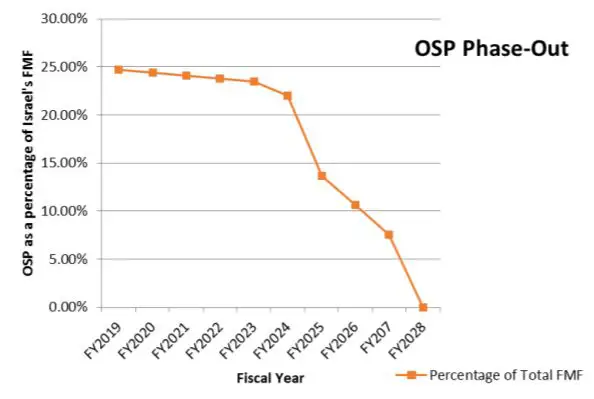
Because nearly all foreign aid is spent domestically—rising to 100% by FY2028—the main beneficiaries are U.S. defense contractors and their suppliers. This funding sustains American jobs, stimulates economic activity, and reduces per-unit costs for weapons systems that the Pentagon also procures. Such economic benefits naturally attract support from lawmakers whose districts gain financially. The map below illustrates this widespread impact by depicting the national distribution of U.S.-Israeli missile-defense co-production facilities. Similar maps exist for other major programs, including combat aircraft and related defense projects.

Sources: Clyde R. Mark, “Israel: U.S. Foreign Assistance,” Congressional Research Service, (July 12, 2004).
U.S. State Department.
USAID.
Congressional Budget Justification for FY06 Foreign Operations, (March 2005).
Jeremy M. Sharp, “U.S. Foreign Aid to Israel,” (DC: Congressional Research Service, (December 22, 2016).
Jim Zanotti, “Israel: Background and U.S. Relations,” Congressional Research Service, (February 28, 2014).
FACT SHEET: Memorandum of Understanding Reached with Israel, The White House, (September 14, 2016).
Herb Keinon, US increased military aid to Israel ahead of Trump visit, Jerusalem Post, (May 25, 2017).
“New defense budget bill foresees US-Israel counter-drone cooperation,” Defense News, (August 13, 2018).
AIPAC.
“Amid Iran tensions, Israel said to ask US to speed up delivery of air refuelers,” Times of Israel, (July 8, 2020).
“Israel to receive 990 million gallons of diesel from United States,” Jerusalem Post, (July 8, 2020).
Jeremy Sharp, “U.S. Foreign Aid to Israel,” Congressional Research Service, (November 16, 2020).
Judah Ari Gross, “Ministers approve NIS 9 billion purchase of aircraft, arms from US,” Times of Israel, (February 8, 2021).
Jacqueline Alemany, “Power Up: Biden administration approves $735 million weapons sale to Israel, raising red flags for some House Democrats,” Washington Post, (May 17, 2021).
Ron Kampeas, “House leader drops plan to ask for weapons transfer delay to Israel, promises greater oversight,” JTA, (May 18, 2021).
Dan Arkin, “US State Department approves sale of CH-53K helicopters to Israeli Air Force,” IsraelDefense, (August 1, 2021).
“US and Israel Ink Defense Agreements to Supply New Fleet of Helicopters, Refueling Aircraft,” Algemeiner, (December 31, 2021).
Betsy Berns Korn, “Congress passes record $4.8 billion for Israel’s security,” email from AIPAC, (March 10, 2022).
Jeremy M. Sharp, “U.S. Foreign Aid to Israel,” Congressional Research Service, (February 18, 2022).
Yaniv Kubovich, “U.S. to Provide Four Refueling Jets to Israel Air Force,” Haaretz, (September 1, 2022).
Justin Katz, “Sikorsky awarded $2.7B contract for 35 CH-53K King Stallions, some bound for Israel,” Breaking Defense, (August 25, 2023).
Tami Luhby, “US aid to Israel and Ukraine: Here’s what’s in the $105 billion national security package Biden requested,” CNN, (October 20, 2023).
“US okays transfer to Israel of 2,300 bombs within months, 25 F-35s in years – report,” Times of Israel, (March 30, 2024).
Tara Copp, “US approves $20 billion in weapons sales to Israel amid threat of wider Middle East war,” AP, (August 13, 2024).
“US approves $165 million sale to Israel of heavy-duty tank trailers,” Times of Israel, (September 13, 2024).
Luke Tress, “19 Senate Democrats back unsuccessful attempt to block weapons shipments to Israel,” JTA, (November 21, 2024).
“Trump administration approves major nearly $3 billion arms sale to Israel,” AP, (February 28, 2025).
“Rubio signs declaration to expedite delivery of $4 billion in military aid to Israel,” Reuters, (March 2, 2025).
“U.S. Foreign Assistance By Country - Israel,” ForeignAssistance.gov, (March 7, 2025).
Mike Wagenheim, “USAID cuts impacting peace-building nonprofits in Israel, Judea, Samaria,” JNS, (March 20, 2025).
Marc Rod, “State Department foreign aid cuts slashed $13 million in Israel grants,” Jewish Insider, (March 31, 2025).
Jeremy Sharp, “U.S. Foreign Aid to Israel,” Congressional Research Service, (May 28, 2025).
“US Approves $510 Mn Sale Of Bomb Guidance Kits To Israel,” AFP, (June 30, 2025).
Oded Yaron, “New Documents Reveal: U.S. Pouring Hundreds of Millions of Dollars in Military Aid Into Building IDF Airbases and Facilities in Israel,” Haaretz, (July 7, 2025).
Marc Rod, “House votes 422-6 to reject MTG bid to cut missile defense aid for Israel,” Jewish Insider, (July 18, 2025).
William D. Hartung, “U.S. Military Aid and Arms Transfers to Israel, October 2023 – September 2025,” Quincy Institute for Responsible Statecraft and Brown University’s Watson School of International and Public Affairs, (October 7, 2025).
“US approves more than $6.5 billion in potential military sales to Israel, Pentagon says,” Reuters, (January 30, 2026).
“US bypasses congressional review to approve munitions sale to Israel,” Times of Israel, (March 8, 2026).
Emanuel Fabian, “Shipments from US carrying 6,500 tons of military gear arrived in Israel in past day,” Times of Israel, (April 30, 2026).