 |
Myths & Facts OnlineU.S. Middle East PolicyBy Mitchell G. Bard“The
creation of Israel resulted solely from U.S.
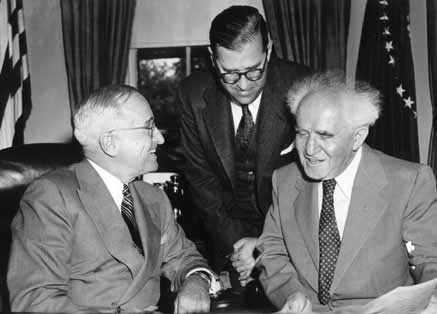
pressure.” “The creation of Israel resulted solely from U.S. pressure.” FACT When the UN took up the question of Palestine, President Harry Truman explicitly said the United States should not “use threats or improper pressure of any kind on other delegations.”1 Some pressure was nevertheless exerted and the U.S. played a key role in securing support for the partition resolution. U.S. influence was limited, however, as became clear when American dependents likesuch as Cuba and Greece voted against partition, and El Salvador and Honduras abstained. Many members of the Truman Administration opposed partition, including Defense Secretary James Forrestal, who believed Zionist aims posed a threat to American oil supplies and its strategic position in the region. The Joint Chiefs of Staff worried that the Arabs might align themselves with the Soviets if they were alienated by the West. These internal opponents did a great deal to undermined U.S. support for the establishment of a Jewish state.2 Although much has been written about the tactics of the supporters of partition, the behavior of the Arab states has been largely ignored. They were, in fact, actively engaged in arm-twisting of their own at the UN trying to scuttle partition.3 “The United States favored Israel over the Arabs in 1948 because of the pressures of the Jewish lobby.” FACT Truman supported the Zionist movement because he believed the international community was obligated to fulfill the promise of the Balfour Declaration and because he believed it was the humanitarian thing to do to ameliorate the plight of the Jewish survivors of the Holocaust. He did not believe the rights of the Arabs should or would be compromised. A sense of his attitude can be gleaned from a remark he made with regard to negotiations as to the boundaries of a Jewish state: The whole region waits to be developed, and if it were handled the way we developed the Tennessee River basin, it could support from 20 to 30 million people more. To open the door to this kind of future would indeed be the constructive and humanitarian thing to do, and it would also redeem the pledges that were given at the time of World War I.4 The American public supported the President’s policy. According to public opinion polls, 65 percent of Americans supported the creation of a Jewish state. During the third quarter of 1947 alone, 62,850 postcards, 1,100 letters and 1,400 telegrams flooded the White House, most urging the President to use American influence at the UN.5
This public support was reflected in Congress where a resolution approving the Balfour Declaration was adopted in 1922. In 1944, both national parties called for the restoration of the Jewish Commonwealth and, in 1945, a similar resolution was adopted by Congress. Rather than giving in to pressure, Truman tended to react negatively to the “Jewish lobby.” He complained repeatedly about being pressured and talked about putting propaganda from the Jews in a pile and striking a match to it. In a letter to Rep. Claude Pepper, Truman wrote: “Had it not been for the unwarranted interference of the Zionists, we would have had the matter settled a year and a half ago.”6 This was hardly the attitude of a politician overly concerned with Jewish votes. “The United States and Israel have nothing in common.” FACT The U.S.-Israel relationship is based on the twin pillars of shared values and mutual interests. Given this commonality of interests and beliefs, it should not be surprising that support for Israel is one of the most pronounced and consistent foreign policy values of the American people. Although Israel is geographically located in a region that is relatively undeveloped and closer to the Third World than the West, Israel has emerged in less than 60 years as an advanced nation with the characteristics of Western society. This is partially attributable to the fact that a high percentage of the population came from Europe or North America and brought with them Western political and cultural norms. It is also a function of the common Judeo-Christian heritage. Simultaneously, Israel is a multicultural society with people from more than 100 nations. Today, nearly half of all Israelis are Eastern or Oriental Jews who trace their origins to the ancient Jewish communities of the Islamic countries of North Africa and the Middle East. While they live in a region characterized by autocracies, Israelis have a commitment to democracy no less passionate than that of Americans. All citizens of Israel, regardless of race, religion or sex, are guaranteed equality before the law and full democratic rights. Freedom of speech, assembly and press is embodied in the country’s laws and traditions. Israel’s independent judiciary vigorously upholds these rights. The political system does differ from America’s — Israel’s is a parliamentary democracy — but it is still based on free elections with divergent parties. And though Israel does not have a formal constitution, it has adopted “Basic Laws” that establish similar legal guarantees. Americans have long viewed Israelis with admiration, at least partly because they see much of themselves in their pioneering spirit and struggle for independence. Like the United States, Israel is also a nation of immigrants. Despite the burden of spending nearly one-fifth of its budget on defense, it has had an extraordinary rate of economic growth for most of its history. It has also succeeded in putting most of the newcomers to work. As in America, immigrants to Israel have tried to make better lives for themselves and their children. Some have come from relatively undeveloped societies like Ethiopia or Yemen and arrived with virtually no possessions, education or training and become productive contributors to Israeli society. Israelis also share Americans’ passion for education. Israelis are among the most highly educated people in the world. From the beginning, Israel had a mixed economy, combining capitalism with socialism along the British model. The economic difficulties Israel has experienced — created largely in the aftermath of the 1973 Yom Kippur War by increased oil prices and the need to spend a disproportionate share of its Gross National Product on defense — have led to a gradual movement toward a free market system analogous to that of the United States. America has been a partner in this evolution. In the 1980’s, attention increasingly focused on one pillar of the relationship — shared interests. This was done because of the threats to the region and because the means for strategic cooperation are more easily addressed with legislative initiatives. Despite the end of the Cold War, Israel continues to have a role to play in joint efforts to protect American interests, including close cooperation in the war on terror. Strategic cooperation has progressed to the point where a de facto alliance now exists. The hallmark of the relationship is consistency and trust: The United States knows it can count on Israel. It is more difficult to devise programs that capitalize on the two nations’ shared values than their security interests; nevertheless, such programs do exist. In fact, these Shared Value Initiatives cover a broad range of areas such as the environment, energy, space, education, occupational safety and health. More than 400 American institutions in 47 states, the District of Columbia and Puerto Rico have received funds from binational programs with Israel. Little-known relationships like the Free Trade Agreement, the Cooperative Development Research Program, the Middle East Regional Cooperation Program and various memoranda of understanding with virtually every U.S. governmental agency demonstrate the depth of the special relationship. Even more important may be the broad ties between Israel and each of the individual 50 states and the District of Columbia. “Most Americans oppose a close U.S. relationship with Israel.” FACT Support for Israel is not restricted to the Jewish community. Americans of all ages, races and religions sympathize with Israel. This support is also nonpartisan, with a majority of Democrats and Republicans consistently favoring Israel by large margins over the Arabs. The best indication of Americans’ attitude toward Israel is found in the response to the most consistently asked question about the Middle East: “In the Middle East situation, are your sympathies more with Israel or with the Arab nations?” The organization that has conducted the most surveys is Gallup. Support for Israel in Gallup Polls has remained consistently around the 50 percent mark since 1967. In 76 Gallup polls, going back to 1967, Israel has had the support of an average of 46 percent of the American people compared to just under 12 percent for the Arab states/Palestinians. Americans have slightly more sympathy for the Palestinians than for the Arab states, but the results of polls asking respondents to choose between Israel and the Palestinians have not differed significantly from the other surveys. Some people have the misperception that sympathy for Israel was once much higher, but the truth is that before the Gulf War the peak had been 56 percent, reached just after the Six-Day War. In January 1991, sympathy for Israel reached a record high of 64 percent, according to Gallup. Meanwhile, support for the Arabs dropped to 8 percent and the margin was a record 56 points. The most recent poll, reported by Gallup in August 2009, found that sympathy for Israel was 58 percent compared to only 8 percent for the Palestinians. Despite the violence of the preceding years, and a steady stream of negative media coverage, this is nearly the same level of support Israel enjoyed after the 1967 war, when many people mistakenly believe that Israel was overwhelmingly popular. Polls also indicate the public views Israel as a reliable U.S. ally, a feeling that grew stronger during the Gulf crisis. A January 1991 Harris Poll, for example, found that 86 percent of Americans consider Israel a “close ally” or “friendly.” This was the highest level ever recorded in a Harris Poll. The figure in 2005 was 72 percent, ranking Israel fourth after Great Britain, Canada, and Australia. In a 2005 ADL poll, the figure was 71 percent, and a May 2003 survey sponsored by ARNSI, the Alliance for Research on National Security Issues, reported that 63 percent of Americans believe Israel is “a reliable ally of the U.S. in the fight against terrorism.” An August 2009 Rasmussen Reports poll found that 70 percent regarded Israel as a reliable ally, ranking it higher than any other nation in the Middle East.6a
“U.S. policy has always been hostile toward the Arabs.” FACT Arabs rarely acknowledge the American role in helping the Arab states achieve independence. President Wilson’s stand for self-determination for all nations, and the U.S. entry into World War I, helped cause the dissolution of the Ottoman Empire and stimulate the move toward independence in the Arab world. The Arabs have always asserted that Middle East policy must be a zero-sum game whereby support for their enemy, Israel, necessarily puts them at a disadvantage. Thus, Arab states have tried to force the United States to choose between support for them or Israel. The U.S. has usually refused to fall into this trap. The fact that the U.S. has a close alliance with Israel while maintaining good relations with several Arab states is proof the two are not incompatible. The U.S. has long sought friendly relations with Arab leaders and has, at one time or another, been on good terms with most Arab states. In the 1930s, the discovery of oil led U.S. companies to become closely involved with the Gulf Arabs. In the 1950s, U.S. strategic objectives stimulated an effort to form an alliance with pro-Western Arab states. Countries such as Iraq and Libya were friends of the U.S. before radical leaders took over those governments. Egypt, which was hostile toward the U.S. under Nasser, shifted to the pro-Western camp under Sadat. Since World War II, the U.S. has poured economic and military assistance into the region and today is the principal backer of nations such as Jordan, Saudi Arabia, Morocco, Egypt and the Gulf sheikdoms. Although the Arab states blamed the U.S. for their defeats in wars they initiated with Israel, the truth is most of the belligerents had either been given or offered American assistance at some time. “The United States has supported Israel automatically ever since 1948.” FACT The United States has been Israel’’s closest ally throughout its history; nevertheless, the U.S. has acted against the Jewish State’s wishes many times. The U.S. effort to balance support for Israel with placating the Arabs began in 1948 when President Truman showed signs of wavering on partition and advocating trusteeship. After the surrounding Arab states invaded Israel, the U.S. maintained an arms embargo that severely restricted the Jews’ ability to defend themselves. Ever since the 1948 war, the U.S. has been unwilling to insist on projects to resettle Arab refugees. The U.S. has also been reluctant to challenge Arab violations of the UN Charter and resolutions. Thus, for example, the Arabs were permitted to get away with blockading the Suez Canal, imposing a boycott on Israel and committing acts of terrorism. In fact, the U.S. has taken positions against Israel at the UN more often than not, and did not use its Security Council veto to block an anti-Israel resolution until 1972. Perhaps the most dramatic example of American policy diverging from that of Israel came during the Suez War when President Eisenhower took a strong stand against Britain, France and Israel. After the war, U.S. pressure forced Israel to withdraw from the territory it conquered. David Ben-Gurion relied on dubious American guarantees that sowed the seeds of the 1967 conflict. At various other times, American Presidents have taken action against Israel. In 1981, for example, Ronald Reagan suspended a strategic cooperation agreement after Israel annexed the Golan Heights. On another occasion, he held up delivery of fighter planes because of unhappiness over an Israeli raid in Lebanon. In 1991, President Bush held a press conference to ask for a delay in considering Israel’s request for loan guarantees to help absorb Soviet and Ethiopian Jews because of his disagreement with Israel’s settlement policy. In staking his prestige on the delay, Bush used intemperate language that inflamed passions and provoked concern in the Jewish community that anti-Semitism would be aroused. Though often described as the most pro-Israel President in history, Bill Clinton also was critical of Israel on numerous occasions. George W. Bush’s administration has also shown no reluctance to criticize Israel for actions it deems contrary to U.S. interests, but has generally been more reserved in its public statements. During the first year of the Palestinian War, the U.S. imposed an arms embargo on spare parts for helicopters because of anger over the use of U.S.-made helicopters in targeted killings. The Bush Administration also punished Israel for agreeing to sell military equipment to China in 2005.8 “The U.S. has always given Israel arms to insure it would have a qualitative edge over the Arabs.” FACT The United States provided only a limited amount of arms to Israel, including ammunition and recoilless rifles, prior to 1962. In that year, President Kennedy sold Israel HAWK anti-aircraft missiles, but only after the Soviet Union provided Egypt with long-range bombers. By 1965, the U.S. had become Israel’s main arms supplier. This was partially necessitated by West Germany’s acquiescence to Arab pressure, which led it to stop selling tanks to Israel. Throughout most of the Johnson Administration, however, the sale of arms to Israel was balanced by corresponding transfers to the Arabs. Thus, the first U.S. tank sale to Israel, in 1965, was offset by a similar sale to Jordan.9 The U.S. did not provide Israel with aircraft until 1966. Even then, secret agreements were made to provide the same planes to Morocco and Libya, and additional military equipment was sent to Lebanon, Saudi Arabia and Tunisia.10 As in 1948, the U.S. imposed an arms embargo on Israel during the Six-Day War, while the Arabs continued to receive Soviet arms. Israel’s position was further undermined by the French decision to embargo arms transfers to the Jewish State, effectively ending their role as Israel’s only other major supplier.
From that point on, the U.S. began to pursue a policy whereby Israel’s qualitative edge was maintained. The U.S. has also remained committed, however, to arming Arab nations, providing sophisticated missiles, tanks and aircraft to Jordan, Morocco, Egypt, Saudi Arabia and the Gulf states. Thus, when Israel received F-15s in 1978, so did Saudi Arabia (and Egypt received F-5Es). In 1981, Saudi Arabia, for the first time, received a weapons system that gave it a qualitative advantage over Israel — AWACS radar planes. Today, Israel buys near top-of-the-line U.S. equipment, but many Arab states also receive some of America’s best tanks, planes and missiles. The qualitative edge may be intact, but it is undoubtedly narrow.
“U.S. aid in the Middle East has always been one-sided, with the Arabs getting practically nothing.” FACT After Israel’s victory in its War of Independence, the U.S. responded to an appeal for economic aid to help absorb immigrants by approving a $135 million Export-Import Bank loan and the sale of surplus commodities. In those early years of Israel’s statehood (also today), U.S. aid was seen as a means of promoting peace. In 1951, Congress voted to help Israel cope with the economic burdens imposed by the influx of Jewish refugees from the displaced persons camps in Europe and from the ghettos of the Arab countries. Arabs then complained the U.S. was neglecting them, though they had no interest in or use for American aid then. In 1951, Syria rejected offers of U.S. aid. Oil-rich Iraq and Saudi Arabia did not need U.S. economic assistance, and Jordan was, until the late 1950s, the ward of Great Britain. After 1957, when the United States assumed responsibility for supporting Jordan and resumed economic aid to Egypt, assistance to the Arab states soared. Also, the United States was by far the biggest contributor of aid to the Palestinians through UNRWA, a status that continues to the present. Israel has received more direct aid from the United States since World War II than any other country, but the amounts for the first half of this period were relatively small. Between 1949 and 1973, the U.S. provided Israel with an average of about $122 million a year, a total of $3.1 billion (and actually more than $1 billion of that was loans for military equipment in 1971-73) . Prior to 1971, Israel received a total of only $277 million in military aid, all in the form of loans as credit sales. The bulk of the economic aid was also lent to Israel. By comparison, the Arab states received nearly three times as much aid before 1971, $4.4 billion, or $170 million per year. Moreover, unlike Israel, which receives nearly all its aid from the United States, Arab nations have gotten assistance from Asia, Eastern Europe, the Soviet Union and the European Community.
Israel did not begin to receive large amounts of assistance until 1974, following the 1973 war, and the sums increased dramatically after the Camp David agreements. Altogether, since 1949, Israel has received more than $90 billion in assistance. Though the totals are impressive, the value of assistance to Israel has been eroded by inflation. Arab states that have signed agreements with Israel have also been rewarded. Since signing the peace treaty with Israel, Egypt has been the second largest recipient of U.S. foreign aid ($1.8 billion in 2005, Israel received $2.6 billion). Jordan has also been the beneficiary of higher levels of aid since it signed a treaty with Israel (increasing from less than $40 million to approximately $250 million). The multibillion dollar debts to the U.S. of both Arab nations were also forgiven. After the Oslo agreements, the United States also began providing fundingaid to the Palestinians. Funding for the West Bank and Gaza between 1993 and 2004 totaled approximately $1.3 billion. In May 2005, Congress passed a $200 million emergency aid package for the Palestinians aimed at promoting development projects in the West Bank and Gaza Strip. In an effort to strengthen Palestinian President Mahmoud Abbas, President Bush agreed to provide the Palestinian Authority with $50 million in direct aid. Past assistance had been indirect, paid through nongovernmental organizations, but these funds were deposited in a special account managed by Palestinian Finance Minister Salam Fayyad, who is widely credited with making the PA’s finances more transparent. The money “is to be used to build housing, schools, roads, water facilities and health clinics in Gaza to help ease the transition as Israelis withdraw.”14 “Israel continues to demand large amounts of economic aid even though it is now a rich country that no longer needs help.” FACT Starting with fiscal year 1987, Israel annually received $1.2 billion in all grant economic aid and $1.8 billion in all grant military assistance. In 1998, Israel offered to voluntarily reduce its dependence on U.S. economic aid. According to an agreement reached with the Clinton Administration and Congress, the economic aid package will be reduced by $120 million each year so that it will be phased out over 10 years. Half of the annual savings in economic assistance each year ($60 million) will be added to Israel’s military aid package in recognition of its increased security needs. Israel made the offer because it does not have the same need for assistance it once did. The foundation of Israel’s economy today is strong; still, Israel remains saddled with past debts to the U.S., which, unlike those of Jordan and Egypt, were not forgiven. In addition, Israel still can use American help. The country still has the tremendous financial burden of absorbing thousands of immigrants, a very high rate of unemployment and an alarmingly high number of people who fall below the poverty line. The situation was further exacerbated by the Palestinian War, which devastated the tourist industry and all related service sectors of the economy. Furthermore, concessions made in peace negotiations have required the dismantling of military bases and the loss of valuable resources that must be replaced. The cost of disengaging from Gaza alone is estimated at more than $2 billion. In 2005, economic aid to Israel was expected to be reduced to $360 million while military aid was to be increased to $2.2 billion. “Israel boasts that it is the fourth strongest nation in the world, so it certainly doesn’t need U.S. military assistance.” FACT Israel has peace treaties with only two of its neighbors. It remains technically at war with the rest of the Arab/Islamic world, and several countries, notably Iran, are openly hostile. Given the potential threats, it is a necessity that Israel continue to maintain a strong defense. As the arms balance chart in the Appendix indicates, Israel faces formidable enemies that could band together, as they have in the past, to threaten its security. It must, therefore, rely on its qualitative advantage to insure it can defeat its enemies, and that can only be guaranteed by the continued purchase of the latest weapons. New tanks, missiles and planes carry high price tags, however, and Israel cannot afford what it needs on its own, so continued aid from the United States is vital to its security. Furthermore, Israel’s enemies have numerous suppliers, but Israel must rely almost entirely on the United States for its hardware. “U.S. military aid subsidizes Israeli defense contractors at the expense of American industry.” FACT Contrary to popular wisdom, the United States does not simply write billion dollar checks and hand them over to Israel to spend as they like. Only about 25 percent ($555 million of $2.2 billion in 2004) of what Israel receives in Foreign Military Financing (FMF) can be spent in Israel for military procurement. The remaining 75 percent is spent in the United States to generate profits and jobs. More than 1,000 companies in 47 states, the District of Columbia and Puerto Rico have signed contracts worth billions of dollars through this program over the last several years. The figures for 2010 are below: The Value of Foreign Military Financing (FMF) Orders by State15
“Israel was never believed to have any strategic value to the United States.” FACT In 1952, Gen. Omar Bradley, head of the Joint Chiefs of Staff, believed the West required 19 divisions to defend the Middle East and that Israel could supply two. He also expected only three states to provide the West air power in Middle Eastern defense by 1955: Great Britain, Turkey and Israel. Bradley’s analysis was rejected because the political echelon decided it was more important for the United States to work with Egypt, and later Iraq. It was feared that integration of Israeli forces in Western strategy would alienate the Arabs.16 Israel’s crushing victory over the combined Arab forces in 1967 caused this view to be revised. The following year, the United States sold Israel sophisticated planes (Phantom jets) for the first time. Washington shifted its Middle East policy from seeking a balance of forces to ensuring that Israel enjoyed a qualitative edge over its enemies. Israel proved its value in 1970 when the United States asked for help in bolstering King Hussein’s regime. Israel’s willingness to aid Amman, and movement of troops to the Jordanian border, persuaded Syria to withdraw the tanks it had sent into Jordan to support PLO forces challenging the King during “Black September.”17 By the early 1970s it had becomewas clear that no Arab state could or would contribute to Western defense in the Middle East. The Baghdad Pact had long ago expired, and the regimes friendly to the United States were weak compared to the anti-Western forces in Egypt, Syria and Iraq. Even after Egypt’s reorientation following the signing of its peace treaty with Israel, the United States did not count on any Arab government for military assistance. The Carter Administration began to implement a form of strategic cooperation (it was not referred to as such) by making Israel eligible to sell military equipment to the United States. The willingness to engage in limited, joint military endeavors was viewed by President Carter as a means of rewarding Israel for “good behavior” in peace talks with Egypt. Though still reluctant to formalize the relationship, strategic cooperation became a major focus of the U.S.-Israel relationship when Ronald Reagan entered office. Before his election, Reagan had written: “Only by full appreciation of the critical role the State of Israel plays in our strategic calculus can we build the foundation for thwarting Moscow’s designs on territories and resources vital to our security and our national well-being.”18 Reagan’s view culminated in the November 30, 1981, signing of a Memorandum of Understanding on “strategic cooperation.” On November 29, 1983, a new agreement was signed creating the Joint Political-Military Group (JPMG) and a group to oversee security assistance, the Joint Security Assistance Planning Group (JSAP). In 1987, Congress designated Israel as a major non-NATO ally. This law formally established Israel as an ally, and allowed its industries to compete equally with NATO countries and other close U.S. allies for contracts to produce a significant number of defense items.
In April 1988, President Reagan signed another MOU encompassing all prior agreements. This agreement institutionalized the strategic relationship. By the end of Reagan’s term, the U.S. had prepositioned equipment in Israel, regularly held joint training exercises, began co-development of the Arrow Anti-Tactical Ballistic Missile and was engaged in a host of other cooperative military endeavors. Since then, U.S.-Israel strategic cooperation has continued to evolve. Israel now regularly engages in joint training exercises with U.S. forces and, in 2005, for the first time, also trained and exercised with NATO forces. Today, strategic ties are stronger than ever and Israel has become a de facto ally of the United States. “The employment of Jonathan Pollard to spy on the United States is proof that Israel works against American interests.” FACT In November 1985, the FBI arrested Jonathan Pollard, a U.S. Navy intelligence analyst, on charges of selling classified material to Israel. Pollard was subsequently sentenced to life imprisonment. His wife, Anne, was sentenced to five years in jail for assisting her husband. Immediately upon Pollard’s arrest, Israel apologized and explained that the operation was unauthorized. “It is Israel’s policy to refrain from any intelligence activity related to the United States,” an official government statement declared, “in view of the close and special relationship of friendship” between the two countries. Prime Minister Shimon Peres stated: “Spying on the United States stands in total contradiction to our policy.”20 The United States and Israel worked together to investigate the Pollard affair. The Israeli inquiry revealed that Pollard was not working for Israeli military intelligence or the Mossad. He was directed by a small, independent scientific intelligence unit. Pollard initiated the contact with the Israelis. A subcommittee of the Knesset’s Defense and Foreign Affairs Committee on Intelligence and Security Services concluded: “Beyond all doubt...the operational echelons (namely: the Scientific Liaison Unit headed by Rafael Eitan) decided to recruit and handle Pollard without any check or consultation with the political echelon or receiving its direct or indirect approval.” The Knesset committee took the government to task for not properly supervising the scientific unit. As promised to the U.S. government, the spy unit that directed Pollard was disbanded, his handlers punished and the stolen documents returned.21 The last point was crucial to the U.S. Department of Justice’s case against Pollard. Pollard denied spying “against” the United States. He said he provided only information he believed was vital to Israeli security and was being withheld by the Pentagon. This included data on Soviet arms shipments to Syria, Iraqi and Syrian chemical weapons, the Pakistani atomic bomb project and Libyan air defense systems.22 Because the information he took is classified, we can't verify if this is true. The United States Attorney arranged a plea-bargain with Pollard: he would plead guilty to the one count of passing classified information to an ally without intent to harm the United States. There would be no trial, and no risk of classified information being disclosed in court. In return, the government said it would not seek the maximum sentence. The trial judge warned Pollard, however, that he could still receive a life sentence.22a Pollard nevertheless pled guilty on June 4, 1986. Before sentencing, and in violation of the plea agreement, Pollard and his wife Anne gave defiant media interviews in which they defended their spying, and attempted to rally American Jews to their cause. In a 60 Minutes interview, Anne said, “I feel my husband and I did what we were expected to do, and what our moral obligation was as Jews, what our moral obligation was as human beings, and I have no regrets about that.” Also prior to sentencing, Secretary of Defense Caspar Weinberger submitted a 46-page classified memorandum to the judge outlining the damage to U.S. national security done by Pollard. Contrary to some accounts, Wolf Blitzer reported that Pollard and his attorneys were permitted to read it and draft a response.22b Weinberger called for severe punishment and the memo is widely cited as a major reason that the judge ultimately sentenced Pollard to life in prison for espionage. His life sentence was the most severe prison term ever given for spying for an ally. It also was far greater than the average term imposed for spying for the Soviet Union and other enemies of the United States.23 Many convicted spies, however, have been given life sentences, including Aldrich Ames, Robert Hanssen, and John Walker. Though initially shunned by Israel, the government of Benjamin Netanyahu admitted that Pollard had worked for Israeli intelligence and granted him citizenship. Netanyahu requested clemency for Pollard during Middle East peace talks at the Wye Plantation in Maryland in 1998. Since then, Israeli officials have made additional entreaties on Pollard’s behalf. Pollard’s supporters in the United States also routinely request that he be pardoned. President Clinton reportedly considered a pardon, but defense and intelligence agency officials vigorously opposed the idea. At the end of Clinton’s term, the issue was again raised and Sen. Richard Shelby (R-AL), chairman of the Senate’s Select Committee on Intelligence, along with a majority of senators argued against a pardon. “Mr. Pollard is a convicted spy who put our national security at risk and endangered the lives of our intelligence officers,” Shelby said. “There not terms strong enough to express my belief that Mr. Pollard should serve every minute of his sentence....”24 In November 2003, a federal judge rejected requests by Pollard to appeal his life sentence and review classified government documents that Pollard said would prove his spying was not as damaging or as extensive as prosecutors had charged. The judge said that Pollard had waited too long — more than a decade after it was imposed — to object to his sentence and ruled that Pollard’s attorneys offered no compelling justification for seeing the sealed intelligence documents.25 A U.S. federal appeals court in July 2005 rejected Pollard’s claim that he had inadequate counsel in his original trial and denied his request to downgrade his life sentence. The court also denied Pollard’s attorneys access to classified information they hoped would help in their attempt to win presidential clemency for their client. The rulings leave Pollard with little recourse but the Supreme Court to change his fate.26 Pollard also petitioned the Israeli Supreme Court to be recognized as a Prisoner of Zion in the hope that such status would win support for him to improve his prison conditions and stimulate a campaign for his release. The Court rejected his petition on January 16, 2006, however, because a Prisoner of Zion is defined as someone who was imprisoned “because of his Zionist activity in a country where such activity was illegal.” Supreme Court President Aharon Barak said typical Zionist activity would include teaching Hebrew and encouraging aliyah, but “it cannot be said that an act of espionage on behalf of Israel constitutes Zionist activity ‘in a country where Zionist activity is prohibited,’he wrote. “The act of spying, including spying for Israel, is prohibited in the U.S. as it is in all countries.”26a In February 2006, Pollard asked the U.S. Supreme Court to overturn a federal appeals court ruling that denied his attorneys access to classified information used in his trial. Pollard’s attorneys insist the documents are needed to make Pollard’s case for clemency. The U.S. Court of Appeals for the District of Columbia Circuit ruled last year that the federal courts lack jurisdiction to review claims for access to documents for clemency, which the court said is the “president’s sole discretion.” On March 20, 2006, the U.S. Supreme Court rejected Pollard’s appeal. “U.S. dependence on Arab oil has decreased over the years.” FACT In 1973, the Arab oil embargo dealt the U.S. economy a major blow. This, combined with OPEC’s subsequent price hikes and a growing American dependence on foreign oil, triggered the recession of the early seventies. In 1973, foreign oil accounted for 35 percent of total U.S. oil demand. By 2010, the figure had risen to 63 percent, and Arab OPEC countries accounted for 22 percent of 2010 U.S. imports (with non-Arab countries Angola, Venezuela, Ecuador and Nigeria, the figure is 42 percent). Saudi Arabia ranked number three and Algeria (#6), Iraq (#7) and Kuwait (#13) were among the top 15 suppliers of petroleum products to the United States in 2010. The Persian Gulf states alone supplied nearly 15% of U.S. petroleum imports for FY2010.27 The growing reliance on imported oil has also made the U.S. economy even more vulnerable to price jumps, as occurred in 1979, 1981, 1982, 1990, 2000, 2005 and 2009. Oil price increases have also allowed Arab oil-producers to generate tremendous revenues at the expense of American consumers. These profits have subsidized large weapons purchases and nonconventional weapons programs such as Iran’s. America’s dependence on Arab oil has occasionally raised the specter of a renewed attempt to blackmail the United States to abandon its support for Israel. In April 2002, for example, Iraq suspended oil shipments for a month to protest Israel’s operation to root out terrorists in the West Bank. No other Arab oil producers followed suit and the Iraqi action had little impact on oil markets and no effect on policy. The good news for Americans is that the top two suppliers of U.S. oil today – Canada and Mexico – are more reliable and better allies than the Persian Gulf nations. “America’s support of Israel is the reason that terrorists attacked the World Trade Center and Pentagon on September 11.” FACT The heinous attacks against the United States were committed by Muslim fanatics who had a variety of motivations for these and other terrorist attacks. These Muslims have a perverted interpretation of Islam and believe they must attack infidels, particularly Americans and Jews, who do not share their beliefs. They oppose Western culture and democracy and object to any U.S. presence in Muslim nations. They are particularly angered by the existence of American military bases in Saudia Arabia and other areas of the Persian Gulf. This would be true regardless of U.S. policy toward the Israeli-Palestinian conflict. Nevertheless, an added excuse for their fanaticism is the fact that the United States is allied with Israel. Previous attacks on American targets, such as the USS Cole and U.S. embassies in Kenya and Tanzania, were perpetrated by suicide bombers whose anger at the United States had little or nothing to do with Israel.
Osama bin Laden claimed he was acting on behalf of the Palestinians, and that his anger toward the United States was shaped by American support for Israel. This was a new invention by bin Laden clearly intended to attract support from the Arab public and justify his terrorist acts. Bin Laden’s antipathy toward the United States has never been related to the Arab-Israeli conflict. Though many Arabs were taken in by bin Laden’s transparent effort to drag Israel into his war, Dr. Abd Al-Hamid Al-Ansari, dean of Shar’ia and Law at Qatar University was critical, “In their hypocrisy, many of the [Arab] intellectuals linked September 11 with the Palestinian problem — something that completely contradicts seven years of Al-Qaida literature. Al-Qaida never linked anything to Palestine.”29 Even Yasser Arafat told the Sunday Times of London that bin Laden should stop hiding behind the Palestinian cause. Bin Laden “never helped us, he was working in another completely different area and against our interests,” Arafat said.30 Though Al-Qaida’s agenda did not include the Palestinian cause, the organization has begun to take a more active role in terror against Israeli targets, starting with the November 28, 2002, suicide bombing at an Israeli-owned hotel in Kenya that killed three Israelis and 11 Kenyans, and the attempt to shoot down an Israeli airliner with a missile as it was taking off from Kenya that same day.31 Al-Qaida operatives have also now has begun to infiltrate the Palestinian Authority.32 “The hijacking of four airliners in one day, on September 11, was an unprecedented act of terror.” FACT The scale of the massacre and destruction on September 11 was indeed unprecedented, as was the use of civilian aircraft as bombs. The coordinated hijackings, however, were not new. On September 6, 1970, members of the Popular Front for the Liberation of Palestine (PFLP) hijacked three jets (Swissair, TWA and Pan Am ) with more than 400 passengers on flights to New York. A fourth plane, an El Al flight, was also targeted, but Israeli security agents foiled the hijacking in mid-air and killed one of the two terrorists when they tried to storm the cockpit. On the 9th, a British BOAC jet was also hijacked by the PFLP.33 The UN could not muster a condemnation of the hijackings. A Security Council Resolution only went so far as to express grave concern, and did not even bring the issue to a vote. Instead of flying their planes into buildings, they landed them on airfields (three in Jordan, one in Egypt). All four hijacked planes were blown up on the ground – after the passengers were taken off the planes — on September 12. More than three dozen Americans were among the passengers who were then held hostage in Jordan as the terrorists attempted to blackmail the Western governments and Israel to swap the hostages for Palestinian terrorists held in their jails. On September 14, after releasing all but 55 hostages, the terrorists said all American hostages would be treated as Israelis. A tense standoff ensued. Seven terrorists were ultimately set free by Britain, Germany and Switzerland in exchange for the hostages.34 After the hijackings, shocked members of cCongress called for immediate and forceful action by the United States and international community. They insisted on quick adoption of measures aimed at preventing air piracy, punishing the perpetrators and recognizing the responsibility of nations that harbor them.35 Virtually nothing was done until 31 years later. The PFLP as an organization, and some of the individual participants responsible for those hijackings still are alive and well, supported by Syria, the Palestinian Authority and others. In fact, Leila Khaled, the person who tried to hijack the El Al jet, was going to be admitted into the territories to attend the Palestine National Council meetings in 1996, but she still refused to disavow terrorism. Today, she is said to live in Amman. “Israel’s Mossad carried out the bombing of the World Trade Center to provoke American hatred of Arabs.” FACT Syrian Defense Minister Mustafa Tlass told a delegation from Great Britain that Israel was responsible for the September 11, 2001, attacks on the United States. He claimed the Mossad had warned thousands of Jewish employees not to go to work that day at the World Trade Center. He was the highest-ranking Arab public official to publicly voice a view that is widespread in the Arab world that the attacks were part of a Jewish conspiracy to provoke U.S. retaliation against the Arab world and to turn American public opinion against Muslims. One poll published in the Lebanese newspaper An Nahar, for example, found that 31 percent of the respondents believed Israel was responsible for the hijackings while only 27 percent blamed Osama bin Laden. A Newsweek poll found that a plurality of Egyptians believed the Jews were responsible for the Trade Center bombings.36 The conspiracy theory is also being circulated by American Muslim leaders. Imam Mohammed Asi of the Islamic Center of Washington said Israeli officials decided to launch the attack after the United States refused their request to put down the Palestinian intifada. “If we’re not going to be secure, neither are you,” was the Israelis’’ thinking following the U.S. response, according to Asi.37 The passing years have not reduced the popularity of the conspiracy theories in the Arab world. An Egyptian researcher, for example, told a television interviewer (Iqra, May 26, 2005) the twin towers were brought down by a pre-planned “controlled demolition” and that “4,000 Jews caught influenza on that exact day.” A Saudi women’s rights activist told another interviewer (Al-Arabiya TV, April 12, 2005) that the attack was “premeditated” and that Osama bin Laden works for “global Zionism.” An Egyptian professor claimed the attack was “fabricated as a pretext to attack Islam and Muslims” (Saudi Channel 1, August 8, 2005). “The plan was to take over the world’s energy sources,” according to Abd Al-Sabour Shahin, who concluded “a dirty Zionist carried out this act.” The editor of Middle East Magazine told Al-Manar TV (December 30, 2004) that the attack was a “grand scheme” engineered by Zionists, evangelical Chrisians and “American right-wing forces” to “push America into war.”37a No U.S. authority has suggested, nor has any evidence been produced, to suggest any Israeli or Jew had any role in the terrorist attacks. These conspiracy theories are complete nonsense and reflect the degree to which many people in the Arab world are prepared to accept anti-Semitic fabrications and the mythology of Jewish power. They may also reflect a refusal to believe that Muslims could be responsible for the atrocities and the hope that they could be blamed on the Jews. “Groups like Hizballah, Islamic Jihad, Hamas and the PFLP are freedom fighters and not terrorists.” FACT When the United States declared a war on terrorists and the nations that harbor them after September 11, Arab states and their sympathizers argued that many of the organizations that engage in violent actions against Americans and Israelis should not be targets of the new American war because they are “freedom fighters” rather than terrorists. This has been the mantra of the terrorists themselves, who claim that their actions are legitimate forms of resistance against the “Israeli occupation.” This argument is deeply flawed. First, the enemies of Israel rationalize any attacks as legitimate because of real and imagined sins committed by Jews since the beginning of the 20th century. Consequently, the Arab bloc and its supporters at the United Nations have succeeded in blocking the condemnation of any terrorist attacks against Israel. Instead, they routinely sponsor resolutions criticizing Israel when it retaliates. Second, nowhere else in the world is the murder of innocent men, women and children considered a “legitimate form of resistance.” The long list of heinous crimes includes snipers shooting infants, suicide bombers blowing up pizzerias and discos, hijackers taking and killing hostages, and infiltrators murdering Olympic athletes. Hizballah, Islamic Jihad, Hamas, the PFLP, and a number of other groups, mostly Palestinian, have engaged in these activities for decades and rarely been condemned or brought to justice. All of them qualify as terrorist groups according to the U.S. government’s own definition — “Terrorism is the unlawful use of force or violence against persons or property to intimidate or coerce a government, the civilian population, or any segment thereof, in furtherance of political or social objectives”38 — and therefore should be targets of U.S. efforts to cut off their funding, to root out their leaders and to bring them to justice. In the case of the Palestinian groups, there is no mystery as to who the leaders are, where their funding comes from and which nations harbor them. American charitable organizations have been linked to funding some of these groups and SaudiaSaudi Arabia, Syria, Lebanon, Iraq, Iran and the Palestinian Authority all shelter and/or financially and logistically support them.
“American universities should divest from companies that do business in Israel to force an end to Israeli ‘occupation’ and human rights abuses.” FACT The word “peace” does not appear in divestment petitions, which makes clear the intent is not to resolve the conflict but to delegitimize Israel. Petitioners blame Israel for the lack of peace and demand that it make unilateral concessions without requiring anything of the Palestinians, not even the cessation of terrorism. Divestment advocates also ignore Israel’s efforts during the Oslo peace process, and at the summit meetings with President Clinton, to reach historic compromises with the Palestinians that would have created a Palestinian state. Even after Israel completely withdrew from the Gaza Strip, certain individuals and groups persisted in their campaign to undermine Israel and further demonstrated that they are interested in Israel’s destruction rather than any territorial compromise. The divestment campaign against South Africa was specifically directed at companies that were using that country’s racist laws to their advantage. In Israel no such racist laws exist; moreover, companies doing business there adhere to the same standards of equal working rights that are applied in the United States. Harvard University President Lawrence Summers observed that the divestment efforts are anti-Semitic. “Profoundly anti-Israel views are increasingly finding support in progressive intellectual communities,” said Summers. “Serious and thoughtful people are advocating and taking actions that are anti-Semitic in their effect, if not their intent.”40 Peace in the Middle East will come only from direct negotiations between the parties, and only after the Arab states recognize Israel’s right to exist, and the Palestinians and other Arabs cease their support of terror. American universities cannot help through misguided divestment campaigns that unfairly single out Israel as the source of conflict in the region. Divestment proponents hope to tar Israel with an association with apartheid South Africa, an offensive comparison that ignores the fact that all Israeli citizens are equal under the law. “Advocates for Israel try to silence critics by labeling them anti-Semitic.” FACT Criticizing Israel does not necessarily make someone anti-Semitic. The determining factor is the intent of the commentator. Legitimate critics accept Israel’s right to exist, whereas anti-Semites do not. Anti-Semites use double standards when they criticize Israel, for example, denying Israelis the right to pursue their legitimate claims while encouraging the Palestinians to do so. Anti-Semites deny Israel the right to defend itself, and ignore Jewish victims, while blaming Israel for pursuing their murderers. Anti-Semites rarely, if ever, make positive statements about Israel. Anti-Semites describe Israelis using pejorative terms and hate-speech, suggesting, for example, that they are “racists” or “Nazis.” Natan Sharansky has suggested a “3-D” test for differentiating legitimate criticism of Israel from anti-Semitism. The first “D” is the test of whether Israel or its leaders are being demonized or their actions blown out of proportion. Equating Israel with Nazi Germany is one example of demonization. The second “D” is the test of double standards. An example is when Israel is singled out for condemnation at the United Nations for perceived human rights abuses while nations that violate human rights on a massive scale, such as Iran, Syria, and Saudi Arabia, are not even mentioned. The third “D” is the test of delegitimization. Questioning Israel’s legitimacy, that is, its right to exist is always anti-Semitic.41 No campaign exists to prevent people from expressing negative opinions about Israeli policy. In fact, the most vociferous critics of Israel are Israelis themselves who use their freedom of speech to express their concerns every day. A glance at any Israeli newspaper will reveal a surfeit of articles questioning particular government policies. Anti-Semites, however, do not share Israelis’ interest in improving the society; their goal is to delegitimize the state in the short-run, and destroy it in the long-run. There is nothing Israel could do to satisfy these critics. “Arab-Americans are a powerful voting bloc that U.S. presidential candidates must pander to for votes.” FACT Arab-Americans represent a tiny fraction (less than one-half of one percent) of the U.S. population. Unlike American Jews, who are overwhelmingly supportive of Israel, Arab-Americans are not a monolithic group. There are approximately 1.2 million Arabs in the United States, and they tend to reflect the general discord of the Arab world, which has twenty-one states with competing interests. While the Palestinian cause receives most of the media’s attention, because of the salience of the Arab-Israeli conflict and the omnipresence of a handful of activists and vocal Palestinian spokespersons, the reality is that only about 70,000 Palestinians (6 percent of all Arab-Americans) live in the United States. Roughly 38 percent of Arab-Americans are Lebanese, primarily Christians. In addition, while attention has focused on the allegedly growing political strength of Muslims in the United States, fewer than one-fourth of all Arab-Americans are Muslims.42Christian Arabs, especially those from Lebanon, do not typically support the Palestinians’ anti-Israel agenda, largely because of their history of mistreatment by Palestinians and Muslims. Consequently, Arab-American voters do not pursue a positive agenda of strengthening U.S.-Arab ties; instead, they focus on weakening U.S.-Israel relations. Presidential candidates, however, and most Americans, historically view Israel as an ally that supports American interests, and are unwilling to support a reversal of this longstanding policy. The divisions were apparent in 2000 when George W. Bush was viewed with suspicion by most Jewish voters and considered likely to be more sympathetic to the Arab cause by Arab-Americans. In that election, 45 percent of Arab-Americans nationwide voted for George Bush, 38 percent for Al Gore, and 13 percent for Ralph Nader (who, incidentally, is of Lebanese descent).43The situation changed dramatically in 2004 when Arab-Americans perceived Bush as pro-Israel, and were disturbed by his support for security measures that they viewed as threats to their civil liberties. Consequently, John Kerry received 63 percent% of the Arab-American vote, while President Bush won 28 percent%.44 Once again, this constituency did not change the outcome. Even if Arab-Americans vote as a bloc, their influence is marginal, and restricted to a handful of states. About half of the Arab population is concentrated in five states — California, Florida, Michigan, New Jersey, and New York — that are all key to the electoral college. Still, the Arab population is dwarfed by that of the Jews in every one of these states except Michigan. Jewish and Arab Populations in Key States45
“The United States must be ‘engaged’ to advance the peace process.” FACT The European Union, Russia, and the UN all have pursued largely one-sided policies in the Middle East detrimental to Israel, which has disqualified them as honest brokers. The United States is the only country that has the trust of both the Israelis and the Arabs and is therefore the only third party that can play a constructive role in the peace process. This has led many people to call for greater involvement by the Bush Administration in negotiations. While the United States can play a valuable role as a mediator, history shows that American peace initiatives have never succeeded, and that it is the parties themselves who must resolve their differences. The Eisenhower Administration tried to ease tensions by proposing the joint Arab-Israeli use of the Jordan River. The plan would have helped the Arab refugees by producing more irrigated land and would have reduced Israel’s need for more water resources. Israel cautiously accepted the plan, the Arab League rejected it. President Johnson outlined five principles for peace. “The first and greatest principle,” Johnson said, “is that every nation in the area has a fundamental right to live and to have this right respected by its neighbors.” The Arab response came a few weeks later: “no peace with Israel, no recognition of Israel, no negotiations with it....” President Nixon’s Secretary of State, William Rogers, offered a plan that sought to “balance” U.S. policy, but leaned on the Israelis to withdraw to the pre-1967 borders, to accept many Palestinian refugees, and to allow Jordan a role in Jerusalem. The plan was totally unacceptable to Israel and, even though it tilted toward the Arab position, was rejected by the Arabs as well. President Ford’s Secretary of State, Henry Kissinger, had a little more success in his shuttle diplomacy, arranging the disengagement of forces after the 1973 war, but he never put forward a peace plan, and failed to move the parties beyond the cessation of hostilities to the formalization of peace. Jimmy Carter was the model for presidential engagement in the conflict. He wanted an international conference at Geneva to produce a comprehensive peace. While Carter spun his wheels trying to organize a conference, Egyptian President Anwar Sadat decided to bypass the Americans and go directly to the Israeli people and address the Knesset. Despite revisionist history by Carter’s former advisers, the Israeli-Egyptian peace agreement was negotiated largely despite Carter. Menachem Begin and Sadat had carried on secret contacts long before Camp David and had reached the basis for an agreement before Carter’s intervention. Carter’s mediation helped seal the treaty, but Sadat’s decision to go to Jerusalem was stimulated largely by his conviction that Carter’s policies were misguided. In 1982, President Reagan announced a surprise peace initiative that called for allowing the Palestinians self-rule in the territories in association with Jordan. The plan rejected both Israeli annexation and the creation of a Palestinian state. Israel denounced the plan as endangering Israeli security. The plan had been formulated largely to pacify the Arab states, which had been angered by the expulsion of the PLO from Beirut, but they also rejected the Reagan Plan. George Bush’s Administration succeeded in convening a historic regional conference in Madrid in 1991, but it ended without any agreements and the multilateral tracks that were supposed to resolve some of the more contentious issues rarely met and failed to resolve anything. Moreover, Bush’s perceived hostility toward Israel eroded trust and made it difficult to convince Israelis to take risks for peace. President Clinton barely had time to get his vision of peace together when he discovered the Israelis had secretly negotiated an agreement with the Palestinians in Oslo. The United States had nothing to do with the breakthrough at Oslo and very little influence on the immediate aftermath. In fact, the peace process became increasingly muddled as the United States got more involved. Peace with Jordan also required no real American involvement. The Israelis and Jordanians already were agreed on the main terms of peace, and the main obstacle had been King Hussein’s unwillingness to sign a treaty before Israel had reached an agreement with the Palestinians. After Oslo, he felt safe to move forward and no American plan was needed. In a last ditch effort to save his presidential legacy, Clinton put forward a peace plan to establish a Palestinian state. Again, it was Prime Minister Ehud Barak’s willingness to offer dramatic concessions that raised the prospects for an agreement rather than the President’s initiative. Even after Clinton was prepared to give the Palestinians a state in virtually all the West Bank and Gaza, and to make east Jerusalem their capital, the Palestinians rejected the deal. President George W. Bush also offered a plan, but it was undercut by Yasser Arafat, who obstructed the required reforms of the Palestinian Authority, and refused to dismantle the terrorist infrastructure and stop the violence. Bush’s plan morphed into the road map, which drew the support of Great Britain, France, Russia, and the United Nations, but has not been implemented because of the continuing Palestinian violence. The peace process only began to move again when Prime Minister Ariel Sharon made his disengagement proposal, a unilateral approach the State Department had long opposed. Rather than try to capitalize on the momentum created by Israel’s evacuation of the Gaza Strip, however, the Bush Administration remains wedded to its plan, which stalled because Mahmoud Abbas has been unable and/or unwilling to fulfill his commitments. History has shown that Middle East peace is not made in America. Only the parties can decide to end the conflict, and the terms that will be acceptable. No American plan has ever succeeded, and it is unlikely anyone will ever bring peace. The end to the Arab-Israeli conflict will not be achieved through American initiatives or intense involvement; it will be possible only when Arab leaders have the courage to follow the examples of Sadat and Hussein and resolve to live in peace with Israel. Notes1Foreign
Relations of the United States 1947, (DC: GPO,
1948), pp. 1173-4, 1198-9, 1248, 1284. [Henceforth
FRUS 1947.] 7 Mitchell
Bard, U.S.-Israel Relations: Looking to the Year
2000, AIPAC Papers on U.S.-Israel Relations,
(1991), p.3. See also: Israel Previous To order the paperback edition, click HERE.
|
 |


 It
was only after it became clear that Israel had no other
sources of arms, and that the Soviet Union had no interest
in limiting its sales to the region, that President
Johnson agreed to
It
was only after it became clear that Israel had no other
sources of arms, and that the Soviet Union had no interest
in limiting its sales to the region, that President
Johnson agreed to 