Online Exclusives Archive (2005-2013)
“The
Palestinian Authority held a free, democratic election in 2005.”
“Israel is
building the security fence as part of a land grab to control the West
Bank and prevent the establishment of a Palestinian state.”
“The demographic
threat to Israel posed by Arabs in the West Bank and Gaza is overrated
and therefore Israel need not make territorial compromises.”
“Israel is
killing Palestinians with radiation spy machines.”
“Unlike other
Arab women, Palestinian women are not killed for dishonoring their families.”
“Israel has
moved the border so it will not withdraw completely from the Gaza Strip.”
“Hamas should
be permitted to participate in Palestinian Authority elections.”
“Israel's
disengagement from Gaza was a victory for terror.”
“Israel is
obstructing Palestinian elections.”
“Academic
freedom means any criticism of Israel is permissible in a university.”
“The Palestinian
Authority held a democratic election and Israel and the rest of the
world must accept that Hamas was the victor.”
“Israel is
digging under the Al-Aksa mosque and intends to destroy it.”
“Israel is
responsible for disparaging cartoons of the Prophet Muhammad.”
“The Palestinians
have maintained a truce and ceased terror operations against Israel.”
“The PA is
entitled to international aid because Hamas was democratically elected
and the Palestinian people should not be made to suffer because Israel
doesn’t like the election outcome.”
“Saudi Arabia
has ended its boycott of Israel.”
“Israel is
knowingly desecrating a Muslim holy place in Jerusalem by building a
museum on top of a cemetery.”
“Hamas is
a threat only to Israel.”
“Palestinians
have the right to sell land to Jews.”
“Israel has
no justification for withholding tax monies due to the Palestinian Authority.”
“If Israel
ends the occupation, there will be peace.”
“Israel deliberately
targets Lebanese civilians.”
“Israel should
exchange Arab prisoners for soldiers kidnaped by Hamas and Hizballah.”
“The media
is fairly and accurately covering the war in Lebanon.”
“Israeli forces
deliberately targeted civilians during the war instigated by Hizballah.”
“A unity Palestinian
government will reinvigorate the peace process.”
“Saudi Arabia
has proposed a new formula for a comprehensive peace.”
“A new report
proves Israeli settlements are built on Palestinian land.”
“The overwhelming
majority of casualties in the war with Hizballah were civilians.”
“Abbas is
helpless to stop the terrorists.”
“Israel is
obstructing progress toward a Palestinian state.”
“Israeli Arabs
are unpatriotic.”
“Women are
not recruited to become suicide bombers.”
“Palestinian
terrorist groups are committed to a cease-fire.”
“Israel is
damaging the Temple Mount and threatening Islamic shrines.”
“Palestinians
are moderating their views toward Israel.”
“The Arab
peace initiative reflects the Arab states’ acceptance of Israel.”
“Israel is
denying health care to Palestinians.”
“The Hamas
takeover of Gaza poses no threat to Christians.”
“Lebanon has
abided by UN Resolution 1701 and poses no direct threat to Israel.”
“Israel is
once again expelling Arabs from Palestine.”
“The ‘occupation’
has sapped Israel's morale as reflected by the decline in Israelis willing
to serve in the IDF.”
“Israel has
nothing to fear from a nuclear Iran.”
“Israel’s
presumed nuclear capability is stoking an arms race.”
“Iran’s nuclear
program threatens only Israel.”
“No state
in the world connects its national identity to a religious identity.”
“Arab participation
in the Annapolis conference signaled a new attitude toward Israel.”
“Palestinians
prefer to live in a Palestinian state.”
“Israel and
the Palestinians agree a future Palestinian state will have an army.”
“Gaza settlers’
greenhouses have bolstered the PA economy.”
“The humanitarian
crisis in Gaza is Israel's fault.”
“Israel's
actions in Gaza were disproportionate and unprovoked.”
“Israel's
enemies must recognize the Jewish state's right to exist.”
“Palestinians
are driven to terror by poverty and desperation.”
“Israel
must negotiate with Hamas.”
“Mahmoud
Abbas has rooted out the corruption in the Palestinian Authority .”
“Hizbollah
is a resistance movement whose only interest is fighting Israel.”
“Palestinian
terrorist groups agreed to a cease-fire to advance the peace process.”
“Olmert's
resignation means the end of peace talks with the Palestinians.”
“Arabs
cannot vote in Israel.”
“Israel is
intolerant of homosexuality.”
“Hamas will
not break a ceasefire.”
“Arab states'
sincerity in promoting their peace initiative is reflected in their
positions in international forums.”
“Charles
Freeman was the right choice for chair of the National Intelligence
Council and the Israel lobby was responsible for his not being appointed.”
“Arab
states support Iran.”
“Netanyahu
is not an advocate for peace.”
“The United
States missed an opportunity to address the issue of global racism in
its non-participation in Durban II.”
“Abbas is
ready to accept a Jewish state in the framework of a two-state solution.”
“Khaled Meshaal
seeks peace, not the destruction of Israel.”
“The
pope’s trip to Israel shows that issues between Israel and the
Vatican have been resolved.”
“Obama and
Netanyahu have irreconcilable visions of peace.”
“Netanyahu's
government refuses to honor past agreements on settlements.”
“There is
urgency to resolve the Palestinian-Israel conflict.”
“Palestinian
leaders are committed to peace.”
“Fatah's
Sixth Congress proved the party's rejuvenated committment to peace.”
“Saudi Arabia
is on the path to normalizing relations with Israel.”
“The Goldstone
Report proves Israel is guilty of war crimes in Gaza.”
“In exchange
for a settlement freeze, Arab states are offering overflight rights
as a peace gesture to Israel.”
“Jews were
responsible for the defeat of Egypt's candidate for UNESCO.”
“The enemies
of Israel will not misuse the Goldstone Report.”
“Amnesty's
water report fairly portrays Israel.”
“The threat
Hizbollah poses to Israel has diminished.”
“Syria
is ready for peace with Israel.”
“Settlements
are an obstacle to negotiations.”
“Egypt's
blockade of Gaza has provoked international criticism.”
“George Mitchell
threatened Israel.”
“The U.S.
is maintaining Israel's qualitative edge.”
“The Israelis
and the Palestinians share equal blame in creating recent obstacles
to peace.”
“Israel is
an apartheid state.”
“Israel’s
Inclusion of Rachel’s Tomb and the Cave of the Patriarchs as Jewish
Heritage Sites is an attack on Palestinian sovereignty and Islam.”
“The re-dedication
of the Hurva Synagogue is an affront to Palestinians.”
“The Palestinian
Authority promotes a culture of tolerance and peace.”
“The
flotilla bound for Gaza was on a humanitarian mission.”
“The naval
blockade of Gaza does not affect Hamas and only hurts innocent civilians.”
“UNIFIL has
kept the peace in southern Lebanon.”
“Palestinian
Authority leaders have a mandate from the people to pursue peace.”
“Ending the
moratorium on settlement construction is designed to torpedo peace negotiations.”
“Renewed
settlement construction in the West Bank proves Israel is uninterested
in peace.”
“Israel has
instituted a racist loyalty oath requiring immigrants to pledge allegiance
to Israel as a “Jewish and democratic state.”
“The Palestinians
can pressure Israel into negotiating on their terms by unilaterally
declaring statehood."
“Israel
cannot be both a democratic state and a Jewish state.”
“The UN helps
preserve Jewish holy sites in the Palestinian Territories.”
“Palestinian
Authority President Mahmoud Abbas is a moderate interested in compromise.”
“Israel is
the only country in the Middle East that feels threatened by Iran's
nuclear ambitions.”
"Saudi Arabia
is an ally of the West in the war on terror."
“The viability of a future Palestinian state is severely hampered
by the continued construction of Israeli settlements."
“Israel illegally
demolished a Palestinian national landmark in East Jerusalem."
“Israel
is required by international law to supply goods and services to Gaza
- its blockade is collective punishment."
“Israel must
accept the demand of Palestinian refugees to 'return' in order for there
to be peace."
“The Egyptian
revolution has no impact on Israel's security.”
“Turmoil
in Egypt is a result of the failure to solve the Israeli-Palestinian
conflict.”
“America's
veto of a UN Security Council resolution condemning settlements undermined
peace talks.”
“American
media coverage of Israel is proportional with coverage given to the
rest of the Middle East.”
“'Israel
Apartheid Week' promotes peace.”
“Palestinian
terrorism is a byproduct of the 'cycle of violence' perpetuated by Israel.”
“Israel
unnecessarily maintains checkpoints to control and humiliate the Palestinians.”
“Rockets
shot from Gaza at southern Israel do not cause enough damage to justify
military retaliation .”
“Justice
Goldstone remains convinced that Israel committed war crimes documented
in the Goldstone Report.”
“The Iron Dome Missile Defense System negates the need for Israel to engage in military operations against Hamas in Gaza
“The targeted assassination of terrorist leaders is a counterproductive military strategy
“Hamas-Fatah
reconciliation paves the way to peace negotiations with Israel.”
“Israel unjustly
responded with violence to the protests of Nakba day.”
“Israel must
withdraw to the June 4, 1967 boundaries.”
"Gaza does not receive necessary humaitarian supplies due to Israel's
blockade.&l's
blockade."
"Palestinian
protestors staged non-violents demonstrations on the Israeli-Syrian
border."
"The 'Flotilla
2' is intended solely to relieve the humanitarian crisis in Gaza."
"The United
Nations repudiated the claim that Israel’s naval blockade of Gaza
is legal."
"A Unilateral
Declaration of Independence is the Palestinians’ only avenue to
advance the Peace Process."
"Palestinian leaders claim that the future Palestinian state will
welcome Jews and Israelis."
"Mahmoud Abbas
is working toward reaching peace with Israel."
"Due to the
ongoing Israeli-Palestinian conflict, Israel's economy has been suffering."
- "Gaza
does not receive necessary humaitarian supplies due to Israel's blockade."
- "The 'Flotilla 2' is intended solely to relieve
the humanitarian crisis in Gaza."
- "The United Nations repudiated the claim that
Israel’s naval blockade of Gaza is legal."
- "A Unilateral Declaration of Independence is the
Palestinians’ only avenue to advance the Peace Process."
- "Palestinian leaders claim that the future Palestinian
state will welcome Jews and Israelis."
- "Mahmoud Abbas is working toward reaching peace
with Israel."
- "Time is not on Iran's side vis-a-vis its acquiring
the atomic bomb."
- "Due to the ongoing Israeli-Palestinian conflict,
Israel's economy has been suffering."
- "Of the Palestinian prisoners released in the
Shalit deal, most who have spoken out say they will renounce terror."
- "Israel's proposed rebuilding of the Mugrabi
Gate leading to the Temple Mount is an act of religious war."
- "The Palestinian leadership wants to normalize
ties with Israel."
- "The Palestinians agreed to negotiate with Israel
without preconditions."
- "Palestinians terrorism is no longer a threat
to Israel."
- "Israel no longer faces any threats from Gaza."
- "The rights of Palestinian women are protected
in the Palestinian Authority."
- "Palestinians are talking about peace with Israelis
in Jordan."
- "Terrorism against Jews is limited to attacks
in Israel and the Palestinian territories."
- "Israeli democracy is threatened and Americans
need to speak out to save it."
- "Iran is the only Muslim nation in the Middle
East seeking to develop nuclear technology."
- "Women do not have equal rights in Israel."
- "Israel's policy of targeted killings is immoral
and counterproductive."
- "Israel does not support humanitarian development
and sustainablity in the Palestinian territories."
- "Israel is whitewashing history to promote the
judaization of Jerusalem."
- "The State Department knows the capital of Israel."
- "Israeli policy has caused an exodus of Christians
from the West Bank."
- "The United States is committed to ensuring a
complete halt to the Iranian nuclear program."
- "Israel's new unity government reduces the prospect
for continued peace negotiations with the Palestinians."
- "Palestinians no longer object to the creation
of Israel."
- "Mahmoud Abbas has rooted out corruption from
the Palestinian Authority."
- "The rise of Islamists in Egypt's government
does not pose a strategic threat to Israel."
- "The Palestinian Authority promotes a culture
of tolerance and peace toward Israel."
- "Egyptian-Israeli security cooperation is at
it weakest point in years."
- "Israel is culpable in the 2003 death of American
activist Rachel Corrie."
- "Intelligence about Iran's nuclear program may
be as faulty as the information about Iraq's."
- "We will know when Iran has a bomb and can take
action at that time."
- "Iran should be allowed a nuclear weapon since
Israel has one."
- "Anti-Semitism is on the decline around the world."
- "Iran does not believe it can win a nuclear war."
- "Iran wants to control its nuclear stockpile
and would never give a bomb or nuclear material to terrorists."
- "We are seeing accurate media coverage from Gaza."
- "Israel is deliberately targeting the media."
- "Israel's war in Gaza was immoral because more
Palestinians died than Israelis."
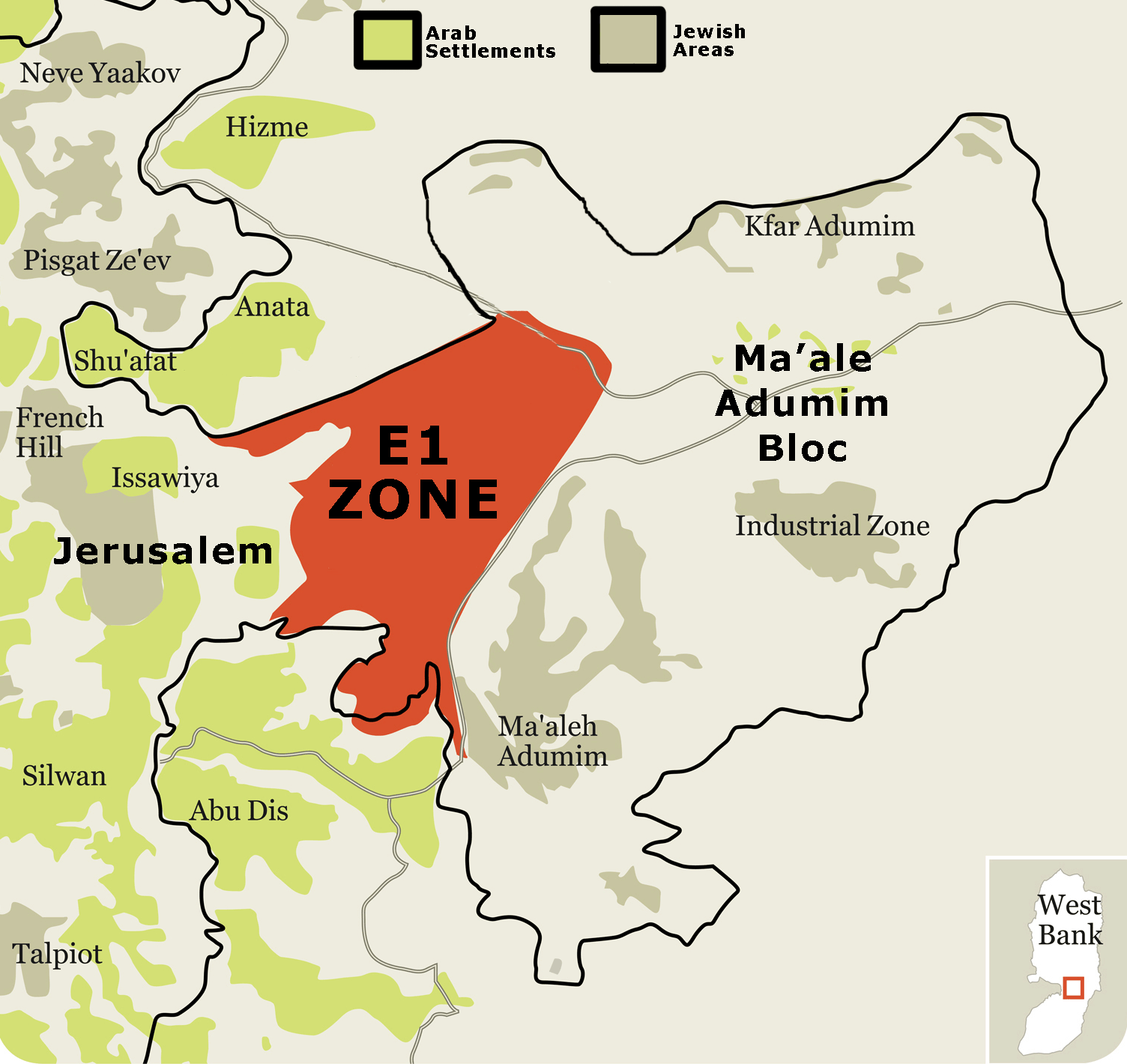
- "The Israeli construction plan called the E1
project threatens the two-state solution and the contiguity of a future
Palestinian state."
- "Israeli policies are obstructing peace."
- "If Iran has a bomb, it can be deterred the way
the U.S. deterred the Soviet Union."
- ?Israeli settlements are an obstacle to Mideast peace.”
- ?The Palestinians are now ready to make peace with Israel.”
- ?Attacking Iran will create more instability in the Middle East.”
- ?If the Israeli-Palestinian conflict was solved, the Middle East would be at peace.”
- ?Israel has created separate bus lines to segregate Jews and Palestinians.”
- ?The European Union has no reason to name Hezbollah a terrorist organization.”
- ?Non-lethal Palestinian rocket attacks have no impact on Israel's civilian population.”
- ?Israelis overreact to harmless rock-throwing by Palestinians.”
- ?The Palestinian Authority is committed to reforming Palestinian society.”
- ?Now is a good time to revive the Arab peace initiative.”
- ?Syria’s chemical weapons pose no threat outside of Syria.”
- ?Israel has refused to discuss a compromise on the future of Jerusalem.”
- ?'Nakba Day' has nothing to do with the peace process.”
- ?An Israeli attack on Iran would endanger U.S. interests in the Middle East.”
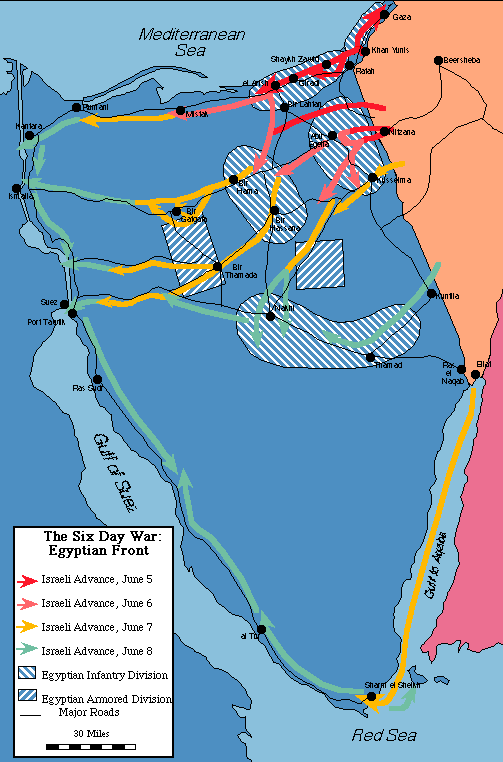
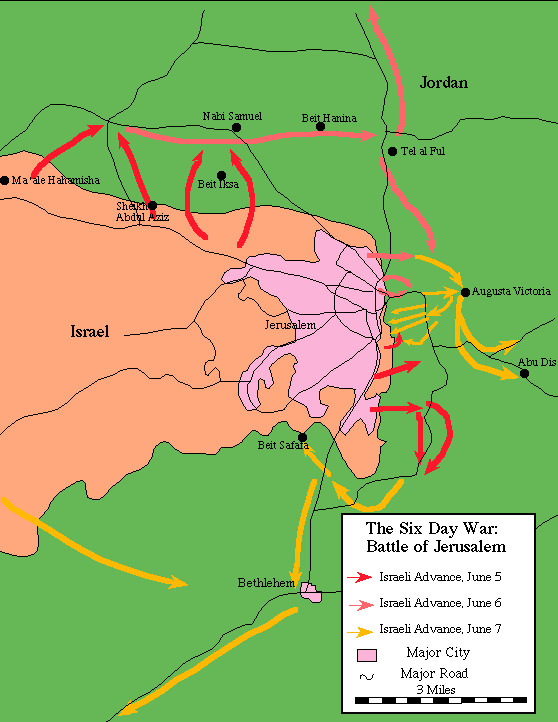
- ?The United States helped Israel defeat the Arabs in six days in June 1967.”
- ?The election of Hassan Rouhani eliminates the Iranian nuclear threat.”
- ?The U.S. must be involved in any successful peace process between Israel and her neighbors.”
- ?Israel 'occupies' the West Bank.”
- ?Palestinian leaders enter peace talks with Israel sharing a common desire for democacy.”
- ?Israel must make concessions for the peace process to succeed.”
- ?Christians are a protected minority in the Middle East.”
- ?Israeli PM Benjamin Netanyahu is disinterested in peace with the Palestinians.”
- ?Palestinians support the boycott and divestment movement against Israel.”
- ?Iran's Supreme Leader Khamenei issued a fatwa against producing nuclear weapons.”
- ?Iran is isolated because of the international sanctions regime.”
- ?Israel is responsible for expelling the Arabs of Palestine during the 1948 War of Independence.”
- ?The Palestinians have made concessions to advance the peace process; Israel has remained uncompromising.”
- ?A third intifada will erupt if Israel does not satisfy Palestinian demands.”
- ?The negotiated compromise with Iran removes Tehran's nuclear weapons threat.”
- ?The Iranian government is committed to fulfilling the terms it agreed to in the Geneva nuclear deal?
MYTH
“The Palestinian Authority held a free, democratic
election in 2005.” top
FACT
Elections are not synonymous with democracy. Several
Arab countries hold elections, including Egypt and Syria, but they have
only one candidate, and there is no doubt about the outcome. The dictators
are always reelected with nearly 100 percent of the vote. In those nations,
no one seriously claims the elections are democratic.
In the case of the Palestinian
Authority (PA) elections held in January 2005, the standards were higher. These were advertised
as an example of democracy and, compared to other Arab states, the voting
was a considerable advancement toward free elections.
Still, the election could hardly be called competitive
as the outcome was never in doubt. Seven candidates ran for president,
but the only question was the size of Mahmoud
Abbas’ margin of victory. He won with 62.3 percent of the
vote. His nearest challenger was Mustafa Barghouti with 19.8 percent.1
The election had a much lower turnout than expected (62 percent), and supporters
of the Islamic terrorist organizations largely boycotted the vote, as
did Arabs living in east Jerusalem.
Thus, Abbas was conservatively estimated by al-Jazeera to have received
the support of only about one-third of the eligible voters.2
The election process went smoothly and, despite Palestinian
predictions of Israeli interference, international observers reported
that Palestinians were not obstructed by Israel from participating in
the election. In fact, Palestinian and Israeli officials were said to
have worked well together to facilitate voting.3
“Free elections
can only take place in societies in which people are free to express
their opinions without fear.”
— Natan Sharansky4 |
Immediately after the election, however, 46 officials
from the PA Central Election Committee resigned, confirming suspicions
of voting irregularities and fraud. The Committee had come under pressure
from Abbas’ staff to extend the vote by an additional two hours
and to allow non-registered voters to cast ballots to guarantee a larger
turnout and improve Abbas’ chance of a “landslide”
victory.
The day of the election, gunmen stormed the Committee
offices to demand that Palestinians who were not registered be allowed
to vote. The deputy chairman of the Committee, Ammar Dwaik, said he
“was personally threatened and pressured” and confirmed
that some voters were able to remove from their thumbs the ink that
was supposed to prevent double voting.5
While Abbas is now seen as a legitimately elected leader
by most Palestinians and the international community, the PA has no
history of democratic institutions, so it remains in doubt whether the
various terrorist groups will also accept his leadership, and whether the security services will
enforce the president’s will.
Natan Sharansky observed that “It is important
that these elections took place, because it important that the new leadership
comes, or will come, not through violence. That can be the beginning
of the process of democracy.”6 To move closer to true democracy, Abbas will also have to remove his
predecessor’s restrictions on the freedoms of speech, religion,
assembly, and the press. Then perhaps the next election will be truly
free and democratic.
MYTH
“Israel is building the security fence as
part of a land grab to control the West Bank and prevent the establishment
of a Palestinian state.” top
FACT
The purpose of the security
fence is the prevention of terror. Its route has been carefully
plotted to maximize the security it provides to the citizens of Israel and minimize the inconvenience and harm to Palestinians. The route of
the fence must take into account topography, population density, and
threat assessment of each area. To be effective in protecting the maximum
number of Israelis, it also must incorporate the largest communities
in the West Bank.
After the Israeli
Supreme Court ruled the government had to more carefully balance security concerns and harm
to the Palestinians, the route of the fence was adjusted to run closer
to the “Green Line.” When completed, the fence will now incorporate just 7 percent of the West Bank — less than
160 square miles — on its “Israeli side,” while 2,100
square miles will be on the “Palestinian side.”
If and when the Palestinians decide to negotiate an
end to the conflict, the fence may be torn down or moved. Even without
any change, a Palestinian state could now theoretically be created in
93 percent of the West Bank (and the PA will control 100
percent of the Gaza Strip after the disengagement is complete). This is very close to the 97 percent Israel offered to
the Palestinians at Camp David in 2000, which means that while other difficult issues remain to be
resolved, the territorial aspect of the dispute will be reduced to a
negotiation over roughly 90 square miles.
MYTH
“The demographic threat to Israel posed by
Arabs in the West Bank and Gaza is overrated and therefore Israel need
not make territorial compromises.” top
FACT
A study was recently published that suggested the assumption
that Arabs in the West Bank and Gaza pose a demographic
threat to Israel has been exaggerated
because the actual population in the territories is significantly lower
than what is reported by Palestinian
Authority (PA) officials. According to a study by a team of independent
researchers, the 2004 Palestinian-Arab population was closer to 2.4
million than to the 3.8 million cited by the PA.7
The independent study comes up with its figures largely
by deconstructing PA statistics, but Israel's leading demographer, Professor
Sergio DellaPergola of Hebrew University, has challenged the result,
saying his estimate of 3.4 million Palestinians is based on Israeli
data (the CIA estimates the population for the West
Bank and Gaza at 3.6 million).
According to DellaPergola, 4.7 million Arabs now live between the Mediterranean
Sea and the Jordan River out of a total of 10,263,000. The Jewish proportion
of this total is 51 percent. DellaPergola argues that because of the
higher rate of birth in the Arab community, they have the demographic
momentum, and that by 2020, the proportion of Jews is likely to drop
to 47 percent and could fall to 37 percent by 2050.8
Even if the new study is more accurate, it only has
a minimal impact on the demographic reality. According to Israeli census
figures, the population of Israel today is approximately 6.8 million. If we add the 2.4 million
Arabs the new study says live in the territories, the total population
from the river to the sea would be 9.2 million (including about 1.3
million Israeli Arabs). The Jewish population is roughly 5.2 million
or 57 percent, slightly better than DellaPergola’s estimate of
51 percent.
These overall statistics also distort the debate over
the disengagement from Gaza where the demographic
picture is crystal clear. According to the new study, the Arab population
there is more than 1.07. The Jewish population, according to the State
Department, prior to the evacuation was 7,500, which means the the
percentage of Jews in Gaza was a fraction of 1 percent.
The independent study focuses solely on discrediting
the PA statistics and does not
address the crucial issue of future trends, which DellaPergola shows
are clearly in the Arabs’ favor. The new report argues that the
growth rates in Israel and the territories have been lower than previously
forecast (though they use figures for only the last four years), but
even the new figures show that the growth rate for the Arabs remains
higher than that of the Jews, so the proportion of Jews should continue
to decline.
Recent data from the Israeli Central Bureau of Statistics
suggests the situation may be even worse. The Bureau said that the proportion
of Jews within the current borders of Israel is expected to decline
from the present figure of 78 percent to 70 percent in 2025 because
of the higher birth rate among Israeli Arabs. According to Industry
and Trade Ministry data released in March 2007, Jewish women in Israel
on average have 2.69 children each and give birth to the first at age
30. Muslim women have an average of four children and give birth to
the first at age 27.9
Many proponents of territorial compromise argue that
these demographic trends make it impossible for Israel to remain both
a Jewish and democratic state if it holds onto the West
Bank and Gaza. If a majority
of the population of Israel, or even a significant minority, were non-Jews,
then the Jewish character of the state would likely change. In fact,
the new report states that “As in 1967, Israel faces a very real
issue on the status of a large minority population in the West
Bank and Gaza” (emphasis
in the original). Extremists have suggested that non-Jews could be prohibited
from voting, but this would make the state undemocratic. Since no Israeli
leader – even those labeled as right-wing fanatics who dream of
“Greater Israel” – have found a way to square this
circle, Israel has never annexed the West
Bank and Gaza. And now
one of those “hardliners,” Ariel
Sharon, was moved by the demographic reality to initiate the disengagement
plan.
Many people argue that it is impossible to predict
the future, and that most past projections were proven inaccurate. Earlier
doomsday predictions were upset by large influxes of immigrants,
and many Israelis still believe this will be their demographic salvation.
After more than one million Jews from the former
Soviet Union arrived in the 1990s, this view was temporarily vindicated,
however, there only about 8 million Jews in the entire world outside
Israel, and a large number would have to decide to move to Israel to
offset the demographic trend. This is especially unlikely given that
roughly 75 percent of the Jews outside Israel live in the United States
from which very few emigrate.
The demographic issue is still only one variable in
the Israeli political calculus related to territorial compromise. The
other principal concerns are whether Israel can have greater peace and
security without controlling some or all of the territories. That is
a matter of great debate within Israel. For now, the majority of Israelis
have come to the conclusion that withdrawal from Gaza and part of Samaria
is in Israel’s best interest.
MYTH
“Israel is killing Palestinians with radiation
spy machines.” top
FACT
Nazi propaganda chief Joseph
Goebbels was the master of the “big lie” tactic in which
a lie, no matter how outrageous, is repeated often enough that it will
eventually be accepted as truth. It is a propaganda tool the Palestinians
have repeatedly tried to use to tar Israel. Past examples have included
specious claims that Israel “massacred” 500 people at Jenin,10 infects Palestinians with the AIDS virus,11 and drops poison candy for children in Gaza from airplanes.12
The latest calumny from the Palestinians is the claim
that Israel is using a “radial spy machine” at checkpoints,
and that the device killed a 55-year-old Palestinian woman.13The
charge is apparently related to the Palestinian
Authority’s decision to close a checkpoint on their side of
the border in Gaza to protest
Israel’s use of advanced radio-wave machines for searching Palestinian
travelers.14
The device is the SafeView Millimeter Wave Radar, an
American-made portal system that uses millimeter a safe wave holographic
technology to screen travelers from Egypt for weapons and explosives. Unlike metal detectors, this system is capable
of detecting virtually any man-made object, regardless of the type of
material, by transmitting ultra-high frequency, low-powered radio frequency
waves as people pass through the portal. The waves penetrate clothing
and reflect off of the person’s skin and any items being carried.
A sensor array captures the reflected waves and uses a desktop computer
to analyze the information and produce a high-resolution, 3-D image
from the signals.15
Since the allegation is coming from the official Palestinian
media, it represents a violation of the Palestinian
Authority’s commitment to end incitement against Israel.
MYTH
“Unlike other Arab women, Palestinian women
are not killed for dishonoring their families.” top
FACT
Maher Shakirat learned that one of his sisters was
thrown out of the house by her husband for an alleged affair. Shakirat
strangled his sister, who was eight months pregnant, and forced two
other sisters he accused of covering up the affair to drink bleach.
One of those was badly injured but escaped, but the third sister was
also strangled by her brother.
Palestinian women who bring dishonor to their families
may be punished by male family members. The punishments may range from
ostracism and abandonment to physical abuse to murder. “Honor
killings” may be carried out for instances of rape, infidelity,
flirting or any other action seen as disgracing the family. By killing
the woman, the family’s name in the community is restored.
Women are usually not allowed to defend themselves;
they are considered “minors” under the authority of male
relatives, and may be killed based on a family member’s suspicions.
An allegation of misbehavior is sufficient to defile a man’s or
family’s honor and justify the killing of the woman. Men who carry
out these murders in the Palestinian Authority typically go unpunished
or receive a maximum of six months in prison.16
Because these crimes often go unreported, it is difficult
to determine the actual number of victims in honor killings, but the Palestinian Authority’s women’s affairs ministry reported that 20 women were murdered
in honor killings in 2005, 15 survived murder attempts, and approximately
50 committed suicide, often under coercion, for shaming the family.17
According to a June 2005 poll, 24% of Palestinians
said that if a family discovered that one of its daughters was involved
in a case of family disgrace (e.g., adultery), the family should kill
the daughter to remove the disgrace.18
MYTH
“Israel has moved the border so it will not
withdraw completely from the Gaza Strip.” top
FACT
Mohammed Dahlan,
the Palestinian Authority’s Minister of Civil Affairs, has claimed that Israel moved the northern border of the Gaza
Strip about 1.2 miles, and that Israel's disengagement will not be complete unless it withdraws to the 1949 armistice lines.19 By suggesting that Israel is holding onto a piece of Gaza, the Palestinians
are threatening to create a Shebaa Farms issue that could undercut the
prospects for peace created by Israel's courageous decision to evacuate
all its citizens and soldiers from the area.
Substantively, Dahlan’s claim is inaccurate.
The border of Gaza was originally determined during the 1949
Rhodes Armistice negotiations with Egypt.
A year later, Israel agreed to move the border southeast, creating a
bulge in the southern part of the Gaza
Strip. In exchange, Egypt redrew the border in the north, moving it more than a mile southwest.
According to Israel's National Security Council chief, Giora Eiland,
the border was reconfirmed in the Oslo
accords.20 Today, Netiv Ha’asara, a community of 125 families, many of which
were evacuated from settlements in the Sinai as part of the peace
treaty with Egypt, is located in the area Dahlan wants included
in Gaza.
In the case of Shebaa
Farms, the Lebanese terrorist group, Hizballah,
has speciously maintained that Israel did not fully withdraw from Lebanon,
despite the UN's verification that it has, and used Israel’s presence in the Shebaa Farms area
as the pretext for continuing its terror campaign against Israel. If the Palestinians adopt a similar policy
toward the sliver of land they claim to be part of Gaza to perpetuate
their image as victims, and to try to win propaganda points by claiming
to still be under “occupation,” they will once again demonstrate
that they never miss an opportunity to miss an opportunity.
If the Palestinians continue terrorist attacks against
Israel, and make claims to additional territory, rather than focusing
on state-building within Gaza and meeting their road
map obligations, Israel will have little interest in pursuing negotiations
regarding the West Bank.
MYTH
“Hamas should be permitted to participate in Palestinian
Authority elections.” top
FACT
The second Oslo agreement (Oslo
II) between Israel and the Palestinian
Authority prohibits the “nomination of any candidates, parties
or coalitions” that “commit or advocate racism” or
“pursue the implementation of their aims by unlawful or non-democratic
means” (Annex II, Article
II).21 Under this agreement, Hamas,
a terrorist organization
responsible for the deaths of thousands of Israelis and Palestinians
alike, cannot legally participate in Palestinian national elections.
The Covenant
of Hamas says nothing about democracy or elections. It does say
that when “enemies (the Jews) usurp some Islamic lands, Jihad becomes a duty binding on all Muslims. In order to face the usurpation
of Palestine by the Jews, we have no escape from raising the banner
of Jihad.”
Prime Minister Ariel
Sharon has warned that Israel will not cooperate with the Palestinian
Authority during elections if candidates from Hamas are allowed to participate. “An armed organization doesn't become
democratic once they participate in the election,” Sharon said.22
Yossi Beilin, the leader of the Meretz-Yahad Party, and one of the architects of the Oslo accords, said that recognizing Hamas as a legitimate
political entity “is a gross violation of the Israeli-Palestinian
interim agreement,” and that in the global struggle against terrorism,
“it would be surprising indeed if Israel, paradoxically, were
to acquiesce in the legitimization of a terrorist organization under
its very nose.”23
The United States has left it up to the Palestinians to decide who can participate in
the Palestinian Legislative Council;
however, National Security Council spokesperson Frederick L. Jones II
said the U.S. would never have diplomatic relations with candidates
from a terrorist organization.“We do not believe that a democratic
state can be built when parties or candidates seek power not through
the ballot box but through terrorist activity,” Jones said.”24
MYTH
“Israel's disengagement from Gaza was a victory
for terror.” top
FACT
Israel's disengagement from the Gaza Strip and northern West Bank was applauded by the
international community as an important and painful step toward resolving
the Israeli-Palestinian conflict. Even the United
Nations, which rarely has anything positive to say about Israel,
praised the “determination and political courage” shown
by Prime Minister Ariel
Sharon25 in implementing the disengagement plan peacefully and successfully.
In an effort to bolster their standing with the Palestinian
public, groups such as Hamas and Islamic Jihad claim
it was their terror campaign that forced Israel to withdraw.26 In fact, the terrorist groups did nothing but bring death and destruction
to the people of Israel and their fellow Palestinians. Israel was not
driven from the territories, it made a calculated decision to leave
based on its own interests.
The 8,000 civilians who lived in Gaza were viewed by the terrorists as targets, and Israel had to devote a
great deal of its human and material resources to protect these innocent
people. In addition, Sharon agreed with those who concluded it would
make no sense for Israel to hold on to an area with a Palestinian population
exceeding one million. By withdrawing, Israel's security has been enhanced,
and the Palestinians have been given the opportunity to govern themselves
and demonstrate whether they are able and willing to create a democratic
society that can coexist with Israel.
At the time of the disengagement, Israel had dramatically
reduced the level of terror, and the security
fence around Gaza had a nearly perfect record of preventing the
infiltration of suicide
bombers. Israeli forces had severely damaged the terrorist infrastructure
and killed or jailed most of the leaders of the major terror groups.
The disengagement took place after Israel won the Palestinian War the Palestinian Authority had instigated
in 2000, and the withdrawal took place from a position of strength,
not weakness.
Palestinian extremists can claim whatever they want,
but even they know the truth. As Zakariya Zubeidi, the leader of the Al-Aqsa Martyrs Brigade terrorist group observed, “Not only was the intifada a failure, but we are a total failure. We achieved nothing in 50 years
of struggle; we've achieved only our survival.”27
And the Palestinian people are not fooled by the rhetoric
of the terrorists, as is evident by this comment by Mohammed Ahmed Moussa,
a grocer in Jabaliya, who said, “Let's be frank. If Israel didn't
want to leave Gaza, no one could have forced them out. Those who claim
the rockets and attacks made them leave are kidding themselves.”28
MYTH
“Israel is obstructing Palestinian elections.” top
FACT
Israel is a democracy
and believes in free elections as the best means of insuring representative
government. Consequently, Israel has been supportive of the idea of
democratic elections in the Palestinian
Authority. In the 2005
presidential election, international observers reported that Israel
made no effort to impede the vote. To the contrary, it took a number
of measures to facilitate the election.
Similarly, Israel has no intention of interfering in
the upcoming legislative elections in the PA.
While there is some dispute about whether and how Palestinians living
in Jerusalem may participate,
a similar issue was resolved before the last election.
The Jerusalem issue, however, is being used as a smokescreen by the Palestinians to
obscure their internal divisions. Palestinian officials have been talking
for months about delaying the elections scheduled for January 25 because
of chaos and disorder throughout the PA, and because of fears that they
will lose power and that Hamas will take seats from the dominant Fatah party.
Many Palestinians also legitimately fear the election
will not be fair. With just three weeks to go before the election, the
Palestinian election commission resigned because the commissioners said
Prime Minister Ahmed Korei was interfering with their work. After the last election, 46 officials
from the PA Central Election Committee resigned to protest voting irregularities
and fraud.
The problem for the PA today is not any Israeli interference
in their affairs, it is the Wild West climate that now dominates the Gaza Strip and much of the West Bank. So long as the PA
is unable to insure the safety of its residents, it will be unable to
hold a free democratic election.
MYTH
“Academic freedom means any criticism of
Israel is permissible in a university.” top
FACT
The one place in America where anti-Semitism is still tolerated is in the university, where “academic freedom”
is often used as a cover to sanction anti-Israel teachings and forums
that are anti-Semitic.
In an address on the subject of academic freedom, Columbia
President Lee Bollinger quoted from a report that described a professor
as someone whom “‘no fair-minded person’ would even
suspect of speaking other than as ‘shaped or restricted by the
judgement . . . of professional scholars.’” He also spoke
about the need for faculty to “resist the allure of certitude,
the temptation to use the podium as an ideological platform, to indoctrinate
a captive audience, to play favorites with the like-minded, and silence
the others.”
Many faculty, however, do not resist temptation; rather,
they embrace their position as an ideological platform. Those who abuse
their rights, and insist they can say what they want, hypocritically
denounce others who exercise their right to criticize them. To suggest
that a professor’s views are inappropriate, or their scholarship
is faulty, is to risk being tarred with the charge of McCarthyism.
Legality is not the issue in evaluating the anti-Israel,
sometimes anti-Semitic speeches and teachings of faculty and speakers
on campus. No one questions that freedom of speech allows individuals
to express their views. The issue is whether this type of speech should
be given the cover of “academic” freedom, and granted legitimacy
by the university through funding, publicity or use of facilities.
For the last several years, for example, an anti-Semitic
forum has been held at different universities by the Palestine Solidarity
Movement (PSM). In 2004, the conference was held at Duke University.
Organizers were asked to sign an innocuous statement before the event
calling for a civil debate that would “condemn the murder of innocent
civilians,” “support a two-state solution” and “recognize
the difference between disagreement and hate speech,” but refused
to do so. By hosting a group that could not bring itself to object to
the murder of Jews, Duke gave their views legitimacy and tarnished the
university’s academic reputation. The 2006 PSM conference is being
held at Georgetown University in Washington, D.C.
It is sometimes suggested critics seek to stifle legitimate
criticism of Israel. There is a clear distinction, however, between
criticism of Israeli policy, which you can read in any Israeli newspaper,
and anti-Semitism, in which the attacks against Israel challenge its
right to exist, or single Israel out among all other nations for special
treatment, as in the case of the PSM’s call for the end to Israeli
“occupation” in all of Palestine and divestment from Israel.
A related question is whether the presentations are
in any way academic or scholarly. Few people would claim that a conference
in which anti-black, anti-gay, or anti-woman sentiments were expressed
would be protected by academic freedom, and yet that is the shield used
to permit attacks on the Jewish people.
“Palestine means
Palestine in its entirety - from the [Mediterranean] Sea to the
[Jordan] River, from Ras Al-Naqura to Rafah. We cannot give up
a single inch of it. Therefore, we will not recognize the Israeli
enemy's [right] to a single inch.”
— Hamas leader Mahmoud
Zahar29 |
MYTH
“The Palestinian Authority held a democratic
election and Israel and the rest of the world must accept that Hamas
was the victor.” top
FACT
Winston Churchill said that “Democracy is the
worst form of government except for all those others that have been
tried.” It was a step forward, then, for the authoritarian Palestinian
Authority to hold elections that by all accounts were conducted fairly. Nevertheless, so long as
the Palestinian people continue to be denied by their leaders the freedoms
of speech, religion, assembly and the press, the election cannot be
considered truly free and democratic.
While democratic outcomes are preferable to the alternatives,
the rest of the world is not obligated to have a relationship with elected
leaders whose policies and views are dangerous. Adolf
Hitler was elected by the German people, but few people would suggest
today that the rest of the world should have ignored his genocidal views
and treated him as an equal just because he emerged from a democratic
process. Similarly, the current Iranian president was elected and is
still widely viewed as a pariah because of his threats to destroy Israel and to pursue nuclear
weapons in defiance of the rest of the world.
The Palestinian people chose to elect members of an
organization whose avowed purpose is the destruction of Israel by violent
means. Hamas is recognized
throughout the world as a terrorist organization. Since the election, Hamas leaders have reaffirmed their commitment to the Hamas
covenant calling for the liberation of all of Palestine and they
have made clear it they have no intention of disarming.
Israel now has on its borders a quasi government run
by people who oppose negotiations and compromise. Hamas can now take over all of the security services and weapons that have
previously been given by Israel and others to the Palestinian
Authority to keep the peace. The institutions that were bound by agreements to stop the violence,
confiscate illegal weapons, end smuggling and cease incitement are now
controlled by the very people most responsible for terror, gun running,
and the use of the media and schools to demonize Israel and Jews.
Most of the world understands that Hamas is not a partner for peace and that it is a terrorist group that threatens
the stability of the region. The United States and other countries rightly
have said that it must recognize Israel and renounce terror before any
diplomatic or economic support can be given to the PA.
Of course, we went through a similar exercise in 1993 when similar demands
were made of the PLO. Yasser
Arafat made the necessary commitments in a letter to then Prime Minister Yitzhak
Rabin, but he never matched the words with deeds. The world will
be wise not to make the same mistake with Hamas.
“Palestinians
need to understand that the exercise of self-government carries
consequences. For too long, the international community has failed
to extract a price for the Palestinian recourse to terror. That
failure has not brought peace, but far worse it has produced the
"Palestine" we have now: destitute, savage against both Israelis
and moderate Arabs, and, so far, incapable of managing its internal
affairs peacefully and competently. By refusing to render Hamas
respectable, the U.S. and Israel aren't punishing the Palestinians.
They're educating them.”
— Wall Street
Journal30 |
MYTH
“Israel is digging under the Al-Aksa mosque
and intends to destroy it.” top
FACT
The Palestinians and other Muslims routinely accuse Israel of threatening their holy places
in Jerusalem and have discovered
that this is a good way to provoke local violence and international
condemnation. The tactic goes back to the 1920s when the Mufti
of Jerusalem made similar charges that provoked widespread rioting.
The latest example of using this method of incitement (which violates
the road map and Oslo
agreements) came when Sheikh Mohammad Hussein, the director of the
Al-Aksa Foundation, accused Israel of excavating under the Temple
Mount with the intention of destroying the Al-Aksa
mosque.31
As in the past, the charge is a total fabrication.
The most recent construction involved the development of a new visitors
center built around new findings excavated near the Western
Wall. Discoveries at the new site include a ritual
bath from the period of the second Jewish
Temple, destroyed in 70 C.E.,
and a wall archaeologists say dates to the first Jewish Temple, destroyed
in 586 B.C.E.32 The work was done in the already tunnel area that has now been open
to tourists for several years. It is not underneath the Temple
Mount and nowhere near the Al-Aksa
mosque. What really bothers the sheikh is that the center will “show
a fabricated heritage that might help them to deceive foreign visitors
into believing Jerusalem as
a historical place of the Jews....” 33
Israel denied the accusations, but official government
denials rarely satisfy those who are ready to believe any libel emanating
from the Palestinian Authority.
In this case, however, UPI reporter Joshua Brilliant attended the Foundation
press conference during which a misleading film was shown purporting
to prove the charges. Brilliant independently investigated the tunnel
and found no evidence of any excavation in the direction of the mosque.
A Hamas website nevertheless
said that a synagogue was
under the mosque and “We will spill blood and offer souls in defense
of the mosque.”34
MYTH
“Israel is responsible for disparaging cartoons
of the Prophet Muhammad.” top
FACT
Iran’s Supreme leader, Ayatollah Ali Khamenei claimed that the cartoons first
published in Denmark, which
have sparked widespread Muslim protests, were part of a “conspiracy by Zionists who were angry because of the victory of Hamas.”35
Sometimes the myths propagated by Arabs and Muslims
are so outrageous and ridiculous that it would seem to be a waste of
time to respond. This is one of those instances. Unfortunately, history
has proven that one cannot underestimate the capacity of people to believe
even the most absurd charges when they are applied to Israel.
After all, large numbers of Muslims still believe that Israel was responsible
for the atrocities committed on 9/11.
The cartoons, of course, haven’t anything to
do with Israel. They were solicited by a Danish publication, Jyllands-Posten,
and have subsequently been reprinted widely. In fact, one blogger posted
images from an Egyptian newspaper that published the cartoons.36Khamenei’s
conspiracy theory also has a minor flaw — the cartoons were published
in September 2005, six months before the Palestinian election.
In a juvenile and bizarre effort to retaliate for what
they consider an affront to Islam, Iran is now soliciting cartoons lampooning
the Holocaust. This really is nothing
new as Iran and other Muslim nations routinely publish vile anti-Semitic cartoons in their state-controlled
media. Sensitivity and tolerance are a one-way street in those countries.
MYTH
“The Palestinians have maintained a truce
and ceased terror operations against Israel.” top
FACT
The number of successful Palestinian
terrorist attacks has fallen dramatically in the last several months.
This is not because of any actions on the part of the Palestinians.
The Palestinian Authority continues
to refuse to fulfill its road
map obligation to stop violence, dismantle terrorist infrastructures,
and confiscate illegal weapons. The decline in violence is due primarily
to the efficiency of Israel’s security forces and the presence
of the security fence. It
has little to do with a supposed cease-fire during which there has been
no lull in the effort to murder Israelis.
Prior to construction of the security fence, the Palestinians
carried out 73 suicide
bomb attacks that killed 293 Israelis. Even with the fence only
about one-third completed, it has helped significantly reduce the carnage.
Since construction began in July 2003, 11 suicide attacks have been
launched that killed 54 people. In 2005, only seven suicide attacks
were successful, which has taken terror against Israelis off the radar
of the international media and given the perception that all is quiet.
The reality is far different.
According to the Shin
Bet, a total of 2,990 attacks were launched against Israel during
2005 following that January’s truce announcement by Islamic Jihad,
the Popular Resistance Committees, and Fatah’s Al-Aksa Martyrs
Brigades. Each month, Israel has more than 70 terror alerts.37
To give just a few examples of the ongoing terror campaign:
• On February 2, 2006, soldiers prevented two
Palestinian teenagers from smuggling 12 pipe bombs through a checkpoint.
The next day two Palestinian teenagers were captured carrying explosive
belts.38
• On February 19, 2006, border police arrested
three Palestinians from Bethlehem on their way to carry out a suicide
bombing in Jerusalem.
That same morning, two Palestinians attempted to place a bomb near the
southern Gaza security fence.39
• On February 20, 2006, the Shin
Bet chief revealed that the IDF uncovered a launcher and eight mortar shells in Bethlehem, which were
planned to be fired at the Jerusalem neighborhood of Gilo.40
• On February 21, 2006, an IDF force found a large bomb factory in Nablus.41
• Since Israel’s withdrawal from the Gaza
Strip, Palestinians have continued to fire rockets into Israel on an almost daily basis (more than 450 have hit Israel in less than six months42),
and increasingly threatened strategic targets, such as the power station
in Ashkelon.
• Smuggling of weapons has accelerated in the Gaza Strip. The head of the
Shin Bet reported that the number of rifles smuggled each month has
increased from 200-300 to 3,000 since disengagement,
and that the Palestinians have also smuggled in anti-aircraft missiles
and tons of explosives.43
Israel may have won the Palestinian
War started by the Palestinian Authority in September 2000, but
that does not mean that it has ended all terror threats. Cease-fires
and truces mean little when those who declare them continue to arm themselves
for the next battle, and their comrades continue to wage war.
The situation is likely to grow more dangerous now
that the security forces responsible for enforcing the law in the Palestinian
Authority will be infiltrated and probably controlled by the terrorists
from Hamas who have made
no secret since the Palestinian
election that they are committed to their covenant’s call for the destruction of Israel. Moreover, the Palestinian people
continue to support terrorism according to the latest poll, which found that 56% of Palestinians support
suicide bombing operations against Israeli civilians.44
MYTH
“The PA is entitled to international aid
because Hamas was democratically elected and the Palestinian people
should not be made to suffer because Israel doesn’t like the election
outcome.” top
FACT
Billions of dollars of aid have flowed to the Palestinian Authority
(PA) over the last 13 years despite the fact that most of it was
siphoned off by corrupt officials and very little has actually reached
the people. Now the PA is led
by a party that pledged to fight corruption, but it also promises to
continue to use terror as a means of achieving the objective of destroying Israel. Why does anyone believe the
United States or any other country has an obligation to underwrite terrorism and programs for genocide?
The New York Times noted:
America cannot bankroll a Hamas government that preaches
and practices terrorism, denies that Israel has any right to exist,
and refuses to abide by peace agreements signed by previous Palestinian
governments....the United States would make a resounding diplomatic
and moral point by cutting off aid. It would demonstrate in the clearest
possible terms that the American people are not prepared to support
governments, elected or unelected, that proclaim the annihilation
of other nations as their goal and embrace terrorism as an acceptable
tactic for achieving it.
It is true that the PA has financial problems, but that is not the rest of the world’s
responsibility. Had the PA not
misspent the billions it had received already from international donors,
it would not be in this predicament. Moreover, as the Times editorialized,
“Continuing United States subsidies while Hamas is in power will
not move the region one step closer to a fair and sustainable peace.”
The Times and others are wrong in suggesting
that Israel be pressured to pay tax and customs funds to the PA.
These are funds that Israel agreed to pay as part of the Oslo
agreements, which the PA has not fulfilled, and Hamas says it does not accept. Moreover, what government would give money
to an authority that is calling for its destruction? Can you imagine
the Israeli prime minister speaking to his Hamas counterpart: “We are very upset that you say that you are committed
to destroying our nation, and we’re disturbed that you are launching
terrorist attacks against us each day, but here’s the money we
owe you. Don’t spend it all on one suicide bomb.”
The Palestinian people aren’t going to starve.
Even if the United States, Israel, and other Western nations were threatening
to withhold all aid until Hamas either is driven from power or completely reforms and renounces its covenant, Iran and other nations will provide the minimum required to sustain the Palestinians,
a group which already receives substantially more aid than far needier
populations around the globe. And the United States and others are not
even talking about cutting off all aid; they all say they will continue
to provide humanitarian funds.
The Palestinian people will blame the world for their
predicament, as they have for the last 58 years, but perhaps a cutoff
of some aid will be the consequence that finally teaches them the lesson
that the path to statehood requires them to make a different choice
– peace over violence.
MYTH
“Saudi Arabia has ended its boycott of Israel.” top
FACT
In late 2005, Saudi
Arabia was required to cease its boycott of Israel as a condition of joining the World Trade Organization (WTO).
After initially saying that it would do so, the government subsequently
announced it would maintain its first-degree boycott of Israeli products.
The government said it agreed to lift the second and third degree boycott
in accordance with an earlier Gulf
Cooperation Council decision rather than the demands of the WTO.46
Saudi Arabia continues, however, to prohibit entry
to products made in Israel or to foreign-made goods containing Israeli
components and hosted a major international conference aimed at promoting
the boycott in Jidda in March 2006. The Organization for the Islamic
Conference’s (OIC) Islamic Office for the Boycott of Israel is
based in Jidda and the head of the office is a former Saudi diplomat.47
In hearings in February 2006 before the Senate Finance
Committee, U.S. trade representative Rob Portman insisted that the Saudis
“have a responsibility to treat Israel as any other member of
the WTO” and added that the U.S. had received assurance “they
will abide by their WTO commitments.”48
While the Saudis were presenting themselves in the
media as peacemakers in early 2007 by resurrecting their 2002 peace plan, the government continued to bar entry
to products manufactured in Israel or to foreign-made goods containing
Israeli components.48a This is in addition to the ongoing political boycott whereby Saudi officials
refuse to meet with Israelis. The Saudi behavior is inconsistent with
their rhetoric and raises questions about the sincerity of their peace
proposals and whether a government that has reneged on its promise to
the WTO to end the boycott can be trusted to fulfill commitments to
peace with Israel.
MYTH
“Israel is knowingly desecrating a Muslim
holy place in Jerusalem by building a museum on top of a cemetery.” top
FACT
An offshoot of the Islamic Movement in Israel petitioned the Israeli Supreme
Court to halt the the Simon Wiesenthal Center from constructing
a new Museum of Tolerance in the center of Jerusalem.
The petitioners, from a group called “the Al-Aqsa Corporation,”
claim the museum is being built on part of an ancient cemetery where
20,000 soldiers from Saladin's army are buried, and want the area recognized as an Islamic waqf. This would give them exclusive rights to any decisions
regarding use of the land. This claim is very controversial because
it would in effect place a Muslim enclave in the heart of West Jersualem.
Over forty years ago, an Islamic court ruled that
the land was no longer sacred and could be used for construction or
other purposes. Even four decades before that ruling, in 1922, the infamous
Grand Mufti of Jerusalem, Haj
Amin al-Husseini, built a luxurious hotel on part of the land. The
Mufti ruled that construction was possible if the tombs were removed
and reburied in another place, and he made plans to build a Muslim university
on the same tract of land.49
The cemetery has been abandoned for well over a century
and, in 1964, an Islamic court ruled that its status was mundaras (erased), meaning that its holiness had expired. Muslim scholars and
religious leaders have allowed the “recycling” of cemeteries
that have not been used for more than a generation. The Islamic Movement,
however, sees the dispute as an opportunity to claim part of Jerusalem as a Muslim enclave.
The Israel Antiquities Authority has been especially
careful in removing remains found at the site for reburial. The Wiesenthal
Center has also offered to re-inter all of the remains in the part of
the cemetery that still exists, and plans to renovate and fence off
the area.
MYTH
“Hamas is a threat only to Israel.” top
FACT
While attention is correctly focused on the threat Hamas poses to Israel because of its commitment
to the destruction of the Jewish State, and its active involvement
in terrorism to accomplish
that goal, the radical Islamic organization also is viewed as a grave
danger to the stability of Jordan.
The Jordanians have no illusions about Hamas and, in late April 2006, arrested several members of the organization
it suspected of planning a terrorist attack against senior members of
the government on orders from Hamas leaders in Damascus.50 This followed an earlier threat uncovered when Jordanian officials learned
that Hamas had smuggled
weapons, including bombs and rockets, into the kingdom. That discovery
led Jordan to cancel a planned visit by Palestinian Foreign Minister Mahmoud Zahar of Hamas.51
Tensions between Hamas and Jordan are nothing new.
In 1998, the government warned leaders of the Islamic resistance movement
in Jordan to refrain from making
statements inciting violence or obstructing the Palestinian-Israeli
Wye River peace deal that had just been signed. The admonition came
after a Hamas bomb attack
on an Israeli school bus in the Gaza
Strip, and a statement by the Hamas politburo chief in Amman, Khalid
Mashal, condemning the Wye agreement and vowing to continue the
war against Israel.52
In 1999, five commercial offices in Amman registered
under the names of Hamas leaders were closed, several of its members were detained and arrest
warrants were issued for several Hamas leaders. On September 22, 1999, Khalid Mashal, Ibrahim
Ghousheh, Mousa Abu Marzook,
Sami Khater and Izzat Rasheq were arrested after returning from a trip
to Tehran. Marzook, who
held a Yemeni passport, was deported. Mashal,
Khater, Rasheq and Ghousheh,
all Jordanian citizens, were given the choice of being tried for membership
in an illegal organization or leaving Jordan.
Ultimately, the four men were deported to Qatar.53
Jordanian officials were growing increasingly worried
about the close ties that Hamas was developing with the radical Muslim Brotherhood and the group’s
close ties with Iran and Syria.
Computer files confiscated from the Hamas offices contained sensitive information about the kingdom and Jordanian
figures, records indicating that around $70 million had been transferred
to Hamas from abroad
over the previous five years, and the locations of arms and explosives
caches around the kingdom.54
Subsequently, Hamas became an “illegal and non-Jordanian” organization whose
presence was no longer tolerated.55
MYTH
“Palestinians have the right to sell land
to Jews.” top
FACT
In 1996, the Palestinian
Authority (PA) Mufti, Ikremah Sabri, issued a fatwa (religious
decree), banning the sale of Arab and Muslim property to Jews. Anyone
who violated the order was to be killed. At least seven land dealers
were killed that year. Six years later, the head of the PA’s General
Intelligence Service in the West
Bank, General Tawfik Tirawi, admitted his men were responsible for
the murders.56
On May 5, 1997, Palestinian
Authority Justice Minister Freih Abu Middein announced that the
death penalty would be imposed on anyone convicted of ceding “one
inch” to Israel. Later that month, two Arab land dealers were
killed. PA officials denied any involvement in the killings. A year
later, another Palestinian suspected of selling land to Jews was murdered.
The PA has also arrested suspected land dealers for violating the Jordanian
law (in force in the West Bank),
which prohibits the sale of land to foreigners.57
During the Palestinian
War, few, if any Palestinians tried to sell land to Jews, but the
prohibition remained in effect. Now that the war is over, the persecutions
have begun again. In April 2006, Muhammad Abu al-Hawa was tortured and
murdered because allegedly sold an apartment building in Israel’s
capital city to Jews. Since the Mufti forbade Muslims accused of selling land to Jews from being buried in a Muslim cemetery,
al-Hawa was laid to rest in a makeshift cemetery on the road between Jerusalem and Jericho.58
In April 2009, the Chief Islamic Judge of the Palestinian
Authority, Tayseer Rajab Tamimi, issued another warning against
selling homes or properties to Jews. Sheikh Tamimi reiterated
that those who violated the ban, including those who rented to Jews
and real estate agents and middlemen facilitating transactions, would
be accused of high treason and face the death penalty. 58a Later that month, a Palestinian Authority military court found a Palestinian
man guilty of selling land to Jews and sentenced him to death by hanging.58b
“There are no words to adequately condemn the despicable
attack in Tel Aviv. Not only because it is contrary to the interests
of the Palestinian people...[but] because of the philosophy
that is behind it....A racist philosophy that is based on the
cruel principle of killing Jews because they are Jews.”
— Colunnist Nazir Majali 59 |
“Hamas faced its first concrete choice this week between
its ambition to govern the West Bank and Gaza and its extremist
commitment to terrorism -- and it chose to side with the suicide
bombers. The sickening Passover attack at a Tel Aviv restaurant
Monday, which killed nine Israelis and injured dozens, was carried
out by Islamic Jihad, an Iranian-backed extremist group that
refuses to observe the shaky cease-fire Hamas has followed for
more than a year. Yet, though the attack violated its own policy
and undermined its interests, several of Hamas's spokesmen quickly
defended it. The result was to put the Palestinian government
on record as an outlaw and to raise dangerously the chances
of a major new outbreak of Middle East violence.”
— Washington Post 60 |
MYTH
“Israel has no justification for withholding
tax monies due to the Palestinian Authority.” top
FACT
Under the Oslo
interim agreement, Israel, the West Bank, and Gaza are in a customs union administered by the Israeli government. Israel collects a duty on any foreign imports destined for the West Bank and
Gaza as welll as a value added tax on goods and services from Israel
destined for the Palestinian territories.
At the beginning of 2001, Israel decided to withhold
more than $50 million in taxes it owed to the Palestinian
Authority (PA) in response to the ongoing violence. U.S. officials,
and others, pressured Israel to transfer the money because of the PA's
dire financial straits and inability to pay many of its bills. Israel
recognized that its action was harsh, but believed it was necessary
to demonstrate to the Palestinians that the inability or unwillingness
to stop the violence had a cost. Israel must use whatever leverage it
can to protect its citizens and this economic sanction was a milder
response than a military one.
While Israel's action was blamed for the sorry state
of the Palestinian economy, the truth was the Arab countries suspended
the transfer of hundreds of millions of dollars, collected as donations,
meant for the PA. The justification for the Arab states' action was
their concern that the funds would be embezzled and encourage further
corruption in the PA.61 For example, a Kuwaiti newspaper reported that Yasser Arafat stole more
than $5 million in foreign aid intended for needy Palestinians.62
In July 2002, Israel agreed to transfer some of the
tax revenues to the Palestinians as a confidence-building measure after
Palestinian violence subsided, and an agreement was reached to set up
a committee of U.S. representatives to oversee the transaction.63 Israel subsequently began to forward the taxes it collected to the PA,
after deducting the amount owed for electricity and water bills that
many Palestinians refused to pay Israeli utilities.
Case
Study
The speaker of the
Palestinian legislative council, and later Prime Minister, Ahmed
Korei, suddenly vacated the
villa he built for $1.5 million in Jericho after President
Bush raised the issue of PA corruption. A sign on the door
was posted that said the villa had become a welfare institution
for the relatives of Palestinians killed in terror attacks.64 |
Following the election of Hamas in 2006, Israel again began to withhold tax revenue on the grounds that
it had no obligation to help finance a government that was calling for
its destruction. Furthermore, Israel argued that the agreement to remit
these taxes to the PA was part
of the Oslo accords that
Hamas explicitly said it would not honor. The United
States, the European Union and other countries also froze funding because Hamas is a terrorist group
that does not recognize Israel as a country.
While Israel wants to deny Hamas the resources it needs to wage a terrorist war, the government does
not want to harm the Palestinian people and therefore agreed in May
2006 to release tax revenues for humanitarian purposes, such as medicine
and health needs.65
MYTH
“If Israel ends the occupation, there will
be peace.” top
FACT
The mantra of the Palestinians and their supporters
since 1967 has been “end
the occupation.” The assumption underlying this slogan is that
peace will follow the end of Israel’s “occupation.”
The equally popular slogan among critics of Israeli policy has been
that it should “trade land for peace.” Again, the premise
being that it is simply Israel’s presence on land claimed by the
Palestinians that is the impediment to peace.
The experience in Gaza has offered a stark case study of the disingenuousness of these slogans.
When Israel announced the plan to
evacuate Gaza, rather than cheer the unilateral end to the occupation,
the Palestinians denounced disengagement and refused for months to cooperate or to take measures to ease the
transition. If the Palestinians’ fervent desire was really to
end Israeli control over their lives, why didn’t they cheer the
disengagement and do everything possible to make it a success?
Israel has withdrawn from every inch of Gaza;
not a single Israeli soldier or civilian remains. The evacuation came
at great emotional and financial cost. And what has the end of “the
occupation” brought Israel? Has it received peace in exchange
for the land? No, to the contrary, the Palestinian answer to meeting
their demands has not been quiet, but a barrage of rocket fire. Since
September 12, 2005, 770 Kassam rockets have been fired, more than 100
since the weekend of June 10, 2006.66
Fortunately, these rockets are relatively inaccurate
and have caused minimal death and destruction, but that is beside the
point. What nation would hold its fire if its population was under daily
attack from missiles? The ongoing rocket fire disrupts the lives of
Israelis, traumatizes the children, and amounts to an act of war.
It has been a testament to Israel’s restraint
that it has not mounted a large-scale military operation to this point
to end the threat to its citizens. The Palestinian
Authority has ceased to exist in Gaza; now it is simply a wild west
outpost for terrorist factions to fight for power and provoke Israel.
Time is running out for the Palestinian leadership to exert control
or face the consequences.
Slogans are good for bumper stickers and sound bites,
but they are irrelevant to the future of Israel and its neighbors. Israelis
have repeatedly shown a desire for peace, and a willingness to make
painful sacrifices, but nothing they do will end the conflict. The escalation
of violence not only has occurred following Israel’s evacuation
of Gaza but after the Israeli Prime Minister expressed his intention
to withdraw from virtually the entire West
Bank. Peace will be possible only when the Palestinians and other
Muslims and Arabs demonstrate by their deeds their willingness to live
beside a Jewish state.
“I extend my hand in peace to Mahmoud Abbas, elected
President of the Palestinian Authority. On behalf of the State
of Israel, we are willing to negotiate with a Palestinian Authority.”
— Prime Minister Ehud Olmert, Speech to Congress67 |
“If we are to look at Israeli society,
it is within the academic community that we've had the most
progressive pro-peace views and views that have come out in
favor of seeing us as equals....If you want to punish any sector,
this is the last one to approach.”
— Al-Quds University President Sari Nusseibeh on academic boycotts of Israel 68 |
“The responsibility for this escalation in the Israeli-Palestinian
conflict rests with the Palestinians who have yet again turned
their backs on peace. Rather than take the withdrawal of Israel
from Gaza as an opportunity to build a future for their children,
they instead refused to relinquish their embrace of a culture
of hate and death.”
— Editorial, Chicago Sun Times69 |
“When Cpl. Gilad Shalit was abducted by the military
wing of Mr. Haniyeh's Hamas movement last weekend, his administration
faced a choice. It could behave like a civilized government
— and work to free the hostage — or align itself
with a terrorist operation. It chose the latter. Hamas government
officials endorsed the militants' demand that Israel release
Palestinian prisoners it has legally arrested in exchange for
a soldier who was attacked while guarding Israeli territory.
Hamas justified this position by citing the terrorist movement
Hizballah, which has extracted prisoners from Israel in exchange
for hostages, as well as governments that exchange POWs in wartime.
Fair enough. But if Hamas wants to be equated with Hizballah
or define itself as at war with Israel, then Israel has every
right to try to destroy the Islamic movement's military capacity,
to capture its leaders...and to topple its government. Isn't
that what happens in war?”
— Editorial, Washington Post 70 |
MYTH
“Israel deliberately targets Lebanese civilians.” top
FACT
Israel does not
target civilians. Israel has no claim to Lebanese territory and no dispute
with the people or government of Lebanon.
Israel’s enemy is Hizballah,
a terrorist organization
that has been launching unprovoked
attacks against Israelis since Israel withdrew
from southern Lebanon in 2000.
It is one of the horrible consequences of war that
civilians die. In Lebanon, Israel has gone to great lengths to avoid
harming civilians. What other army drops leaflets telling civilians
to leave an area, thereby giving away the element of surprise, in the
interest of protecting innocents?
Let the critics of Israel’s campaign explain
how they would respond to a barrage of more than 1,400 rockets on their
cities. How would they stop the rockets without hurting any noncombatants
when the rockets are being fired from civilian neighborhoods rather
than military bases?
Meanwhile, look carefully at the television pictures
of the destruction in places such as Beirut. While the commentary by
reporters often suggests Israel has bombed targets indiscriminately,
what is remarkable is how precise the attacks actually have been. Frequently
you see only a single building or a couple of structures damaged while
the rest of the area is untouched. Israel could have easily leveled
entire neighborhoods, but it did not.
Listen carefully as well. When reporters go to neighborhoods
in Lebanon they are being guided by men from Hizballah who show them only what they want the reporters to see and tell them
what Hizballah wants them
to hear. The Hizballah terrorist says the building was a civilian residence,
but the reporter has no way of knowing what was in the buildings, whether
it was a rocket workshop, a hiding place for katyushas, the home of
a Hizballah leader, or
a command center. In fact, he doesn’t even know if the Israel was responsible for the destruction that
he is shown. Does it make any sense that Israel would pick out a single
residence in a Beirut neighborhood to bomb for no reason?
And notice too that the only people around are from Hizballah. The civilians
are gone, so when the Hizballah terrorist tells the reporter they have to keep moving because the Israelis
might strike, he knows that he and his fellow terrorists are the only
targets.
Tragically, many civilians have died, but history has
shown that the terrorists are very good at fabricating statistics. At
one point, it was reported that something like 300 civilians had been
killed and only one member of Hizballah.
Does it seem plausible that in all of Israel’s attacks it only
managed to kill one terrorist? Is everyone a civilian that the Lebanese
claim is a civilian?
In war, mistakes are sometimes made. In some cases,
troops kill each other in friendly fire incidents. In others, civilians
die, as was the case when the United States killed 48 people at a wedding
during fighting in Afghanistan. No one seriously believed the United
States bombers had targeted people celebrating a marriage and no one
should believe Israel has any reason to target trucks of food and medicine
as the Lebanese president has alleged, or any other purely civilian
target.
Besides the ethical and moral restraints, Israel has
very good political reasons not to hurt noncombatants. Israeli officials
know that a mistake leading to a large number of civilian casualties
will hurt their image and provoke greater demands that they cease-fire
before accomplishing their military objectives. An Israeli pilot openly
admitted this consideration:
It’s strange how the focus in these missions
is not to succeed, hit the target precisely, but rather – not
to make any mistakes. The message is clear all the way from the Squadron
commander to the last pilot. One mistake can jeopardize the whole
war, like Kfar-Kana, in one of the last operations in Lebanon, where
artillery bombarded a refugee camp, killing over 100 people, which
resulted in international pressure that halted the operation. Hitting
the target is expected, no misses are acceptable.71
The main reasons Lebanese civilians are in danger have
nothing to do with Israel. First, the Lebanese government failed to
fulfill its obligation under UN
Security Council Resolution 1559 to disarm Hizballah and deploy its army in southern Lebanon. Second, Hizballah has so little regard for civilians that it purposely bases its weapons
and fighters in their homes and neighborhoods where they will be put
at risk. Third, the civilians themselves have allowed Hizballah to create a state within Lebanon and to carry out terrorist attacks.
Finally, if Hizballah had
not attacked Israel, not a single Lebanese civilian would have been
hurt. If Hizballah returns
the soldiers it kidnaped and disarms, not one more civilian will die.
“The criticism that Israeli attacks aimed at Hezbollah
are disproportionate is lazy and facile in several ways, especially
in implying a moral relativism between the two sides that does
not exist. This is not the contest between misguided equals
that many in the West seem to see. One is the region’s
lone democracy, which for much of its existence has faced a
very real existential threat and would like, if possible, to
live in peace with its neighbours. The other is a terrorist
organization, bent on preventing such a future. ”
— Editorial, London Times72 |
MYTH
“Israel should exchange Arab prisoners for soldiers kidnapped
by Hamas and Hizballah.” top
FACT
The fighting that broke out between Israel and Hamas in Gaza,
and Israel and Hizballah in Lebanon in 2006, was provoked
by longstanding threats by the terrorist
organizations against Israel’s civilian population. The final
straw that stimulated Israel’s military campaign was the kidnapping
of three soldiers. The kidnappers demanded that Israel release prisoners in exchange for the soldiers they were holding.
The people in Israeli jails are there because they
were involved in terrorist activities and many committed heinous crimes.
In an effort to win greater sympathy for their gambit, Hamas asked for the release of women and children, giving the impression that
housewives and toddlers were being unfairly imprisoned. Out of the 109
women and 313 juveniles then in prison, 64 women and 91 juveniles “have
blood on their hands.” Palestinian prisoners under the age of
18 threw Molotov cocktails, transported weapons and associated with terrorist organizations.
The women planned suicide attacks, prepared bombs and assisted suicide
bombers; they also attacked Israeli soldiers and joined terrorist organizations.
Ahlan Tanimi, for example, brought the bomb that murdered 16 in the
Sbarro pizza restaurant in Jerusalem.
Kahira Sa’adi drove a terrorist to King George Avenue, where he
blew up three people. Hanady Jaradats killed 21 in the Maxim restaurant
in Haifa.73
The focus of Hizballah’s
demand was the release of Samir Kuntar. He was captured in 1979 and
tried and convicted for the murder of Danny Haran and his 4-year-old
daughter Einat, and for killing two Israeli policemen. Upon taking them
hostage, Kuntar shot the father dead at close range in front of his
daughter. He then smashed the girl’s head, killing her. He was
sentenced to multiple life terms, amounting to 542 years in prison.73a
It is true that Israel has exchanged prisoners for soldiers in the past, often in lopsided
trades of dozens of prisoners for a handful of Israelis. Sometimes the
Israelis have already been killed and the nation is just trying to retrieve
the bodies of its soldiers. These cases demonstrated how much Israel
values the lives of its citizens, and reflect the IDF policy of leaving no soldier — dead or alive — on the battlefield.
This sense
of obligation explains the deal struck on July 16, 2008 in which
Israel agreed
to trade Samir Kuntar, along with five other Lebanese militants,
in return for the bodies of its fallen soldiers, Ehud Goldwasser and
Eldad Regev, both killed after being kidnapped by Hizballah,
and information regarding missing Israeli airman Ron
Arad, who disappeared when his jet went down over Lebanon in 1986. The report on Arad contained no new information and said Hizballah
did not know what happened to Arad, but they believe he is dead.
Meanwhile, Kuntar, the murderer, was given a hero’s
welcome in Beirut and his release was praised by Palestinian
Authority president Mahmoud
Abbas.
The decision to make the trade was a painful and difficult
one for Israel. The idea of releasing
prisoners like Kuntar is odious to Israelis. Moreover, prisoner
exchanges are dangerous because they increase the risk that the
terrorists will see kidnapping as a weapon to use repeatedly to force
Israel to make concessions. It also lessens the terrorists’ incentive
to keep hostages alive.
The latest prisoner exchange has emboldened Hamas to increase its demands for the return of kidnapped soldier Gilad Shalit.
“We have to take advantage of this to release our prisoners,”
said Gaza strongman Mahmoud
Zahar.73b
MYTH
“The media is fairly and accurately covering
the war in Lebanon.” top
FACT
During the last war in Lebanon, disinformation was the norm and Israel’s enemies
learned that they could disseminate lies that the media would not investigate,
that they could exaggerate Israeli actions, and that reporters could
be manipulated by controlling their access. This pattern is now repeating
itself in coverage of Israel’s war with Hizballah terrorists.
Reporters covering the war from Lebanon have been particularly
egregious in revealing their own biases based, it seems, on having been
based in the country and developing sympathies for their subjects. More
serious, however, has been the way some of these correspondents have
allowed themselves to be used by Hizballah.
In the first Lebanon war,
the PLO threatened reporters
and made favorable coverage the price of access. Hizballah learned from
their example and now influences much of what reporters can see and
say.
CNN’s Nic Robertson, for example, was taken to
an area of Beirut and told that the rubble of buildings was a result
of Israeli air strikes on civilian targets. He repeated the allegation
as fact. He had no way of knowing what was in the buildings, whether
it was a rocket workshop, a hiding place for katyushas, the home of
a Hizballah leader, or
a command center. In fact, he didn’t even know if Israel was responsible
for the destruction that he was shown.
Robertson later admitted that his report had been influenced
by his Hizballah guide.
He acknowledged that he had been told what to film and where. “They
designated the places that we went to, and we certainly didn’t
have time to go into the houses or lift up the rubble to see what was
underneath.” Robertson said Hizballah controls south Beirut. “You don’t get in there without their
permission. We didn’t have enough time to see if perhaps there
was somebody there who was, you know, a taxi driver by day, and a Hizballah fighter by night.” Unlike what he said on air during his guided
reports, Robertson told CNN’s Reliable Sources, “there's
no doubt that the bombs there are hitting Hizballah facilities.”74
Robertson’s CNN colleague, Anderson Cooper, is
one of the journalists who has been consistently fair and balanced.
He also has not hesitated to point out Hizballah's mendacity. He said the group was “just making things up,”
and gave as one example a tour he was given in which Hizballah had lined up some ambulances. They were told to turn on their sirens
and then the ambulances drove off as if they were picking up wounded
civilians when, in fact, they were simply going back and forth.75
Time Magazine contributor Christopher Albritton
made clear that reporters understand the rules of the game. “To
the south, along the curve of the coast, Hizballah is launching Katyushas, but I’m loath to say too much about them.
The Party of God has a copy of every journalist’s passport, and
they’ve already hassled a number of us and threatened one.”76
Under no duress whatsoever, the Washington Post’s Thomas Ricks made perhaps the most outrageous charge of the war when
he claimed that Israel is intentionally leaving Hizballah launchers intact because having Israeli civilians killed helps Israel
in the public relations war.77
Israel’s image is also being tarred by suggestions
that it is targeting Lebanese Christian areas, intimating that Israel
is killing innocent Christians and is not restricting its attacks to
the Shiite Muslims of Hizballah.
CNN reported, for example, an Israeli strike “on the edge of the
city’s mostly Christian eastern district” that killed
10 people. In the next paragraph, however, the report says Israel hit
“a building near a mosque” (emphasis added)78
Photographs can be especially powerful, but they can
also be misleading or outright fakes. In the last Lebanon
war, for example, the Washington Post published a photograph
(August 2, 1982) of a baby that appeared to have lost both its arms.
The UPI caption said that the seven-month-old had been severely burned
when an Israeli jet accidentally hit a Christian residential area. The
photo and the caption, however, were inaccurate. The baby did not lose
its arms, and the burns the child suffered were the result of a PLO attack on East Beirut.
A similarly dramatic photo of a baby pulled from the
rubble of a building in Qana that appeared on front pages around the
world is now being challenged as a fake.79 One of the photographers involved, Adnan Hajj, was discovered to have
doctored at least two photographs, one of which was changed to show
more and darker smoke rising from buildings in Beirut bombed by Israel,
and the other changed the image of an Israeli jet so it showed three
flares being discharged instead of one. Reuters admitted the photos
had been changed, suspended the photographer, and removed all of his
photographs from its database.80 This incident should make editors and viewers alike suspicious of images
being disseminated by freelance Arab photographers and videographers
who are engaging in propaganda rather than photo-journalism.
It is also conceivable that some of the scenes that
reporters are being shown have been staged. It is difficult to prove
without access to the raw footage of the photographers, but anyone who
doubts that this is part of the strategy of Israel’s enemies need
only look at the examples of Palestinians choreographing events in the
territories documented on The
Second Draft web site.
Reporters in Lebanon also continue to exaggerate the
destruction in Beirut and elsewhere by showing tight shots of buildings
hit in Israeli air strikes and rebroadcasting the same images repeatedly.
“You would think Beirut has begun to resemble Dresden and Hamburg
in the aftermath of Second World War air raids,” observed former Sunday Telegraph correspondent Tom Gross. But, Gross notes, “a
careful look at aerial satellite photos of the areas targeted by Israel
in Beirut shows that certain specific buildings housing Hizballah command centers in the city’s southern suburbs have been singled
out. Most of the rest of Beirut, apart from strategic sites such as
airport runways used to ferry Hizballah weapons in and out of Lebanon, has been left pretty much untouched.”81
Qana was also an example of how the press immediately
reports whatever statistics they are fed by Lebanese officials. Again,
we learned in the last war that these figures are usually inflated and
the press rarely bothers to verify them. Front page stories around the
world said that 57 civilians were killed when Israel bombed a building
it believed to be empty. While still tragic, the actual casualty figure
was only 28. Moreover, most accounts failed to mention the building
was in an area where 150 rocket attacks on Israel had originated.
While an Israeli strike that killed UN observers drew
headlines, little attention was given to reports that Hizballah was using the UN posts as shields. A Canadian soldier with UNIFIL, for
example, reported that his team could observe “most of the Hizballah static positions in and around our patrol base” and noted that
Israeli ordnance that fell near the base was not a result of deliberate
targeting, but “has rather been due to tactical necessity.”82
Over the years, the Arabs have learned one sure-fire
way to get media attention is to scream “massacre” when
Israelis are in the neighborhood. On August 7, news outlets repeated
Lebanese Prime Minister Fouad Siniora’s claim that Israel had
committed a “massacre” by killing 40 people in an air raid
on the village of Houla. Later, it was learned that one person had died.83 Throughout the fighting Siniora’s statements to the media have
suggested that Israel has unique weaponry that only hits civilians and
never terrorists.
Turning momentarily away from the carnage of war, some
reporters have suggested that Israeli attacks have created environmental
problems in Lebanon. Meanwhile,
little attention has been devoted to the ecological damage caused by
fires sparked by Katyusha rockets that have destroyed 16,500 acres of
forests and grazing fields.
The press is also spending a great deal of time talking
to Lebanese civilians and their relatives in the United States and highlighting
the difficult conditions they are enduring. This is no doubt the case
since they are living in a war zone; however, the media has spent almost
no time talking to the Israelis living under the constant threat of
rocket attacks. Few reporters have gone into the bomb shelters to interview
the frightened Israeli families. No one seems interested in how the
relatives of Israelis in the United States feel about their loved ones
living under siege.
Similarly, initial reports focused on the Americans
living in Lebanon while no
one seems interested in the 120,000 North Americans living in Israel.
It is terrible that tourists and students had to be evacuated from Lebanon,
but what about those same groups in Israel? How many reporters talked
to the hundreds of students on summer tours and programs in Israel,
many of whom were in the north when the violence escalated? While the
complications of leaving the country may not be as severe as in Lebanon,
it is still very difficult to arrange a quick exit from Israel, and
many American parents are in a state of panic worrying about their family
and friends in Israel.
Here are some facts that the media has neglected:
- Two million Israelis are now living under threat of rockets,
including approximately 700,000 Israeli Arabs.
- Altogether, more than 300,000 Israelis have been displaced from
their homes.
- Fifteen percent of the entire Israeli population is living in
bomb shelters.
- Approximately 5,500 homes have been damaged by Hizballah rockets.
- Israel’s tourist industry, which had finally started to
recover from the Palestinian
War, is again being devastated.
- Towns that are home to important sites of the three major religions
have come under fire, including Tiberias, Nazareth and Safed.
Wars are never easy to cover, and each side of a conflict
wants to make its case through the media. A responsible press, however,
does not repeat whatever it hears, it first makes every effort to insure
the accuracy of its reporting. That is the standard expected of journalists
covering the war between Israel and Hizballah.
MYTH
“Israeli forces deliberately targeted civilians
during the war instigated by Hizballah.” top
FACT
Three weeks after the beginning of the war initiated by Hizballah on July 12, 2006, Human Rights Watch (HRW) issued a report that charged Israel with indiscriminate attacks
against civilians in Lebanon.”84 Nothing in the report was based on first-hand knowledge of
HRW; rather it was gathered from interviews with “eye-witnesses
and survivors” of Israeli strikes who “told HRW that neither Hizballah fighters nor
other legitimate military targets were in the area that the IDF attacked.” The HRW staff added for emphasis that they did not
see “any signs of military activity in the area[s] attacked, such
as trenches, destroyed rocket launchers, other military equipment, or
dead or wounded fighters.”
If the investigators did not find evidence of Hizballah’s presence at bomb sites, it does not necessarily follow that the terrorists had not been there since it is possible that any weapons, documents
or bodies were removed before HRW arrived on the scene. As Joshua Muravchik
observed, “There was no dependable method by which HRW could assess
the veracity of what it was told by the ‘witnesses,’ many
of whom were in areas where the population was sympathetic to, or intimidated
by Hizballah. Indeed, there
was no means by which it could be sure that they were not Hizballah cadres, since members of the group do not ordinarily wear uniforms or
display identity badges.”85
HRW also has no evidence for the scurrilous accusation
that civilians were “deliberately” killed. Unless the investigators
are mind readers, they could not divine Israeli intentions. Moreover,
it is easy to find a great deal of evidence to show the efforts Israel
made to avoid harming noncombatants, such as the dropping of leaflets
to warn civilians to evacuate locations before they were attacked, the
pinpoint attacks of buildings in neighborhoods that could more easily
have been carpet-bombed, and the reports of Israeli pilots and others
who withheld fire because of the presence of civilians in target areas.
When challenged about the group’s methods, HRW
director Kenneth Roth said, essentially, trust me. Anyone watching TV,
however, saw the images of rockets being fired from civilian areas,
and the photos of weapons and armed men in what should have been peaceful
neighborhoods. Numerous witnesses also told reporters very different
stories than those reported by HRW, giving examples of weapons caches
in mosques and fighters using UN troops as shields.86 HRW had no trouble accepting the word of the Lebanese people it interviewed,
but gave no credence to evidence presented by Israel, such as weapons
captured in fighting in civilian areas or videos showing the deployment and launching of rockets from areas that were
attacked.
Two days after the release of their report on Israel,
and while being subjected to serious criticism for having double standards,
a relatively short statement (7 pages compared to 51 on Lebanon) was
released by HRW.87 Rockets had already been falling on Israel for three weeks before Roth
managed to call on Hizballah’s to stop its attacks and declare that “Lobbing rockets blindly
into civilian areas is without doubt a war crime.” Even in this
report documenting strikes on Israeli hospitals, educational institutions,
businesses and civilian homes, HRW couldn’t resist reiterating
its charges against Israel.
The decision by HRW to treat Israel as the main culprit
in this war also entailed a studied refusal to make basic moral and
legal distinctions. The group did not differentiate between Hizballah’s action in initiating the conflict and Israel's reaction in self-defense,
nor between Hizballah’s openly announced and deliberate targeting of civilians and Israel’s
efforts to avoid civilian casualties by, for example, appealing to Lebanese
civilians to evacuate areas it intended to attack (and thereby giving
up the element of surprise and increasing the risk to its own troops).
Most remarkably, HRW did not take note of the contrasting
goals of the combatants. One of Hizballah’s declared aims is to destroy Israel, while Israel's goal was to survive
and to protect its citizens. HRW justifies this self-imposed moral blindness
on the grounds that its touchstone is law, not morality.
The spurious allegations made by HRW, as well as similar
ones published by Amnesty International, were further undermined by
a report issued in November
2006 by the Intelligence and Terrorism Center at the Israeli Center
for Special Studies. This publication provides extensive documentation
and photographic evidence of “Hizballah’s consistent pattern of intentionally placing its fighters and weapons
among civilians.” It also shows that Hizballah was “well aware of the civilian casualties that would ensue”
from this activity.
MYTH
“A unity Palestinian government will reinvigorate
the peace process.” top
FACT
Israel has been
hoping since the death of Yasser
Arafat that a Palestinian leader who would emerge with the vision
and courage to pursue peace negotiations.
The hope was that Mahmoud
Abbas was that leader, however, he has proven over the last two
years to be unable to control the Palestinian
Authority, and he is therefore incapable of negotiating any agreement
that Israelis could expect to be implemented.
The election of Hamas to power further
undermined the position of Abbas,
and worsened the overall situation of the Palestinians as the international
community has withheld most of its financial and political support for
the PA unless and until Hamas agrees to recognize Israel, end its campaign of terror and agree to
fulfill past agreements signed with Israel. Though Abbas has repeatedly offered to form a unity
government with Hamas,
and said that it was prepared to meet those conditions, Hamas has adamantly refused to do so.
As recently as September 21, 2006, Abbas told the UN General Assembly that
a Hamas-Fatah government would recognize Israel. Hamas denied this, however, and Prime Minister Ismail
Haniyeh reiterated his opposition to recognizing Israel’s
right to exist and reasserted the Palestinians’ intention to continue
their “resistance.” Haniyeh also urged moderate Arab countries not to support U.S.
policy just as Secretary of State Condoleezza Rice was meeting in Egypt with Arab allies in
an effort to revive the road map.88
The only way that a unity Palestinian government can
become a partner for peace is if the Hamas half of the government effectively ceases to reflect the core values
of the organization expressed in its covenant,
which calls for Israel’s destruction.
For now, the Palestinians cannot even make peace among
themselves. Fatah’s al-Aksa Martyrs Brigades threatened to kill all of Hamas’ leaders, including Haniyeh, and 11 Palestinians were killed and more than 150 were wounded in battles
between the rival Palestinian groups.89 In addition to either instigating the violence or being unable to stop
it, Abbas has also failed
to secure the release of the Israeli soldier still being held by Hamas.
None of these developments inspire confidence that an Abbas-led government,
unified or not, can advance the peace process.
MYTH
“Saudi Arabia has proposed a new formula for
a comprehensive peace.” top
FACT
In an effort to jumpstart the peace process, Saudi
Arabia has resurrected the idea of negotiating with Israel on the basis of a formula outlined by then Crown
Prince Abdullah in 2002. Abdullah’s ideas were revised and
adopted by the Arab League as a peace initiative that
offered Israel “normal relations” in exchange for a withdrawal
to the 1967 borders and resolution of the Palestinian refugee issue.
In response to the renewed discussion of the plan in
March 2007, Prime Minister Olmert expressed a willingness
to talk about the Saudi initiative. When the plan was brought up a few
months earlier, Olmert reportedly met secretly with a member of the Saudi royal family.90 More recently, Israel tried to persuade the Saudis to modify the plan’s
position on the refugees to make it more palatable, but the Palestinians
objected to any changes.
For the plan to have any chance of serving as a starting
point for negotiations, the Saudis and other Arab League members will
have to negotiate directly with Israel. In 2002, Prime Minister Ariel
Sharon said he would go the Arab
League summit to discuss the plan, but he was not invited. The Saudis
were also been invited to Jerusalem to discuss their proposal, but they rejected this idea as well.
As it is, this initiative is nothing more than a restatement
of the Arab interpretation of UN
Resolution 242. The problem is that 242 does not say what the Saudi
plan demands of Israel. The resolution calls on Israel to withdraw from
territories occupied during the war, not “all” the territories
in exchange for peace.
In addition, Resolution 242 also says that every state
has the right to live within “secure and recognizable boundaries,”
which all military analysts have understood to mean the 1967 borders with modifications to satisfy Israel’s security requirements.
Moreover, Israel is under no obligation to withdraw before the Arabs
agree to live in peace.
The Arab plan calls for Israel to withdraw from the Golan Heights. The Israeli
government has offered to withdraw from most, if not all of the Golan
in exchange for a peace agreement; however, Syrian President Bashar
Assad has so far been unwilling to negotiate at all with Israel.
The demand that Israel withdraw from “the remaining
occupied Lebanese territories in the south of Lebanon” is at odds
with the UN conclusion that
Israel has completely fulfilled its obligation to withdraw from Lebanese
territory.
The Arab initiative calls for a just solution to the Palestinian refugee problem based on the nonbinding UN General
Assembly Resolution 194. Today, the UNRWA says that 4.3. million Palestinians are refugees. The current population
of Israel is approximately 7 million, 5 million of whom are Jews. If
the Palestinians all returned, the population would exceed 10 million
and the proportion of Jews and Palestinian Arabs would be roughly 60-40.
Given the higher Arab birth rate, Israel would soon cease to be a Jewish
state and would de facto become a second Palestinian state (along with
the one expected to be created on the West
Bank and Gaza Strip).
This suicidal formula has been rejected by Israel since the end of the
1948 war and is totally unacceptable to all Israelis today. Israel does,
however, recognize a right for all the refugees to live in a future
Palestinian state.
Israel has agreed to allow some Palestinian refugees
to live in Israel on a humanitarian basis, and as part of family reunification.
Thousands have returned already this way. In the past, Israel has repeatedly
expressed a willingness to accept as many as 100,000 refugees as part
of a resolution of the issue. In fact, one government report said that
Israel accepted 140,000 refugees in the decade following the Oslo
agreement of 1993.91
The refugee issue was not part of Abdullah’s
original proposal and was added at the summit under pressure from other
delegations. Also, it is important to note that Resolution 242 says
nothing about the Palestinians and the reference to refugees can also
be applied to the Jews who fled and were driven from their homes in
Arab countries. Another change from Abdullah’s previously stated
vision was a retreat from a promise of full normalization of relations
with Israel to an even vaguer pledge of “normal relations.”
The Arab demand that Israel accept the establishment
of a Palestinian state in the West
Bank and Gaza with East
Jerusalem as its capital has been part of the negotiations since
Oslo. Israel’s leaders, including Prime Minister Ehud
Olmert, have accepted the idea of creating a Palestinian state in
part of those territories, and Israel has even offered compromises on
the status of Jerusalem, but
the Palestinians have rejected them all.
It is also worth noting that most of the Arab
League nations have no reason not to be at peace with Israel now.
Israel holds none of their territory and is more than willing to make
peace with the members of the League. Several members of the League
had already begun to normalize relations with Israel before the latest
outbreak of violence, and their principal critic was Saudi
Arabia.
MYTH
“A report proves Israeli settlements are built
on Palestinian land.” top
FACT
A report disseminated by Peace Now charged that “Palestinians
privately own nearly 40% of the land on which the settlements have been built.”92 This sensational allegation, however, is not supported by any evidence
and was subsequently undermined by data released by the government.
The Peace Now study stated as fact data that it admitted was leaked
to the organization by a government official. When asked to produce
any of the data to backup the claims, the coauthor of the study said
he could not do so and that it was up to the Israeli government to release
the information. The result is that the organization has put an inflammatory
allegation out before the public without presenting any documentation
to back it up.
Without giving readers any information to evaluate
the report’s accuracy and reliability, it is impossible to verify
the conclusions. If the data was made available, it is likely that arguments
would be made about the ownership of the land. As Steve Erlanger noted
in the New York Times, “The definitions of private and
state land are complicated, given different administrations of the West
Bank going back to the Ottoman
Empire, the British mandate, Jordan and now Israel.
During the Ottoman Empire, only small areas of the West Bank were registered
to specific owners, and often villagers would hold land in common to
avoid taxes. The British began a more formal land registry based on
land use, taxation or house ownership that continued through the Jordanian
period.”93
Palestinians can and often do challenge Israeli land
seizures in court. In fact, the Peace Now report reviews the case of
Elon More in which Palestinians petitioned the Israeli High
Court of Justice and the justices prevented private land from being
seized for the establishment of a settlement. Often, however, the Palestinians
cannot prove ownership of land they claim. Moreover, while Peace Now
makes a distinction, the Palestinians do not see any difference between
the West Bank and Israel proper, which they also claim was stolen and
belongs to them.
The Civil Administration, from which the data was leaked,
also challenged the report’s accuracy, noting that much of the
land believed to be privately held was actually state land. The government
agency also said it carries out “an in-depth reexamination of
the status of the land in order to ensure that no harm comes to or use
is made of privately held Palestinian land for the needs of Israeli
settlement.”94
Not surprisingly, the Times put the incendiary
story on the front page, but, as has become typical of the “Paper
of Record’s” shabby reporting, Erlanger failed to verify
the information. He said only that the paper “spoke to the person
who received it from the Civil Administration official.” So Erlanger
did not see the original documents and did not get a second source,
as journalistic ethics require, to verify unsubstantiated claims put
out by a partisan organization.
Several months later, the government released data
that cast the entire Peace Now report in doubt. One of the findings
the original report sensationalized was that 86 percent of the largest
Israeli community in the West Bank, Ma’ale Adumim,
was built on private Palestinian land. The government data, however,
showed that only 0.5 percent of the settlement is on private land. The
response of the Peace Now study’s author was to blame the military
for not releasing the data earlier.94a
At one level, the accuracy of the report is irrelevant.
The authors’ primary interest was in tarring the Israeli government,
and that goal was aided by the Times, which cooperated by publishing
the story in advance of the report’s official release, before
anyone could respond and without checking its veracity. Furthermore,
even if the data would have shown that 100% of the land belonged to
Jews, it would not have mattered because Peace Now believes, despite
nearly 60 years of evidence
to the contrary (including the recent disengagement from Gaza), that settlements
are the obstacle to peace.
Every Israeli wants “peace now,” but it
will not be achieved by trying to embarrass the government. Even if
data is eventually released to substantiate some or all of the claims
in the Peace Now report, it will not change the dynamics of the region; Hamas, Hizballah and Iran will be no more likely
to accept a Jewish state in the Middle East. It will not even have much
impact on the settlements as the tens of thousands of Jews living in
the larger consensus settlements such as Ma’ale Adumim and Ariel, whose land is alleged to belong
in part to Palestinians, will not be evacuated. If Palestinian claims
could be proven, at worst, Israel would be expected to compensate the
landowners, as it has in the past, and it will deservedly receive a
black eye. Most people, however, will also understand that the situation
that exists in the West Bank has always been first and foremost the result of the decision of Jordan to attack Israel in 1967 and has persisted because of the refusal of any Palestinian leader to
trade peace for land.
“It's easy enough for global leaders to issue flowery
appeals for action on the Middle East or to imply that progress
would be possible if only the United States used its leverage
with Israel. The stubborn reality is that there can be no movement
toward peace until a Palestinian leadership appears that is
ready to accept a two-state soluiton.”
— Editorial, Washington Post 95 |
MYTH
“The overwhelming majority of casualties in
the war with Hizballah were civilians.” top
FACT
Throughout the 2006
war with Hizballah,
the media reported casualty totals offered by Lebanese officials as
facts with no apparent effort to verify them. When the number of Hizballah terrorists killed was mentioned at all, it was invariably with a qualifier
such as “Israel says” or “Israel claims.” The
evidence suggests, however, that it is likely that half or more of the
casualties were not innocent civilians, but Hizballah fighters.
According to Lebanon’s Higher Relief Council,
the total number of Lebanese who died in the war was 1,191.96 No distinctions are made between civilians and terrorists.
Press reports usually ignored the fact that it was in Hizballah and the Lebanese government’s interest to exaggerate the number
of civilian casualties to blacken the image of Israel and support their contention that Israeli attacks were disproportionate
and indiscriminate. Simultaneously, Hizballah sought to conceal its casualties to enhance its prestige and make propagandistic
claims about the damage it was inflicting on Israel while suffering
few losses of its own.
The truth did dribble out, though it was largely ignored.
For example, the Daily Telegraph reported: “Lebanese officials
estimate that up to 500 fighters have been killed in the past three
weeks of hostilities with Israel, and another 1,500 injured. Lebanese
officials have also disclosed that many of Hizballah’s wounded are being treated in hospitals in Syria to conceal the true extent of the casualties. ‘Hizballah is desperate to conceal its casualties because it wants to give the
impression that it is winning its war,’ said a senior security
official. ‘People might reach a very different conclusion if they
knew the true extent of Hizballah’s casualties.’”97 The Kuwait Times quoted a report that said Hizballah “buried more than 700 fighters so far, with many more to go.”98 Military expert John Keegan said Hizballah losses might have been as high as 1,000 out of a total strength of 5,000.99
These sources are consistent with information provided
by Israel. Maj. Gen. Yaakov Amidror, a former
senior officer in Israeli military intelligence, said “Israel
identified 440 dead guerillas by name and address, and experience shows
that Israeli figures are half to two-thirds of the enemy’s real
casualties. Therefore, Amidror estimated, Hizballah’s real death toll might be as high as 700.”100 A subsequent report three weeks later said that Israel had identified
the names of 532 dead Hizballah terrorists and estimated at least 200 others had been killed.101
These reports suggest that at a minimum, roughly half
the casualties in the war were combatants. It is more likely the figure
approaches 60 percent, which would mean the majority of dead were terrorists.
This reinforces the Israeli position that it did indeed inflict heavy
losses on Hizballah and that the civilian casualties were not a result of deliberate or
indiscriminate attacks. Tragically, many civilians were killed, but
as Israel has also shown,
many of them died because they were used as human shields. Of course,
there would have been zero casualties if Hizballah had not attacked Israel and kidnaped its soldiers (who have still not
been returned or visited by the Red Cross).
“The major difficulty is that the
Palestinians don't accept Israel's right to exist.”
— British Prime Minister Tony Blair102 |
“What is urgently needed is decisive
steps by the U.S. and its allies to counter the extremists
and to force them to pay a price for their aggression. Passage
of a UN sanctions resolution against Iran cannot be put off
any longer. The Security Council should also be prodded to
investigate whether Damascus has respected its resolutions
calling for Hizballah's disarmament and an end to Syrian weapons
trafficking. ‘Realism’ in the Middle East means
understanding that Syria and Iran won't stop waging war against
the U.S. and its allies unless they are given reasons to fear
they might lose.”
— Washington Post editorial 103 |
“We offered the Syrians
peace four times, including withdrawing from the Golan Heights,
and it didn’t happen four times. It's true that this
was during the days of his father Hafez, but now he has
to prove that this is what he wants. A statesman is examined
according to his deeds, not according to his declarations.”
— Shimon Peres104 |
MYTH
“Abbas is helpless to stop the terrorists.” top
FACT
The media has helped create the misperception that
the Palestinian Authority (PA) cannot
dismantle the terrorist network in its midst because of the strength
and popularity of the radical Islamic Palestinian
terrorist groups.
Hamas and Islamic Jihad are not
huge armed forces. Together, the armed wings of both organizations total
fewer than 5,000 men. By contrast, the PA has 45,000 people in a variety
of police, intelligence, and security forces.105 Not only does the PA have overwhelming superiority of manpower and firepower,
it also has the intelligence assets to find most, if not all of the
terrorists.
Given the disparity of forces, the Jerusalem Post’s Palestinian affairs correspondent, Khaled Abu Toameh,
asked “Why then, doesn’t [PA President Mahmoud] Abbas simply order thousands of his policemen to deploy along the border with
Israel to halt the Kassam attacks? How come he hasn’t even made
the slightest effort to stop the smuggling of tons of explosives from
Egypt into the Gaza Strip?”106
Toameh answers the questions himself. “Abbas lacks the will — not the ability — to take harsh decisions.
In fact, he appears comfortable with the image of a weak leader low
on funds and resources.”
Despite the suffering the terrorists have brought them,
the Palestinian public has not called for an end to the violence. No
equivalent to Israel’s Peace Now movement has emerged.
Still, on an individual basis, it is possible for Palestinians
to say no to terror. When the suicide bombing recruiter phoned the wife
of former Hamas leader
Abdel Aziz al-Rantisi to ask if her son was available for an operation,
she turned him down.107
In other countries, including Israel (where they helped
prompt a withdrawal from Lebanon), mothers have often helped stimulate
positive change. When enough Palestinian mothers stand up to the terror
recruiters, and to their political leaders, and say that they will no
longer allow their children to be used as bombs, the prospects for peace
will improve. So long as they prefer their children to be martyrs rather
than doctors, bombers rather than scholars, and murderers rather than
lawyers, the violence will persist, young Palestinians will continue
to die needlessly and peace will remain a dream.
MYTH
“Israel is obstructing progress toward a Palestinian state.” top
FACT
Newspaper headlines in mid-January 2007 said it all:
“Palestinian Opposes Provisional State” (New York Times,
January 14) and “Abbas Rejects ‘Temporary Borders’
for Palestine” (Washington Post, January15). Israel once again offered to move the peace
process forward and advanced ideas to allow the Palestinians to
achieve independence before the thorniest issues are resolved, but Mahmoud
Abbas, following in the footsteps of his mentor Yasser
Arafat, chose to prove again the Palestinian penchant for never
missing an opportunity to miss an opportunity.
Abbas not only rejected the chance for peace and interim
statehood, he declared his continued support for violence against Israel.
Speaking at the 42nd anniversary of the founding of Fatah on January 11, 2007, in Ramallah, Abbas said, “Let a thousand
flowers bloom, and let our rifles, all our rifles, all our rifles, be
aimed at the Occupation.” Paying tribute to Arafat,
Abbas continued, “I say to the master of the martyrs your sons
will continue your march. I say to you, your lion cubs will continue
this struggle, this battle until a Palestinian state is established
on the land of Palestine with Jerusalem as its capital.”
Abbas also used the type of anti-Semitic rhetoric normally associated with Hamas.
While criticizing Israeli counter-terror operations, he said, “The
sons of Israel are mentioned as those who are corrupting humanity on
earth.”108
At the very moment when the United States, Israel and
Europe are trying to strengthen his position against Hamas in the belief that he will act to stop terror, Abbas was condoning attacks
against Israel. Just days before Secretary of State Condoleezza Rice
arrived to ask him to fulfill his commitments under the road
map for peace, Abbas announced he supported the very actions the
road map calls for him to stop. This is the familiar tactic of Palestinians
who pretend to be moderates in English for the Western press and then
express their true feelings in Arabic to the Palestinian public.
The priority for Abbas today is not peace or improving
the lives of the Palestinian people that he is responsible for as president
of the Palestinian Authority.
Abbas is now just trying to survive. To do so, he must unify the factions
fighting for dominance. Since he is unwilling to confront his opponents
militarily, he hopes to cajole them to cease their mutiny against him
by playing the Israel card. He is asking for unity to fight against
their common enemy – Israel. Simultaneously, he seeks the means
to stay in power from the West by presenting himself as the only alternative
to Hamas. And it is working
because he is being armed and financed even as he continues to allow
the attacks against Israel to continue.
The Palestinians’ latest rejection of an offer
for statehood can now be added to the long list of missed opportunities
starting as far back as 1937. Will the Palestinian people ever choose
a leader who will put their interests first and choose prosperity over
power, peace over violence and the future over the past?
MYTH
“Israeli Arabs are unpatriotic.” top
FACT
While Jimmy
Carter and other critics of Israel attempt to paint the country as intolerant and discriminatory toward
Arabs based on their ill-informed and distorted views of both the past
and present, Israeli
Arabs themselves have a very high opinion of their country. According
to a new poll released in January 2007109,
82 percent of Israeli Arabs said it is “better to be a citizen
of my country than others.” By comparison, 90 percent of Americans
agreed with the statement and 88 percent of Israeli Jews.
In addition, 77 percent of Israeli Arabs agreed “my
country is better than others,” which was only slightly less than
the 83 percent of Australians and 79 percent of Canadians and Americans
who felt the same way. Interestingly, the figure for Israeli Arabs was
11 points higher than that for Jews.
While almost everyone in the survey from Ireland and
the United States said they were proud to be a citizen of their country,
83 percent of Israeli Jews said they were proud and 44 percent of Israeli
Arabs. Another 27 percent of Israeli Arabs said they were willing to
fight for their country, an increase from 22 percent in 2000. While
still well below the overwhelming 94 percent of Israeli Jews who are
prepared to fight (Finland was second with 83 percent and the U.S. third
with 63 percent), it is significant that more than one-quarter of Israeli
Arabs, who are exempt from military service, are still prepared to defend
their nation.
Analyzing the survey data it is clear why Israeli Arabs
are adamant about remaining citizens of Israel and express no desire
to be part of a Palestinian state. The results also illustrate why Palestinian
Arabs in the territories express a high regard for Israel in polls.
They see how their fellow Arabs are treated and the type of society
Israel has built and wish to emulate it.
It is too bad the Jimmy Carters of the world do not
see Israel the way its citizens – Jewish and non-Jewish –
view their nation. If they did, they’d recognize that Israeli
society can serve as a model, albeit an imperfect one, for the values
they espouse.
MYTH
“Women are not recruited to become suicide bombers.” top
FACT
In the perverse world of Islamic fanaticism, women who become suicide
bombers are viewed as noble and heroic feminists acting out the
collective desire of Muslim women to defeat the enemies of Islam. These
women, however, are usually pawns of psychotic men who do not have the
courage to kill themselves and who instead prey on the vulnerabilities
of women who have often already been victimized by the norms of Muslim
society.
Hamas leader Ahmad Yassin ruled
that women should not become suicide
bombers because it was more important for them to “ensure
the nation’s existence” by reproducing. He nevertheless
approved suicide actions by women who stained their family honor. In
one case, for example, a married mother of two small children requested
Yassin’s permission to carry out an attack after her relationship
with a lover became known.
The first female suicide
bomber was Wafa Idris, who blew herself up in Jerusalem on January 27, 2002. Idris
was 25 years-old and had been divorced after failing to have children.
“Her status as a divorced and barren woman, and her return as
a dependent to her parents’ home where she became an economic
burden, put her in what is a dead end situation in a patriarchal society,”
explained Ben-Gurion University Professor Mira Tzoreff.110 Idris believed the way out of her inferior status was by becoming a
martyr.
Roughly 70 women have followed in her footsteps, though
only eight succeeded in blowing themselves up. These are not uneducated
women; more than one-fifth, for example, had more than a high school
education.111 Tzoreff notes that women who are childless, divorced, and “unbetrothable”
are targets of recruiters. Some younger women are seduced by terrorists and then are blackmailed if they become pregnant. Those who do not become
pregnant are still viewed as having shamed themselves and their families
by having violated the society’s norms regarding modesty. They
are then offered the opportunity to redeem themselves by dying for the
terrorists’ cause.
It is not only the young, however, who can be turned
into murderers. In what the National Post called a “new
low,” even by the standards of Palestinian terrorists, a woman
thought to be over 60 with more than 40 grandchildren was recruited
by Hamas to attack Israeli
soldiers in Gaza. The Post editorialized that the good news was that the woman didn’t kill
anyone but herself, but the bad news was that “there are Muslims
on this earth who think Allah wants them to turn grandmothers into walking
bombs.”112
MYTH
“Palestinian terrorist groups are committed to a cease-fire.” top
FACT
In November 2006, Israel and the Palestinian factions
in Gaza announced a cease-fire
following an agreement reached between Palestinian
Authority Chairman Mahmoud
Abbas and the Palestinian factions. As part of the agreement the
Palestinians had agreed to stop Qassam rocket fire, suicide
bombings and the digging of tunnels.113
Despite the cease-fire, Qassam rockets continue to
be launched frequently into Israeli territory and tunnels are dug along
the border with Egypt. Such a tunnel provided the opportunity to conduct
a deadly suicide bombing attack in Eilat on January 29,
2007 , which took the life of three innocent people.
Two Palestinian groups, Islamic
Jihad and the Al-Aqsa
Martyrs’ Brigades (the military wing of PA Chairman Mahmoud
Abbas’ Fatah faction), claimed joint responsibility for the attack. A spokesman for
the ruling Hamas movement
praised the bombing, a sentiment echoed by a senior Islamic Jihad leader,
who called the attack “a natural response to the continued crimes
by the Zionist enemy.” According
to Israel Radio, Abbas condemned the suicide bombing, adding that he
was opposed to all attacks that harm civilians.114 Such condemnations were criticized in the past by militants within its
own party.115
This latest attack and the Palestinian response follows
an all too familiar pattern. The PA proclaims a cease-fire and the leadership
presents itself as a force of moderation. Simultaneously, those same
leaders either look the other way or actively encourage terrorist attacks.
Once an atrocity occurs, some Palestinians condemn the attacks, including
those who have the power to prevent them, and others openly praise them.
The implication for Israel is clear: Palestinian leaders
cannot be trusted to keep agreements or to prevent violence. And it
should come as no surprise given the long history of such behavior,
which is also reflected in the actions of the Palestinians among themselves. Fatah and Hamas agreed to stop fighting each other after weeks of bloody clashes, but
the internal truce was almost immediately broken and the groups continue
to engage in a civil war.
MYTH
“Israel is damaging the Temple Mount and threatening
Islamic shrines.” top
FACT
“We denounce this blatant act of provocation
and the complete disregard for the sanctity of the holy mosque. This
act will ignite the feelings of Muslims all over the world and is in
fact a retrogressive step in the efforts to achieve peace in the region.”116 This statement from the Malaysian Foreign Minister refers to the Israeli
excavation and plan for construction at the site of the Mugrabi ramp
in the Old City of Jerusalem and serves as a call to action and incitement rather than as a warning
of a concerned observer.
In February 2004, the Mugrabi ramp, which provided
access to the Temple
Mount, collapsed as a result of numerous natural disasters. The
Jerusalem Municipal Authority approved the building of a permanent bridge
to replace the wooden structure that was built as a temporary entry.
The commencement of an archeological dig, required by law to salvage
any artifacts in the area before construction begins, has been met with
outrage and violence from the Islamic
world, which claims that Israel’s actions are meant to destroy Islam’s third holiest site to replace it with the Third Temple.
A four-member team from UNESCO found that the construction
and excavation at the Mugrabi ramp site, located 50 yards from the Temple
Mount, was being conducted with complete transparency and poses
no danger to the Temple Mount or to the Al-Aksa
mosque.116a Israel has a record of safeguarding
the holy places of Christians and Muslims and has no interest in the
destruction of the Temple
Mount, the holiest site in Judaism.
In contrast, the Muslim Waqf, which has been in control of the Temple
Mount since 1967, banned
the Israel Antiquities Authority from the area in 2000 to conduct illegal
construction on an underground mosque. In the process, the Waqf dumped
13,000 tons of dirt containing artifacts from the First
and Second Temple period in Municipal garbage dumps, rendering many
of the ruins useless.
Muslim leaders are expressing outrage over the excavation
and construction in an effort to unite the Palestinians against Israel and to distract from internal Palestinian factional tensions. The Palestinians
have a long history of using false accusations of Jewish threats to
Muslim holy sites to rally the Muslim population, going as far back
as the riots of the 1920’s. Riots today echo the Western
Wall tunnel riots of 1996 when Israel was also falsely accused of
endangering Muslim shrines by opening an additional exit to the already
existing tunnels. The tunnel exit was a significant distance from any
Muslim holy places and posed no danger whatsover to the Temple
Mount. The exit actually facilitated the use of the tunnels and
helped make them a popular archeological park.117
The media and international organizations have served
to perpetuate these false accusations by reporting on conflicting “claims”
rather than by accurately reporting the facts, which contradict the
rumors.
MYTH
“Palestinians are moderating their views toward
Israel.” top
FACT
It is often suggested that the Palestinians have moderated
their views toward Israel. When it
is pointed out that groups such as Hamas (a partner in the Palestinian Authority government) openly advocate the destruction of Israel, as the group’s
spokesman did on March 12, 2007,118 their position is often dismissed as mere rhetoric. The Palestinian
people, we are told, are prepared to live in peace with Israel. Surveys
of Palestinian public opinion,
however, consistently present a very different picture. Large majorities
of Palestinians repeatedly tell pollsters they support terror and oppose
a two-state solution. In February 2007, for example, Near East Consulting
(NEC)119 found that 70% of Palestinians support a one-state solution and 75%
said Israel is not a peace partner. Though 70% did support a peace settlement
with Israel, 75% said Israel has no right to exist and another 51% agreed
that Hamas should maintain
its position on the elimination of Israel.
Even more alarming are the signs that young Palestinians
are more militant than their elders. On the question of whether Hamas should continue to seek the elimination of Israel, for example, 66%
of Palestinians 18-21 agreed and an overwhelming majority of 90% said
Israel has no right to exist.
Given the steady diet of anti-Israel propaganda in
the Palestinian Authority media
and educational system,
these results are not surprising and reinforce Israel’s longstanding
view that incitement through those channels is having a significant
negative impact on Palestinian attitudes toward Jews and Israel and
hurting the prospects for peace. These results are sobering for anyone
who believes that Israeli concessions will end the conflict or that
a new generation of Palestinian leaders will be any more willing to
accept Israel than their predecessors.
MYTH
“The Arab peace initiative reflects the Arab
states’ acceptance of Israel.” top
FACT
Imagine if one day someone who has always despised
you let it be known through a third party that they were willing to
be your friend. But first you had to meet some conditions and, if you
didn’t, your enemy would try to kill you. How seriously would
you take your adversary’s offer of friendship?
This is similar to the position Israel finds itself in following the Arab
League’s reiteration of its “peace
plan.” Israel has made clear that it is prepared to negotiate
with the Arab states on the basis of the plan, but that many of their
demands, such as the withdrawal from all territory captured in 1967 and the acceptance of a “right of return” for Palestinian
refugees, are unacceptable.
If the Arab proponents of the plan were sincere, the
response should be that they are prepared to sit down with Israel’s
leaders and discuss how to overcome the disagreements. But this has
not been the Arab response. Rather than accept an Israeli invitation
to come to Jerusalem to negotiate
or exploit the willingness of Israel’s leaders to go to an Arab
capital for talks, the Arabs have told Israel it must accept the plan
or face the threat of war. Here are a few examples:
Saudi Foreign Minister Prince Saud al-Faisal, said:
“If Israel refuses, that means it doesn’t want peace and
it places everything back into the hands of fate. They will be putting
their future not in the hands of the peacemakers but in the hands
of the lords of war.”120
The Syrian information minister, Muhsen Bilal, declared:
“If Israel rejects the Arab League peace proposal, resistance
will be the only way to liberate the Golan
Heights.”121
The secretary general of the Gulf Cooperation Council,
Abdulrahman al-Attiya said that Israel should respond expeditiously
to the Arab peace initiative because the Arabs are in no mood to wait
interminably.122
Make peace on our terms or else. Is this the rhetoric
you would expect from leaders who have moderated their views and want
to seek an accommodation with Israel?
Peace plans are not worth the paper they are printed
on if the proponents continue to talk about war and pursue policies
such as supporting terrorists,
arming radical Muslims, inciting their populations with anti-Semitic propaganda and enforcing boycotts that promote conflict. Progress toward real peace requires the Arab
states to show by words and deeds that they are committed to finding
a formula for coexisting with Israel. The only ultimatum should be that
if the first efforts to reach an understanding do not succeed, they
will try and try again.
MYTH
“Israel is denying health care to Palestinians.” top
FACT
The Palestinian
Authority’s ongoing inability and unwillingness to prevent
terror attacks against Israel has
required the imposition of security measures to prevent most Palestinians
from entering the country. Still, Israel has remained open to Palestinians
in need of medical assistance.
Contrary to frequent Palestinian claims that Israel
prevents Arabs from obtaining health care, the Civil Administration
in the West Bank receives and
grants thousands of requests by Palestinians to visit Israeli hospitals
where they are treated by some of the finest medical professionals in
the world. In 2006 alone, 81,000 Palestinians were given permits to
enter Israel for health reasons, an increase of 61 percent from 2005.
According to the Health Coordinator responsible for responding to requests,
90 percent of the applications for permits are approved.123
In addition to providing direct care to Palestinians
from the territories, Israel is also training Palestinian health care
workers. Courses have been offered since 2000 and since then 200 Palestinians
have taken part, including Marwan Baqer, who heads of team of ambulance
workers in Gaza. Baqer was
invited to participate in a course in emergency medicine. “It
is excellent that people from the Palestinian territories come to participate
in an Israeli course.” He added that when he returned to Gaza
he would say he “learned something good.”
One of the Israeli physicians on the board of Physicians
for Human Rights’, the group sponsoring the course, observed,
“We have a common enemy – disease.”124
Israel is committed to providing health care for anyone
in need, including not only Palestinians but sometimes Arabs from countries
still at war with Israel. This concern for the individual, and willingness
to cooperate with Palestinians in the field of medicine, offers hope
that Israelis and Palestinians will find more common ground in the future.
MYTH
“The Hamas takeover of Gaza poses no threat
to Christians.” top
FACT
On June 14, 2007, the Rosary Sisters School and Latin
Church in the Gaza Strip were
ransacked, burned and looted by Hamas gunmen who used rocket-propelled grenades to storm the buildings. Father
Manuel Musalam, leader of the Latin community in Gaza, expressed outrage
that copies of the Bible were burned, crosses destroyed and computers
and other equipment stolen.125
“I expect our Christian neighbors to understand
the new Hamas rule means
real changes. They must be ready for Islamic rule if they want to live
in peace in Gaza,” said
Sheik Abu Saqer, leader of Jihadia Salafiya, an Islamic outreach movement
that recently announced the opening of a “military wing”
to enforce Muslim law in Gaza.
The application of Islamic law, he said, includes a prohibition on alcohol
and a requirement that women be covered at all times while in public.126
Critics of Israel who express concern for Christians, such as former president Jimmy Carter
and columnist Robert Novak, have consistently ignored the persistent
discrimination and abuse of Christians by Muslims throughout the Middle
East and especially by Palestinian Muslims. It is therefore not surprising
that they are once again silent as Christians come under attack in the Gaza Strip as Hamas begins to impose its extreme Islamic views on all the people now living
under its control.
The Christian position throughout the territories has
always been precarious, which is why most have fled the Palestinian
Authority. In Gaza only
about 2,000 Christians live among more than one million Muslims and they are now seeking international protection and many are planning
to leave.
MYTH
“Lebanon has abided by UN Resolution 1701 and poses no direct
threat to Israel.” top
FACT
On August 11, 2006, the UN Security Council adopted Resolution
1701 in response to the Israel-Hizballah war. The resolution called upon the Lebanese government “to secure
its borders and other entry points to prevent the entry in Lebanon without
its consent of arms and related materials.”
In May 2007, United
Nations Secretary General Ban Ki-moon established the Lebanon Independent Border Assessment Team
(LIBAT) to evaluate Lebanon’s compliance with Resolution 1701.
The committee concluded that “The performance of the (Lebanese
inspection) agencies in stopping ongoing arms smuggling, which is generally
accepted as a fact, can only be described as not up to what can be expected.”127
The committee discovered widespread corruption amongst Lebanese border police and
described the ease by which missiles and militants can sneak across
the Syrian-Lebanese border. The report illustrated the United
Nations’ skepticism of Lebanese attempts to end the flow of illegal arms into Lebanon when it said “one would have expected that an occasional seizure
of arms…would have taken place. If by nothing else, then by pure
chance. This lack of performance is worrying.”128
Lebanon’s
failure to implement Resolution
1701 poses a direct threat to Israel and to Lebanese stability.
Since last summer’s war, large amounts of weapons (including rockets
capable of striking as far south as Tel
Aviv and southern Israel), have
been smuggled into Lebanon from Syria and Iran. Hizballah leader Hassan
Nasrallah has declared openly that Hizballah will not disarm so long as Israel remains a threat. He also claims to have tens of thousands of rockets
ready to fire at Israel (Israeli
military estimates place the number at 20,000).129 The smuggling and stockpiling of weapons by Hebollah, with the
complicity of Lebanese border
officials, also threatens the pro-Western Lebanese government. If the UN does not take steps to insure the implementation
of its resolution, the risk of renewed violence between Israel and Hizballah will grow, as will the possibility of a takeover of Lebanon by Hizballah.
MYTH
“Israel is once again expelling Arabs from Palestine.” top
FACT
Palestinians are fleeing in droves of their own volition. Israel is not forcing any of them
to leave.
Today, Palestinians have the opportunity to build the
infrastructure of a democratic state in the Palestinian
Authority. They control all of the Gaza
Strip and the population centers of the West
Bank, but have squandered the chance by engaging in fratricide and terror. Palestinians
are voting with their feet, however, and tens of thousands have left,
or are now trying to emigrate. According to Palestinian sources, as
many as 80,000 people have departed the territories since the Palestinian
War began in September 2000, and a study by Bir Zeit University
found that 32 percent of Palestinians, and 44 percent of young Palestinians,
would emigrate if they could.130
Undoubtedly, Israel’s measures to curtail terrorism
– roadblocks, military operations, closures – have created
hardships for Palestinians, but this does not explain why so many people
would abandon their homeland. In fact, many Palestinians have moved
to Israel because they would rather live in a democracy than a theocratic
mobocracy. This is especially true for Arabs living near Jerusalem who have chosen the “hell in Jerusalem over paradise in the PA.”131
Palestinian officials have become so alarmed that the
PA’s mufti issued a fatwa [religious decree] forbidding Muslims
to leave.132
MYTH
“The ‘occupation’ has sapped Israel's morale as
reflected by the decline in Israelis willing to serve in the IDF.” top
FACT
The Israeli government released figures showing that
25 percent of potential male draftees do not serve in the Israel
Defense Forces. This reflects an increase from 12.1 percent in 1980.
As political scientist Stuart Cohen noted, however, these figures are
misleading and do not reflect the ongoing commitment to service of Israel’s
youth.133
The principal reason the number of draftees has declined,
Cohen relates, is that the number of ultra-Orthodox males granted deferments
has grown dramatically, as this population nearly tripled from 3.7 percent
of all potential recruits to 11 percent. Of the remaining 14 percent
of non-Orthodox Jews, 9 percent either reside abroad or are rejected
because they have a criminal record or are physically incapable of serving.
This means that the percentage of Israeli “draft dodgers”
who actively seek to avoid service for any reason is only 5 percent.
It is more striking that the overwhelming majority
of Israelis serve their country despite often having to carry out unpleasant
duties. In wartime, moreover, Israelis respond to the call to service
in even greater numbers than required. For example, in 2002, during
the Palestinian War, more than 100 percent of the reserves showed up
to join their units during Operation
Defensive Shield, which means many who had been excused reported
for duty,. The same phenomenon occurred in the 2006 war
with Hizballah, where certain units were ready to be operational
in less than 24 hours and soldiers who were not called up volunteered
to defend their country.
MYTH
“Israel has nothing to fear from a nuclear Iran.” top
FACT
Some argue Iran would never launch a nuclear attack against Israel because no Muslim leader
would risk an Israeli counterstrike that might destroy them. This theory
doesn’t hold up, however, if the Iranian leaders believe there
will be destruction anyway at the end of time. What matters, Bernard
Lewis observed, is that infidels go to hell and believers go to heaven.
Lewis quotes a passage from Ayatollah Khomeini cited in an 11th grade
Iranian schoolbook, “I am decisively announcing to the whole world
that if the world-devourers [the infidel powers] wish to stand against
our religion, we will stand against the whole world and will not cease
until the annihilation of all of them. Either we all become free, or
we will go to the greater freedom, which is martyrdom. Either we shake
one another’s hands in joy at the victory of Islam in the world,
or all of us will turn to eternal life and martyrdom. In both cases,
victory and success are ours.”134
Iranian President, Mahmoud
Ahmadinejad, believes the most important task of the Iranian Revolution
was to prepare the way for the return of the Twelfth Imam, who disappeared
in 874, bringing an end to Muhammad’s lineage. This imam, the Mahdi or “divinely guided one,” Shiites believe, will return
in an apocalyptic battle in which the forces of righteousness will defeat
the forces of evil and bring about a new era in which Shi’a Islam
ultimately becomes the dominant religion throughout the world. The Shiites
have been waiting patiently for the Twelfth Imam for more than a thousand
years, but Ahmadinejad may believe he can now hasten the return through
a nuclear war. It is this apocalyptic world view, Lewis notes, that
distinguishes Iran from other governments with nuclear weapons.
There are those who think that Iran would never use
such weapons against Israel because innocent Muslims would be killed
as well, but Ayatollah Ali Akbar Hashemi-Rafsanjani, Ahmadinejad’s
predecessor, explicitly said he wasn’t concerned about fallout
from an attack on Israel. “If a day comes when the world of Islam
is duly equipped with the arms Israel has in possession,” he said,
“the strategy of colonialism would face a stalemate because application
of an atomic bomb would not leave any thing in Israel but the same thing
would just produce damages in the Muslim world.” As one Iranian
commentator noted, Rafsanjani apparently wasn't concerned that the destruction
of the Jewish State would also result in the mass murder of Palestinians
as well.135
Iran will not have to use nuclear weapons to influence
events in the region. By possessing a nuclear capability, the Iranians
can deter Israel or any other nation from attacking Iran or its allies.
When Hizballah attacked
Israel in 2006, for example,
a nuclear Iran could have threatened retaliation against Tel
Aviv if Israeli forces bombed Beirut. The mere threat of using nuclear
weapons would be sufficient to drive Israelis into shelters and could
cripple the economy. Will immigrants want to come to a country that
lives in the shadow of annihilation? Will companies want to do business
under those conditions? Will Israelis be willing to live under a nuclear
cloud?
If you were the prime minister of Israel, could you
afford to take the risk of allowing Iran to acquire nuclear weapons?
MYTH
“Israel’s presumed nuclear capability is stoking an arms
race.” top
FACT
Israel is widely
believed to have developed a nuclear
weapon in the late 1960s. Despite U.S. fears at the time that this
would provoke a nuclear arms race in the Middle East, this did not happen.
Now, however, it appears many nations are interested in pursuing a nuclear
capability, but it is in response to what they see as the danger posed
by Iran’s nuclear program,
not Israel’s.
The only Muslim nation that currently has a nuclear
capability is Pakistan. The
decision by Pakistan to build the “Islamic bomb” had nothing
to do with Israel; it was a response to the development of the bomb
by its neighbor and rival India.
Iran began its secret development of nuclear weapons
nearly two decades ago, but that decision was also unrelated to Israel.
Iran’s principal concern was to counterbalance what Iranians viewed
as the dangerous nuclear ambitions of their rival in Baghdad. Israel
had long been Iran’s ally and even the paranoid mullahs in Tehran
knew Israel had no hostile intentions toward the Islamic Republic. Iran
is now determined to build a bomb to achieve regional domination over
the Arab states.
The focus on the belligerent rhetoric of Iranian President Mahmoud Ahmadinejad has
led many to wrongly assume that he is the driving force behind the Iranian
nuclear effort, but the program was initiated long before his election.
For Iranians, the drive for a bomb is a function of their nationalistic
belief that they have just as much right to nuclear weapons as any other
nation, so it is a mistake to believe that a difference of opinion exists
between pro-Western Iranians in the opposition and the Islamists currently
in power.
Some Arab leaders, notably Saddam
Hussein and Muammar Qaddafi,
may have believed that the only way they could ultimately achieve their
goal of destroying Israel, given their belief in Israel’s nuclear
arsenal, was to have bombs of their own, but neither leader seemed primarily
motivated by Israel’s capability. Hussein knew he had little to
fear from Israel and was more interested in developing a weapon that
would give him an advantage over Iran and help establish Iraq as
a regional power. The same is true for Libya,
which was for many years interested in a nuclear weapon because its
megalomaniacal leader believed it would make his country a superpower.
In recent months, as tensions with Iran have escalated,
several Arab countries suddenly announced their interest in nuclear
power. Like the Iranians, they all publicly claim their interest is
solely in the peaceful purpose of electrical generation. After more
than 30 years of living with Israel’s assumed arsenal, Jordan, Egypt, Yemen, Algeria, Morocco, Tunisia, the UAE and Saudi Arabia did not suddenly
decide they needed nuclear energy.136 Since Jordan and Egypt have peace treaties with Israel and the other Arab states have no dispute
with Israel, their motivation is more likely to have come from the fear
of a nuclear Iran.
If Iran’s nuclear program is not stopped, it
is clear the arms race in the Middle East will be on and the proliferation
of nuclear weapons will become a far more serious danger.
MYTH
“Iran’s nuclear program threatens only Israel.” top
FACT
Israel is not alone in its concern about Iran’s nuclear weapons program.
In fact, the nations most worried about Iran are its immediate neighbors who have no doubts about the hegemonic ambitions
of the radical Islamists in Tehran.
Former Bahraini army chief of staff Sheikh Maj.-Gen.
Khalifa ibn Ahmad al-Khalifa said Iran stirs trouble in many Gulf nations.
“[Iran] is like an octopus – it is rummaging around in Iraq, Kuwait, Lebanon, Gaza and Bahrain,”
al-Khalifa proclaimed.136a The Crown Prince of Bahrain was the first Gulf leader to explicitly
accuse Iran of lying about its weapons program. “While they don’t
have the bomb yet, they are developing it, or the capability for it,”
Salman bin Hamad bin Isa al-Khalifa said.137
At least 12 Arab countries have either announced new
plans to explore atomic energy or revived pre-existing nuclear programs
between February 2006 and January 2007 (Saudi
Arabia, Algeria, Egypt, Jordan, Morocco, Tunisia, Turkey, Syria, Yemen, Iraq, Libya,
& the GCC) in response to Iran’s nuclear program, according
to a report released by the London-based International Institute for
Strategic Studies (IISS).
The trend continued in 2008 as many Middle Eastern
countries sought to strengthen their nuclear cooperation with other
Western nations, such as the United States, Russia and France.
Both Saudi Arabia and UAE signed nuclear cooperation accords with the United States, and Russia
and Egypt have laid the groundwork
for Russia to join a tender for Egypt’s first civilian nuclear
power station.
Kuwait, Bahrain, Libya, Algeria, Morocco,
and Jordan announced plans
to build nuclear plants as well. Even Yemen,
one of the poorest countries in the Arab world announced plans to purchase
a nuclear reactor.
Iran’s neighbors have good reason to worry.
In October 2007, a senior Iranian general said that suicide
bombers were ready to strike at targets throughout the Gulf “if
necessary.” The threat was aimed at Qatar, Saudi
Arabia and the United Arab
Emirates. Earlier in 2007, a close associate of President Mahmoud
Ahmadinejad resurrected an old claim on Bahrain as Iran’s 14th province, which Bahrain’s foreign minister
said “touched on the legitimacy of our country.” The effect
of Iran’s saber rattling, Giles Whittell wrote, “is especially
chilling in Bahrain as the only Sunni-led country with a Shia majority
that is not at war or on the brink of war.”138
European leaders also clearly see Iran as a threat to their interests. French President Nicolas Sarkozy has
said, for example, “Iran is trying to acquire a nuclear bomb.
I say to the French, it’s unacceptable.” France has indeed recently signed a nuclear framework agreement with the UAE.
Similarly, German Chancellor Angela Merkel has stated,
“I’m emphatically in favor of solving the problem through
negotiations, but we also need to be ready to impose further sanctions
if Iran does not give ground.”139
Great Britain’s Prime Minister Gordon Brown
proclaimed, “We are absolutely clear that we are ready, and will
push for, further sanctions against Iran....We will work through the United Nations to achieve this.
We are prepared also to have tougher European sanctions. We want to
make it clear that we do not support the nuclear ambitions of that country.”140
President George
W. Bush has been even more emphatic, “I've told people that,
if you're interested in avoiding World War III, it seems like you ought
to be interested in preventing them from having the knowledge necessary
to make a nuclear weapon.”141
“But the
true realism is that Iran is a menace — potentially a great
one — and that its Revolutionary Guard is engaged in the
dirty business of killing Americans and others. The fact that
the Bush administration says so does not make it otherwise. The
Senate's resolution [to label the al-Quds Force of Iran's Islamic
Revolutionary Guard Corps a terrorist organization] was a necessary
step toward tightening sanctions on Iran — a way to avoid
war, not the overture to one.”
— Washington
Post Columnist Richard Cohen 142 |
The international concern that has prompted a series
of UN
resolutions and ongoing condemnation of Iranian behavior has nothing
to do with Israel.
Most of the world understands that a nuclear Iran poses a direct threat
to countries inside and outside the Middle East, raises the specter
of nuclear terrorism,
increases the prospects for regional instability, and promote proliferation.
Israel’s detractors, such as professors Stephen Walt and John
Mearsheimer, portray Israel and the “Israeli lobby” as campaigning
for military action against Iran.
In fact, Israel and its supporters have been the most outspoken in their
desire to see tough measures implemented to stop Iran’s nuclear
weapons program to avoid war.
MYTH
“No state in the world connects its national identity
to a religious identity.” top
FACT
Just as the parties were preparing for peace talks
in Annapolis, the Palestine Authority’s chief negotiator, Saeb Erekat,
said the Palestinians would not recognize Israel as a Jewish state. This latest effort by a Palestinian official to delegitimize
Israel was accompanied by Erekat’s startling statement that “no
state in the world connects its national identity to a religious identity.”143
Apparently Erekat has not read the draft constitution
for the future state he envisions in Palestine or the PA’s Basic
Law, which declare Islam the state religion of Palestine. He also conveniently overlooks the
following nations that have established Islam as their state religion: Afghanistan, Algeria, Azerbaijan, Bahrain,
Bangladesh, Brunei, Iran, Iraq, Jordan, Kuwait, Maldives, Mauritania, Morocco, Oman, Pakistan, Qatar, Saudi Arabia, Tunisia, Yemen, United
Arab Emirates.
Nations with predominantly Muslim populations are not
the only ones to link their national and religious identity. These nations
constitutionally recognize Christianity or Catholicism as their state
religion: Argentina, Armenia, Bolivia, Costa
Rica, Denmark, El
Salvador, Finland, Greece,
Iceland, Lichtenstein, Malta, Monaco, Norway and the United Kingdom. Bhutan
and Cambodia are officially Buddhist nations.144
Israel has no official state religion. Freedom
of worship is guaranteed to all. It is, however, the homeland of
the Jewish people and was established and recognized internationally
as a Jewish state by the United Nations in the partition resolution.
MYTH
“Arab participation in the Annapolis conference signaled
a new attitude toward Israel.” top
FACT
As most analysts expected, no substantive agreements
came out of the conference convened by the United States in Annapolis,
MD, on November 27, 2007, to discuss Arab-Israeli peace. Optimists did
hope, however, that by attending the conference Arab
states might finally signal their recognition of Israel and begin
a process of normalizing relations. That, too, did not happen. Instead,
most Arab participants reinforced their rejectionist policies and demonstrated that simply
gathering around a conference table will not make them less intransigent.
Israel’s Foreign Minister, Tzipi
Livni, reiterated Israel’s interest in a two-state solution
with the Palestinians and in peace with the entire Arab world. She also
talked about Israel’s willingness
to compromise:
We are not trying to establish
facts on the ground through settlements and we are willing to pay
a heavy price in terms of territory for peace. We do not want to control
the Palestinians or to dictate their lives. We do not want our children,
as soldiers, to stand at checkpoints and screen civilians, and we
do not want your children’s childhood pictures to be our children,
as soldiers, putting their parents through a security check. We have
no hidden agenda. Not so long ago, we decided on disengagement.
We left Gaza, we dismantled settlements, we withdrew
our army, we took risks with the understanding that Gaza will not be the last step. We want to
take the next steps through agreement.It
is clear to us that in order to carry out change, we will have to
give up parts of Israel.
Substantively, none of the Arab delegates showed any
interest in compromise. Palestinian
Authority President Mahmoud
Abbas did not back down from the traditional irredentist demands
of Yasser Arafat. The
Syrian Foreign Minister rejected the idea that giving up the Golan
Heights would be a painful compromise for Israel and reiterated Syria’s longstanding
position that Israel must evacuate the Golan before Damascus would even
consider peace. The Lebanese representative also said nothing about
peace, but demanded Israel withdraw not only from the disputed Shebaa
Farms region but also a new area never contested before.
The biggest disappointment may have once again been
the Saudis, whose participation
was treated as a major achievement by the U.S. State Department. A Saudi
diplomat told non-Israeli reporters (he wouldn’t speak to Israelis)
Israel could not expect normalization of relations until it reached
an agreement with the Palestinians. The Saudi Foreign Minister repeated
Arab maximalist demands regarding settlements and the return of Palestinian
refugees.145
Livni also pointed out how the Arab delegates had missed an important opportunity
to show they had changed their attitudes:
I have heard some say that Israel should not expect a handshake,
and I will not ask for one. But let us imagine what might happen if
the worst possible scenario occurs and there is a handshake between
an Israeli leader and an Arab leader whose country has no diplomatic
relations with Israel, and that
handshake is broadcast around the world.Then
the extremists in the Palestinian
Authority will understand that the fact that Abu
Mazen, Salam Fayyad and Abu Ala are meeting
with Israelis and conducting peace talks is not a betrayal of these
principles but rather a process that is supported by the Arab world.
Alas, Foreign Minister Saud al-Faisal said he would
not shake hands with the Israelis and the Saudis went so far as to request
that they be allowed to enter through a different door than the Israelis. Livni sought meetings with
some of the participants from countries that do not have diplomatic
relations with Israel; they all refused. Dutch European Affairs Minister
Frans Timmermans said the Arab delegates “shun her like she is
Count Dracula’s younger sister.”146
Instead of a psychological breakthrough, the conference
once again illustrated the difficulty of achieving progress toward peace
so long as most of the Arab leaders refuse to even acknowledge their
Israeli counterparts’ existence, let alone the right of a Jewish
state to exist in their midst.
MYTH
“Palestinians prefer to live in a Palestinian state.” top
FACT
Most Palestinians currently living inside Israel’s
borders say they would prefer to live in Israel rather than a Palestinian state. In fact, 62% of Israeli
Arabs prefer to remain Israeli citizens rather than become citizens
of a future Palestinian state.147 Israeli Arabs sometimes say they prefer the hell of Israel to the paradise
of Palestine because they know that, despite its faults, Israel is still
a democratic state that offers them freedom of speech, assembly, religion,
and the press, and respects human rights in general and women’s
rights and gay rights in particular, all rights they would be denied
under Palestinian rule.
Residents of East
Jerusalem began voting with their feet when politicians began discussing
the possibility of dividing Jerusalem prior to the Annapolis Conference in 2007. Only about 12,000 East Jerusalemites had applied for citizenship
since 1967 (out of some 250,000), but 3,000 new applications flooded
Israel’s Ministry of Interior in the four months prior to the
meeting.148
With the peace talks resuming after years of stagnation,
hundreds of thousands of Palestinians accustomed to the social and economic
freedoms in Israel see themselves at risk of losing their rights. For
the Palestinians of the Ras Hamis and Shuafat refugee camps, which are
a part of Jerusalem, but would most likely fall on the side of Jerusalem
apportioned to the Palestinian Authority in any future peace agreement, the preference for staying in Israel
is clear. They plan to take advantage of their status as Israeli permanent
residents, which allows them freedom of movement, and move to a city
well within Israel’s borders and legal jurisdiction. “If
they put a border here, we’ll move to Haifa and Tel Aviv. You’ll
have fifty thousand people who live here leaving East
Jerusalem in minutes,” declared Jamil Sanduqa, head of the
refugee camp’s local council.149
Many of the 250,000 East Jerusalemites depend heavily
on Israel for jobs, health care, and unemployment insurance. They do
not foresee having the same opportunities or benefits under the Palestinian
Authority. Palestinians living in Israel want to live normal lives
and earn a living to help their family and don’t want to be involved
with extremists. “I don’t want to raise my children on throwing
stones, or on Hamas,”
Sanduqa said.150
One of the proposals for moving toward a two-state
solution is a land swap. The idea is that Israel would evacuate most
of the West Bank but keep the
large settlement blocs that are home to approximately 170,000 Jews.
This area is estimated to be 3-5 percent of the West Bank. Israel has
proposed a land swap of a similar amount of territory now within Israel.
One idea is to shift the border so the 45,000 residents of Umm el-Fahm,
plus an additional 150,000 Israeli
Arabs who sit on 200 square miles of land just northeast of the West Bank, would be a part of
a future Palestinian state. The Palestinians swap citizenship; Israel
exchanges land. In theory, it’s a win-win situation where everyone
gets to be citizens of their own nation. But the Israeli Arabs in these
towns, especially Umm el-Fahm, the largest Muslim Israeli Arab city
in Israel, are vehemently opposed to being part of the deal.
“We wish to express our sharp opposition to any
initiative taken by the State of Israel and the Palestinian
Authority with regard to our civil, political and human rights,”
the heads of the Arab regional councils and cities wrote to Prime Minister
Olmert and his cabinet members in response to the land swap proposal.
“…We wish to make it clear that as citizens of the State
of Israel since 1948-1949…the proposed moving of borders will
deprive us of these human rights and tear apart the social and economic
ties that have been constructed on the basis of a long and difficult
struggle.”
One of the first to sign the letter to Prime
Minister Olmert was Sheikh Hasham Abed Elrahman, Umm el-Fahm Mayor
and head of the Wadi Ara Forum of Arab and Jewish Mayors. He wrote,
“I cannot argue with feelings. I can tell you that we want to
work together with the Jewish majority for the betterment of all of
Israel. Religiously, politically and socially, we want to remain part
of the State of Israel.”151
Not only do few Palestinians want to move to “Palestine,”
many Palestinians now living in the Palestinian
Authority would emigrate if they could. According to a December
2007 survey, 34 percent of the residents would like to leave.152
MYTH
“Israel and the Palestinians agree a future Palestinian state
will have an army.” top
FACT
Israel has always
regarded the creation of a Palestinian state as a threat to its security.
This remains true today, but most
Israelis believe the best chance for coexistence with the Palestinians
is to negotiate an agreement whereby a demilitarized state is created
in the Gaza Strip and most
of the West Bank.
Given the damage and terror caused by the rockets Palestinians are firing daily from Gaza,
it should not be surprising that Israelis worry about the possibility
of a Palestinian military force with missiles, artillery, tanks, warships
or fighter planes. Long before the two-state solution became popular,
discussions about the creation of a Palestinian state envisioned that
it would be demilitarized to minimize the risk of an Israeli withdrawal.153 Jordan is equally concerned that a Palestinian army that could turn
in its direction.
Following the Annapolis conference, Palestinian officials
denounced the idea that their future state should have any limits placed
on it. “The Palestinian Authority rejects talk about a demilitarized
Palestinian state,” a senior PA official told the Jerusalem
Post.154
While the focus of the negotiations, and media coverage
of them, has been on the familiar issues of settlements, refugees and Jerusalem,
it is the issue of whether the Palestinian state will be permitted to
create an army that could threaten its neighbors that may yet turn into
the major obstacle to an agreement.
MYTH
“Gaza settlers’ greenhouses have bolstered
the PA economy.” top
FACT
On the eve of Israel’s disengagement from the Gaza Strip in August
2005, Middle East envoy James Wolfensohn brokered a deal to purchase greenhouses built by Jewish
settlers in the hope of providing employment and export income to the
Palestinian people and boost the fledgling economy. Wolfensohn and a
number of other donors, including several American Jews, bought the
greenhouses, which averaged more than $75 million in total crop output
annually, and gave them to the Palestinian
Authority.155
Almost immediately after Israel’s withdrawal
from the Gaza Strip, many
greenhouses were ransacked and looted. In September 2005, looters in
Neve Dekalim, the largest Jewish
settlement in Gaza, walked away with irrigation hoses, water pumps,
and plastic sheeting, often while Palestinian policemen watched.156
Despite pleas from the Palestinian Prime Minister to
leave the structures intact, the security situation around the greenhouses worsened. In 2006, roving gunmen destroyed greenhouses in the former
settlement of Morag, and dozens of armed militiamen ransacked more than
50 acres of greenhouse space in the former settlement of Gush
Katif.157 Witnesses said the militants used bulldozers to demolish the buildings’
frames, and then destroyed or stole whatever equipment they could find
inside, including irrigation computers.158
The Palestinian Company for Economic Development, the
organization in charge of running the greenhouses, complained that hundreds
of greenhouses and other agricultural installations were destroyed.
In an appeal to the Palestinian
Authority leadership, the company said, “These greenhouses
and other installations and projects provide a source of income for
over 4,500 families. We are very disturbed by the recurring attacks
and thefts. Such actions jeopardize the largest agricultural project
carried by the Palestinian Authority after the Israeli withdrawal.”159
In addition to rendering the greenhouses useless for their intended purpose of building up the PA economy, Hamas has also established terrorist training centers on some of the lands
of the evacuated settlements. Abu Abdullah, a senior member of Hamas’
military wing, said the two former settlements of Eli Sinai and Dagit are now advanced training zones.160
Nearly 70% of the greenhouses have been completely destroyed, most recently by Palestinians who dismantled
some of the remaining greenhouses to sell to Egyptians after the Gaza-Egypt
border was breached in January 2008.161 The treatment of the greenhouses is an example of how, contrary to Palestinian
propaganda blaming Israel, the economic
troubles in the Gaza Strip are largely self-inflicted.
MYTH
“The humanitarian crisis in Gaza is Israel’s fault.” top
FACT
Life in the Gaza
Strip is difficult, and many Palestinians are suffering deprivations
because the international community has imposed a boycott against Hamas since it seized control in a violent coup. Hamas, however, has attempted
to blame Israel for the situation it created by its ongoing terrorist
campaign against Israeli citizens, refusal to recognize the Jewish
state and daily bombardment of innocent Israeli civilians with lethal explosive rockets. Cynically,
Hamas is using innocent Gazans in an effort to manipulate public opinion.
The most recent example of this and Hamas’
manipulation of the international media was the protest conducted on
“peace boats” off the coast of the Gaza shore. Lauren Booth, sister-in-law of Middle East Envoy and Former British
Prime Minister Tony Blair, arrived in Gaza on one of these “peace
boats” and proclaimed that Gaza is “the largest concentration
camp in the world today” and a “humanitarian crisis on the
scale of Darfur.”161a
Although all of her fellow protestors eventually left
Gaza on the same boats they arrived in, Booth decided to remain behind.
Although having been offered opportunities to leave, Booth declined,
and she was later photographed at a well-stocked grocery shop inside
the world’s “largest concentration camp.” (To view
the photo, click here.).
During her month-long stay in the Gaza
Strip campaigning for human
rights, Booth did not once mention the name of captured Israeli
soldier Gilad Schalit.
Earlier this year, Palestinians announced they would
form a human chain, mostly women and children, to highlight Israel’s
refusal to allow the free movement of goods until the rocket fire ceases.
That propaganda ploy backfired, however, when only a few thousand people
participated instead of the 50,000 or more Hamas said it was mobilizing.162
Hamas’ propaganda efforts have been more successful
in the past. In January, pictures released by foreign news agencies
showed a meeting of the Hamas-led government lit by candlelight, suggesting Israel had deprived Gaza of power. Meanwhile, sunshine can be seen streaming through the
window curtains since the meeting was actually held at one o’clock
in the afternoon. Other pictures depict protests in the streets; masses
of Palestinians march down Gaza sidewalks, each one holding a lit candle
for the world to see the desperateness of a society living without electricity
and running water. Yet, a streetlight shines in the background.
According to Arabic Daily Asharq Al-Awsat, Hamas thrives at the
expensive of the people, paying about 18,000 militants nearly 16 million
dollars a month to carry out their dirty work. “So how can there
be talk of lifting the Gaza siege and relieving the distress of its
people, while Hamas concentrates all its efforts on recruiting and providing
for its thousands of fighters. It is clear that Hamas’ priority
is to look after its militants, at the expense of Gaza’s people
and their suffering!” exclaimed columnist Tariq Alhomayed.162a
As part of their effort to promote the Palestinian
image of victimhood, Hamas forced businesses to close in Gaza. A top Palestinian
Authority official recently accused Hamas of ordering owners of bakeries to keep their businesses closed for the
second day running to keep up the ruse of an imminent crisis in the
Gaza Strip. “Hamas is preventing people from buying bread,”
he said. “They want to deepen the crisis so as to serve their
own interests.”
The official also said that, contrary to Hamas’s
claims, there is enough fuel and flour to keep the bakeries in the Gaza
Strip operating for another two months. “Hamas members have
stolen most of the fuel in the Gaza Strip to fill their vehicles,”
he said.163
Shlomo Dror, a spokesman for Israel’s Defense
Ministry, reiterated the PA official’s remarks. Gaza has enough
fuel, he said, and he accused Palestinian officials of trying to create
the impression of a crisis that did not exist. In fact, at one point
after Israel initially decided to reduce fuel supplies to the Strip, the Israeli
fuel company Dor offered the Palestinian distribution companies shipments
of gasoline, which they refused.164
Less than a week later, the PA Health Ministry accused Hamas of stealing fuel and medicine stockpiles from hospitals in the Gaza
Strip. The PA Health Ministry sent these provisions into the territory
after the initial fuel cuts, but Hamas used the fuel instead for cars
belonging to senior officials.165
Furthermore, in addition to the fuel it receives from
Israel to power its electrical plant, Gaza gets about two-thirds of its electricity directly from Israel. Israeli
officials said that supply would not be affected. In fact, 70 percent
of the fuel Israel supplies to Gaza was still flowing into the territory
during the border closings, but Hamas still ordered the power plant
in Gaza to turn off its turbines.166
“If they shut it down, it’s not because
of a fuel shortage,“ Dror said. “The power plant shutdown,”
he explained, “would not be comfortable, but it’s not a
humanitarian crisis.” 167 Most of Gaza’s electricity comes from Israel and Egypt.
Very little is supplied by the Gaza plant.
Of course, Hamas officials do not have to worry about the impact of even these modest
power cuts. Ahmed Youssef, an adviser to the Hamas foreign ministry
said that when the lights go out during a dinner party with foreign
guests, Hamas can call the power company and have them turned back on.168
The press has consistently exaggerated and misreported
the situation in Gaza.
For instance, the Boston Globe ran an op-ed on January 26,
2008, claiming, “Gaza daily requires 680,000 tons of flour to
feed its population,” and that “Israel had cut this to 90
tons per day by November 2007, a reduction of 99 percent.”169 According to both a 2007 UN document and the Palestinian Ministry of
Economy, however, flour consumption needed daily in the Gaza Strip falls
somewhere between 350 to 450 tons, nowhere near the gross miscalculation
of 680,000. At 680,000 tons daily, and at a total population of
nearly 1.5 million people, the Boston Globe is claiming that
each Gazan needs almost half a ton of flour every day. The newspaper
did run a correction shortly thereafter by simply amending the “tons”
to “pounds,” a measurement that no one in the international
community would use.170
In addition, the breaking down of the security fence
along Gaza’s border with Egypt was another propaganda coup for Hamas.
As tens of thousands of Palestinians flocked into Sinai, aid officials
estimated that the supposedly penniless residents of Gaza spent more than $100 million on goods in the first few days after the
border breach.171
Hamas has no shortage of funds. Senior officials have
been caught at the border carrying suitcases with millions of dollars;
many other cash deliveries have undoubtedly been smuggled in undetected.
The terror group ensures that their officials and soldiers are well-fed
and housed, while the rest of the population suffer for the benefit
of the television cameras.
In May 2006, Hamas political leader Khaled Meshaal made clear that he is not interested
in medicine or other humanitarian supplies. “We ask all
the people in surrounding Arab countries, the Muslim world and everyone
who wants to support us to send weapons, money and men,” Meshaal
said).172
Rather then spend money on food and medicine for the people of Gaza,
Hamas buys weapons on the black market and the smuggling of arms into
Gaza continues unabated.
Hamas has gone so far as to block shipments of food.
In July 2007, for example, Hamas prevented more than 60 truckloads of
Israeli fruit and vegetables from arriving in Gaza through the Kerem
Shalom crossing.173
MYTH
“Israel's actions in Gaza were disproportionate
and unprovoked.” top
FACT
Israel's military operation in Gaza was a response to the unceasing indiscriminate rocket attacks by Hamas terrorists that have targeted the civilian population centers of southern
Israel. Between January 9 and March 1, 2008, at least 231 rockets have
rained down on Israeli kindergartens, schools, parks and homes.174
Initially, the Gaza terrorists could only terrorize nearby Jewish communities such as the
town of Sderot (population
19,400) with their lethal rockets because the Qassam’s range was
4.3 miles. Hamas has
been determined, however, to threaten more innocent Israeli lives. Hamas subsequently developed longer range projectiles and also smuggled in
through Egypt more sophisticated weapons supplied by Iran and others. The upgraded Qassams now have a range of 7.5 miles.
More ominously, Hamas has acquired deadly and accurate Iranian-made Grad rockets, which have
nearly doubled the reach of the Qassams.175 The Grad rockets are now threatening the Israeli port city of Ashkelon (population 108,600).176 Hamas is expected to
continue to improve the range and lethality of its arsenal and to be
capable of producing their own Grad-type rockets by the end of the year.177
The men, women and children who live within range
of the rockets go about their lives in a perpetual state of trauma and
fear. Imagine for a moment how it must be to live under those conditions.
Perhaps you are a student, commuting to the university, as Roni Yechiah,
a 47-year-old father of four was doing on February 27, 2008. Roni was
sitting in his car in the parking lot of Sapir College on the outskirts
of Sderot when the "Color
Red" alarm sounded, indicating a rocket
strike was moments away. A rocket struck nearby and Roni suffered
mortal shrapnel wounds.178
He is only one of many Israelis who have been killed
or maimed by the barrages from Gaza.
Brothers Osher and Remi Twito were on their way to the bank on the evening
of February 9, 2008, when the "Color Red" alarm sounded. They
dove for cover, but there simply was not enough time. The rocket landed
almost on top of the boys. Remi took shrapnel in both his legs. His
little brother, Osher, who aspired to play professional soccer one day,
had his left leg amputated below the knee.179
Thousands of families have been made to live in fear.
The most ordinary tasks, like driving to school or walking to the bank,
cannot be completed without putting one's life at risk. Terror has seized
these communities —communities of teachers, students, parents
and children.
The decision to take military action in Gaza was not made lightly. Israeli leaders were forced to choose one of two
evils: either sit by and allow Hamas to besiege southern Israel with rockets or to take action to stop
the terror. Israel's Operation Warm Winter, began February 29 and ended
March 3, 2008. It involved air strikes on Hamas power centers and military bunkers (often hidden in Palestinian population
centers, as well as ground operations. As in past conflicts with the
Palestinians, Israeli infantry engaged Hamas militants in close, urban warfare for the purpose of limiting the civilian
death toll, often putting themselves at greater risk to do so.180 While Hamas militants
used the Jabalya refugee camp as a shield, Israeli soldiers endeavored
to disarm and arrest militants with non-lethal force.181
Hamas is deeply entrenched in Gaza and has made no secret that its long-term objective is the destruction
of Israel. Shortly after Israeli troops withdrew, the terror attacks
resumed, with three Grad rockets striking Ashkelon,
one hitting an apartment building and another a kindergarten playground.182 Israel will undoubtedly continue to engage in military operations until
its civilian population is safe, a policy that would certainly be followed
by any other government facing similar threats.
MYTH
“Israel’s enemies must recognize the Jewish state’s
right to exist.” top
FACT
Whenever Israel has been asked to negotiate with one
of its enemies, one condition that is often presented is that Israel’s
right to exist be recognized. When, for example, Israeli Prime Minister Yitzhak Rabin agreed to
lift the longtime ban on negotiations with the PLO, Yasser Arafat was first
required to write a letter renouncing terrorism and recognizing Israel’s
right to exist. Israel subsequently began what came to be known as the Oslo peace
process. Of course, it turned out the “recognition”
was largely meaningless as Arafat continued to support violence aimed at undermining Israel’s existence.
Since the Hamas takeover of Gaza, some people,
including Israeli and American officials, have conditioned talks with
that terrorist group on its recognition of Israel. As in the case of
the PLO, such a statement
would mean little without corresponding deeds. To date, Hamas has explicitly said it has no intention of ever recognizing Israel’s
right to exist and has repeatedly said it is committed to Israel’s
destruction.
Even Mahmoud
Abbas, who is often referred to as a “moderate,” has
made clear that he does not recognize Israel as a Jewish state.198 This has not deterred Israeli officials from negotiating with him because
they understand that Israel’s future depends on their ability
to reach an agreement with the Palestinians and other neighbors that
ensures Israel’s security whether the Arabs or Muslims acknowledge
the Jews’ right to statehood or not.
Most people have forgotten Abba
Eban’s wise admonition made more than 25 years ago:
“Nobody does Israel any service by proclaiming its ‘right
to exist.’ Israel’s right to exist, like that of the United
States, Saudi Arabia and
152 other states, is axiomatic and unreserved. Israel’s legitimacy
is not suspended in midair awaiting acknowledgement....There is certainly
no other state, big or small, young or old, that would consider mere
recognition of its ‘right to exist’ a favor, or a negotiable
concession.”199
MYTH
“Palestinians are driven to terror by poverty and desperation.” top
FACT
The situation many Palestinians find themselves in
is unfortunate and often quite severe. Many live in poverty, see the
future as hopeless, and are unhappy with the way they are treated by
Israelis. None of these are excuses for engaging in terrorism.
In fact, many of the terrorists are not poor, desperate people at all.
The world’s most wanted terrorist, Osama
bin Laden, for example, is a Saudi millionaire.
In the most recent attack at the Merkaz Harav yeshiva
in Jerusalem on March 6, 2008,
in which eight seminary students were brutally gunned down and another
15 wounded, the perpetrator, Ala Abu Dhaim, was not poor or desperate.
He was engaged to be married, he came from a family that is financially
comfortable, and was employed by the yeshiva as a driver. Dhaim also
was not suffering under “occupation.” In fact, as a resident
of the East Jerusalem village of Jabel Mukaber, which lies within Jerusalem’s
municipal boundaries, he was entitled to all the same social and welfare
benefits as Israeli citizens.
The stereotype that Palestinians turn to terrorism out of desperation is simply untrue. “There is no clear profile
of someone who hates Israel and the
Jewish people. They come in every shape and from every culture. Demonstrators,
rioters and stone throwers do tend to be younger, unmarried males. But
there’s a big difference between the young men who participate
in those types of disturbances and terrorists,” remarked Aryeh
Amit, former Jerusalem District Police Chief.200
A report by the National Bureau of Economic Research
concluded, “economic conditions and education are largely unrelated
to participation in, and support for, terrorism.” The researchers
said the outbreak of violence in the region that began in 2000 could
not be blamed on deteriorating economic conditions because there is
no connection between terrorism and economic depression. Furthermore, the authors found that support
for violent action against Israel,
including suicide bombing,
does not vary much according to social background.201
For example, the cousin of one of the two Palestinian suicide bombers who
blew themselves up on a pedestrian mall in Jerusalem in 2001, killing 10 people between the ages of 14 and 21, remarked candidly,
“These two were not deprived of anything.”202
Amnesty International published a study that condemned
all attacks by Palestinians against Israeli civilians and said that
no Israeli action justified them. According to the report, “The
attacks against civilians by Palestinian armed groups are widespread,
systematic and in pursuit of an explicit policy to attack civilians.
They therefore constitute crimes against humanity under international
law.”203
Terrorism is not Israel’s fault. It is not the result of “occupation.”
And it certainly is not the only response available to the Palestinians’
discontentment. Palestinians have an option for improving their situation,
namely negotiations. But under the current Hamas regime, this is adamantly rejected. The Palestinians could also choose
the nonviolent path emphasized by Martin
Luther King or Gandhi.
Unfortunately, they choose to pursue a war
of terror instead of a process
for peace. Israel has proven
time and again a willingness to trade land for peace, but it can never
concede land for terror.
“The use of suicide bombing is entirely
unacceptable. Nothing can justify this. ”
— UN Special Representative
for the protection of children in armed conflict, Under Secretary-General
Olara Otunnu204
|
MYTH
“Israel must negotiate with Hamas.” top
FACT
Hamas controls the Gaza Strip and,
therefore, some people, including knowledgeable Israelis, argue that
Israel must negotiate with the terror
group. No one seriously believes that Hamas is interested in any lasting peace with Israel, but the advocates for
negotiations believe it may be possible to reach a ceasefire agreement
in which Hamas promises
to stop firing rockets into Israel and Israel ceases its military operations against the group
in Gaza. A byproduct of such
an agreement is hoped to be a prisoner exchange that would lead to the
release of Gilad Shalit who
was kidnapped by Hamas 21 months ago.
Israel has not pursued this strategy for a number of
reasons. First, Hamas has given little indication it is prepared to end its terror campaign. On the contrary, its spokesmen continue to make belligerent
statements. On March 28, for example, Hamas leader Khalil al-Haya, declared: “The Zionist enemy doesn’t
have a vision of peace. Only force... fighting and holy war works with
[Israel].”205 Hamas also remains committed to its covenant that calls for the destruction of Israel.
From Israel’s perspective, a ceasefire would
be exploited by Hamas to build up its forces. Without Israeli counter-terror operations, the
group will be free to continue to smuggle in weapons and money from Iran and elsewhere, and to
develop longer range missiles capable of striking Israeli population
centers. In exchange for a short-term respite in attacks, many Israelis
fear they will be allowing Hamas to become a far more dangerous adversary in the future.
It is often said that you don’t make peace
with your friends, you make peace with your enemies, but this assumes
the enemy you are negotiating with is not committed to your destruction. Golda Meir said it best when
she explained the conflict had nothing to do with territory. “We’re
the only people in the world where our neighbors openly announce
they just won’t have us here,” she observed. “And
they will not give up fighting and they will not give up war as long
as we remain alive. Here....They say we must be dead. And we say we
want to be alive. Between life and death, I don’t know of a compromise.” MYTH
“Mahmoud Abbas has rooted out the corruption
in the Palestinian Authority .” top
FACT
In a June 2002
speech outlining a vision for Middle East peace, United States President George W. Bush said, “Today,
the Palestinian people live in economic stagnation, made worse by official
corruption. A Palestinian state will require a vibrant economy, where
honest enterprise is encouraged by honest government....If Palestinians
embrace democracy, confront corruption and firmly reject terror, they
can count on American support for the creation of a provisional state
of Palestine.”
Despite failing on all these counts, the United
States continues to support the Palestinians, though their failure
to meet former President Bush’s
as well as current President
Obama's expectations explains their current predicament and the
stagnated peace process.
The Palestinian
Authority’s record on rejecting terror is clear - they have
done no such thing. While the PA often publicly condemns terrorism, internally it continues to support
and even encourage violence against Israel.
Even more glaring than its failure to stop terrorism,
however, has been the PA’s
failure to confront and stamp out corruption. Less than a year after Bush’s speech, the IMF reported that former
PA Chairman Yasser Arafat had diverted approximately $900 million of international aid into his
own personal bank accounts. The revelation helped show why the Palestinian
people had seen very little improvement in their standard of living
despite international contributions to the PA of more than $6 billion.
While the international community continued to focus
on the peace process, Palestinians
in the territories became more and more concerned with the affect of
widespread corruption in their government and its main political party, Fatah. Their true sentiment
finally became apparent to the West when general elections in 2006 led to Hamas assuming control of the Palestinian legislature.
Since then, the Palestinian Authority has taken minor
steps to promote more honest and transparent government - placing Western-educated
economist Salam Fayyad as PA Prime Minister and establishing an Anti-Corruption
Commission in 2010 - however the situation is still bad and a series
of scandals that emerged in 2008 and another in 2012 are once again
provoking outrage.
In 2008, former Prime Minister Ahmed
Qurei (Abu Alaa) was accused by the PA ambassador to Romania of
depositing $3 million of PLO funds into his personal bank account. Rouhi Fattouh, one of Abbas’
advisers and the former speaker of the Palestinian
Legislative Council, was caught by Israeli customs officials using
his Israeli-issued VIP pass to smuggle thousands of cellular phones
from Jordan into the West
Bank.208 In addition, another crony of Yasser
Arafat, Khaled Salam, was investigated after PA officials learned he planned to invest $600 million in a tourist project
in Jordan. Furthermore, officials
in the Palestinian Ministry of Health were suspected of working with
doctors and pharmacists to smuggle expired medicine into the West
Bank. Some of these medications are believed responsible for the
death of Palestinian patients.
In 2012, Mohammed Rashid, a shadowy financial adviser
of the late Arafat, was reported to be the subject of the highest profile
investigation of the Palestinian Anti-Corruption Commission for suspicion
that he transfered millions of dollars out of the Palestinian Investment
Fund and setting up fake companies to embezzle the money. Rashid had
left the West Bank following Arafat's death in 2004 and has since been
moving between countries while the Palestinian Authority is supposedly
working with Interpol to secure his capture.208a
This series of ongoing scandals create serious problems
for Israel as well as American peace efforts. The disaffection with Abbas threatens to further
strengthen Hamas at a
time when Israelis are increasingly concerned that Abbas is losing control of the West Bank and seeking to solidy his power by reconciling with the terror organization.
This would reduce the prospects for peace and increase the probability
of war. The ongoing corruption also undermines confidence in the Palestinians’
ability to create a viable governing authority.
President Bush had the correct formula for peace in
2002. The Palestinians have now had nearly a decade years to fulfill
his vision. Their inability or unwillingness to do so is the principal
reason they have not achieved their goal of statehood and the conflict
with Israel has continued.
MYTH
“Hizbollah is a resistance movement whose
only interest is fighting Israel.” top
FACT
Hizbollah,
backed by Iran and Syria,
has been building up its forces since its establishment in the early
1980s with the intent of eventually establishing an Islamic government
in Lebanon and across the Arab
world. After provoking a war
with Israel in the summer of 2006, and bringing ruin to much of
the country, Hizbollah set out to undermine the pro-Western government of Prime Minister Fouad
Siniora.
When their demand for a national unity government and
veto power was rebuffed in late 2006, Hizbollah (and Amal Party) representatives resigned from their cabinet posts and
carried out protests again Siniora’s government. For months, Hizbollah supporters conducted demonstrations in Beirut and prevented pro-Western,
anti-Syrian members of the Lebanese legislature from electing a new
president who would not be loyal to Syria or sympathetic to Hizbollah’s
agenda. Other anti-Syrian legislators were assassinated, presumably
by Syrian agents or supporters, to reduce the number of potential votes
against Hizbollah’s
(and Syria’s) preferred
candidate.
In a bid to gain power, armed Hizbollah militiamen stormed Beirut on May 9 and took control of the western part
of the capital. Fierce street battles ensued between the armed gunmen
and Sunnis loyal to the U.S.-backed
government. At least 67 people died over the course of five days of
intense fighting.
The staged coup came shortly after the Lebanese government
shut down Hizbollah’s
private telephone network, as well as firing the airport security chief
for alleged ties to the organization. The two measures sparked the bloodiest
confrontations since the civil war
ended in 1990. In response, Hizbollah spiritual leader Sheik
Hassan Nasrallah proclaimed, “We have said before that we
will cut off the hand that targets the weapons of the resistance.”209
The two moves aimed at reigning in Hizbollah backfired. After Hizbollah threatened further violence, the Lebanese government rescinded both
measures on May 15 in what was viewed as a victory for the terrorist
organization.
The veto was a major triumph for Hizbollah and their supporters, effectively allowing them to nix any legislation
they oppose. In addition, the Syrian-backed opposition party received
11 seats in the Cabinet. A new election law was also adopted that divides Lebanon into smaller-sized
districts that will redistribute power in favor of the allies of Iran and Syria.210
Siniora also gave up enforcing the UN resolutions requiring Hizbollah to be disarmed. This insures the group will continue to act as a state
within the state and destabilize the country and also allows the terrorists
to remain a threat to Israel.
The general population was not fooled by the rhetoric
of Hizbollah officials
and recognized the group was interested in dominating the country rather
than resisting the non-existent Israeli occupation. “Hizbollah are liars; they are despicable,” said Nawal al-Meouchi, an innocent
bystander to the sectarian violence. “They said they would never
turn their arms on the Lebanese, but they have.”211
MYTH
“Palestinian terrorist groups agreed to a
cease-fire to advance the peace process.” top
FACT
In an effort to stop the nearly daily onslaught
of rockets from Gaza,
Israeli officials have discussed the possibility of a cease-fire with
the Hamas terrorists bombarding the Israeli civilian population. Egypt and others have also tried to mediate a cessation of terror that would
allow Israel to end its counterterror measures. Rather than agree to a simple cease-fire,
however, Hamas,
has engaged in verbal gymnastics to suggest it will adopt a policy that
will, at best, offer a temporary respite while the organization continues
to build up its arsenal to pursue its long-term goal of destroying Israel.
The latest example of this Hamas tactic is the proposal
in May 2008 to accept a “tahdiyah,” or period of
calm. Earlier, in June 2003, Islamic
Jihad and Hamas agreed to a hudna in response to demands from then Palestinian
Authority prime minister Mahmoud
Abbas to stop their attacks on Israel so he could fulfill his obligations under the Middle East road
map. The agreement was interpreted in the Western media as the declaration
of a cease-fire, which was hailed as a step forward in the peace
process. Violence continued after the supposed cease-fire, however,
and Israeli intelligence found evidence the Palestinians exploited the
situation to reorganize their forces. They recruited suicide
bombers, increased the rate of production of Qassam
rockets, and sought to extend their range. Over the last five years
since the declaration of the hudna, attacks on Israel increased and Hamas succeeded in smuggling in more weapons with longer ranges.
While any cessation of violence against Israeli civilians
is to be welcomed, it is important to understand the cease-fire the
radical Islamic groups are contemplating in the Muslim context.
The media and some political leaders portray a hudna as a truce or a cease-fire designed to bring peace. Though the term hudna does refer to a temporary cession of hostilities, it
has historically been used as a tactic aimed at allowing the party declaring
the hudna to regroup while tricking an enemy into lowering
its guard. When the hudna expires, the party that declared
it is stronger and the enemy weaker. The term comes from the story of
the Muslim conquest of Mecca. Instead of a rapid victory, Muhammad made a ten-year treaty with the Kuraysh tribe. In 628 AD, after
only two years of the ten-year treaty, Muhammad and his forces concluded that the Kuraysh were too weak to
resist. The Muslims broke the treaty and took over all of Mecca without
opposition.212
A modern-day hudna is not a form of compromise,
rather it is a tactical tool to gain a military advantage. Hamas has used it no fewer than 10 times in 10 years.213
The hudna declared by Islamic terrorist organizations
in 2003 was no different. The Hamas
charter openly rejects the notion of a peaceful solution to the
Arab-Israeli conflict, and the group did not change its views. On the
contrary, Hamas spokesmen said they would not give up their weapons, that they would
continue to resist “illegal occupation,” and that they believed
the “violent awakenening from a few weeks or months of quiet”
will “reaffirm Palestinians’ belief in the
intifada as the only option for them.”214 Even the hudna declaration asserted “the legitimate right to resist the occupation
as a strategic option until the end of the Zionist occupation of our homeland and until we achieve all our national rights.” Hamas
contends that all of Israel is occupied territory.215 This is why Secretary of State Colin Powell called Hamas an “enemy of peace” just before the hudna was declared,
and said “the entire international community must speak out strongly
against the activities of Hamas.”216
Israel understandably fears a repeat of the earlier experience.
Hamas officials, meanwhile, made clear that an agreement will not change the
group’s policy. “The confrontation with the [Israeli] occupation
will continue despite the talk about a tahdiyah [calm],” said
Osama Hamdan, Hamas’s
representative in Lebanon.
“As far as Hamas is concerned, all options remain open,” he added.217
Whether the Palestinian
terrorist groups are sincere in their declaration of a cease-fire
is irrelevant to the fulfillment of the Palestinians’ road
map obligations. The road
map explicitly calls on Abbas to do more than just achieve a cessation of hostilities; he is obligated
to disarm the terrorists and dismantle the terrorist infrastructure.
MYTH
“Olmert’s resignation means the end
of peace talks with the Palestinians.” top
FACT
Ehud
Olmert’s decision
to resign as prime minister will naturally cause a delay in negotiations
with the Palestinians as Israel’s
democratic process works toward the creation of a new government. Israeli
Foreign Minister Tzipi Livni won the Kadima Party primary and has now been asked to form a government. Livni has been
the lead negotiator for nearly a year and has developed a very good
working relationship with her Palestinian interlocutors. If Livni forms
a government, she can be expected to quickly return to the talks with
the Palestinians. If she is unable to do so, elections will be called
and the campaign will indeed preoccupy Israeli leaders.
This is the nature of democracy. American leaders
are also distracted by the presidential campaign, but everyone knows
once it is over, the new administration will turn its attention to the
Middle East. After Israeli elections, the new prime minister will also
return to the bargaining table.
The outline of a future agreement has long been on
the table and it has been further refined in recent months according
to details of the negotiations leaked to the Israeli press. It should
come as a surprise to no one that the security
fence is likely to become a de facto border with the major settlement
blocs inside the fence. The settlements outside the fence would be evacuated and legislation is already before
the Knesset that would pay
settlers living west of the fence $305,000 each to leave voluntarily.218 Whether this bill passes or not, the message is clear that the intention
is to dismantle most settlements and compensate their residents.
Israel has proposed
a land swap that would result in the Palestinians receiving an area
of land equivalent to what Israel annexes. According to the details
in the press, Israel would annex 7 percent of the West
Bank and, in return, cede 5.5 percent of the Negev and an area equivalent to the other 1.5 percent for a passageway connecting
the Gaza Strip and West Bank.
This proposal is very similar to what the Palestinians were offered
in negotiations between President Clinton, Ehud Barak and Yasser
Arafat in 2000. Arafat rejected the “Clinton
parameters,” but many Palestinians subsequently lamented the
lost opportunity for statehood.
The negotiations have been very detailed with Israel,
for example, as both sides have discussed security arrangements such
as demilitarization (Israel wants but the Palestinians reject), warning
stations and deployments in the Jordan Valley. Israel has also offered
to allow 1,500-2,000 Palestinians to move to Israel each year for 10
years. The Palestinians want the total figure to be 100,000, a figure
Israel may yet approve as it was the number David
Ben-Gurion said he would allow after the 1948
war (and well over 100,000 have been allowed into Israel since 1993).
The question of Jerusalem remains one of the most controversial, but the contours of an agreement
have also been around for some time and there is reportedly an understanding
that the Jewish neighborhoods would be part of Israel and the Arab neighborhoods
Palestine and some interim arrangement over the holy areas of the Old
City.219
Benjamin
Netanyahu, the leader of the opposition, has different ideas about
what a final agreement would look like with the Palestinians. If he
were to win a future election, as current polls project, the details
of an agreement are likely to change, but he is no less committed to
pursuing peace with the Palestinians.
MYTH
“Jerusalem Arabs cannot vote in Israel.” top
FACT
On November 11, 2008, Nir Barkat was elected mayor
of Jerusalem. Not participating in the mayoral election, once again,
was Jerusalem's Arab population.
As permanent residents of the city, Jerusalem's Arabs are entitled to vote in municipal elections, although the overwhelming
majority of the Arab population boycott these elections.
Since 1967, various Palestinian
Authority associations (now run both by Fatah and Hamas) have demanded
that the Jerusalem Arabs refrain
from voting in these elections. According to these groups, any voting
in Israeli government elections on the part of the Arabs will signify
their approval of the Israeli “occupation” of what they
claim is Palestinian territory. East
Jerusalem, of course, is one of these highly contested areas. In
the days leading up to the 2008 election, Hamas and Fatah leaders again
threatened any Arab who might consider going to the polls.
In addition to voting, Palestinians in Jerusalem may run for office. Zohir Hamden, an Arab from the village of Sur Baher,
intended on running for mayor
of Jerusalem but withdrew his candidacy one month before the election
and became candidate Arcadi Gaydamak’s advisor on East
Jerusalem issues.
Fouad Suleiman, another Jerusalem Arab resident, joined
the Meretz Party for the
city's election. His personal platform focused on improving education
and general living conditions in East
Jerusalem.
Pressure is also exerted by Palestinians in the territories
to discourage Arabs running for office. In a similar municipal election
in 1998, “The Lobby for Human Rights in Jerusalem” - made
up of nine private Palestinian agencies - decried Arab candidates' participation
in the election. In a published letter they wrote:
“The candidacy of and the support for the “Arab
List” violates all international law and norms, and seriously
undermines the prospects for a successful struggle of the Palestinian
people to liberate their capital Jerusalem.”220
The boycott of this election shows, yet again, that Jerusalem's Arab population
is cutting off their nose to spite their collective face. Indeed, if
Palestinians do not express their right to vote in municipal elections,
and especially if they do not support their own Arab candidates, how
can they expect to influence policy in Israel? Israel and the Palestinians
cannot come to a real peace agreement if the Palestinians are prohibited
by their own leaders from exercising a basic human right – the
right to vote.
MYTH
“Israel is intolerant of homosexuality.” top
FACT
Until 2007, Israel was the only country in the Middle
East and all of Asia to protect homosexuals under its anti-discrimination
law. It is still the only country in the Middle East to do so. Israel, Turkey, Cyprus and Jordan are the only nations
in the region where homosexuality is not expressly illegal. In other
Middle Eastern nations, homosexuals are prosecuted under the law and
persecuted by their neighbors.
Abusive treatment of gays in Arab and Muslim societies
abounds, leading many Palestinian homosexuals to seek refuge in Israel’s
cosmopolitan cities like Tel
Aviv, which hosted its 10th Annual Pride Parade in 2008. A
young gay Palestinian named Tarek provided the details for one such
story of abuse in the May 2003 issue of the Gay & Lesbian Review
Worldwide. Upon suspicion of his homosexuality, Tarek was sentenced
to a reeducation camp, run by Muslim clerics under the jurisdiction
of the Palestinian Authority,
where he was tortured for two months.221
In regards to gay rights, Israel is even more progressive
than the United States and some European countries. In 1992, Israel
passed a law preventing discrimination in the workplace based on sexual
orientation. In contrast to the United States military’s “don’t
ask, don’t tell” policy, openly gay Israelis can serve in
the Israeli Defense
Forces. In 2006, Israel became the only nation in the Middle East
and Asia to formally recognize same-sex marriages performed in other
countries.222 Because civil marriages are not legal in Israel for heterosexual or
same-sex couples, (individuals must be married religiously by a rabbi,
imam or priest), gay marriages, like other civil unions, are not performed
in Israel. Israelis can also legally adopt the children of their same-sex
partner. Foreign partners of gay Israeli citizens are granted residency
permits in Israel and same-sex partners are eligible for spousal benefits,
pensions and tax exemptions.
Israel’s record for LGBT (Lesbian, Gay, Bisexual,
Transgender) rights is also likely to improve with the passing of new
legislation by the 18th
Knesset. Only a few minutes into its opening session on February
23, 2009, first-term Meretz MK Nitzan Horovitz submitted a bill for the legalization of civil marriages
and divorces in Israel. The first openly gay member of the Knesset,
Horovitz explained in a written statement that the bill would provide
every Israeli with the right to choose between a religious or civil
marriage and a religious or civil divorce.223
“Let Obama —
or anyone else — be a Zionist; let America — or anyone
else — be the custodian of Israeli interests in the region;
nonetheless, Israel should not be our greatest concern, nor should
Palestine be our be-all and end-all. For even if Israel disappeared
entirely, and we had a new Palestinian state from the [Jordan]
river to the [Mediterranean] sea to add to the list of Arab states,
the situation would still remain the same....”
— Turki Al-Hamad224 |
MYTH
“Hamas will not break a ceasefire.” top
FACT
Operation
Cast Lead, Israel’s military incursion into Gaza for the purpose of ending Hamas’ rocket attacks on Israeli
civilians, ended with a unilateral ceasefire declaration by Israel on
January 18, 2009. The same day, a Hamas spokesperson announced the militant group would halt fire for a week
in order for Israeli forces to withdraw from the Gaza
Strip.225
Only a few hours following both unilateral ceasefire
declarations, Hamas fired
at least 18 rockets into Israel.226 After a retaliatory air strike, Israel continued to withdraw its troops,
as promised, a process that was complete within four days. Since
January 18, Hamas has
continued to rearm itself via smuggling tunnels on the Gaza-Egypt border and deliberately target Israel’s civilian population in
ongoing attacks. This continued violence includes over 100 rocket
and mortar shell attacks on Israel, in addition to multiple IED detonations
and attacks on IDF border guards.227
On March 2, 2009, at least 10 rockets were fired into
southern Israel and exploded in a schoolyard in Ashkelon.
This attack came a day after 7 rockets struck Sderot and prompted the Israeli government to file an official complaint with
the United Nations over the unceasing
rocket fire threatening the lives of innocent citizens.228
Despite once again being under siege, Israel continues
to deliver increasing amounts of humanitarian
aid to Gaza. Since
the end of Operation Cast
Lead, over 127,431 tons of food and medical supplies and over 12,275,900
liters of fuel have been delivered to the Gaza
Strip.229
MYTH
“Arab states’ sincerity in promoting
their peace initiative is reflected in their positions in international
forums.” top
FACT
The Arab states have renewed their call for Israel
to accept the Arab League peace initiative. When it
was originally proposed, their sincerity was called into question when
the principal sponsors, the Saudis,
and others refused Israeli invitations to negotiate. Since then, the Saudis have remained unwilling
to go to Jerusalem or to invite
the Israeli prime minister to Riyadh to demonstrate a genuine interest in peace. In addition, the
Arab states have continued their historic campaign to delegitimize Israel
in international forums such as the UN
General Assembly and Human Rights Council. The latest example of
their insincerity is the Arab states’ active participation in
the Durban Review Conference,
scheduled for April 2009.
This second round of the Durban process has already begun to take the shape of its predecessor in its
anti-Israel rhetoric through draft resolutions presented for discussion
by the Organization of the Islamic Conference (OIC) and to be voted
on at the conference.230 Proposed draft resolutions include injecting the text with critical
references to Israel as an occupying power that carries out racist and
discriminatory policies that are a “contemporary form of apartheid.”231
As it has become clear that Durban
II will be a repetition of the anti-Semitic hate fest of Durban
I, Israel, Canada and Italy have announced they will
not attend the meeting. President
Obama sent representatives to the meeting of the coordinating committee,
but they also withdrew in disgust after they concluded the planners
were determined to turn the conference into a mockery of its purported
purpose. The Obama administration announced that it would not participate in Durban
II unless the text of the 2001
Durban Declaration and Program of Action is revised to “not
single out any one country or conflict, nor embrace the troubling concept
of ‘defamation of religion’.”232 Meanwhile, officials from several European nations announced they are
also considering withdrawing from the conference.233
Durban
II is another test of the honesty of the Saudis and other Arabs promoting their peace initiative. They cannot claim
to be interested in peace while engaging in an effort to delegitimize
Israel. To be taken seriously, they must immediately take the steps
outlined by the Obama administration to strip away the irrelevant and the anti-Israel elements of the Durban
program and embrace the stated goal of the conference to fight racism,
racial discrimination, xenophobia, and related intolerance. Otherwise,
the Arab League initiative
can be dismissed as nothing more than what most people suspected, a
public relations stunt concocted by the Saudis to divert attention from their role as state
sponsors of terror and the fact that 15 of the perpetrators of 9/11
were Saudi citizens.
MYTH
“Charles Freeman was the right choice for
chair of the National Intelligence Council and the Israel lobby was
responsible for his not being appointed.” top
FACT
Imagine if a former U.S. ambassador to Pakistan served for years on the board of a Pakistani funded think tank, sang
the praises of the dictatorial junta in Islamabad, served as a consultant
for a company doing business in China and defended that country’s human rights abuses while also routinely
making disparaging remarks about India.
Would it be a surprise if opposition arose to that person’s appointment
to a sensitive U.S. government intelligence post?
A similar situation arose when a former ambassador
to Saudi Arabia, Charles Freeman,
was appointed chair of the National Intelligence Council and, not surprisingly,
provoked opposition from a wide range of people, including several members
of Congress who called for a review of Freeman’s ties to foreign
governments.
Since retiring from the Foreign Service, Freeman has
been an outspoken defender of the apartheid regime in Saudi
Arabia, extolling the virtues of “Abdullah
the Great,” the Saudi autocrat, while running the Saudi supported
Middle East Policy Council in Washington, D.C. Freeman has also been
well-known for his strident criticism of Israel and the U.S.-Israel
relationship.234
While many of his defenders argued that he was being
targeted because Freeman had the courage to speak out against Israel,
many of his harshest critics were far more concerned with his statements
and activities related to China.
Freeman served on the advisory board of the Chinese-government-owned
entity Chinese National Offshore Oil Co. This affiliation and his comments
regarding the Tiananmen Square massacre are what elicited serious objections
to his appointment by Speaker of the House Nancy Pelosi. In a 2005 public
e-mail, Freeman wrote about the massacre, “[T]he truly unforgivable
mistake of the Chinese authorities was the failure to intervene on a
timely basis to nip the demonstrations in the bud…. In this optic,
the Politburo’s response to the mob scene at ‘Tian’anmen’
stands as a monument to overly cautious behavior on the part of the
leadership, not as an example of rash action.”235
After withdrawing his name from consideration, Freeman
was quick to blame the Israeli lobby for derailing his appointment,
a charge the Washington Post called a “grotesque libel.”236 In fact, the American Israeli
Public Affairs Committee never took a formal position on Freeman’s
appointment and numerous members of Congress, both Republicans and Democrats,
questioned whether someone who “headed a Saudi-funded Middle East
advocacy group in Washington and served on the advisory board of a state-owned
Chinese oil company” was the right choice to the chairmanship
responsible for reviewing intelligence agencies’ analysis and
preparing intelligence reports for the new administration.237 In fact, in his explanation for why he opposed Freeman’s appointment,
Rep. Frank Wolf (R-VA) did not even mention Israel.238
In a scathing editorial, the Washington Post also rejected Freeman’s contention that American policy is somehow
dictated by Israeli leaders. “That will certainly be news to Israel’s
‘ruling faction,’ which in the past few years alone has
seen the U.S. government promote a Palestinian election that it opposed;
refuse it weapons it might have used for an attack on Iran's
nuclear facilities; and adopt a policy of direct negotiations with a
regime that denies the Holocaust and
that promises to wipe Israel off the map. Two Israeli governments have
been forced from office since the early 1990s after open clashes with
Washington over matters such as settlement construction in the occupied
territories.” The Post noted that Freeman and “like-minded
conspiracy theorists” ignore such facts.239
The Post also rejected Freeman’s claim
that Americans cannot discuss “Israel’s nefarious influence,”
noting that “several of his allies have made themselves famous
(and advanced their careers) by making such charges -- and no doubt
Mr. Freeman himself will now win plenty of admiring attention. Crackpot
tirades such as his have always had an eager audience here and around
the world. The real question is why an administration that says it aims
to depoliticize U.S. intelligence estimates would have chosen such a
man to oversee them.”240
MYTH
“Arab states support Iran.” top
FACT
Arab states have joined with most of the world in condemning
the Iranian drive to produce a nuclear weapon. They understand that
a nuclear-armed Iran would
be a grave threat to their security. Even now, Iran is threatening its neighbors and provoking outrage in the Arab world.
In recent weeks, Iran’s
Arab neighbors have accused it of threatening the sovereignty and independence
of the Kingdom of Bahrain and territories of the United Arab
Emirates, “issuing provocative statements against Arab states,”
and interfering in the affairs of the Palestinians, Iraq and Morocco.241
In statements challenging Bahrain’s
sovereignty, Iranian officials recently renewed claims that the kingdom
was actually a part of the Persian Empire. At the same time, Iran reasserted its authority over three islands of the United
Arab Emirates that it forcibly seized in the early 1970s and continues
to occupy. While joint sovereignty was maintained between Iran and the UAE over the Abu Musa
and Greater and Lesser Tunbs islands until 1994, Iran significantly increased its military capabilities on Abu Musa, stationed
Islamic Revolutionary Guard Corps soldiers there, and expelled foreign
workers in attempts to assert full control of the island. The United Nations General Assembly,
the Arab League, and the
Arab Parliamentary Union have all affirmed their support for the UAE and have made clear that Iran illegally occupies the islands.242
Reactions to the statements challenging Bahrain’s
sovereignty and the UAE’s
rightful administration of its islands rippled throughout the Middle
East. Arab parliamentarians warned Iran that its assertions “harm the fraternal relations and common interests
between Iran and the Arab
States, and that the recurrence of such statements and irresponsible
allegations undermine confidence between the peoples and lead to instability
in the region.”243
Arab League Deputy Secretary-General Ahmad Bin Hali angrily denounced Iran’s
claims to Bahrain. He also
called Iran’s interference
in Palestinian affairs unjustified and said that the Arab countries
would not allow Iranian influence in Iraq during the war-torn country’s fragile period of rebuilding. He
also said that Iran had not
been invited to attend the upcoming Arab
League summit in Doha.244
Morocco went even further, severing diplomatic relations with Iran in response to the inflammatory statements concerning Bahrain and hostile activity by Iranians inside Morocco. Morocco’s foreign ministry
accused the Iranian diplomatic mission in Rabat of interfering in the
internal affairs of the kingdom and attempting to spread Shi’a
Islam in the nation where 99 percent of the population is Sunni Muslims. The foreign ministry said that since King Mohammed VI is Morocco’s
official religious leader, proselytizing to convert Sunni Muslims is an attack on the monarchy.245
Fear of Iran has grown, especially
as Arab states have become more skeptical that the international community
will succeed in preventing Iran from developing nuclear weapons. Consequently, Saudi Foreign Minister
Sa’oud Al-Fei’sal has called for the development of a joint
Arab strategy to deal with the “Iranian challenge.”246
MYTH
“Netanyahu is not an advocate for peace.” top
FACT
Before even taking office, Benjamin
Netanyahu is being caricatured as a right-wing extremist uninterested
in peace when, in fact, he is a proven peacemaker who carried out the
last large-scale Israeli withdrawal from the West
Bank and negotiated with even his sworn enemy Yasser
Arafat. It was no surprise that Netanyahu staked out tough positions during his election campaign, emphasizing
his commitment to Israel’s security, but after being chosen to
serve as prime minister he also pledged his government a “partner
for peace.”247
When Netanyahu became prime minister the first time, he also was vilified by the media
and Arab leaders; yet, he entered talks with Arafat and agreed to withdraw Israeli troops from Hebron.
Both leaders signed the Protocol
Concerning the Redeployment in Hebron on January 17, 1997, turning
over to Palestinian jurisdiction more than 80 percent of the city of Hebron with the promise
of further redeployment from the West
Bank in the coming weeks.248 Here was the “right-wing” prime minister agreeing to give
up territory in a city with a long Jewish religious and political history
in the hope of achieving peace.
This same opponent of peace signed the Wye
River Memorandum on October 23, 1998, at the White House. Netanyahu agreed to turn over another 13 percent of the remaining territory under
full Israeli control to the Palestinians in return for their pledge
to outlaw and combat terrorist
organizations, prohibit illegal weapons and prevent weapons smuggling,
and prevent incitement of violence and terrorism. Netanyahu’s government
also agreed to resume permanent status negotiations.249 Unfortunately, the Palestinians once again failed to fulfill their promise
to end terror and sabotaged the plan for additional Israeli redeployments.
Today, the political climate is very different. The
Palestinians are in disarray. The Palestinian
Authority is split, with Hamas terrorists controlling Gaza and Fatah clinging to
power in the West Bank. The
nominal president of the PA is considered a reasonable person who simply is impotent to negotiate
or implement an agreement. In addition, Israelis are in no mood to make
territorial compromises after seeing how the complete evacuation of Gaza brought them more terror
rather than peace. Until the Palestinians demonstrate they are committed
to peace, few Israelis are prepared to give up territory the Palestinians
may use to launch rockets at Tel
Aviv, Jerusalem or Ben-Gurion
Airport.
In this context, Netanyahu is advocating that the next steps in the peace
process focus on improving the lives of the Palestinians. He believes
that by strengthening the Palestinian economy and promoting rapid growth,
the average Palestinian civilian will have a greater stake in coexistence.250 While critics seeking to discredit Netanyahu suggest he is trying to avoid political concessions, Netanyahu has made clear this is not the case. “The economic track is not
a substitute for political negotiations, it’s a complement to
it,” he explained. “If we have a strong Israeli-Palestinian
economic relationship, that’s a strong foundation for peace.”251 He has also told international leaders that the Palestinians should
have the rights to govern themselves as long as they do not threaten
Israel252 and at the Knesset’s commemoration of the 30th anniversary of
the signing of the Israel-Egypt
peace treaty, Netanyahu reaffirmed this commitment. “The government I am about to form
will do all in its power to reach peace with our neighbor. …
Every one of our neighbors who will be ready for peace will find our
hands outstretched before them.”253
MYTH
“The United States missed an opportunity to address the issue
of global racism by boycotting Durban II.” top
FACT
Prior to the Durban II Conference, U.S. President Barack
Obama explained, “I would love to be involved in a useful
conference that addressed continuing issues of racism and discrimination
around the globe.” The U.S., however, decided to join Israel, Poland, the
Netherlands, Italy, Canada, Australia, and New
Zealand in boycotting the conference when language in the draft
final communiqué of the conference equated Zionism with racism. President Obama described such anti-Israel language as “hypocritical and counterproductive.”254
By the close of the first day of the second U.N. anti-racism conference, it was already clear Durban II would not be
the productive conference President
Obama envisioned. Following fastidiously in its 2001 predecessor’s
footsteps, hopes for an honest discussion on global racism at the U.N. forum disappeared with Iranian President Mahmoud
Ahmadinejad’s speech on the opening day of the conference. Ahmadinejad described Israel as having established a “totally
racist government” and as “the most cruel and repressive”
racist regime. Echoing the vitriolic attacks on Israel from the 2001 Durban Conference, Ahmadinejad declared, “It is time the ideal of Zionism,
which is the paragon of racism, be broken.”255
Ahmadinejad’s inflammatory statements provoked doznes of western diplomats to walk
out during the speech. It also led the Czech
Republic, which currently holds the EU rotating presidency, to join
the countries boycotting the conference.256
Even the normally ambivalent U.N. Secretary-General, Ban Ki-moon, criticized Ahmadinejad’s misuse of the conference platform “to accuse, divide and even
incite,” essentially the exact opposite of the what the conference
was intended to achieve.257
Just as Israel’s deputy minister of foreign affairs Daniel
Ayalon correctly predicted, “Durban II, like its predecessor,
will go down in infamy and will massively deviate from its original
purpose.”258
MYTH
“Abbas is ready to accept a Jewish state in the framework
of a two-state solution.” top
FACT
Palestinian Authority President Mahmoud Abbas demands Palestinian statehood and an Israeli commitment to a two-state
solution, but recently reiterated his longstanding, extremist position
denying Israel comparable legitimacy.
"I say this clearly,” Abbas told a conference in Ramallah, “I do not accept the Jewish State,
call it what you will…”259 His refusal to recognize the fundamental Jewish character of the State
of Israel is just one of many barriers
that Abbas has erected
along the road to peace.
In 2008, Israeli Prime Minister Ehud
Olmert extended a peace proposal to Abbas that would create two nation-states. Under the plan Israel would have withdrawn from almost the entire West
Bank and partitioned Jerusalem on a demographic basis. Abbas rejected the offer.260
Abbas also continues to insist on a “right
of return” for Palestinian
refugees, a position no Israeli leader will accept. Even respected
Palestinians, such as the head of Al-Quds University, Sari
Nusseibeh, believe his position is unrealistic.261
As recently as 2005, when campaigning for the Palestinian
Authority presidency, the “moderate” Abbas held a flag of the Al
Aqsa Martyrs’ Bridgade (a U.S.-designated
terrorist group) and referred to Israel as the “Zionist enemy.”262 A few days later, after winning the election, Abbas dedicated his victory to the “shahids [martyrs] and prisoners”
and his “brother shahid Yasser
Arafat.”263
Israel’s leaders
remain committed to peace, but after Palestinians have repeatedly rejected
offers that would have allowed them to establish a state, it should
be clear to all that the biggest obstacle to a two-state
solution is the leadership of the Palestinians and their more than
60-year refusal to live with a Jewish state.
“The 'Jewish
state.' What is a 'Jewish state?' We call it, the 'State of Israel'.
You can call yourselves whatever you want. But I will not accept
it. And I say this on a live broadcast... It's not my job to define
it, to provide a definition for the state and what it contains.
You can call yourselves the Zionist Republic, the Hebrew, the
National, the Socialist [Republic] call it whatever you like.
I don't care.”
— Palestinian
Authority President Mahmoud Abbas 264 |
MYTH
“Khaled Meshaal seeks peace, not the destruction of Israel.” top
FACT
In an interview with the New York Times, Khaled
Meshaal, leader of Hamas,
said the terrorist group was seeking the creation of a Palestinian state
in the West Bank and Gaza,
based on the 1967 boundaries. When asked about establishing peace with Israel,
he stated the ultimate goal was a 10 year ceasefire, but he still would
not commit to peace.265 Despite this apparent overture, when pressed about Hamas’
charter which cites the anti-Semitic tome The Protocols of
the Elders of Zion, and calls for the destruction of Israel,
he simply suggests people ignore what amounts to the group’s constitution.266
In the time-tested practice once regularly employed
by Yasser Arafat of
saying one thing to Western audiences and something entirely different
to people in the Middle East, Meshaal delivered a speech on May 27 , 2008, at Tehran University entitled,
“The Decline of the Zionist Regime,” during which he said,
“We will never recognize Israel or cease to fight for our land.”267
Though he has slightly tempered his remarks for Western
media, Meshaal will not
publicly deny that he works for the destruction of Israel,
whether it comes today or 10 years from now. Though now it appears he
is posturing to gain support from the West, as recently as December
2008, he stated on al-Jazeera that “Allah made a laughingstock
of America” and “[the] world will change, submitting to
the Arab Islamic will, Allah willing.”268
Since splitting from the Palestinian
Authority and staging a violent takeover in Gaza in the summer of 2007, Hamas under Meshaal has worked
tirelessly to subvert the efforts of the Palestinian
Authority and Israel to reach
a peace agreement. In that time,
under the direction of Meshaal,
thousands of rockets have
been fired from the Gaza Strip into civilian neighborhoods of Israel.
Today, Hamas is not even
willing to make peace with his fellow Palestinians, let alone the Israelis.
MYTH
“The pope’s trip to Israel shows that issues between
Israel and the Vatican have been resolved.” top
FACT
The Catholic Church has had a difficult relationship
with the Zionist idea since
the early 20th century when Theodor
Herzl sought the support of Pope Pius X for a Jewish homeland and
was told by the pontiff that “the Jews did not acknowledge our
Lord and thus we cannot recognize the Jewish people. Hence, if you go
to Palestine, and if the Jewish people settle there, our churches and
our priests will be ready to baptize you all.”269
In 1947, the Vatican voted in favor of UN
General Assembly Resolution 181 to partition Palestine; however,
it did not officially recognize Israel until 1993. Since then, the Catholic Church has taken strides to improve
its relationship with the Jewish state, including signing a diplomatic
treaty and exchanging ambassadors with Israel.270
In 2000, Pope John Paul II visited the Holy Land and
Pope Benedict XVI’s trip to Israel was meant to follow a similar path to foster interfaith dialogue and
improve Vatican-Israel relations. Unfortunately, a series of missteps
by the pope have shown that past wounds are far from healed.
Pope Benedict XVI was born in Germany and has said he reluctantly became a member of the Hitler
Youth during World War II (a Vatican spokesman denied this during the tour and had to issue a
retraction after it was pointed out that Benedict admitted it in his
autobiography). This personal background made his May 11, 2009, visit
to Israel’s Yad
Vashem Holocaust Memorial especially poignant. Though his address
condemned Holocaust denial and anti-Semitism,
many Israelis expected him to go further. Rabbi
Yisrael Meir Lau, the Chairman of Yad
Vashem, expressed his disappointment following the speech, “Something
was missing. There was no mention of the Germans or the Nazis who participated in the butchery, nor a word of regret.” Though
the pope referred to the millions of innocent victims, he did not specifically
mention the 6 million Jewish victims.271
The role of the Catholic Church during the Holocaust has long been a contentious issue for Israel and the Vatican. At Yad Vashem,
there is a plaque criticizing Pius
XII, who was pope from 1939 to 1958, for not doing more to save
the Jews of Europe during the Holocaust.
The Vatican continues to limit access to archives that might shed further
light on the actions of Pius.
Furthermore, in 2008, Pope Benedict announced his intention to beatify Pius XII, a high religious
honor of the Church that is the last step before sainthood.272 This decision angered some Jews as did his announcement in January 2009,
that he was lifting the excommunication of Bishop Richard Williamson,
a Holocaust denier who believes that
Jews are bent on world domination.273
Israelis hoped that the pope’s visit to Israeli
sites and meetings with Israeli officials would be accompanied by positive
statements about Israel’s quest
for peace and some recognition of the ongoing dangers it faces. Benedict,
however, reserved his more political remarks for his tour of Palestinian
areas. Speaking to a crowd in Bethlehem,
for example, Pope Benedict XVI reasserted the policy of the Vatican
on Palestinian statehood. While declaring their rights to a sovereign
homeland, the pope lamented Palestinian losses suffered in Gaza.
He told a crowd in Manger Square, “Please be assured of my solidarity
with you in the immense work of rebuilding which now lies ahead and
my prayers that the embargo will soon be lifted.” Though he urged
Palestinian youth to resist the temptation to resort to terrorism,
he did not condemn Hamas for its acts of terror against Israel that made the embargo on the Gaza
Strip essential to halting weapons smugglers and provoked Operation
Cast Lead.274
The Palestinians also took full advantage of the propaganda
value of the pope’s appearances in the West
Bank. Mahmoud Abbas,
for example, used the pope’s speech in Bethlehem as an opportunity to criticize Israel’s security fence, labeling
it an “apartheid wall”.275 Later, on a visit to a Palestinian refugee camp, the pontiff was photographed
in front of one of the few sections of the fence that is actually a
wall and lamented that it symbolized the “stalemate” in
relations between Israel and the
Palestinians. He expressed his wish that the wall would come down soon
so that “the people of Palestine… will at last be able
to enjoy the peace, freedom and stability that have eluded [them] for
so long.”276
In addition to ignoring the Palestinian violence that
killed more than 800 Israelis and prompted the building of the security
barrier, the pope was also silent with regard to the ongoing persecution
of Christians throughout the Middle East and especially within the Palestinian Authority. This
was another missed opportunity for the pope to show concern for the
plight of his followers.
The decision of Pope Benedict XVI to make a pilgrimage
to Israel was a welcome one and did
show the distance the Vatican has traveled in the century that has passed
since Herzl’s visit
to Rome. The acts of commission
and omission during the pope’s trip indicated, however, that there
is still some distance to go before Israel will have the respect it deserves from the Holy See.
MYTH
“Obama and Netanyahu have irreconcilable visions of peace.” top
FACT
Meeting in Washington in May 2009, President
Obama and Prime Minister
Netanyahu reaffirmed their commitments to seeking a comprehensive Middle East peace. What
may not have been expected, however, is just how alike the leaders’
priorities and agendas are in achieving that goal.
In their public remarks, Netanyahu and Obama elucidated
their shared visions of negotiations, security, Israeli national sovereignty,
and Palestinian self-governance.277 Netanyahu expressed
his desire to move forward in negotiations and live in peace with the Palestinians whom Israel “want[s] to govern themselves.” Obama declared that in his Middle East policies “Israel’s security is paramount.” He called for steps to be taken that would
assure Israel’s security by
halting terrorist attacks and also facilitate the creation of an independent Palestinian state.278
Obama and Netanyahu also agreed
on the importance of collaboration with Arab nations to attain peace. Obama called on Arab
states to be “more supportive and bolder in seeking potential
normalization with Israel,”
a message he said he would deliver to Palestinian
Authority President Mahmoud
Abbas and Egyptian President Hosni
Mubarak when he met with them. Both leaders also emphasized the
importance of involving Arab nations in dealing with the regional threat
posed by Iran.279
The issue of a nuclear Iran was Netanyahu’s top priority in his discussions with Obama.
The president said he recognized that a nuclear-armed Iran posed a threat not only to Israel,
but also to the rest of the international community. Netanyahu described an Iran with nuclear
military capabilities as “the worst danger we face,” a threat
to Israel’s existence, U.S. interests worldwide, and moderate Arab regimes of the Middle East. Obama reiterated his
commitment to engaging Iran in an effort to change its policy. He gave no timetable for how long
he would pursue this course, but left no doubt that he was committed
to preventing Iran from developing
a nuclear arsenal.280
Netanyahu has been in office for less time than Obama and has not yet publicly announced positions on many contentious issues,
including ones raised by the president. For example, Obama expressed concern over Israeli
settlement policy, but the issue has long been a point of contention
between the United States and Israel. Netanyahu has not yet
announced what his policy will be toward existing or new settlements.
Obama also called on Israel to open the
border crossing of the Gaza Strip,
which was closed by Netanyahu’s predecessor in response to years of rocket
attacks and weapons smuggling. Again, Netanyahu has not yet stated whether he is prepared to loosen restrictions on Gaza and the president’s
position was undermined the following day by yet another rocket fired from Gaza into Israel,
which landed in the backyard of a home in Sderot and injured an Israeli woman.281
Following his meeting, Obama expressed confidence in Netanyahu’s leadership. “I’m confident that he’s going to seize
this moment. And the United States is going to do everything we can to be constructive, effective partners
in this process,” Obama said. Echoing these sentiments, Netanyahu said, “We share the same goals and we face the same threats. The
common goal is peace. Everybody
in Israel, as in the United
States, wants peace.”282
MYTH
“Netanyahu’s government refuses to honor past agreements
on settlements.” top
FACT
Though he did not respond for the press to President
Obama’s call for Israel to halt settlement expansion
during their meeting in Washington DC on May 18, Prime
Minister Netanyahu has since acted on his commitment to honor the
agreements reached by previous administrations.
One of the conditions of the 2003 Road
Map was that all unauthorized Israeli settlements established after March 2001 be dismantled. In accordance with
the agreement, reached between the Ariel
Sharon government and the United States,
Israeli Defense Minister Ehud
Barak said that 26 illegal outposts would be evacuated.283 Netanyahu also informed
the U.S. leadership of his commitment to remove the illegal West
Bank outposts and not build any new settlements.
Three days after his meeting with Obama,
police forces demolished a Jewish outpost in Samaria called Maoz Esther,
the first settlement to
be dismantled under Netanyahu’s newly formed government.284 Israel’s Defense Ministry also began delivering delimiting orders to ten additional
illegal outposts, an action required by Israeli law before outposts
can be cleared.285
Another member of Netanyahu’s cabinet calling for ratification of the three-phase road
map to peace, that has a
clearly stated goal of Palestinian statehood, is Foreign Minister Avigdor
Lieberman. During an interview before he was sworn in, Lieberman told Haaretz that Israel had undertaken obligations under the road
map and that those obligations would be honored. He criticized previous
Israeli administrations for not acting on those commitments and dismantling settlements and removing
roadblocks. Elaborating on these obligations, he said, “Unlike
others, we will carry out everything that is in writing, and there will
be no contradiction between what we say and what we mean, but we will
stick to the phased nature of the road
map.”286
Netanyahu has also expressed his interest in adhering to agreements reached with
the Bush administration whereby Israel was permitted to accomodate
natural growth in existing settlements,
such as expanding the size of a family’s home within the boundaries
of the community. Another understanding with the Bush
administration was that Israel would be allowed to continue construction in consensus
settlements that are expected to become a part of Israel at the end of negotiations.287
In addition to the issue of settlements, Netanyahu’s government
is honoring previously agreed upon documents in its commitment to reengaging
the Palestinians in negotiations without preconditions. At his public
meeting with President Obama at the White House, Netanyahu expressed this commitment, “I share with you very much the desire
to move the peace process forward.
And I want to start peace negotiations
with the Palestinians immediately.”288
MYTH
“There is urgency to resolve the Palestinian-Israel conflict.” top
FACT
President
Barak Obama has said the Palestinian-Israeli conflict “is
a critical issue to deal with, in part because it is in the United
States’ interest to achieve peace;
that the absence of peace between
Palestinians and Israelis is a impediment to a whole host of other areas
of increased cooperation and more stable security for people in the
region, as well as the United States.”289
It may be argued that resolving the Israeli-Palestinian
conflict is urgent for the United
States if you believe that the
conflict is really an impediment to Arab cooperation on the Iranian
nuclear issue. The evidence, however, is that the Arab states have never
seriously cared about the Palestinians and that they have their own
self-interest in seeing Iran’s nuclear ambitions thwarted, an
issue which has nothing to do with the Palestinian question.
The parties also do not see any urgency. In fact,
in September 2008, Palestinian Authority President Mahmoud Abbas turned down then-Israeli Prime Minister Ehud
Olmert’s sweeping offer for Palestinian statehood that would
have given the Palestinians 98.1% of the West
Bank and allowed thousands of Palestinians to return to Israel.290 Yet, Abbas turned down
the offer, claiming there were “gaps,”291 and failed to offer a viable counteroffer.
Following his May 2009 meeting with President
Obama, Abbas also
made clear the Palestinians are in no hurry to negotiate with Israel,
let alone make any concessions. He expressed the view that Obama’s opposition to Israeli settlements would eventually bring down the Netanyahu government and he was content to put off any peace
talks until Netanyahu is out of office. Jackson Diehl wrote in The Washington Post that “Abbas and
his team…plan to sit back and watch while U.S. pressure slowly
squeezes the Israeli prime minister from office. ‘It will take
a couple of years,’ one official breezily predicted.”292 Until then, Abbas stated,
“in the West Bank we have
a good reality… we are having a good life”293.
This statement contrasts starkly with the typical
image projected by the PA and
the media of the Palestinians as an impoverished, suffering people. Abbas also left no doubt
that the Palestinian leadership feels no urgency for a resumption of
the peace process. Abbas told Obama, “There’s
just about nothing you can do.”294
Israelis also see no urgency. While the Israeli public
and prime minister are committed to peace with the Palestinians they are very cognizant of the Palestinians’
obstinate position. Furthermore, Israelis see no chance of reaching
an agreement with the Palestinians so long as their leadership remains
splintered with Hamas controlling the Gaza Strip and the West Bank barely controlled
by the unpopular and politically weak Abbas.
Israelis also need confidence building time to recover
from fighting three wars in the last nine years that have cost more
than 1,200 Israeli lives and forced parts of the country to live in
a state of almost constant anxiety as a result of years of rocket bombardments. Indeed, during Obama’s meeting with Abbas, the
president told the Palestinian president that the Israelis have good
reason to be concerned about security.295 The American president should therefore understand that now is not the
time for a rush to diplomacy and that the first priority should be creating
a sense of security in Israel.
“Peace now” is not just a slogan, it is
what every Israeli wants. President
Obama should be applauded for sharing this desire and wanting to
make it a reality; however, the conditions in the region will have to
radically improve before it will be possible to achieve the goal Americans
and Israelis share.
MYTH
“Palestinian leaders are committed to peace.” top
FACT
On June 14, 2009, Israeli Prime Minister Benjamin
Netanyahu called for negotiations with the Palestinians to resume
without preconditions. He also described his vision of peace as one
between two sovereign nations living side-by-side. To achieve this two-state
solution, he said, the Palestinians must recognize the State
of Israel and accept a demilitarized state.296
Following Netanyahu’s
speech, White House Press Secretary Robert Gibbs issued a statement praising Netanyahu’s remarks, “The President is committed to two states, a Jewish state
of Israel and an independent Palestine,
in the historic homeland of both peoples. He believes this solution
can and must ensure both Israel's security and the fulfillment of the Palestinians' legitimate aspirations
for a viable state, and he welcomes Prime
Minister Netanyahu's endorsement of that goal.”297
The response of the Palestinian leadership to Netanyahu’s
invitation to revive the peace process, however, was hostile. Chief Palestinian Authority negotiator, Saeb Erekat, called on
the Arab countries to suspend the Arab
peace initiative. Multiple spokesmen for PA President Mahmoud Abbas called on the international community to isolate Netanyahu for what they describe as his “sabotage” of the peace
process, and PA officials
in Ramallah warned of a new round of violence and a new intifada.298 This followed Abbas’s earlier remarks suggesting that he was prepared to wait for years, until
he believed Netanyahu was forced from office, before resuming negotiations with Israel.299
MYTH
“Fatah's Sixth Congress expressed the party's commitment
to peace.” top
FACT
In August 2009, Fatah’s Sixth Congress convened in the West
Bank to redraft the party’s political program. Though its
leaders highlighted for the Western media Fatah’s interest in peace, the irredentist positions expressed during the conference
illustrated why Israelis feel Palestinian President Mahmoud
Abbas’ political party is not a partner in peace.
For example, in a policy speech at the conference, Abbas said, “Although
peace is our choice, we reserve the right to resistance,” using
a term that encompassed armed confrontation in addition to non-violent
protests. Elaborating on Abbas’ stance, senior Fatah official Jibril Rajoub explained that armed struggle remained a tool
at the Palestinians’ disposal and that Fatah would not abandon it as an option.300 Azzam al-Ahmad, another senior Fatah leader, said, “We have the right to practice all forms of national
struggle. We are in the phase of national liberation and we have the
right to use all means in the fight to end the occupation until we establish
the state.”301
Pamphlets from the conference also repeatedly stressed
that resistance in all its forms is a legitimate right of the Palestinians.
These pamphlets included images of Fatah leaders carrying weapons and included poetry and narratives glorifying
martyrdom in the fight against Israel.302
Fatah sentiments on resorting
to violence against Israel were also
echoed in the new draft of its political program, which left open the
option of “armed struggle” and a unilateral declaration
of Palestinian statehood should negotiations fail or remain stalemated.303 The program also rejected the recognition of Israel as a Jewish state.304 Conference participants also refused to revise the party’s charter,
written by Yasser Arafat,
which calls for the destruction of the Jewish state and armed struggle
“until the Zionist entity is wiped out.”305
MYTH
“Saudi Arabia is on the path to normalizing relations with
Israel.” top
FACT
In spite of efforts by the Obama
Administration to push Saudi
Arabia to open up to Israel diplomatically,
the oil-rich nation has in fact further distanced itself from the Jewish
State. Recently, Saudi Arabia has been pushing the Arab League to more strongly enforce its boycott of Israel. Between 2006 and 2008, Saudi Arabia increased the number
of boycott-related and restrictive trade-practice requests it sent to
American companies by 76 percent.306 These are requests in which Saudi
Arabia asks foreign suppliers to ensure that no goods or parts of
the goods exported to the kingdom are manufactured in Israel.
Though it is illegal for U.S. companies to comply with these requests
and to not report them, the IRS estimates that 55 percent of reported
requests concluded with some type of boycott agreement.307
Saudi Arabia has a long history of discriminatory activities against Americans as
well as Israelis. In addition to blacklisting U.S. companies, the Saudis
also objected to Jews entering the country to work for American companies
or to serve with U.S. forces in the kingdom. As far back as the 1950s,
Congress introduced legislation to bar aid to Saudi
Arabia if it discriminated against Americans on the basis of religion.
President Kennedy complained about the inability of American Jews, including members of Congress,
to obtain visas.
The American public was not aware of the extent of
the Arab boycott until 1970
when Senator Frank Church released a list of 1,500 American firms on
the Saudi blacklist. At the time, the Pentagon and State Department
were enabling the Saudis, justifying the discrimination of U.S. citizens
as necessary to conform to the laws and traditions of Saudi
Arabia. Imagine U.S. officials justifying the discrimination of
blacks in South Africa because
it was consistent with apartheid laws and customs.
Finally, in the 1970s, Congress took action and stood
up for American principles and outlawed compliance by American companies
with the boycott, despite
threats from the Saudis and others of dire consequences, which never
came to pass.
While most Arab states no longer enforce the boycott,
the Saudis have maintained it is legitimate.
In 2005, the United States supported Saudi
Arabia’s entry into the World Trade Organization on the condition
it end its boycott of Israel.
The Saudi Kingdom agreed, but once it gained entry, reneged on its part
of the deal and is now in violation of WTO regulations prohibiting
its members from operating trade embargoes or boycotts.308 In 2006, the House of Representatives passed a resolution condemning Saudi Arabia for
failing to end its boycott of Israel after its admission into
the WTO.
As the Obama
Administration attempts to encourage the parties in the Middle East
to take steps toward peace, it might start with insisting that Saudi
Arabia live up to the promises it made in the past to end its discriminatory
practices.
MYTH
“The Goldstone Report proves Israel is guilty of war crimes
in Gaza.” top
FACT
The Goldstone Commission was created to investigate
alleged war crimes during the conflict between Israel and Hamas during Israel’s Operation Cast Lead in Gaza in December 2008/January
2009. No one was surprised when the Commission issued a report highly
critical of Israel given that it
was created by the UN Human
Rights Council, an organization long ago discredited for its obsessive
and biased focus on Israel, and that
one of the Commission members, Christine Chinkin, had previously accused Israel of war crimes.309
Following the report’s release, Susan Rice, the
U.S. Ambassador to the United Nations,
said, “The mandate was unbalanced, one-sided and unacceptable…
The weight of the report is something like 85% oriented towards very
specific and harsh condemnation and conclusions related to Israel and very lightly treats without great specificity Hamas’ terrorism and its own atrocities.”310
The four-person panel, led by Judge Richard Goldstone,
based virtually all of its 575-page report on unverified accounts by
Palestinians and NGOs. The Goldstone Commission fixated on Israel’s incursion into Gaza while
failing to adequately address the provocation – three years of Hamas rocket
bombardment of Israeli towns and villages – that led to the
Israeli operation. The Israeli government did not cooperate with the
Commission because of its one-sided mandate that presumed Israel was guilty of war crimes.311 During the Commission’s five-month investigation, a handful of
Israelis were allowed a few hours to testify about Hamas terror attacks. Photos
taken while an Israeli described their ordeal show Richard Goldstone
taking a nap.312
While ignoring journalistic accounts of the activities
of Hamas, the Commission
relied on critical reports of Israeli actions by groups such as Human
Rights Watch (HRW), which had already been disputed. HRW, in particular,
has been discredited by revelations that it has tried to raise money
from Saudi Arabia by touting
its history of anti-Israel reportage and that its “senior military
expert,” Marc Garlasco, is a collector of Nazi memorabilia.313
When interviewing Gazans, the Commission was chaperoned
by Hamas officials.313a Hence, it was not surprising that investigators made little effort to
investigate Hamas activities
before or during Operation
Cast Lead. It was equally unremarkable for the commission to then
report that it found no evidence that Hamas fired rockets from civilian
homes, that terrorists hid among the civilian population, fired mortars, anti-tank missiles
and machine guns into Palestinian villages when IDF forces were in proximity, or that they seized and booby-trapped Palestinian
civilian houses to ambush IDF soldiers. In fact, the report refers to Hamas “police” as civilians, absolving them of terrorist
rocket attacks against Israeli civilians and their illegal actions
in Gaza during the conflict.314 This directly contradicts the ample photos, video and reports by journalists
that depict Hamas militants
participating in all of these illegal activities.315
Hamas viewed the Commission’s investigation as an opportunity to score
propaganda points against Israel and it is therefore not surprising that members interviewed by the commission
would fabricate stories to support accusations against Israel.
For example, Hamas official
Mouteeh al-Silawi stated that he was giving a sermon in a mosque filled
with Palestinian civilians seeking refuge. Al-Silawi claimed that no Hamas militants were
inside the mosque or in its vicinity, and that the IDF attacked civilians inside the mosque. Palestinian sources, however,
identified all of the casualties at the mosque and they turned out to
all be Hamas operatives.316
The Goldstone Report is rife with inaccuracies, mischaracterizations
and falsehoods, which do nothing to better the lives of Palestinians
living under the rule of Hamas in Gaza or deter Hamas from targeting Israeli civilians. The report makes no mention of Hamas’ illegal activities in Gaza,
such as using human shields and utilizing mosques, hospitals and schools
as bases of operation, and downplays the firing of rockets at Israeli civilians. By not holding Hamas accountable for targeting Israeli civilians, the report essentially
legitimizes terrorism and criminalizes self-defense.
Israel does not
need outsiders to tell it how to defend itself or how to investigate
the actions of its military. The people of Israel expect their soldiers to uphold the highest moral standards and they
demand that allegations of misconduct be promptly and thoroughly probed
even when the results may be embarrassing. The war in Gaza was no exception. Israel has already
examined various charges, and taken action against soldiers who acted
inappropriately, and will continue to do so without intervention by
parties with political agendas who start with the premise that Israelis
are guilty and then set out to prove it.
MYTH
“In exchange for a settlement freeze, Arab states are offering
overflight rights as a peace gesture to Israel.” top
FACT
News reports have suggested that U.S. Middle East envoy George Mitchell has received assurances from some Arab leaders that in exchange for
an Israeli settlement freeze
they will agree to allow Israel the
right to overfly their countries.317 So far, however, no Arab leader has publicly said they are prepared
to take this step and the Saudis have once again led the rejectionists
in making clear they will not allow overflights.
Even if such a deal were achieved, it is difficult
to interpret this as a significant step toward peace that warrants Israel making new concessions and taking further risks. The Arabs are giving
up little by allowing Israel to fly
30,000 feet over their countries. Yes, Israel would benefit by having shorter distances to fly and save money on fuel,
but this is trivial in the context of the peace
process. If Arab leaders were serious about peace, they would begin
to take the following steps:
- Publicly acknowledge Israel’s legitimacy as a Jewish state in the Middle East.
- Put Israel on maps of the Middle
East.
- End anti-Israel and anti-Semitic incitement in
the media and schools.
- Encourage exchanges of scientists, artists and athletes.
- Cease efforts to condemn and delegitimize Israel at the UN and UN agencies.
- Expel all terrorist
groups (this especially applies to Syria,
which promised the Bush
Administration it would close all headquarters of terrorist
groups in Damascus) and cease political and financial support
for Hamas, Hezbollah and other terrorist entities.
- End the Arab boycott.
- Sell oil to Israel.
- Allow people traveling with Israeli stamps in their passports to
enter Arab countries.
- Permit direct flights between Israel and Arab countries and allow Israelis to visit.
- Allow Israel to open trade offices
and/or interests sections in Arab countries.
- Visit Israel and engage in face-to-face
talks to discuss all issues of mutual interest and concern.
- Open trade offices and/or interests sections in Israel.
- Sign formal peace agreements and begin normal relations in all spheres.
Given that Israel occupies no territory claimed by another country, except Syria (Lebanon claims Israel holds a small strip of land that Israel says belongs to Syria),
there is no reason why most Arab states should withhold any or all of
these steps if they are truly interested in peace. If the Arab states
want to continue to foster the illusion they care about the Palestinians,
they could at least take the more modest of these steps now and offer
to take more in exchange for Israeli gestures to the Palestinians. No
one, however, should take seriously Arab overtures that are only made
privately, offer only trivial concessions and first require Israeli
capitulation to their demands.
MYTH
“Jews were responsible for the defeat of Egypt's candidate
for UNESCO.” top
FACT
Egypt’s Minister of Culture, Farouk Hosni, lost a close election for the leadership
role of UNESCO (The United Nations Educational, Scientific and Cultural
Organization) in September 2009 and immediately blamed the Jews for
his loss. Hosni had been a controversial candidate from the outset because
of his past accusation that Israel stole Egyptian culture, his opposion to the creation of a Jewish
antiquities and culture museum in Cairo318,
and his call to burn Israeli books found in Egyptian libraries.319
Despite his radical anti-Israel views (Egypt,
after all, has a peace treaty with Israel),
Hosni was heavily favored to win the UNESCO election, due largely to
the support of members of the Arab
League, the Organization of African Unity (which were pressured
by Egypt), and the Organization of the Islamic Conference – all
organizations whose member-nations have poor track records on human
rights and less-than-progressive perspectives on cultural diversity.320
Despite Hosni's record, Israeli Prime Minister Benjamin
Netanyahu made an agreement with Egyptian President Hosni
Mubarak in May 2009 not to oppose Hosni’s election.321 Many other organizations and individuals from across the globe did condemn
the Egyptian. For example, French philosopher Bernard Henri-Lévy,
French filmmaker Claude Lanzmann and Nobel Laureate Elie
Wiesel issued a joint statement in which they declared that the
election of Hosni to UNESCO would constitute a “shipwreck,”
that the organization “should spare itself the shame of electing
such a leader,” and that “Mr. Farouk Hosni is the opposite
of a man of peace, dialogue and culture, [he] is a dangerous man, and
inciter of hearts and minds.”322 The Simon Wiesenthal Center called the possible election of Hosni “a
major threat to the very values of UNESCO.” The journalism watch-dog
organization, Reporters Without Borders, also condemned Hosni’s
possible appointment, stating “This minister of [Egyptian President] Hosni Mubarak has been
one of the main actors of censorship in Egypt,
unfailingly trying to control press freedom as well as citizens’
freedom of information.”323 An article in the September/October 2009 issue of Foreign Policy referred to Hosni’s impending election as “scandalous.”324
Hosni’s defeat was not only a function of opposition
to his hostile attitude toward Israeli culture but it was also a result
of the support for the candidacy of the eventual winner, Irina Bokova,
a career diplomat from Bulgaria who had previously served as her nation’s Foreign Minister and
Ambassador to France.325 Jews did not have any votes in the election. The outcome was decided
by 31 nations that supported Bokova over Hosni, including Spain and Italy who changed their votes
after learning about Hosni's role in protecting the perpetrators of
the terrorist attack on the Achille
Lauro in 1985.326
After the democratic process was over, Hosni validated
the concerns of those who voted against him by blaming his defeat on
a vast Jewish conspiracy, buoyed by the United
States, Eastern Europe and Japan. He subsequently
declared his intention to “launch a culture war against Israel.”327
MYTH
“The enemies of Israel will not misuse the Goldstone Report.” top
FACT
When the Goldstone
Commission released its one-sided report, blaming Israel for war crimes in Gaza, the United States and many other nations
denounced it for what it was: an irresponsible and extremely biased
report that blames Israel while forgiving
the terrorist violence
waged against Israeli civilians by Hamas.
The UN Human Rights Council (HRC) wasted no time in
weaponizing the Goldstone
Report. The HRC was not slated to convene again this year, but met
in a special session to endorse the Goldstone
Report. By a vote of 25-6, the UN Human Rights Council endorsed
the report and recommended that other UN groups follow its recommendations, including the UN Security Council,
by referring war crime prosecutions to the International
Criminal Court if Israel fails
to investigate the war crimes proffered by the Goldstone
Commission.328
The resolution was opposed by the United
States, Hungary, Italy, the Netherlands, Slovakia and Ukraine. Eleven additional
nations abstained while another five withheld their vote completely.
Even South African judge Richard Goldstone, primary author of the troubled Goldstone Report stated his displeasure with the HRC’s resolution, stating “There
is not a single phrase condemning Hamas,
as we have done in the report.”329
The HRC, whose membership includes serial human
rights violators such as Saudi Arabia, Egypt and China,
has a demonstrated obsession with Israel-bashing. The council has held
six special sessions on Israel alone.
For all the world’s other nations, it has held a combined total
of four.330 The council ignored testimony from experts such as Col. Richard Kemp,
former commander of British forces in Afghanistan,
who stated that “During Operation
Cast Lead, the Israeli
Defense Forces did more to safeguard the rights of civilians in
a combat zone than any other army in the history of warfare.”331 This expert testimony fell on deaf ears, as the council had only intended
to issue a resolution attacking Israel,
as it has done in 80% of all the resolutions it has passed in its entire
history.332
It was the intention of the HRC to pass a resolution
that at a minimum, would damage Israel’s image with the possible result of having Israelis charged with war crimes
at The Hague.
Israel’s supposed
peace partner, Palestinian Authority President Mahmoud Abbas,
who is committed by the Oslo
Accords not to engage in acts of incitement against Israel,
is leading the public campaign to stigmatize Israel and criminalize its self-defense measures and thereby driving a stake
further through the heart of the peace
process that President
Obama has tried to resuscitate with the assent of Israeli Prime
Minister Benjamin Netanyahu.333 By caving to pressure from Hamas and flaunting this sensational resolution, Abbas continues to demonstrate why so many are concerned that the Palestinian
leadership does not yet have the courage or vision to lead the Palestinian
people to a lasting, secure and equitable peace with Israel.
MYTH
“Amnesty's water report fairly portrays Israel.” top
FACT
Amnesty International released a report in October
2009 condemning Israel’s water-usage
policy in the West Bank.
Before the report’s release, the Israeli Water Authority offered
to issue a report or presentation to Amnesty, but was refused.334 Given the unwillingness to hear Israel’s side, as well as it’s now long history of anti-Israel animus,
it was not surprising the report was an error-filled, one-sided critique
that accused Israel of using a disproportionately
large amount of the region’s water resources while leaving little for the Palestinians.
Over the years, Israelis have drastically decreased
the amount of water they
use while Palestinian consumption has increased. Before 1967, Israel’s water usage was approximately 500 cubic meters per person per year. Today,
it is 70% less at 149 cubic meters per person per year. In that time,
Palestinian water consumption
has increased from 86 to 105 cubic meters per person per year.335 The report is laden with errors as well. For example, it claims Palestinian
villages in the vicinity of Jerusalem,
such as Beit Ula, are not connected to a water system. In fact, Beit
Ula has been connected to the Palestinian water network of the Palestinian
Water Authority since 1974.336
Palestinians accuse Israel of stealing their water,
despite the fact that the majority of Israel's water comes from within the pre-1967
armistice lines. Also forgotten is that Palestinian agriculture
flourished after 1967 because
Israelis introduced drip irrigation and other modern agricultural techniques.
Prior to 1967, of the 430
Palestinian towns and villages in the West
Bank, 50 had access to running water. By 1992, an influx of capital
and infrastructure from Israel had
increased the number to 260.337
Year after year, the Israeli Water Authority has delivered
more water per year to
the Palestinians than the amounts agreed upon in the Oslo
Accords. Meanwhile, the Palestinian Authority has threatened the water security of both
themselves and the Israelis by digging 250 illegal wells and refusing
to purify sewage water in violation of the Oslo Accords,
instead dumping sewage into West
Bank streams, causing massive pollution and threatening the lives
of everyone.338 Palestinian mismanagement has already destroyed the aquifer in Gaza,
making the water undrinkable. The Palestinian Authority has received
billions of dollars in international aid and large sums of money were
earmarked for the Palestinians to build sewage treatment plants, but
not a single facility has been constructed. This violates the commitment
made in the Oslo Declaration
of Principles for Cooperation on Water-Related Matters that states
that water projects be environmentally sound. There are currently five
sewage treatment plants located in the West
Bank. Of these, the Palestinian
Authority has only managed to keep one functioning. The Palestinian
population in the West Bank exceeds 2 million. The one plant the Palestinian
Authority has managed to keep functioning has the capacity to service
50,000 people - a huge disparity. In light of the Palestinian
Authority's inability to serve its own people's water needs, one
can understand Israel's reluctance
to share more precious water resources.339 Still, Israel has offered to supply
Palestinians with desalinated water but, due to political posturing,
Palestinian leaders have refused.340
The issue of water in the Middle East is a serious issue for both the Palestinians and
Israelis – one not easily resolved, and was therefore reserved
for negotiation among the other final-status issues. The Amnesty Report
does little to explain the complexities of the problem, but rather opportunistically
and unproductively shovels mud on Israel.
It is perhaps no coincidence that the release of the report coincides
with the start of a speaking tour on U.S. university campuses entitled
“Israel’s Control of Water as a Tool of Apartheid and a
Means of Ethnic Cleansing,” organized by the Palestinian Cultural
Academic Boycott of Israel movement.341
It is ironic that Amnesty would choose to focus on
the issue of water, as it is an issue on which Palestinians and Israelis
have demonstrated a tremendous amount of cooperation. In 2001, for example,
Israel and the Palestinian Authority issued a joint
statement declaring their shared intention to “keep the water
infrastructure out of the cycle of violence.” When Israel disengaged from Gaza in 2005, Israel left the Palestinians all of the water treatment utilities
they had built for Israeli settlements in the Gaza Strip.342 As recently as 2007, Israeli and Palestinian municipalities released
a joint memorandum declaring their shared interest in protecting water resources.
MYTH
“The threat Hizbollah poses to Israel has diminished.” top
FACT
Despite the relative calm Israel has experienced along its northern border in 2009, the Lebanon-based
terrorist organization Hizbollah has made significant advances in its ability to terrorize and threaten
the Jewish State. With support from Iran, Hizbollah has built up its arsenal to surpass the capability it had during the Lebanon War of 2006. The
terrorist organization has stockpiled an estimated 40,000 rockets near the Israeli border.343 In the past, these terrorists used Katyusha
rockets to lay siege to Israel’s north; Hizbollah now has
missiles capable of reaching up to 300 kilometers into Israel,
putting Tel
Aviv and Jerusalem well
within rocket range.344
On November 5, 2009, the Israeli
Navy intercepted the Antiguan cargo ship Francop, en route
to the Syrian port of Latakia, carrying more than 3,000 rockets. The rockets,
bound for Hizbollah arsenals,
were found in crates disguised as civilian cargo labeled IRISL (Islamic
Republic of Iran Shipping
Lines).345 The weaponry aboard included 9,000 mortar shells, thousands of 107-mm. Katyusha rockets that have a range of 15 kilometers, some 600 Russian-made 122-mm. rockets with a 40-km. range and hundreds of thousands of Kalashnikov bullets.346 Syria and Iran have conspired to arm Hizbollah for years and they have now been caught red-handed in violation of UN
Security Council Resolutions 1747 and 1701, which strictly prohibit Iran from exporting
or trading any form of weaponry.347
While this ship was stopped, it is unknown how many
other shipments have gone undetected. Deputy Israeli Navy Commander,
Rear Admiral Roni Ben-Yehuda stated that though the seizure stopped
hundreds of tons of weapons from reaching Hizbollah,
it only represented “a drop in the bucket” of what Iran and Syria manage to smuggle
to the Hizbollah terrorists.
Israeli Prime Minister Benjamin
Netanyahu stated the threat succinctly: “Whoever still needed
indisputable proof that Iran continues to send weapons to terror organizations got it today in a
clear and unequivocal manner. Iran sends these weapons to terror organizations in order to hit Israeli
cities and kill civilians.”348
MYTH
“Syria is ready for peace with Israel.” top
FACT
In November 2009, after meeting with French President
Nicolas Sarkozy, Israeli Prime Minister Benjamin
Netanyahu stated that he would meet Syrian President Bashar
Assad for direct negotiations,
anywhere, anytime, without preconditions to discuss a permanent peace
treaty between Israel and Syria. Assad, after meeting with
Sarkozy two days later, flatly rejected Netanyahu’s offer and half-heartedly countered with the possibility of restarting
indirect negotiations through Turkey.349
This was vintage Assad.
Typically, he meets with world leaders who praise him for privately
expressing an interest in peace before he publicly declares he has no intention of negotiating with Israel. This pattern actually began
with Assad’s father
as early as the mid-1970s when President Carter met with Hafez Assad and
extolled his virtues only to recall later in his memoirs that Assad subsequently did everything he could to sabotage his peace
efforts. In those years, Israel was reluctant to offer any concessions on the Golan
Heights, but starting with Yitzhak
Rabin in the early 1990s, successive Israeli prime ministers have
offered to withdraw from the area in exchange for peace.
In 2008, under Ehud
Olmert, Israel engaged in what
originally were secret talks moderated by Turkey.
Though progress was reportedly made, Assad undercut the talks by tying Israel-Palestinian
peace to a Syrian deal.350
The basic terms of a treaty have been established over
these last two decades, but finalization of the deal has been prevented
by Assad’s position
that Israel must return the Golan to Syria as a precondition
of negotiations and his unwillingness
to commit to the full normalization of relations after Israel’s withdrawal.351
Meanwhile, even as he tells Western leaders he wants
peace, he continues to work with Iran to arm Hizballah with guns
and rockets and to host in Damascus a variety of terror groups whom he had promised Secretary
of State Powell he would expel.
Israel would very
much like peace with Syria as it would not only ensure that border remains quiet but would pave
the way for negotiations with Lebanon. Israel’s commitment to peace is evident in the risk it is prepared to take in leaving the strategically
valuable Golan Heights. Syria is long overdue in reciprocating with concessions through direct talks.
MYTH
“Settlements are an obstacle to negotiations.” top
FACT
Today, the Palestinian leadership propagates the myth
that settlements are an
obstacle to peace negotiations,
and that all settlement construction must cease before negotiations can resume. This has never
been true in the history of Arab-Israeli peace negotiations. Israel captured and
settled Sinai and did not agree to remove settlements there in advance of negotiations with Egypt.
After Egypt agreed to a peace treaty, Israel evacuated the Settlers from Sinai. Israel did not have to change its
policies regarding settlements to achieve peace with Jordan.
Once King Hussein agreed
to normalize relations, however, Israel made territorial and other concessions in exchange for peace.
When Israel and
the Palestinians began their secret talks in Oslo,
the PLO did so without
first demanding a settlement freeze. The ensuing Oslo peace
process was also conducted without a settlement freeze. In fact, the Palestinians continued to negotiate through 2008
without ever making a freeze a condition of talks.
So what do the Palestinians hope to accomplish by demanding
that Israel freeze all construction
not only in the West Bank, but
also in their capital, Jerusalem?
Apparently they still hold out hope that the United
States and the international community will force Israel to capitulate to all their demands without requiring them to end the
conflict with Israel and to agree
to a compromise that would lead to the establishment of a Palestinian
state that incorporates less than 100 percent of the West
Bank and Jerusalem.
The future of Jewish communities in the West
Bank is a key issue for Israel and the Palestinians. Because of its sensitivity, it is considered a
“final-status issue,” meaning that it needs to be resolved
at the end of negotiations not in advance of them.
Moreover, just as the evacuation of Gaza served as a demonstration that it is a myth to suggest that settlements and “occupation” are the obstacle to peace,
there is also a historical precedent that disproves the Obama
administration’s notation that a settlement freeze will encourage Palestinians to negotiate peace.
During the Camp David peace process, Menachem Begin agreed
to a three-month settlement freeze in response to Jimmy
Carter’s Obama-like belief that settlements were the obstacle to resolving the Palestinian issue. Like Mahmoud
Abbas, Yasser Arafat also maligned the Israeli concession and the Palestinians refused to
discuss Begin’s proposal for autonomy. It was a catastrophic mistake.
Had the Palestinians accepted autonomy, there is little
doubt they would have a state today. In addition, at the time of Camp
David, only about 12,000 Jews lived in the West
Bank. Because of their intransigence in the last three decades,
they have remained stateless while the Jewish population has grown to
nearly 300,000.
This unwillingness of the Palestinian
Authority to restart negotiations because of settlement construction represents a new tactic to avoid making the tough decisions
and sacrifices that will come with any final-status agreement. Some
Palestinians believe time is on their side and that their population
growth will eventually overwhelm Israel.
So far, however, demography has worked against them as the Jewish settler
population has grown and, by their own admission, made it more difficult
to create a state in all the territory they claim. This situation will
only grow worse if Abbas does not take advantage of Israeli Prime Minister Benjamin
Netanyahu’s declaration of a 10-month freeze on settlement construction.
“I hope that this decision will help launch
meaningful negotiations to reach a historic peace agreement that would finally end the conflict between Israel and the Palestinians,” Netanyahu said.352
By launching this unprecedented moratorium on settlement construction, Israel has removed
the Palestinians’ latest excuse for avoiding negotiations. It
would be yet another, in a long record of squandered opportunities if Abbas did not immediately
return to the table and negotiate a lasting and equitable peace on behalf of his people.
MYTH
“Egypt’s blockade of Gaza has provoked international
criticism.” top
FACT
Though critics have insisted the international boycott
of Hamas is really an
Israeli crime against Palestinian civilians in Gaza, Egypt has strongly supported
Israel’s efforts to prevent Hamas from obtaining weapons and goods from which the terrorist
organization can manufacture rockets to fire at Israeli cities. In fact, Egypt is in the process of building a wall to seal part of the area and prevent
smuggling through tunnels under the border. These tunnels are used to
bring in weapons and advanced rockets from Iran, which are capable
of striking deeper and more accurately into Israel. Palestinian smugglers
reap huge profits smuggling weapons, as an assault rifle purchased in Egypt for less than $200
will sell in Gaza for as much
as $1,200.353
The Islamic Research Council of Al-Azhar University
in Egypt, the voice of Sunni
Islam, has publicly supported Egypt’s attempts to destroy the smuggling tunnels that run between the Gaza
Strip and Egypt. “It
is one of Egypt’s legitimate
rights to place a barrier that prevents the harm from the tunnels under
Rafah, which are used to smuggle drugs and other (contraband) that threaten Egypt’s stability,”
the Council said. “Those who oppose building this wall are violating
the commands of Islamic Law.”354
Israelis support Egypt's effort to seal the border and inhibit the ability of Hamas to build up its arsenal. It also has not escaped their notice that international
detractors who were so outraged by their construction of a security
barrier, and efforts to prevent terror from Gaza,
have nothing to say about Egypt’s actions.
MYTH
“George Mitchell threatened Israel.” top
FACT
In an interview with Charlie Rose on January 6, 2010,
US Middle East Envoy George
Mitchell hypothetically explained how the United
States can withhold loan guarantees from Israel as a means of applying pressure. He said this in response to a question
about what sticks the U.S. could use
to try to bring about peace. Mitchell noted this was an option that had been utilized by previous presidents
(actually, only George H.W.
Bush used the guarantees as a stick), but emphasized the Obama
Administration planned a different tactic. “We think the way
to approach this is to try and persuade the parties what is in their
self interests,” said Mitchell.
“And we think we are making progress in that regard, and we are
going to continue in that effort and we think the way to do that is
to get them into negotiations.”355
During the interview, Mitchell lauded Israeli Prime Minister Benjamin
Netanyahu’s unprecedented 10-month moratorium on new settlement construction in the West Bank.356 With U.S. support, Israel has made significant overtures toward the Palestinian
Authority in an effort to restart negotiations. Both the U.S. and Israel are prepared to begin
immediately. The hold-up continues to be the Palestinians, who recently
insisted on a laundry list of impossible preconditions to resuming negotiations.
These unreasonable demands include a complete construction freeze everywhere
beyond the Green Line (which
includes Israel’s capital, Jerusalem), a starting point
of Ehud Olmert’s last offer (which they rejected despite being offered 94% of the West
Bank, plus a land swap, passage to a Mediterranean port and Gaza,
international control of the Old
City and joint control of East
Jerusalem), a commitment to withdrawal to the 1949
armistice lines, and a return of the refugees, a refusal to recognize Israel as a Jewish
state, and a finalization of an agreement within two years.357
While the United States and Israel march in lock-step toward the resumption of peace
talks, it is the Palestinian
Authority that obstructs a peace agreement by making impossible
demands of Israel instead of deliberating
with Israelis over the contentious issues. George
Mitchell and the Obama
Administration have come to recognize that the principal obstacles
to a peace agreement are the
Palestinian and Arab leaders who have rejected all their carrots.
MYTH
“The U.S. is maintaining Israel's qualitative edge.” top
FACT
Beginning with the 1968
Phantom jet sale, the United States adopted a policy of assuring that Israel would have a qualitative military edge over its neighbors. Ten years
later that edge began to erode with the decision of Jimmy
Carter to sell advanced fighter planes to Egypt and Saudi Arabia. Since that
time, even as the United States has
continued to provide Israel with
advanced weaponry, its advantage has diminished as successive presidents
sold increasingly sophisticated systems to Arab states.
Israel has not objected
to the sale of arms to Egypt since the Camp David Accords,
but the quantity and quality of those sales has become increasingly
alarming given that Egypt has consistently directed its war games toward Israel and that President Hosni Mubarak is now in his eighties with no clear successor. While the prospects
of a radical change in Egypt’s policy toward Israel is currently
viewed as unlikely, it cannot be discounted and therefore makes the
continued arming of an Egyptian military that faces no external threats
a matter of concern.
While Egypt has signed a peace treaty with Israel, Saudi
Arabia has not. For years, the U.S. secretly armed the Saudis and then began to openly provide the kingdom with more and better weapons. Starting with the 1981
sale of AWACS radar planes, the Saudis began to acquire some of
America’s most sophisticated weapons sales while at the same time
buying advanced systems from countries such as Britain and France.
For years the sales to the Saudis were justified on
the grounds that they needed them to defend themselves against the Soviet
Union. As Henry Kissinger noted, however, it was hypocritical to suggest that the arms could be
effective against the Red Army but pose no threat to Israel.358
After 9/11, new sales were rationalized as necessities
for fighting the war on terror even though the principal threat against
the kingdom was internal and F-15s and other advanced weapons were useless
against al-Qaida. Still, the Bush
Administration agreed to the sale of even more advanced F-15 fighter-bombers
and laser-guided “smart-bombs”, advanced anti-ship missiles
and electronic hardware for aircraft for Saudi
Arabia, as well as Egypt and the United Arab Emirates.359 Few people seriously believe these weapons are needed or would be effective
in deterring any external threats. In fact, it was the Saudis’
impotence, even after acquiring billions of dollars of arms, that necessitated U.S. forces coming to their rescue
in 1991. More recently,
arms sales have been made on the pretext of strengthening the Arab states
against Iran, which, like Iraq, would have little trouble
overrunning its neighbors in the absence of American troops.
The trend has been alarming for a number of years and
has now reached a point where Israel is seeking new assurances from the United
States that the commitment to Israel’s qualitative edge remains intact. In September 2009, Defense Minister Ehud Barak visited
Washington to discuss the situation and U.S. National Security Advisor
James Jones met with Israeli officials in Jerusalem in January 2010 to talk about ensuring Israel’s qualitative edge over its Arab neighbors.
Israeli Ambassador to the United
States, Michael Oren, said that once Israel brought the matter up, the Obama
Administration took immediate steps to correct the problem. “They
said they are going to deal with this matter and ensure that the qualitative
edge of the IDF is preserved,” stated Oren. “Since then we have embarked
on a dialogue [on preserving the IDF’s
qualitative edge].”360
MYTH
“The Israelis and Palestinians share equal blame
in creating recent obstacles to peace.” top
FACT
In a January 2010 interview with Time, President
Obama described his frustrations with the rate of progress in the
Israeli-Palestinian conflict. He said political conditions in both the
Israeli and Palestinian governments made it difficult to pursue peace,
and that both sides have contributed to stalling of meaningful negotiations.
On the Palestinian side, he referred to “Hamas looking over [Palestinian Authority President Mahmoud Abbas’]
shoulder,” and “an environment generally within the Arab
world that feels impatient with any process.”361 The Israelis, Obama observed,
“showed a willingness to make some modifications in their policies,
[but] they still found it very hard to move with any bold gestures.”362
In an effort to show balance, President
Obama offered a severely distorted reality of the impediments to
the peace process. First,
he ignored the history preceding his election and the repeated offers
of statehood the Palestinians turned down as recently as the year before.
He also downplayed the achievements and steps Israel has taken for peace, including
the implementation of a moratorium on settlement construction, the removal of checkpoints and the easing of restrictions
on Palestinians in the West Bank.
Meanwhile, ignoring all evidence to the contrary, Obama suggested Abbas is interested
in peace but excused his obstinance
as a result of daunting conditions.
Throughout the year, Netanyahu reiterated his desire to return to negotiations without preconditions,
but Abbas has done nothing
but stonewall Israel and the United
States, refusing to participate in any negotiation until a list
of unreasonable preconditions were met.363 In fact, the same week Obama gave his interview, his envoy George
Mitchell was meeting with the two leaders. Netanyahu again said that he was prepared to begin talks immediately while Abbas refused to drop his demands.364
Obama began the year pressuring one side, Israel,
and that failed to bring the Palestinians or other Arab states to the
negotiating table. Now, acknowledging the failure to make progress toward peace, he is blaming both sides
rather than admitting his policy was a failure and that it is the Arab
leaders who are obstructing the effort to negotiate an agreement the
Israeli and Palestinian people seek to end the conflict.
MYTH
“Israel is an apartheid state.” top
FACT
Even before the State
of Israel was established, Jewish leaders consciously sought to
avoid the creation of a segregated society.
Since the United
Nations Conference on Racism in August of 2001, anti-Semites and racists have tried to delegitimize Israel by calling it an apartheid
state. Their hope is that this false equation will tar Israel and encourage
measures similar to those used against South
Africa, such as sanctions and divestment,
to be applied to Israel.
The comparison is malicious and insults the South Africans
who suffered under apartheid.
The term “apartheid” refers to the official
government policy of racial segregation formerly practiced in South
Africa. The whites sought to dominate the nonwhite population, especially
the indigenous black population, and discriminated against people of
color in the political, legal, and economic sectors.
- Whites and nonwhites lived in separate regions of the country.
- Nonwhites were prohibited from running businesses or professional
practices in the white areas without permits.
- Nonwhites had separate amenities (i.e. beaches, buses, schools,
benches, drinking fountains, restrooms).
- Nonwhites received inferior education, medical care, and other public
services.
- Though they were the overwhelming majority of the population, nonwhites
could not vote or become citizens.
By contrast, Israel’s Declaration
of Independence called upon the Arab inhabitants of Israel to “participate in the upbuilding of the
State on the basis of full and equal citizenship and due representation
in all its provisional and permanent institutions.”
The 156,000 Arabs within Israel’s borders in 1948 were given citizenship in the
new State of Israel. Today, this Arab minority
comprises 20% of the population.
It is illegal for employers to discriminate on the
basis of race and Arab citizens of Israel are represented
in all walks of Israeli life. Arabs have served in senior diplomatic and government positions and an Arab currently serves on the Supreme
Court.
Israeli
Arabs have formed their own political parties and won representation
in the Knesset. Arabs are also members of the major Israeli parties. Twelve non-Jews (10 Arabs,
two Druze) are members of the Seventeenth
Knesset.
Laws dictated where nonwhites could live, work, and
travel in South Africa,
and the government imprisoned and sometimes killed those who protested
against its policies. By contrast, Israel allows freedom of movement, assembly and speech. Some of the government’s
harshest critics are Israeli
Arabs in the Knesset.
Arab students and professors study, research, and teach
at Israeli universities. At Haifa University, the target of British
advocates of an academic boycott against Israel, 20 percent of the students
are Arabs.
Israeli society is not perfect — discrimination
and unfairness exist there as it does in every other country. These
differences, however, are nothing like the horrors of the apartheid
system. Moreover, when inequalities are identified, minorities in Israel
have the right to seek redress through the government and the courts,
and progress toward equality has been made over the years.
The situation of Palestinians in the territories is
different. While many Palestinians in the West
Bank and Gaza Strip dispute Israel’s right to exist, nonwhites
did not seek the destruction of South
Africa, only of the apartheid regime.
Unlike South
Africa, where restrictions were racially motivated, Israel is forced by incessant Palestinian
terrorism to take actions, such as building checkpoints and the security fence, to protect
its citizens. Israel has consistently
demonstrated a willingness, however, to ease restrictions when violence
subsides.
Beyond limits placed on their ability to attack Israel,
roughly 98% of the Palestinians
in the territories are governed by the rules of the Palestinian
Authority, which do not permit freedom of speech, religion, assembly
or other rights taken for granted by Westerners — and guaranteed
in Israel.
If Israel were to
give Palestinians full citizenship, it would mean the territories had
been annexed and the possibility of the creation of a Palestinian state
foreclosed. No Israeli government has been prepared to take that step.
Instead, Israel seeks a two-state
solution predicated on a Palestinian willingness to live in peace.
The clearest refutation of the calumny against Israel
comes from the Palestinians themselves. When asked what governments
they admire most, more than 80 percent of Palestinians consistently
choose Israel because they can see
up close the thriving democracy in Israel,
and the rights the Arab citizens enjoy there.
“We do not want to create
a situation like that which exists in South
Africa, where the whites are the owners and rulers, and the
blacks are the workers. If we do not do all kinds of work, easy
and hard, skilled and unskilled, if we become merely landlords,
then this will not be our homeland.”
— David Ben
Gurion |
“The Israeli regime is
not Apartheid. It is a unique case of Democracy.”
—Chief Mangosuthu
Buthelezi, South African Interior Minister |
MYTH
“Israel’s Inclusion of Rachel’s Tomb
and the Cave of the Patriarchs as Jewish Heritage Sites is an attack
on Palestinian sovereignty and Islam.” top
FACT
In February 2010, Prime
Minister Netanyahu’s Cabinet moved to include Rachel’s
Tomb and the Cave of the
Patriarchs in a list of about 150 sites that have significant historical
or religious significance for the Jewish people that Israel plans to renovate and preserve in a $107 million project.365 Rachel’s
Tomb, located in Bethlehem,
and the Cave of the Patriarchs in Hebron, are both sites
that are also revered by Muslims and Christians.
When the announcement was made, Palestinian
Authority leaders cried foul, claiming this was an attempt by Israel to subvert the peace process and steal Palestinian heritage. Hamas strongman Ismail Haniyeh called for another intifada and claimed the project “aims to erase our identity, alter our
Islamic monuments and steal our history.”366
As has so often been the case, Israel’s “peace partners” first reaction to any Israeli policy is
not to talk but to talk of new war, as PA President Mahmoud Abbas stated that this was Netanyahu's plan to “wreck international efforts at returning to (peace) talks.”367 It is also typical for the Palestinians to object to Israel reminding anyone of the significance of places they prefer to erase
from Jewish history.
Netanyahu’s office released a statement that “Rachel’s
Tomb and the Cave of the
Patriarchs are burial sites dating from more than 3,500 years ago
of Israel’s forefathers Abraham, Isaac and Jacob and the nation’s foremothers, Sarah, Rebecca, Leah and Rachel – and
are worthy of preservation and renovation.”368
Countering the propaganda that this was some right-wing
measure to undermine peace Nobel Peace Prize Winner and Israeli President Shimon Peres stated that
“Israel plans to invest significant
amounts in infrastructure that will increase the accessibility of holy
sites to all worshippers. By doing so it aims to honor and allow freedom
of worship to all, irrespective of their faith, and protect the holy
sites. There is no violation of Muslim or Christian religious rights
in any holy place.”369
Israel’s only
intention in undergoing this expensive renovation of these sites is
preserve them, so they may be visited for many years to come. Given
the disrespect accorded Jewish holy sites by the Palestinians, it is
all the more important to undertake these measures now since most peace
plans have envisioned these shrines will ultimately be within the borders
of a future Palestinian state.
MYTH
“The re-dedication of the Hurva Synagogue is an
affront to Palestinians.” top
FACT
On March 14, 2010, The Hurva
Synagogue in the Jewish Quarter of Jerusalem was re-dedicated.
Palestinians used the occasion as a pretext to stir tensions and claim
that Israel has designs on the Temple
Mount, intends to destroy the Al-Aqsa Mosque and rebuild the ancient
Jewish Temple. The incitement provoked violent protests in which Palestinians
burned tires and threw rocks in East
Jerusalem.370 Lies about Jewish threats to the Temple
Mount go back nearly a century and are a proven tactic for rallying
Arabs throughout the region against Israel.
U.S. State Department Spokesperson PJ Crowley immediately
responded to this latest fabrication: “We are deeply disturbed
by statements made by several Palestinian officials mischaracterizing
the event in question, which can only serve to heighten the tensions
we see. And we call upon Palestinian officials to put an end to such
incitement.”371
The Hurva Synagogue was first built in 1701 by Rabbi
Judah the Pious and his followers after the previous Ashkenazi synagogue of Jerusalem fell
into disrepair. After Rabbi
Judah died, the congregation was unable to pay their Muslim creditors,
who burned down the Synagogue.
It was rebuilt between the years of 1855 and 1864 with support from
Rabbi Menachem Mendel of Shklov (a disciple of the Gaon
of Vilna), Britain, Austria, Sir Moses Montefiore, the Rothschilds and Jewish
communities from around the world. It even had the support of the Ottoman
Empire, as its chief architect, Assad Effendi, was commissioned
to design the building. The Hurva
Synagogue stood until May 1948, when it was packed with explosives
and blown up by the Jordanian army.372
The Hurva Synagogue is a house of worship that dates back 300 years. It is not even within
sight of the Temple
Mount so the renovation had no impact on Muslim shrines. Its re-dedication
is a proud moment for Jewish people around the world and should not
be twisted by Israel’s detractors
into yet another anti-Semitic blood
libel meant to prevent peace.
MYTH
“The Palestinian Authority promotes a culture of
tolerance and peace.” top
FACT
While stoking anti-Israel sentiment in Europe and America
by claiming Israelis have no interest in peace,
Palestinian leaders promote and embrace a culture of violence in the West Bank and Gaza.
The naming of a square after terrorist Dalal Mughrabi, who murdered 37 Israeli civilians (including one American
photographer Gail Rubin), made headlines in January 2010, however it
represents but one example of a dark cultural trend of Palestinian leadership
glorifying terrorists and acts of murder. When confronted about the naming of Mughrabi Square, Palestinian Authority President Mahmoud Abbas unconscionably
compared it to the Israelis naming a road after an Israeli victim of terror.373
Palestinian leaders regularly honor individuals who
have died while committing acts of terror against Israeli civilians. Since December 2009, Palestinian
Authority Prime Minister Salam
Fayyad has visited the families of no less than five terrorists responsible for the murder or attempted murder of Israelis.374 Mahmoud Abbas has unabashedly
glorified terrorism.
In December 2009, he threw Dalal Mughrabi a memorial birthday party
and has supported her veneration among Palestinians.375 On March 6, 2010, Abbas promoted terrorist mastermind
Mahmoud Damra to the rank of Major-General. Damra planned terrorist attacks that left scores of Israelis and three Americans dead and has
been serving a prison sentence in Israel since 2006.376
On April 7, 2010, the Palestinian
Authority announced it would name its presidential offices in Ramallah
after Hamas’ most
notorious bomb-maker, Yahya
Ayyash – a man whose bombs murdered hundreds of Israeli
men, women and children, before he was brought to justice by Israeli
security forces.377
The glorification of terrorists is part of the culture of violence in the Palestinian Territories and
a form of incitement that violates agreements signed by the Palestinians.
More troubling is the impact these expressions of hatred for Jews and
Israelis must be having on Palestinian youth. Imagine being taught that
the way to achieve acclaim is not by statesmanship or making contributions
to the betterment of humanity through science or the arts, but through
the murder of innocents. How is a lasting peace plausible when Palestinian children are taught to glorify death this
way?
"All
these reports about [the Palestinian Authority] recognizing Israel
are false. It's all media nonsense. We don't ask other factions
to recognize Israel because we in Fatah have never recognized
Israel ... [Fatah] will never relinquish the armed struggle no
matter how long the occupation continues."
— Rafik Natsheh,
Palestinian Authority Minister/Chairman Fatah Disciplinary Court 377a |
MYTH
“The flotilla bound for Gaza was on a humanitarian
mission.” top
FACT
Israel and Egypt have imposed an embargo on the importation of weapons and certain dual-use
items into the Gaza Strip.
Meanwhile, Israel has allowed regular
convoys of humanitarian supplies into Gaza,
provided Palestinians access to medical care, continued to provide most
of Gaza’s electricity,
and transferred funds for the ongoing activity of international organizations
and to pay the salaries of Palestinian
Authority workers. Photos that appeared in a Palestinian newspaper
showed bustling marketplaces full of consumer goods and fruits and vegetables.378
Hamas has nevertheless allied with various critics of Israel to promote the
idea of a humanitarian crisis in Gaza for the purpose of embarrassing Israel and stimulating international pressure on Jerusalem to end its blockade. The latest provocation involved the mobilization
of a flotilla of ships, which was advertised as an aid mission, but
behaved in a manner that showed their true interest was to achieve a
propaganda victory through a public confrontation with Israeli forces.
In the days before the ships left Turkey,
the Israeli government informed the organizers of the mission that they
would not be allowed to enter Gaza because it was a closed military zone. They were told that they would
be welcome to dock in the Israeli port city of Ashdod where, after inspection to ensure no weapons or prohibited articles
were included in the cargo, the goods would be handed over to the UN for delivery to Palestinians in Gaza.
The organizers of the mission refused. They made clear that this mission
was not about delivering aid, but was in fact a political demonstration
to “break the siege on Gaza.”379
One of the organizations that organized this “humanitarian
mission” is a radical Islamic, Turkish organization called IHH.
This organization has publicly supported al-Qaeda and has ties to Hamas,
the terrorist organization that has taken control of the Gaza
Strip, calls for the destruction of Israel,
and launched thousands of rockets and mortars onto Israeli civilians.
When six ships approached Israeli waters off the coast
of Gaza in the early hours
of May 31, 2010, Israeli naval forces met them in international waters.
The ships were again told that they would not be allowed to sail to Gaza. If they attempted to
continue on their course, they were informed they would be boarded and
redirected to Ashdod.
When confronted with the Israeli naval blockade, five
of the six ships complied and sailed on to Ashdod after being boarded by Israeli naval personnel. As an Israeli journalist
witnessed, and videos confirmed, when Israeli naval personnel boarded
the Mavi Marmara, however, they were ambushed by passengers
on deck, wielding clubs, bats, pipes, and knives.380 The naval forces that boarded the ship, carrying non-lethal paintball
guns as their primary weapons, were savagely beaten. Though they were
carrying live-ammunition handguns as their secondary weapons, they were
instructed not to use them, unless met with deadly force. The passengers
wrestled one of the Naval commandos to the ground, stripped him of his
handgun and threw him over the side, where he landed on a lower deck,
30 feet below, and suffered serious head trauma. At this point the commandos
asked for permission to open fire if attacked. They fired on passengers
who attacked them, some of whom had handguns that they had taken from
commandos. One passenger opened fire with a rifle. Only after 30 minutes
of melee and gunfire was exchanged, were the Israelis able to get to
the bridge and take control of the ship.381 Nine passengers were killed in the fighting and seven Israeli soldiers
were wounded.
It is clear the purpose of this mission was not to
deliver goods to Gaza, but
rather to initiate a violent confrontation with Israel.
As the flotilla left Turkey,
the passengers chanted songs about reaching martyrdom and the murder
of Jews.382 On May 27, Greta Berlin, a spokesperson for the flotilla stated that
“this mission is not about delivering humanitarian supplies, it
is about breaking Israel’s siege.”383 Israeli soldiers found crates of weapons aboard that ship from which
passengers armed themselves in preparation of Israelis coming aboard.
Israel’s soldiers
sought to avoid a confrontation from the outset by offering to take
the aid from the ships and make sure it reached the Palestinians. They
also took every precaution to try to avoid violence and none transpired
on five of the six ships; it was only in response to being attacked
and their own lives put in danger that the soldiers responded with live
fire. Tragically, lives were lost, but this could have been easily avoided
if the passengers had not attempted to lynch Israel’s soldiers. Whether Israel could have
handled the situation differently, or been better prepared for an ambush,
were questions raised by Israelis immediately after the incident. There
is no doubt, however, about the necessity of preventing Hamas from obtaining weapons through unfettered access to the Gaza
Strip.
If a flotilla of ships from a foreign nation showed
up on America’s shores with humanitarian aid for impoverished
Americans, it would not be allowed to simply land anywhere it wanted
and unload its cargo. The ships would probably also be stopped by the U.S. Navy and its cargo certainly
inspected. Israel has even greater
justification for its naval embargo, as Israel and Hamas are in an ongoing
state of conflict. International law provides for the right to impose
and enforce an embargo and to do so, if necessary, from international
waters.384 Smugglers have often tried to bring weapons to Hamas by way of the sea and Israel has
the right to prevent this. The embargo is literally a matter of life
and death for Israel, whose citizens
endured three years of rocket and mortar attacks which originated in Gaza, perpetrated by Hamas.
“If Hamas were in Canada,
America would have a tougher blockade than Israel has. ”
— Rep. Barney
Frank385 |
MYTH
“The naval blockade of Gaza does not affect Hamas
and only hurts innocent civilians.” top
FACT
Since the incident aboard the Mavi
Marmara on May 31, 2010, in which nine passengers were killed
after attacking a boarding party of Israeli naval commandos, Israel has come under increasing international pressure to lift its naval blockade
of the Gaza Strip. Despite
the furor, all the regional players continue to support the policy of
preventing Hamas’ ability to import goods, and potentially weapons, without restriction.
In June 2010, Yuval Diskin, head of the Shin
Bet, stated that lifting the blockade would endanger Israel,
giving Hamas a new route
by which to smuggle weapons. By Diskin’s estimate, Hamas has already stockpiled 5,000 rockets.
An end to the blockade would give Iran an open door through which it could send Hamas additional weapons, including rockets with greater range and accuracy. Hamas already has the capability of reaching the suburbs of Tel
Aviv; an end to the blockade would give Iran the opportunity to deliver rockets that could place Israel’s population
centers in jeopardy.386
Egypt is
equally committed to the blockade. Egypt shares a six-mile border with Gaza and has significantly stepped up its efforts to prevent the smuggling
of weapons and money headed to Hamas. Egypt’s efforts are
beginning to have a serious effect on Hamas.
While domestic goods are smuggled easily through the tunnels under the
border, Iran and other supporters
of Hamas have had difficulty
smuggling money to Hamas’ strongmen, creating a cash-flow crisis for the terrorist organization. Hamas has begun to levy
additional taxes on the Palestinians of Gaza,
creating some pushback from Palestinians and driving a wedge further
between the interests of the people of Gaza and the Hamas leadership.387
Palestinian Authority President Mahmoud Abbas voiced his support of the blockade to U.S. President Barack
Obama when they met at the White House on June 9, 2010. Abbas stated that lifting the blockade would give Hamas access to more weaponry. Though he supported the idea of an increase
in the types of goods Israel allowed
into Gaza, he advocated making
changes to Israel’s policy
slowly, so that it could not be interpreted as a victory for Hamas.388
Israel has said
all along it does not want to punish the people of Gaza and has been gradually loosening the restrictions on what it permits
into the area. The government has indicated it intends to provide even
more assistance in the future.
Israel’s government
announced it will investigate why five ships were peacefully brought
to Ashdod and their
cargo unloaded and forwarded to Gaza while one ship’s passengers provoked a confrontation. Meanwhile,
the unfortunate events at sea did not change any of the facts on the
ground and should not be allowed to trigger a knee-jerk reversal of
a policy that is saving Israeli lives. The necessity of the blockade
was obvious shortly after the uproar over the flotilla when Hamas launched a
series of rockets into Israel. Hamas remains an Islamic terrorist organization,
backed by Iran, which is less
interested in the creation of a Palestinian state than the destruction
of a Jewish one.
MYTH
“UNIFIL has kept the peace in southern Lebanon.” top
FACT
In 1978, the United
Nations Security Council ratified Resolutions 425 and 426, which simultaneously
called upon Israel to withdraw from
Lebanese territory and created a UN force “for the purpose of
confirming the withdrawal of Israeli forces, restoring international
peace and security and assisting the Government of Lebanon in ensuring the return of its effective authority in the area.”389
The UN Interim Force
in Lebanon (UNIFIL) has now been stationed in southern Lebanon since 1978. Since its arrival, UNIFIL’s mission has been threefold: prevent attacks on Israel,
support the established Lebanese government and, lastly, to keep peace,
an objectively difficult task in the fractious region that has been
dominated in the past by terrorist organizations and paramilitary forces
such as the PLO, the Southern
Lebanon Army and Hezbollah.
For most of its history, UNIFIL has either failed to prevent conflict or has stood by silently as terrorists
have built up arsenals that enabled them to start or renew violent attacks
against Israel. Under UNIFIL’s “watchful” eye, southern Lebanon has served as the staging ground for terrorist
attacks on Israel which have
provoked two wars each of which could have been averted if the peacekeepers
had done their job.
After the 2006
war provoked by Hezbollah attacks on Israel and the abduction
of three of its soldiers, UNIFIL’s failure became clear to everyone. Rather than abandon the idea of a
toothless international force to keep the peace, however, the UN decided
to employ a similar force with a slightly expanded mandate. In
passing UN Security Council Resolution
1701, the UN called for a larger UNIFIL contingent of up to 15,000 troops.390 Once again, Israel was promised that
its security would be enhanced. U.S. officials said Lebanon would require a “robust” force to prevent Hezbollah from reestablishing itself near Israel’s border and to prevent the terrorists from being rearmed by Syria and Iran.391 The UN also reasserted its insistence that Hezbollah be disarmed and the only force with weapons should be the official Lebanese
Army.
Four years later, it is again apparent UNIFIL is not only failing in its mission but may actually be doing precisely
the opposite of peacekeeping by enabling Hezbollah to become an even greater threat to the stability of both Lebanon and Israel than it was before 2006.
In fact, Hezbollah is currently
better armed and more equipped than ever before. In October 2009, Israeli
intelligence forces estimated that Hezbollah had stockpiled between 40,000 and 80,000 rockets
and missiles for use against Israel.392 In April 2010, U.S. Defense Secretary Robert Gates stated that “Syria and Iran are providing Hezbollah with so many rockets that they are at a point where they have more missiles than most governments
in the world.”393 UNIFIL has operated so ineptly
that the situation in southern Lebanon is more dangerous and explosive than it has ever been. Under its watch, Hezbollah grew from a small
and battered terrorist organization into a military force that has co-opted
the Lebanese government and poses a growing threat to Israel.
UNIFIL has proven
itself so tragically inept and it is even incapable of policing the
local civilian population. On July 3, 2010, a French patrol of UNIFIL peacekeepers were disarmed by local villagers armed only with rocks,
sticks and eggs.394 This apparently is not an uncommon occurrence in Lebanon.
If a UN peacekeeping force cannot defend itself from a pack of local
villagers weilding nothing more potent than sticks and rocks, how can
we expect it to fair against the best armed terrorist organization in
the world?
MYTH
“Palestinian Authority leaders have a mandate from
the people to pursue peace.” top
FACT
President Mahmoud
Abbas’ term as President of the Palestinian
Authority expired in January 2009. Elections have not been held
since Hamas forcibly
took over the Gaza Strip in
2007. Salaam Fayyad has
an even more dubious claim to his job as Prime Minister. Fayyad’s Third Way Party won only two parliamentary seats in the 2006 elections
which has now reduced to one since his other party member, Hanan
Ashrawi, left the party. Fayyad was appointed to the position under heavy pressure from the United
States and Europe because he was viewed as a moderate and a reformer.395 Even as he has taken steps to make the PA more fiscally responsible and begun to build the infrastructure for
a state, Fayyad has remained
more popular abroad than among his own constituenets, the Palestinian
people. This fact was reflected by a poll in January 2010 that gave
him only 8% of the vote in a hypothetical run for Palestinian
Authority President.396
Abbas,
on the other hand, does not even have the support of the governing body
of his own party. The PLO Executive Committee (which itself is comprised of 18 un-elected but
influential political players) gathered to approve Abbas' direct negotiations
with Israel yet only nine members
of the committee showed up for the meeting- well short of the 12 required
by the PLO constitution
to approve of Abbas’ participation.397 Additionally, no public record exists of Abbas receiving approval to negotiate from Fatah,
the dominant faction in the PLO,
whose central council is viewed with heightened suspicion by Palestinians
after a 2009 election left it packed with Abbas supporters.398
The legitimacy of the PA negotiators is further weakened by the fact that Hamas controls the Gaza Strip, home
to about 40 percent of the Palestinians in the territories. Hamas,
meanwhile, has made no secret of its opposition to any compromise with Israel or any acceptance of its right
to exist.
These questions of legitimacy make it difficult for
Israeli negotiators who seek to reach a compromise with the Palestinians
but have to feel confident that such an agreement can be enforced on
the ground. In addition to doubts about the support Abbas has from the Palestinian people, Israelis also worry about his ability
to fulfill the terms of any deal he might sign. He cannot guarantee peace so long as he has no control
of the Gaza Strip; moreover,
the terrorist attacks carried out in the West
Bank during the Washington summit raised significant doubts about
his control over the area in which he is supposed to have authority.
Despite these concerns with Abbas’ willingness and ability to reach and enforce a deal, Israel is negotiating with him in good faith with the hope that achieving an
agreement might enable him to win the support that he now lacks of the
Palestinian people .
MYTH
“Ending the moratorium on settlement construction
is designed to torpedo peace negotiations.” top
FACT
Contrary to claims that a settlement freeze is required for Israel-Palestinian
talks, a moratorium on construction has never before been a precondition
for peace talks.
When Israel and the Palestinians
began their secret talks in Oslo in 1992, the PLO did so
without first demanding a settlement freeze. The ensuing Oslo
peace process was also conducted without a settlement freeze. In fact, Palestinian leaders negotiated with Israel through 2008 without ever making a construction freeze a pre-condition
for talks.
The 10-month construction freeze imposed by Benjamin
Netanyahu in November 2009 was in place for nearly nine months before
Palestinian President Mahmoud
Abbas finally agreed to sit down with Netanyahu, Obama and Secretary of
State Hillary Clinton to discuss the terms of negotiation. Just before the expiration
of the freeze, the Palestinians warned they would walk out
of the talks if construction resumed.399
Abbas apparently wants to set up Israel as the cause of any breakdown in talks. He may also hope the Obama administration is so determined to achieve peace that it will pressure Israel to impose new restrictions
on settlements without the
Palestinians having to make any concessions. In fact, the Palestinians
act as though showing up for negotiations is a major compromise.
The settlements were never before an obstacle to negotiations and need not be one now. Refusing to talk will not hurt Israel;
in fact, it will only lead to the growth of settlements and delay steps toward Palestinian independence.
MYTH
“Renewed settlement construction in the West Bank
proves Israel is uninterested in peace.” top
FACT
The empirical evidence of the last six decades has
shown that settlements are
not an obstacle to peace; nevertheless, Israel has responded to American calls for moratoriums in the hope of enticing
the Palestinians to agree to
peace.
Most people have forgotten that Menachem
Begin agreed to a three-month settlement freeze during the Camp
David negotiations because Jimmy
Carter mistakenly believed this would convince the Palestinians
to discuss the proposal to give them autonomy. Had they agreed,
the Palestinians would have likely stopped the growth of settlements at a time when the population in the territories was about 6,000. The
Palestinians, instead, rejected the idea and refused to talk to Israel for more than a decade during which time the settlement population grew to more than 100,000. By contrast, when Egypt agreed to peace with Israel all of
the settlements in Sinai were
evacuated.
The Oslo accords signed by the Palestinians did not require Israel to stop building settlements.
The Palestinians continued to negotiate even as Israel expanded the communities in the territories. In fact, settlements were not an impediment to talks until President
Obama demanded that Israel freeze
construction.
Unwittingly, the president undermined his objective
of promoting peace talks by
setting a condition that the Palestinians themselves had never imposed. In fact, just a year earlier, the Palestinians were in direct talks with then-Israeli Prime Minister Ehud
Olmert, though they eventually also rejected his proposal to create
a Palestinian state in nearly 93% of the West
Bank.400 Once Obama made settlements the issue, it was impossible for the Palestinians to be less demanding than the United States.
Prime Minister Benjamin
Netanyahu ultimately agreed in November 2009 to a 10-month settlement
freeze with the expectation that the Palestinians would immediately sit down to negotiate. Instead, the Palestinians refused
to enter talks for the first nine months of the freeze. It was only
when the moratorium was about to expire, and the Palestinians were afraid to refuse the invitation of President
Obama to a peace summit, that they agreed to participate in bilateral
negotiations. Before the talks even began, however, the Palestinians
threatened to walk out if Israel resumed building in the West Bank or Jerusalem.
Israel had made
clear from the outset that the moratorium would last for only 10 months.
Now Israel is being pressured to
extend the freeze to keep the Palestinians from walking out, but this essentially gives them the power to blackmail Israel indefinitely. If Israel gives in to pressure and extends the freeze for, say, two months, then
what is to keep the Palestinians from renewing their threat at that time? The tactic will allow them
to prevent Israel from providing
for the needs of its citizens without ever conceding anything. By rewarding Palestinian intransigence, the
belief is reinforced that Israel can be coerced to capitulate to their demands, a delusion that damages
the prospects for peace.
MYTH
“Israel has instituted a racist loyalty oath requiring
immigrants to pledge allegiance to Israel as a “Jewish and democratic
state.” top
FACT
In October 2010, the Israeli cabinet proposed the adoption of an oath of allegiance for new immigrants who wish to
settle in the country.
If adopted, all those seeking to become naturalized citizens- both Jews
and non-Jews- will have to explicitly pledge an oath of allegiance to
the State of Israel as a “Jewish
and democratic state” while also promising to “honor the
laws of the state.”401 No changes to existing laws have been implemented as yet and since the
idea of requiring an oath with such language is controversial in Israel
it is likely to be revised during the deliberative process in the Knesset.
The new oath may not even be approved at all because the characterization
and recognition of Israel as a Jewish
and democratic state is already deeply embedded in the country's 1948 Declaration of Independence,
1992 “Basic
Law on Human Dignity and Liberty” and, as Hebrew
University law professor Ruth Gavison notes, in the "understanding
of most of the people who live [in Israel]".402
Although the proposed law instructs immigrants to
officially declare and recognize Israel as a Jewish state, it does not stipulate a requirement for being Jewish in order to receive citizenship. Israel has never put restrictions on what religion its citizens choose to follow
and assures freedom of religion within Israel as a matter of law.403 Moreover, the oath will not affect current Israeli citizens or those
who acquire Israeli citizenship through birth, thus allaying many fears
within Israel’s various Arab communities that their children would have to pledge allegiance to a
“Jewish state.”
Syrian President
Assad as well as Arab members of Israel’s parliament have suggested the oath is a “fascist act” and cements Israel as a “racist country.”404 In truth, the expectation that immigrants swear an oath to their new
homeland is not unusual; check, for example, the requirements of citizenship
in the U.S. and other Western countries.
Consider also the preamble to the Palestinian
Basic Law, as well as the Hamas Charter,
which both assert that Palestine is part of the “Arab world”
and that “Islam is its official religion.”405
Standing in stark contrast to the broad ranging religious freedoms granted to all citizens in Israel,
non-Muslims are not accorded equal rights in the Palestinian
Authority or any other Muslim country in the Middle East.
From its inception Israel has been a Jewish state without compromising the rights and freedoms
of its citizens, regardless of ethnicity or religion. The proposed oath
will ensure that any immigrant who voluntarily chooses to move to Israel in the future will understand the essential
connection between the Jewish people and the State
of Israel. The oath has not yet been instituted into law and, in
the end, the decision on whether it is necessary or desirable will be
determined through the democratic processes of Israel's government.
"It
is not wise or right to say that the proposal is fascist or anti-democratic.
It is not.... The law may be an indication of an undesirable process,
but the labels of 'antidemocratic' and 'fascist' are not helpful."
—Ruth Gavison,
Hebrew University 406 |
"We
expect anyone wishing to become an Israeli citizen to recognize
Israel as the Jewish nation state and a democratic state... The
State of Israel was not established as 'just another state'- it
was founded as the sovereign state of the Jewish people in their
historic homeland; and as a democratic nation, whose citizens,
Jews and non-Jews, enjoy full civil equality."
—Benjamin Netanyahu,
Israeli Prime Minister407 |
MYTH
“The Palestinians can pressure Israel to neogtiate
on their terms by unilaterally declaring statehood.” top
FACT
Palestinian Prime
Minister Salam Fayyad announced in early 2010 his intention to declare
an independent Palestinian state in the summer of 2011 irrespective
of whether or not a peace agreement is signed with Israel.
Angered by Israel’s unwillingness
to capitulate to demands for an extended settlement moratorium, the Palestinian Authority is now
threatening to seek recognition by the UN of a Palestinian state based on the 1949
armistice lines (i.e., the pre-1967 frontier).408
While some nations have expressed a willingness to support such a move,
the United States does not and remains
committed to a negotiated solution to the Israeli-Palestinian conflict.409
Moreover, without US backing it is
unlikely a Palestinian state would receive international recognition.
A unilateral declaration of statehood would be more
likely to harden Israeli attitudes
than to encourage concessions. Such a move would demonstrate the
Palestinians are not prepared to end the conflict and would actually
force Israel to take measures that
would ensure the security of its citizens. For example, instead
of evacuating the settlements-
a foreseen outcome of peace talks- Israel would have to fortify these communities and defend them, as the Jews
living there, as citizens of Israel,
would remain the responsibility of the state.
Likewise, without an agreement on security matters,
the Israeli Defense
Forces would remain in place in the West
Bank to defend the country. If a terror attack or any other
threat to Israeli security were to
emanate from the newly declared state, Israel would be justified to retaliate and to take whatever other measures
are required for its self-defense. Furthermore, Israel would have no incentive to make any concessions on other issues, such
as water, or to negotiate
any change in the status of Jerusalem,
which would remain the undivided capital of Israel regardless of any Palestinian declarations. Israel would in fact be within its own rights to prevent Palestinians, who
would be foreign nationals, from entering any part of Israel,
including Jerusalem, without
proper documentation.
Additionally, international recognition of “Palestine”
is not an assurance.410
Some nations may be reluctant to grant recognition because of the precedent
it would set for other people aspiring for independence. When Kosovo pulled away from Serbia in 2008, for example, neither China nor Russia supported the Kosovar
independence because of fears that their approval might pave the way
for Tibet and Chechnya to pursue a similar strategy.411
Other countries, especially the United
States and the United Kingdom,
may also oppose recognition because it would suggest they are unable
to resolve the conflict through negotiations which would damage their
state-building credibility.
Rather than end the conflict, the goal of negotiations,
unilateral actions by the Palestinians could exacerbate and prolong
a dispute that has already gone on far too long.
"There
is no substitute for face-to-face discussion and, ultimately,
for an agreement that leads to a just and lasting peace That is
the only path that will lead to the fulfillment of the Palestinian
national aspirations and the necessary outcome of two states for
two peoples.... Nor is it viable to build the institutions of
a future state without the negotiations that will ultimately create
it."
—Hillary Clinton,
US Secretary of State412 |
MYTH
“Israel cannot be both a democratic state and a
Jewish state.” top
FACT
The uproar over Israel’s proposed
loyalty oath for new immigrants has sparked renewed debate over whether Israel’s insistence on being
a “Jewish state” violates the principles of western democracy.
Critics claim that by identifying the country with Jewish symbols, such
as the Star of David or menorah,
having its national anthem relate to the Jewish yearning for a “return to Zion” and
granting Jews automatic citizenship through the Law
of Return, Israel is verging
on theocratic ideals and rudely affronts its non-Jewish citizens. Israel is not a theocracy, however;
it is governed by the rule of law as drafted by a democratically elected parliament and enforced by
a highly praised judicial
system.
Israeli law adheres to many Jewish
religious customs and is largely informed by Jewish values, but this
structure makes it no different than other democracies that shape themselves
around Christian or Islamic traditions. The Greek constitution outlines the country as an Eastern Orthodox state; Christian
crosses don the flags of Switzerland, Sweden and Finland;
the monarchs of the UK, Norway and Denmark head their respective
national churches. 413
In addition, Ireland has a law
allowing immigrants of “Irish descent or Irish associations”
to be exempt from ordinary naturalization rules while Bulgaria, Croatia, Germany and a number of other democratic states also have precedents strikingly
similar to Israel's Law
of Return. No one, though, claims that these countries cannot be
democratic while also maintaining strong connections with their national
heritage and religious core.
Israel is the prototypical “ethnic
democracy”, wherein Jews account for a majority of the population,
but its democratic foundation grants all faiths freedom of worship,
protects the rights of minorities and allows non-Jews the right to run
for government offices and fully participate in political processes.414 Israeli law also grants freedom of
the press and freedom to assemble for all citizens, thrives off of open
political debate and welcomes immigrants without racial discrimination.
In fact, Israel is the largest per-capita
immigrant-absorbing nation in the world with citizens hailing from more
than 100 different countries and representing more than six distinct
ethnic and religious groups.415
At its core, democracy is “rule of the people, by the people,
for the people”, and it is therefore understandable that democracy
would look slightly different as the shared history, culture and traditions
of people differ from one country to the next. Just as Arabs,
Turks or Japanese people, Jews have the right to self-determination
in their own sovereign state. Israel is that sovereign homeland of the Jewish people and it is also democratic,
tenets that are not inherently oxymoronic or contradictory.
"In
accordance with the resolutions of the United Nations, the State
of Israel is a Jewish state. In accordance with the basic principles
on which it was established, the State of Israel is a democracy.
There is no contradiction between Israel's character as a Jewish
state and its character as a democracy. The existence of a Jewish
state does not contravene democratic values, nor does it in any
way infringe on the principle of freedom or the principle of civic
equality."
— "The
Kinneret Agreement", The Committee for National Responsibility 469 |
�
MYTH
“The UN helps preserve Jewish holy sites located
in the Palestinian territories.” top
FACT
In a move derided as “absurd” by Israeli
Prime Minister Benjamin
Netanyahu, the United Nations Educational, Scientific and Cultural Organization (UNESCO) voted overwhelmingly
to officially declare Hebron’s Cave of the Patriarchs and Rachel’s
Tomb in Bethlehem as Palestinian
mosques- with no mention of the sites’ significance to the Jewish
people. In late October, the UNESCO executive board approved five
politically-charged decisions about holy sites in Israel and the Palestinian territories and, in a vote of 44 to 1 with 12 abstentions,
affirmed these two specific sites as “an integral part of the
occupied Palestinian territories and that any unilateral action by the Israel authorities is to be considered
a violation of international law.”416
By completely ignoring thousands of years of Jewish legacy and heritage,
the United Nations has proven once
again that it is a hostage of the anti-Israel voting bloc and makes
decisions based on politics rather than facts.
The decision by the UN body in
charge of preserving and protecting the world’s historical sites
comes as a delight to the Palestinians who themselves refuse to acknowledge
the Jewish people’s connection with the land of Israel.
Earlier this year, when Netanyahu’s cabinet decided to include the Cave
of the Patriarchs and Rachel’s
Tomb on a planned ‘Jewish Heritage Trail,’ both the Palestinian Authority and Hamas cried foul and claimed the decision aimed “to erase [Palestinian]
identity, alter Islamic monuments and steal [Palestinian] history.”417
Robert Serry, the UN’s special
coordinator for the Middle East, noted at the time that he “was
concerned over this proclamation” since those sites “are
on Palestinian territory and bear importance not only to Judaism but
in Islam as well.”418
While the Israeli plan was meant
simply to ensure that the connection between the Jewish people and their
biblical holy sites would be maintained, the UN’s recent decision blatantly disregards and attempts to erase Jewish claims
to the areas. Unlike their earlier response to Israel’s announcement, neither Serry nor any UNESCO official made a statement
regarding the sites’ dual significance to Islam and Judaism.
This is not the first time the UN has shown disregard for the heritage of the Jewish people. In 2000,
the UN failed to condemn the Palestinians
for destroying and desecrating two Jewish holy sites - Joseph’s
Tomb in Nablus and the “Shalom
al-Israel” synagogue in Jericho – yet adopted a resolution denouncing Israel for its archeological digs in East Jerusalem and the Temple
Mount.419
Whether one is in favor of Jewish settlements in the
disputed territories or not, it is an undeniable fact that this geographical
area was the cradle of Jewish biblical history. The UN decision has reinforced the view that it acts with bias and malice toward Israel and, therefore, has no constructive
role to play in promoting Middle
East peace.
"The
attempt to separate the nation of Israel from its cultural heritage
is absurd... If the places where the fathers and mothers of the
Jewish nation- Abraham, Isaac, Jacob, Sarah, Leah and Rachel-
are buried some 4,000 years ago, are not part of the Jewish heritage,
then what is? It is unfortunate that an organization that was
established with the goal of promoting the cultural preservation
of historical sites around the world, is attempting to uproot
the connection between the nation of Israel and its cultural heritage."
—Benjamin Netanyahu,
Israeli Prime Minister 420 |
"It
is deeply troubling that UNESCO allowed itself to be manipulated
by ignoring Jewish and Islamic tradition and buying into the new
Palestinian claim from 1996 that Rachel’s Tomb should be named
for Muhammad’s slave, Bilal ibn Ribah, who was buried in Damascus."
—Dore Gold,
Former Israeli Ambassador to the UN 421 |
MYTH
“Palestinian Authority President Mahmoud
Abbas is a moderate interested in compromise.” top
FACT
The definition of “moderate” is relative.
Compared to Hamas, Hizbullah and Ahmadinejad, for
example, Abbas can be
viewed as a moderate since he explicitly negotiates with Israel. Abbas, however, has expressed
no true willingness to compromise on any substantive issue, balks at
true peace efforts and vehemently spews anti-Israel rhetoric that has
significantly hampered the peace process in the past.
In November 2010, Abbas spoke at the sixth annual memorial service for Yasser
Arafat and definitively announced that he will continue to tow the
hard line agenda of his mentor and predecessor.422 Arafat, the Palestinian
leader who died in 2004, is considered one of the fathers of Palestinian
terrorism. Abbas is holding to Arafat’s policies of declaring Jerusalem the capital of Palestine; requiring Israeli withdrawal from all settlements;
demanding the full right of
return for Palestinian
refugees and their descendants; and refusing to acknowledge the
Jewish character of the State of Israel. Abbas also publicly glorifies
Palestinian martyrs and allows Holocaust denial to spread in official Palestinian sources.
On the issue of Jerusalem, Abbas maintains that
the city will be the capital of a future Palestinian state. “At
the Camp David summit, the
Palestinian leadership rejected an Israeli proposal to share sovereignty,” he said in 2005, “We continue
to reject this offer. We cannot compromise on Jerusalem.”423 In an interview with the Washington Post in 2007, Abbas declared, “I have always said that East Jerusalem is an occupied
territory. We have to restore it.”424 Again in 2010, he said that “the Arab city of Jerusalem,
including its holy sites, is an integral part” of the future Palestinian
state.425
On the subject of Israel’s 2005 disengagement from Gaza, Abbas insisted that “The withdrawal from Gaza must only be part of other withdrawals…. Israel must pull out of all Palestinian lands occupied in 1967.”426 He reiterated again in a letter to Presidents Obama and Medvedev in 2010 that “the shortest way to peace is ending
the Israeli occupation of all territory… including Jerusalem,
occupied Syrian Arab Golan Heights and the remaining Lebanese territories.”427 Abbas refuses to acknowledge
Israeli security concerns that would
stem from a complete withdrawl and is categorically opposed to land-swap
deals to allay those fears.
With regards to the Palestinian
refugees “right of
return”, Abbas has been staunch in his view that he will not compromise.428
According to Abbas, there
are 4.7 million Palestinians
refugees to whom the right
of return must be conferred. “We will never forget the
rights of the refugees,” Abbas said, “They will eventually gain their rights, and the day will
come when the refugees return home.”429.
In November 2010, the Fatah Revolutionary Council praised Abbas for
standing up to pressure and maintaining his position on the Palestinian
right of return. 429a
Though Abbas negotiates with Israel he rejects
its raison d’etre as a Jewish state. Speaking to the Palestinian
youth parliament in 2009, Abbas declared his refusal to recognize Israel's
Jewish character saying, “Call yourselves what you want, but I
will not accept it… The ‘Jewish State’… I
will not accept it.” 430 Abbas backed that statement
again in September 2010, when he told members of the Hadash party it was an “unacceptable demand” that he recognize Israel as a Jewish state.431
Abbas is also supposed to have forsworn terror, but in February 2008, he told
the Jordanian paper al-Dustur that he did not rule out returning
to the path of armed “resistance” against Israel.
In fact, his reason for not currently engaging in “armed struggle”
is not because he has disavowed terror, but simply because he doesn’t
believe the Palestinians can achieve their objectives without a coalition.
As he told the Arab League in July 2010, “If you want war, and will fight Israel [with us], we are in favor.” 432 Additionally, Abbas was
one of the founders of the Fatah terrorist group and, in February 2008, he proudly claimed credit for
initiating the terror campaign against Israel.
“I had the honor of firing the first shot in 1965 and of being
the one who taught resistance,” Abbas said. The PA president even
takes credit for training Hizbullah-
“We had the honor of leading the resistance and we taught resistance
to everyone, including Hizbullah.” 433 The daily newspaper of the Palestinian
Authority, Al Hayat Al Jadida, whose budget is supplied
by Abbas, has praised,
honored and even eulogized martyred terrorists. The paper, for example,
praised the Palestinian who murdered eight youths in a Jerusalem school in 2008, referring to him as having achieved Islamic martyrdom.
In 2010, Abbas eulogized
the mastermind behind the massacre at the 1972
Munich Olympics in which 11 Israeli athletes were murdered as “a leading figure in resistance and
sincere work” who “sacrificed for his people’s just
causes.”434
Like Ahmadinejad, Abbas also allows Holocaust denial to spread under his watch. The official PA media outlet airs programs where Palestinian academics teach that Auschwitz and Dachau “never
existed” and the Palestinian Ministry of Education produces schoolbooks
which teach the history of World War II yet completely ignores the Holocaust and the extermination of six million Jews. 435
On the issues, Abbas is no moderate. Israel has
no illusions about Abbas and from the time he took over for Arafat has expressed skepticism that any agreements could be reached with a
man who has shown neither the will nor the ability to carry out any
of his promises. Nevertheless, Israeli leaders understand he is the
only interlocutor they presently have and are willing to pursue negotiations
in the hope that Abbas will eventually moderate his views and compromise on the issues required
to reach an agreement.
"Yasser
Arafat cleaved to the permanent national rights that cannot be
diminished...We state today, we will not deviate one iota from
the principles of Yasser Arafat and his objectives."
—Mahmoud Abbas,
Palestinian Authority President436 |
MYTH
“Israel is the only country in the Middle
East that feels threatened by Iran's nuclear ambitions.” top
FACT
In light of the thousands of secret documents and cables
released by the whistle-blowing site WikiLeaks in late November 2010,
it is clear that Israel is neither
alone in its concern over the Iranian government’s budding nuclear
weapons program nor in its desire to see that program destroyed.
Western media outlets have consistently harped on Israel’s deep concerns over the Iranian march toward becoming a nuclear power,
however much of the Arab world also feel threatened by Iran and harbor similar, if not more extreme, views towards confronting Iran’s nuclear ambitions.
While most nations in the Arab world continue to state publicly that
the Israeli-Palestinian conflict
is the greatest threat to the region, the WikiLeaks cables tell a different
story. The leaked documents, many of which detail meetings between U.S. diplomats and high-ranking officials
in Arab governments, expose how many Arab states in the Middle East feel threatened by the prospect of a nuclear Tehran and are advocating for military action. As Mustafa El-Labbad,
director of the Al-Sharq Center for Regional and Strategic Studies in
Cairo, notes, WikiLeaks unveiled to the world that “the official
stance in the Middle East,
led by Saudi Arabia and including Egypt, Jordan, UAE and Bahrain is that Iran and not Israel poses the main threat to the region.”437
In a meeting with top U.S. military
commanders in 2008, King
Abdullah of Saudi Arabia allegedly exhorted the US to “cut
off the head of the snake” by launching military strikes against Iran’s nuclear facilities.438
Another leaked cable detailed a 2009 meeting at the U.S. Embassy in Bahrain in which
King Hamad bin Isa al-Khalifa argued “forcefully for taking action
to terminate [Iran’s]
nuclear program, by whatever means necessary.”439
This view is shared by the Crown Prince of Abu Dhabi, Mohammed bin Zayed,
who proposed using “ground forces” to “take out all
locations of concern” in Iran if air power alone would not be successful. 440 The Kingdom of Jordan also
views Iran as a threat to
the entire Middle East.
Referring to the Shia Muslim-majority
nation, Jordanian officials told the U.S.,
“It is an octopus whose tentacles reach out insidiously to manipulate,
foment, and undermine the best laid plan of regional moderates… Iran’s tentacles include
its allies Qatar and Syria, Hezbollah in Lebanon, Hamas in the Palestinian
territories.” 441 WikiLeaks documents also revealed that an Egyptian intelligence chief
told the U.S. Chairman of the Joint
Chiefs of Staff that Egypt would cooperate with the U.S. if they
confront Iran, a claim reverberated
by Egyptian President Mubarak who said, “No one will accept a nuclear Iran.” 442
Israeli Prime Minister Benjamin
Netanyahu expressed confidence that these revelations will help
build momentum for a larger international coalition that can place tougher
restrictions on Iran and trusts
that “more and more states… believe [Iran]
is the fundamental threat.”443
Steve Plocker, a leading commentator for the Israeli newspaper Yediot Ahronoth, echoes Netanyahu’s views and
hopes.“The leaked documents show that the entire world, not just Israel, is panicked over the Iranian
nuclear program,” he writes, “Iran poses the greatest clear and present danger to the stability of the
world, and the world has to act to remove this malignant tumor.” 444
"That
[Iranian nuclear] program must be stopped. The danger or letting
it go on is greater than the danger of stopping it."
—Hamad ibn
Isa Al Khalifa, King of Bahrain445 |
MYTH
“Saudi Arabia is an ally of the West in the
war on terror.” top
FACT
While the United States has publicly lauded Saudi Arabia as a major ally in the ongoing war on terror, classified diplomatic
cables uncovered by the whistleblower site WikiLeaks in late November
2010 show that the State Department holds a much more pessimistic view
towards the Saudi commitment
to counter-terrorism. More than nine years after the attacks of
September 11th, the released cables reveal that U.S. officials feel Saudi Arabia continues to permit, and at worst even encourage, the financing of terrorists.
In recent years, wealthy Saudi nationals were identified as funneling
millions of dollars through various government-sanctioned charitable
organizations that help fund Islamic terror organizations, including
Bin-Laden’s Al-Qaeda and Palestinian Hamas.
According to one of the released cables, “Donors in Saudi
Arabia constitute the most significant source of funding to Sunni terrorist groups worldwide.” 446
Though the Saudi government
was not directly indicted by WikiLeaks for financing terrorism, both
their support for extremism and their reluctance to embrace the American-led
war on terror is well documented. In 2002, at the height of the Palestinian Intifada, the Saudi’s sponsored a telethon for “Palestinian martyrs”
through which hundreds of thousands of dollars were distributed to the
families of suicide bombers. 447 An estimate released in 2003 showed up to 60% of Hamas’
total budget was supplied by Saudi
Arabia, either from official government sources or through organizations
whose ongoing activities were protected by the government. 448 Towards the end of the Bush
administration, after years of receiving millions of dollars in
economic and military aid from the U.S., Saudi leaders attacked the U.S. by calling it “a first class sponsor of international terrorism”
and even issued a fatwa allowing the use of WMD’s against the U.S. 449 In one of the cables released through WikiLeaks, dated December 2009, U.S. Secretary of State Hillary
Clinton was privately critical of the Saudi government’s staunch refusal to ban three charities that the U.S. classified as terrorist entities
after intelligence reports suggested “that these groups continue
to send money overseas… and fund extremism.” 450 Clinton was also
deeply frustrated that the Saudi’s had done little to disrupt the internal access to fundraising that terrorist
groups such as Hamas,
the Taliban and Lashkar-e-Taiba (LeT) enjoy within the Kingdom.451
For example, not one person directly identified by the United
States and United Nations as
a terror financier for these groups has been prosecuted in Saudi courts.
The Saudi Arabian government
has indeed made some efforts to curb terrorism stemming from its country;
however, the measures taken have been almost exclusively aimed at protecting
the royal family and their vast oil reserves. As Stuart Levey,
Under Secretary for Terrorist and Financial Intelligence within the
Department of the Treasury, noted, beyond those “personal”
initiatives, Saudi Arabia has
taken only minimal steps to curb Islamic extremism. In an interview
with ABC News, Levey said, “If I could somehow snap my fingers
and cut off the funding [to terrorists] from one country, it would be Saudi Arabia.”452 Despite being publicly hailed by the United
States as a critical military and diplomatic ally, Saudi
Arabia has yet to prove that it is fully committed to assisting
in the war on terror.
"Saudi
Arabia is active at every level of the terror chain, from planners
to financiers, from cadre to foot soldier, from ideologist to
cheerleader... Saudi Arabis supports our enemies and attacks our
allies."
—Laurent Murawiec,
RAND Corporation 468 |
MYTH
"The viability of a future Palestinian state
is severely hampered by the continued construction of Israeli settlements." top
FACT
When the 10 month Israeli moratorium on settlement building in the West Bank expired
in September 2010, the approval of construction requests resumed. Despite
the moratorium, the Palestinian
Authority still had refused to enter negotiations for the first
nine months. At the last hour, and under intense international pressure,
the Palestinians agreed to participate in one round of talks yet immediately
threatened to leave if the moratorium was not extended. In separate
negotiations with the United States, Israeli Prime Minister Benjamin
Netanyahu was prepared to extend the freeze for another three months
but the Americans nixed the proposal. 453
Meanwhile, the Palestinians continued to insist they would not talk
if any building took place in East
Jerusalem. Israel never agreed
to place any restrictions on building in its capital and the Palestinians
used this as a pretext to avoid peace negotiations, this despite the
fact that they had engaged in talks for nearly 17 years without the
precondition of a settlement freeze.
Announcements of new construction in the West
Bank after the moratorium ended immediately set off hysterical cries
from the Palestinians and their supporters, as well as ill-informed
journalists, that the continued building would make peace impossible.
A December editorial in the Baltimore Sun, for example, mentioned that Israel’s settlements are expanding “at a rate that will soon render the whole issue
[of peace] moot because eventually there won’t be enough land
to create a viable Palestinian state”. 454 The New York Times noted that Israel was making it exponentially harder for the Palestinians to achieve independence
by allowing more Jews to move and settle into the West
Bank. While the accusations aimed at Israel paint a picture of the settlements as “land-hungry” and dominating the landscape of the Palestinian
territories, the facts tell a completely different story.
According to data released by the Israeli Central Bureau of Statistics, and independently verified by the anti-settlement Israeli organization Peace Now, there
are currently 303,900 Jews living in 122 settlements - a number representing only 12% of the West
Bank’s total population and proportionally much smaller than
the Arab population of Israel.455 The settlements population
increase over the last year was also actually significantly lower than
the average annual increase of the last two decades.456 Moreover, almost 65% of the settlers live in just four settlements - Ma’ale
Adumim, Betar
Illit, Modi’in
Illit and Gush
Etzion– communities that are all near the “Green
Line,” and expected to be incorporated into Israel in any future agreement involving the creation of a Palestinian state.457
Most of the remaining settlers are scattered in small communities that Israel has previously indicated it
would consider evacuating in exchange for peace. This precedent was
set years ago when thousands of Israelis were evacuated
from Sinai in 1982 as part of the Israel-Egypt peace treaty. Israel also unilaterally withdrew thousand of settlers from the Gaza
Strip in 2005 in the hope this would stimulate the Palestinians
to negotiate a peaceful end to the conflict.
Additionally, all new settlement construction in the West Bank is within the boundaries of already established settlements.
“In-fill,” as this type of construction is generally termed,
is a common practice in urban development whereby one builds on unused
land inside an existing neighborhood and it is the only type of building
that Israel legally permits for Jews
in the Palestinian territories. 458 Furthermore, more than half of the building is within the four large settlement blocs. 459
Not one new legal settlement has been built since 1999 when Israel approved the construction of Negahot in the Hebron hills. In fact, after
more than 40 years of Israeli control
over the West Bank, built-up
areas of Israeli settlements constitute less than 1.7% of the territory’s total area. 460
"We
are in a pointless discussion about the marginal issue of building
in the settlements.... To reach peace, we need to discuss the
issues that are really hindering peace, the question of recognition,
security, refugess and of course many other issues."
—Benjamin Netanyahu,
Israeli Prime Minister 467 |
MYTH
"Israel illegally demolished a Palestinian
national landmark in East Jerusalem." top
FACT
On January 9, 2011, Israeli crews began demolition work on the Shepherd Hotel building in the Sheikh
Jarrah community of Jerusalem to make way for the planned construction of a Jewish housing project. Palestinian Authority President
Mahmoud Abbas insists the hotel is a historic national landmark
and Palestinian Chief Negotiator Saeb
Erekat claims that Israel is
illegally demolishing the hotel as part of their attempt to “ethnically
cleanse Jerusalem from its
Palestinian inhabitants, culture and history.” 461
In truth, the hotel, situated in the middle of a predominantly Arab
neighborhood that overlooks Hebrew
University and the Mount
of Olives, was built in the 1930s. The building, which served as
an Israeli district court after 1967
and then as a border police station during the first
Intifadah, was privately purchased in 1985 by an American businessman
yet has been vacant for almost a decade. Plans to build a 20 unit apartment
complex on the site were approved less than six months ago and the government
has ensured that the project will not displace any Arab residents or
affect any other buildings in the neighborhood. The site was never considered
a Palestinian cultural heritage spot and, in fact, its only claim to
Palestinian historical fame was that it served as a home for Hajj
Amin al-Husseini, the former Grand Mufti of Jerusalem and Nazi collaborator.462 The British exiled al-Husseini during the Mandatory period and
confiscated the property; ultimately the building's rights were passed
to Israel from Jordan after the Six Day War. Contrary
to reports, the Israeli government
did not illegally confiscate the building under the “Absentee
Property Law” and the sale of the property in 1985 was conducted
in the same legal manner as other real estate transactions. 463
Secretary of State Hillary
Clinton criticized Israel’s actions, suggesting that demolition of an unused building somehow “undermines
peace efforts to achieve a two-state solution.” 464 In doing so, Clinton once again - as with the earlier insistence on a settlement freeze -
gave President Abbas an excuse for refusing to return to peace negotiations advocated by President Obama.
There are no precedents or statutes in international law that would
prohibit Israel from granting construction
permits to private citizens to build in its capital. As Israeli Prime Minister Benjamin
Netanyahu said, “No democratic government would impose a ban
on Jews purchasing private property… Just as Arabs can buy property
in Jewish neighborhoods in Jerusalem,
Jews can buy property in predominantly Arab neighborhoods.”465
"Calling
Jerusalem a settlement is a misinterpretation, an insult to the
city. It is incomprehensible that they are mixing questions of
private rights, international law and politics. [The hotel was
built] on private land, the development of which has nothing to
do with diplomacy."
—Yigal Palmor,
Israel Ministry of Foregin Affairs Spokesman 466 |
MYTH
"Israel is required by international law to
supply goods and services to Gaza- its blockade is 'collective punishment'." top
FACT
The statutes of international law only require Israel to permit passage of food, clothing and medicines intended
for children under fifteen, expectant mothers and maternity cases. Israel,
however, is not bound by the law to provide these supplies-
it is only obligated not to interfere with provisions sent by others.470 Israel has not only complied with
the law but has gone beyond precedent by providing humanitarian supplies itself. On the other hand, if Israel has reason to believe that Hamas will intercept these materials and the enemy will benefit, even these
basic provisions may be prohibited.
Furthermore, the law does not prohibit Israel from cutting off fuel supplies and electricity to Gaza,
withholding commercial items or sealing its border. Additionally, Israel has no obligation to even
provide the minimum supplies which would prevent a “humanitarian
crisis.” In practice, though, Israel has gone above and beyond what is required- it provides for nearly 70%
of Gaza’s energy supplies,
allows sick and wounded Palestinians to be treated in Israeli hospitals and has even helped to upgrade Gaza’s sewage pumping and water purification stations. 471 Israel maintains this humanitarian
corridor even though terror attacks continue to emanate from inside
the strip.
Some critics have labeled Israel’s actions as "collective punishment," which is a reference to
Article 50 of the Hague Convention on the Laws and Customs of War; however,
this article pertains to the “imposition of criminal-type penalties
to individuals or groups on the basis of another’s guilt.”472 Israel has done no such thing. Israel has no obligation to maintain open borders with a hostile territory.
The suspension of trade relations and naval embargoes are frequent tools
of international diplomacy and have never been regarded as “collective
punishment.”473
"Since
one of the main purposes of imposing a naval blockade is to use
coercion against a hostile entity or state that is a party to
an armed conflict, the affected population genrally feel the effects
of this pressure.... The issue is not that there is coercive actions
which impacts the population collaterally, but rather what the
impact is and what mitigating humanitarian measures are put in
place... Thus, the fact that the fabric of economic life of the
civilian population is adversely affected as a result of economic
warfare does not, in itself, amount to collective punishment."
— "The
Turkel Commission", The Public Commission to Examine the
Maritime Incident of May 31, 2010, Part One 475 |
"Legally,
[Israel] is obliged only to prevent the civilian population from
dying from starvation. In practice we have done much more than
that... It is clear that the civilian population has suffered,
but that does not mean the measure was illegal. We will not [target
the areas where terrorists fire from], we will not do that. We
will not harm the civilian population."
—Major General
Avichai Mandelbilt, Israeli Military Advocate-General 474 |
�
MYTH
"Israel must accept the demand of Palestinian
refugees to ‘return’ in order to achieve peace." top
FACT
The Israeli refusal to allow Palestinian
refugees to flood Israel is both
a lawful and understandable position that should not impede a peace
agreement with the Palestinians.
Publicly, Palestinians insist the refugees have a “right of return.” In December 2010, for example,
Palestinian Chief Negotiator Saeb
Erekat declared that peace with Israel would be “completely untenable” if Israel continued to “disregard the aspirations [of the Palestinian
refugees] to return to their homeland.”476
Privately, however, Palestinian president Mahmoud
Abbas acknowledged in a meeting with the Palestinian Negotiations
Support Unit on March 29, 2008, “On numbers of refugees,
it is illogical to ask Israel to
take 5 million, or even 1 million, that would mean the end of Israel.” 477
In negotiations with Abbas,
former Israeli Prime Minister Ehud
Olmert, like other Israeli leaders
before him, offered to accept a limited number of refugees on a humanitarian basis. No agreement was reached, but the record shows
that the disagreements were over the number of refugees and the amount of monetary compensation rather than an Israeli acceptance of the demand that all refugees have an option to 'return' to Israel.
In the envisioned two-state solution, the refugees will have a right to return – to the new State of Palestine.
"The
conflict we're trying to solve is between two peoples.... The
basis for the creation of the State of Israel is that it was created
for the Jewish people. [The Palestinian] state will be the answer
to all Palestinians including the refugees. Putting an end to
[right of return] claims means fulfilling national right for all."
— Tzipi Livni,
former Israeli Foreign Minister478 |
MYTH
"The Egyptian revolution has no impact on
Israel's security." top
FACT
The impact of unrest in Egypt on Israel’s security will not
be known until it is clear who will be leading the country. Whatever
his failings as a leader within Egypt, Hosni Mubarak faithfully
upheld the peace treaty with Israel. If Mubarak is replaced by someone who does not keep the country’s treaty
commitments, Israel’s security
will be endangered.
Since signing the peace
deal with Egypt in 1979, Israel has reduced the percentage
of its GDP devoted to defense by nearly a third- from 23% in the 1970s
to 9% today. 479 Israel also significantly reduced
the number of soldiers stationed on its southern border and has been
able to focus its strategic planning on other threats. Peace with Egypt has contributed to the economic growth of Israel and also was a catalyst for other peace negotiations. Psychologically,
the treaty also
showed Israelis that peace with an
Arab, Muslim state is possible. 480
A change in regime could easily lead to the reversal of these trends.
While Mubarak fulfilled
the letter of the peace
treaty, he never was committed to its spirit. Thus, the media, military
and general public were never conditioned to accept Israel as its neighbor. The Egyptian media has often been critical of Israel to the point of anti-Semitism and
the military has consistently directed war games against Israel. 481
If the next leader of Egypt reneges on the treaty, Israel will
find itself essentially surrounded by enemies- the same position it
was in for decades following independence. A potentially belligerent Egypt would join the threats
currently posed to Israel from Hamas in Gaza, Syria-
who remains formally at war with Israel,
and Lebanon who has become
essentially an Iranian proxy dominated by Hezbollah. Jordan is also facing unrest
and its future is uncertain. 482
If this scenario plays out, the region will be destabilized and become
a powderkeg for renewed conflict. The risks of compromise with the Palestinians
would also grow as the creation of a Palestinian state would complete Israel’s encirclement by potentially
hostile forces.
A change in the Egyptian regime has broader implications as well, especially if the Islamist-oriented Muslim Brotherhood-
a crucial player in the protests- gains power. This scenario would open
the possibility for Egypt to become an Islamic republic- much like Iran,
a base for terror and even a more internally repressive regime. The Brotherhood has pledged with popular support to revoke the Egyptian-Israeli
peace treaty and, since Egypt has the region’s largest military force, it could threaten not
only Israel but pro-Western regimes
such as Jordan and the Gulf
states as well. 483
Mohammed ElBaradei has emerged as one possible opposition leader, but
it is by no means clear which direction he would take the country if
he were to take power. The fact that he is now backed by the Muslim
Brotherhood is cause for concern, as is his vocal criticism of Israel and his record as an apologist for Iran during his term as head of the International Atomic Energy Administration. 484
Egyptians deserve freedom and democracy, but that is not always the
outcome of revolutions. The 1979 Iranian revolution, for example, started
as a revolt against the oppression of the Shah but resulted in the establishment
of an Islamic tyranny; the 2005 revolt in Lebanon paved the way for the takeover of Hezbollah;
and the 2006 Palestinian Authority elections brought Hamas to power and helped doom peace talks. 485
Despite the historical precedent, Egypt could emerge from the current turmoil with a democratic government that
is committed to good relations with Israel. Israel, unfortunately, must plan
for the possibility of another outcome.
MYTH
"Turmoil in Egypt is a result of the failure
to solve the Israeli-Palestinian conflict." top
FACT
Echoing an oft-repeated dogma of the last decade, James
Jones, former national security adviser to President
Obama, recently said that the Israeli-Palestinian conflict remains
the core problem of the Middle
East and that failing to solve it could lead to more “Egypt-like
demonstrations in other countries in the region.” 486 Numerous Arab officials, including Amr
Moussa, one of the potential candidates to take over for Egyptian President Hosni Mubarak,
have also promoted this view that Israel’s conflict with the Palestinians is the key to solving the Middle
East’s woes. Last year Moussa told France 24 News that “the
stability of the region, security of the region, and the future of the
region” relies on solving the Israeli-Palestinian conflict. 487
Conflating the absence of progress in Israeli-Palestinian negotiations
with the emergence of the Egyptian crisis or any other intra-Arab conflict
in the Middle East ignores
the internal conflicts that exist within the Arab world and individual
countries. In the case of Egypt,
the Egyptian people have suffered under the autocratic regime of President
Mubarak for more than three decades and were inspired to finally
revolt by the uprising in Tunisia,
which was also a response to the dictatorial rule of its leader. The Israel and Palestinian issue has
nothing to do with the fact that Egyptians have lived under martial
law, that they are poor and disenfranchised. Protestors are not demanding
an end to the Palestinian-Israeli conflict; they are demanding Mubarak’s ouster and democratic reforms.
As scholar Daniel Pipes once noted, Americans tend to think of every
dispute in the Middle East in terms of its connection with Israel,
even if completely superficial. 488 However, solving the Israeli-Palestinian conflict, while obviously important
in its own right, would have no impact on the current turmoil in Egypt,
the takeover of Lebanon by Hezbollah, the growing
dissent in Jordan or Iran’s pursuit of nuclear weapons and threats against its neighbors. It is
the myopic focus of many on the Palestinian issue that has contributed
to the failure to address other problems across the Middle
East, such as the lack of freedom in Egypt that is currently the true source of disaffection in that country.
MYTH
"America's veto of a UN Security Council resolution
condemning settlements undermined peace talks." top
FACT
In a direct rebuke to the Obama
Administration, Palestinian
Authority President Mahmoud
Abbas rejected a number of compromise offers from the President
to express concern about the settlements and, instead, insisted on a vote at the United
Nations Security Council on a resolution condemning Israeli settlements as “illegal”
and calling for an immediate building cessation in the West Bank and
East Jerusalem. The United States vetoed the resolution, according to US Ambassador to UN Susan Rice,
because “[the resolution] could encourage the parties to stay
out of negotiations.” US House of Representatives Majority Leader Eric Cantor echoed Rice’s
sentiment and added that the US needed to “make it clear that
peace cannot be imposed, it must be directly negotiated.” 489
It was especially ironic that the UN would be devoting its energy to debating settlements at the very time when much of the Arab Middle East was in upheaval.
Rather than direct its attention to turmoil in Egypt, Tunisia, Libya, Bahrain and Yemen,
the Security Council was considering
a measure that would not have had any impact on Israeli policy and done nothing to advance the cause of peace.
The Palestinians may well have insisted on bringing the matter to a
vote in an effort to divert attention away from embarrassing revelations
shown in leaked documents from their negotiating teams that indicated, among other things, an
acceptance of some Israeli settlements in exchange for Palestinian statehood. 490 By going to the UN the Palestinians
may have also hoped to justify their ongoing refusal to engage in direct
negotiations with Israel. Though
never insisting on a settlement freeze before President
Obama called for one, Abbas has now made this a prerequisite for future talks.
Abbas also appears to
have concluded that Obama’s
failure to force Israel into a settlement
construction freeze means that the U.S. cannot be counted upon to compel Israel to capitulate to Palestinian
demands. Thus, instead of direct talks, the Palestinians are attempting
to avoid compromise by stoking international pressure on Israel to concede on the issues. Since talks broke down in September 2010,
the PA has been engaged in a
global campaign to convince countries to endorse the creation of a Palestinian
state within the 1967 armistice lines. The UNSC resolution was yet another effort to win international sympathy in the
hope of imposing a solution on Israel.
Even if the resolution had passed, it would not have altered the status
of settlements in international
law since the Security Council is a political body with no judicial power. The council would also have
contradicted its own precedents. UNSC Resolution 242, which
passed in 1967 and remains the agreed basis for a settlement of the
Arab-Israeli conflict, calls for unspecified Israeli withdrawal from the Palestinian territory butt only with the guarantee
of secure and defensible borders.
Rather than mutually discussing the pertinent issues to resolve the
conflict, Mahmoud Abbas and the Palestinians have launched, in the words of Israeli Foreign
Minister Avigdor Lieberman, “a political offensive against
the State of Israel” that includes
exploiting the UN to weaken Israel’s international legitimacy. 491By
accepting its role as a pawn of the Arab world, the United
Nations Security Council has
proven yet again that it lacks the legitimacy or the backbone required
to play a constructive role in facilitating peace between Israel and the Palestinians.
"Direct
negotiations between Israel and the Palestinians have been and
still remain the only way forward to resolve the longstanding
conflict in our region. Therefore, the resolution before [the
Security Council] should never have been submitted. Instead the
international community and the Security Council should have called
upon the Palestinian leadership - in a clear and resolute voice
- to immediately return to the negotiating table without preconditions
and to renew direct negotiations."
— Meron Reuben,
Israeli Ambassador to the United Nations 492 |
MYTH
"American media coverage of Israel is proportional
with coverage given to the rest of the Middle East." top
FACT
Though the seeds of Arab revolution were sown during
the last few years by the brutal policies of their dictators, American media coverage of the Middle
East over the last decade has meant Israel and Israel alone. Until the street
protests in Tunisia and Egypt forced media outlets to focus on these countries, the American media seemed to conveniently forget that hundreds of millions of people
throughout the Arab world lived under ruthless rulers who continuously
subjugated their citizens and abused their basic human rights. If a
story did not deal with the Israeli-Palestinian conflict it was inauspiciously
placed on the back-burner.
Minute scrutiny was given to every action of the Israeli government or IDF and the media routinely lambasted Israel while making headline news out of such trivial events as the renovation
of an abandoned hotel in East Jerusalem or the government decision
to implement a citizen
loyalty oath. Though egregious human rights violations were happening
simultaneously in Iran, Libya, Tunisia and Egypt,
there was practically no coverage conferred to these events.
Israel probably has the highest per
capita “fame quotient” in the world because of the disproportionate
media coverage it is given. Americans tend to know more about Israeli politics
and find Israel’s leaders more
recognizable than even those of their neighbors in Canada or Mexico. Moreover, there are
more news correspondents and organizations based in Israel than in any other country in world except for the United
Kingdom. Unfortunately it took such momentous actions as the complete
upheaval of the status-quo in the Middle
East to remind the media that stories exist outside the borders
of Israel.
MYTH
"'Israel Apartheid Week' promotes peace." top
FACT
The seventh annual “Israel
Apartheid Week” (IAW), on college campuses in the United
States, Canada, England and South Africa during
the beginning of March 2011, is part of a smear campaign aimed at delegitimizing Israel that has nothing to do with
supporting the Palestinian struggle for independence. One need not look
any further than the events’ perverse title, which attempts to
draw a specious moral equivalency between modern democratic Israel and racist South Africa, to understand the deliberate and wanton desire
of IAW’s founders to harm Israel.
As Israel’s former ambassador
to the United Nations, Dore Gold,
notes, “Israel Apartheid Week is not about respect for human rights…
and not a movement dedicated to making peace, but rather to denying
the historical rights of the Jewish people.” 493
Shrewdly operating under the broad scope of academic freedom, the proponents
of IAW are no more legitimately struggling for “justice, equality
and peace” in Israel than they
are actually supporting the Palestinian national cause. Rather than
highlighting possible avenues to peace that have been or still can be
created through mutual cooperation by Israel and the Palestinians, IAW seeks only to demonize the Jewish state. Canada’s National Post, for example, called out IAW as nothing more
than a “festival of bigotry” that “vilifies a single
country… and whose message is more or less the same as Ahmadinejad or Hamas- that Israel is a uniquely evil and fundamentally illegitimate nation.” 494 Canadian Liberal Party leader Michael Ignatieff notes that, “Israel
Apartheid Week…tarnishes our freedom of speech … [and shows]
intolerance that has no place … anywhere in the world.” 495
The goal of the delegitimizers is to create an indelible image in the
public mind of Israel and apartheid,
like McDonald’s and hamburgers. They believe that if they succeed,
the next logical steps will be to take draconian measures against Israel,
similar to those used to dismantle the South African regime.
The good news is that only about a dozen campuses out of roughly 4,000
in America were sites of these hate fests. At the same time, more than
50 “Israel Peace Weeks” and other positive events were being
held by students who understand that Arabs- both men and women- enjoy
more freedoms in Israel, such as the right to vote, worship, protest,
and petition the court, than they do in any other country in the Middle
East.496 Unlike the ignorant sponsors of anti-Israel events, these students know
that Arabs have been elected to Israel’s parliament in every vote since independence, Muslims work in the Israeli
Foreign Ministry and even thousands of Bedouins, Druze, Arabs and Christians serve alongside Jews in the Israel
Defense Forces.497 More importantly, the students behind peace weeks recognize that the
path to improving the lives of both Israelis and Palestinians lies through
dialogue rather than demonization, and that the fulfillment of Palestinian
national aspirations is possible only through direct negotiations with
Israelis and not by caricaturing them as monsters.
"'Apartheid'
is used in this case and elsewhere because it comes easily to
hand: it is a lazy label for the complexities of the Middle East
conflict. It is also used because, if it can be made to stick,
then Israel can be made to appear to be as vile as was apartheid
South Africa and seeking its destruction can be presented to the
world as an equally moral cause."
— Benjamin
Pogrund, South African Apartheid Opponent 498 |
MYTH
"'Palestinian terrorism is a byproduct of
the 'cycle of violence' perpetuated by Israel." top
FACT
The heinous attack on March 11, 2011, in which two
Palestinian terrorists infiltrated the Israeli town of Itamar in the West Bank and brutally murdered a family of five, including a four-year-old son
and a three-month-old daughter, has the international media once again
discussing the “cycle of violence” in the Israeli-Palestinian
conflict. According to numerous international news agencies, violent
attacks by Palestinians are part of a cycle of violence that is perpetuated
and escalated by actions on both sides and that cannot be stopped until Israel gives in to Palestinian demands.
For example, the Los Angeles Times wrote that the tragic event
was only part of a “continuing cycle of violence” while
the BBC and CNN both highlighted Israeli Prime
Minister Benjamin Netanyahu's announcement of extended settlement
building as a direct reaction to the atrocious attack.499 The Palestinian Authority, through
spokesman Nabil Abu Reudeina, condemned Israel for extending this cycle of violence, calling it “wrong and unacceptable,”
and warned it could lead to even further escalation of the conflict.500
Suggesting that Palestinian terrorism is just part of a cycle of violence
for which Israel also bears responsibility
is akin to equating the arsonist with the firefighter. The terrorists
are like arsonists and the Israelis firefighters. You would not accuse
the firefighter who puts out an arsonist’s fire, or tries to prevent
him from setting one, of perpetuating arson. The terrorists are engaged
in a persistent war that leaves Israel with no choice but to defend its citizens. If the terror stops, Israel will have no need to engage in countermeasures.
In his seminal work, To End a War, that followed years of diplomacy
in the Balkans, U.S. diplomat Richard
Holbrooke dismissed the idea that “ancient hatreds” had
fueled that regional war and instead focused on the endemic spread of
incitement through the media that had “aroused an entire generation
of Serbs, Croats and Muslims to hate their neighbors.” 501 Similarly, despite repeatedly agreeing to cease such provocations (see
the 1993 Oslo Accords, 1998
Wye River Memorandum and the 2003
Road Map), the Palestinian Authority continues to tolerate and instigate incitement in the media, mosques
and schools. As in the Balkans, this policy has aroused a generation
of Palestinians to hate both Israel and Jews. In the last quarter of 2010 alone, the PA was responsible for more than 20 cartoons, videos and speeches calling
for violence and the destruction of Israel. 502
In early 2011, PA President
Mahmoud Abbas personally delivered $2,000 to the family of a terrorist
who had attacked IDF soldiers and the PA’s official newspaper, Al Hayat Al Jadida, promoted a soccer tournament
named after Wafa Idris, the first female Palestinian suicide bomber. 503 Just three weeks prior to the attack in Itamar, PA-TV aired a video
tribute to a number of “martyrs,” which included a terrorist
who had killed three Israelis in a similar attack in Itamar in 2002. 504 These provocations of the Palestinian
Authority have all led to what the Chairman of the Israel Ministry
of Strategic Affairs, Yossi Kuperwasser, calls “an attitude of
hate and demonization towards Israel”
that has created “a situation where it occurs to someone to carry
out a [terrorist] attack.” 505
The Western media has mostly ignored Palestinian incitement. Worse,
many outlets have rationalized Palestinian terrorism, often refusing
to even use the word “terrorism” to refer to atrocities.
The media portrayal of the innocents murdered in Itamar is reminiscent
of suggestions that rape victims “asked for it.” The fact
that the family lived in a settlement did not excuse, justify or cause
their murder. Parents and children sleeping in their beds did not deserve
to be killed because they lived in a disputed territory.
The reaction of the international community should be unambiguous outrage
to this atrocity and those media outlets that essentially have blamed
the victims should be chastised for their moral, ethical and journalistic
lapse.
"I
expect the international community to sharply and unequivocally
condemn this murder, the murder of children ... There is no justification
and there can be neither excuse nor forgiveness for the murder
of children ... This requires [more than] unequivocal condemnation.
This requires a halt to the [Palestinian] incitement. I demand
that the Palestinian Authority stop the incitement that is conducted
on a daily basis in their schools, mosques and the media under
their control. The time has come to stop the incitement and begin
educating their people for peace."
— Benjamin
Netanyahu, Israeli Prime Minister 506 |
MYTH
"'Israel unnecessarily maintains checkpoints
to control and humiliate the Palestinians." top
FACT
Checkpoints exist solely to protect the lives of innocents
on both sides. If no terrorist threat existed, no barriers would be
necessary.
Thanks to improved security cooperation between Israeli and Palestinian
security forces, a greater commitment to preventing terror on the part
of the Palestinian Authority and Israel’s successful counterterror
measures, the level of violence emanating from the West
Bank has significantly declined. This has allowed Israel to take steps to ease restrictions on Palestinian movement and remove
many of the road blocks and checkpoints. In 2010, for example, Israel issued more than 651,000 entry permits to West
Bank residents wishing to travel to Israel,
an increase of 42 percent over 2009. 507 In 2009-10, Israel removed more than
200 roadblocks and reduced the number of manned checkpoints from 41
to 14. 508
Israel also balances its security
concerns with sensitivity to the medical needs of Palestinians. In 2009-10,
more than 28,500 Palestinian hospital patients and their companions
were transported from Gaza to Israel to receive world class
medical treatment. An additional 175,000 patients from the West
Bank, among them 7,500 children, were brought to Israel for various procedures, surgeries and treatments. 509 For example, thousands of Gaza residents suffering from cancer are admitted for radiation, chemotherapy
and clinical trials in Israel. 510 Israel has created numerous medical
programs, such as Heart to Heart, that are specifically targeted at
helping Palestinian children who suffer from rare, life-threatening
diseases. 511 Moreover, many Israeli hospitals
have opened internship programs to help train Palestinian doctors from
the West Bank and Gaza.
Still, as recently as March 9 when a Palestinian terrorist was caught
at the Tapuach checkpoint south of Nablus carrying five pipe bombs and three firebombs intended for use against Israeli civilians, we are reminded
why the checkpoints were established and why they cannot all be removed. Israelis look forward to a day when
a peace agreement with the Palestinians obviates the need for these
security measures.
MYTH
"Rockets shot from Gaza at southern Israel
do not cause enough damage to justify military retaliation." top
FACT
Since the start of the Palestinian
War in 2000, terrorists from inside Gaza have fired no fewer than 12,000 Kassam rockets, GRAD missiles and mortars
at southern Israel, including more
than 6,000 since Israel unilaterally
withdrew from the area in 2005, and nearly 100 since the beginning of
March 2011 alone. These explosive weapons have killed 28 Israeli civilians, injured hundreds more and have inflicted heavy damages on
schools, synagogues, houses and hospitals in the region. 512
Like the Nazi rocket attacks on London during the Blitz, the Hamas barrages terrorize all the people within their range- an area has extended
to include all of southern Israel,
home to roughly one million Israelis. 513 Two of Israel’s most populated
cities, Be’er Sheva and Ashdod,
as well as hundreds of smaller towns and villages are situated within
rocket range of Gaza. Places
such as Sderot and Kfar Azza are so close that residents have mere seconds to find
shelter after hearing the warning siren, keeping them in a near constant
state of fear and anxiety. 514 Since the most recent escalation in mid-March, schools and many businesses
have been forced to close.
The indiscriminate attacks on civilians are a violation of human rights
and constitute a war crime. 515 No country would tolerate such ongoing threats to its civilian population.
The Israeli government took only
measured responses against the terrorists during the first three years
of barrages before finally launching Operation Cast Lead in December
2008. It is a testament to Israel’s restraint, and desire to not escalate the conflict, that the government
has not taken more aggressive steps to end the latest bombardment.
Still, no one should expect Israel’s leaders to allow its civilian population to be terrorized on a daily
basis. As President Obama said before his election to the post in 2008,
“If somebody was sending rockets into my house … I’m
going to do everything in my power to stop that.”516 Israel cannot be expected to do any
less.
MYTH
"Justice Goldstone remains convinced that
Israel committed war crimes documented in the Goldstone Report." top
FACT
In an April 1, 2011, editorial published by the Washington
Post, Justice Richard Goldstone retracted his accusations that
Israel intentionally targeted civilians and was guilty of war crimes
during its conflict with Hamas in Gaza in December 2008.517 The principal author of the 575
page report bearing his name, commissioned by the UN Human Rights
Council to investigate allegations of criminal misconduct during the Gaza conflict, Goldstone
now admits the work used by Israel’s detractors to vilify Israel was based on incomplete information and falsely accused Israel of wrongdoing. Goldstone conceded that “if I had known then what
I know now, the Goldstone Report would have been a different document.” 518
The report, which erroneously claimed that Israel led a “deliberately disproportionate attack designed to punish,
humiliate and terrorize a civilian population,” became a tool
for Israel’s detractors to demonize the Jewish state and denigrate
its right to self-defense. 519 Goldstone now accepts that “civilians were not intentionally targeted
[by Israel] as a matter of policy”
and that in the aftermath of having thousands of rockets and missiles
fired at its cities, Israel had the
“right and obligation to defend itself and its citizens against
such attacks.” 520 In fact, as Colonel
Richard Kemp, former Commander British Forces in Afghanistan, testified
to the Goldstone committee in 2009, “The IDF did more to safeguard
the rights of civilians in a combat zone than any other army in the
history of warfare.”521
Israel’s claims regarding casualties also have proved correct,
Goldstone acknowledges. “The Israeli military’s numbers
have turned out to be similar to those recently furnished by Hamas.”
He is referring to the recent Hamas admission that, as Israel maintained,
most of the Palestinians who were killed in the fighting were terrorists
and not bystanders. 522
Goldstone also takes the UN Human Rights Council to task, noting that
its original mandate was “skewed against Israel.”
He said he “hoped that our inquiry into all aspects of the Gaza
conflict would begin a new era of evenhandedness at the UN Human
Rights Council, whose history of bias against Israel cannot be doubted.” 523
Goldstone also now rightfully focuses his criticism on Hamas.
“That comparatively few Israelis have been killed by the unlawful
rocket and mortar attacks from Gaza,”
Goldstone writes, “in no way minimizes their criminality.” 524 He added that Hamas’
actions during the conflict were intentional and “purposefully
indiscriminate” and he excoriates them for failing to investigate
any of the war crimes accusations. By contrast, Goldstone acknowledged
that Israel has “dedicated
significant resources to investigate” allegations of misconduct.
Though long overdue, Goldstone’s retraction is timely because Hamas has resumed rocket
attacks on Israeli civilians and Israel may again be forced to reengage Hamas to defend its citizens. Nevertheless, the damage caused to Israel by the Goldstone Report is incalculable. Public protests, university forums and official declarations
have used the “evidence” released in the report to smear Israel and its brave soldiers.
Unfortunately, renouncing his report will not stem the tide of anti-Israel propaganda based on its mendacious
claims. Goldstone nevertheless has an obligation to go to all the forums
where his report was misused
and set the record straight. As a member of the UN Human Rights Council,
the United States should demand that the Goldstone
Report be denounced as a sham and erased from the record.
"Everything
that we said proved to be true. Israel did not intentionally target
civilians and it has proper investigatory bodies. In contrast,
Hamas intentionally directed strikes towards innocent civilians
and did not conduct any kind of probe ... The fact that Goldstone
changed his mind must lead to the shelving of [the Goldstone Report]
once and for all."
— Benjamin
Netanyahu, Israeli Prime Minister 525 |
"We
always said that the IDF was a moral army that acted according
to international law. Judge Goldstone needs to publish his present
conclusions before all international bodies where he published
his distorted report ... It is unfortunate that it took Goldstone
such a long time to change his mind, but its better late than
never.
— Ehud Barak,
Israeli Defense Minister 526 |
MYTH
"The Iron Dome Missile Defense System negates
the need for Israel to engage in military operations against Hamas in
Gaza." top
FACT
The escalation in rocket barrages from terrorists in Gaza against southern Israel in 2011 has forced the Israeli government to rush deployment of the “Iron
Dome” missile defense system to protect its citizens who live
within rocket range. In the beginning of April, two Iron
Dome batteries were placed outside of Beersheva and Ashkelon and immediately
proved their value by intercepting several GRAD rockets aimed at civilian
areas in Israel.527
The Iron Dome,
jointly developed by the Israeli Defense
Ministry and Israel-based Rafael
Advanced Defense Systems, is an “outstanding system unmatched
by any other in the world.” 528 The missile shield comes at a steep price, however, as each battery
costs nearly $80 million and the individual missiles are an additional
$75,000. 529 The high price-tag initially kept the Israeli government from purchasing additional batteries, but after seeing the
system's effectiveness, Israel has
ordered four additional batteries that are expected to be for with U.S.
military aid. Unfortunately, the new batteries will not be ready to
use for a number of months. 530 Hamas, meanwhile, can
continue to fire hundreds of homemade mortars and kassams, along with
Iranian supplied rockets.
With only two batteries in operation, Iron
Dome cannot cover every area of Israel within range of Hamas rockets. Moreover, the system does not create an impregnable shield; Iron Dome was not designed to destroy smaller rockets, mortars or anti-tank missiles,
a vulnerability that Hamas has already exploited. Since the Dome’s deployment, dozens of
mortars and rockets have hit southern Israel. 531 Hamas also fired a Russian-made,
laser guided anti-tank missile at an Israeli school bus that could have killed several children and did severely
injure one. 532
The anti-missile system is solely a defensive weapon; it does not prevent
future barrages. Therefore, Israel may still need to take preemptive or retaliatory measures against Hamas to protect its citizens. To maximize its effectiveness, Iron
Dome must be combined with offensive military operations against
the terrorists in Gaza. 533
"This
is a great technological achievement, it's the first time that
these type of missiles have been intercepted ... But we can't
cover every house, every citizen, every site in Israel ... Ultimately,
our response to those that fire rockets on our cities and on our
civilians is to attack them."
— Benjamin
Netanyahu, Israeli Prime Minister 534
|
"[Hamas]
is not going to let [rocket fire] rest ... If this new [Iron Dome]
system is seen to be effective, then Hamas and other extremist
groups will do what they can to find other modes of attack."
— Colonel Richard
Kemp, Former Commander UK Forces Afghanistan 535 |
"Our
holy warriors drew useful lessons [from studying the Iron Dome]
that can help in defeating it ... What will they [Israel] do when
there is intensive rocket fire, all in one direction and at the
same time? It will fail."
— Abu Attaya,
Palestinian Popular Resistance Committee (PRC) Spokeman 536
|
MYTH
"The targeted assassination of terrorist leaders
is a counterproductive military strategy." top
FACT
While Israel has routinely been criticized
for the targeted killing of terrorists, the United States has
actively engaged in a policy of assassinating al-Qaeda operatives since
9/11, culminating in the announcement on May 1, 2011, that Osama bin
Laden was killed by U.S. special operations forces.537 Like Israel, the United
States believes that killing the planners and perpetrators of terror
attacks is vital to its national security. This strategy prevents attacks,
sends a message to would-be terrorists that there is a price to pay
for terror and makes the planning of attacks more difficult by keeping
the terrorists on the run. 538
Killing bin Laden was part of a broader strategy of eliminating the
leadership of al-Qaeda. Israel has
successfully pursued a similar approach in targeting
the leadership of Hamas.
Pinpoint Israeli strikes killed Mahmoud Adani (2001), Salah
Shahade (2002), Ahmed Yassin (2004) and Abdel Aziz al-Rantissi (2004).539 The death of its leaders temporarily crippled Hamas and compelled the organization to call for a protracted cease-fire with Israel in December 2004. 540 After Hamas recommenced
rocket attacks into southern Israel in 2011, Israel resumed targeting
the terrorists and the group again called for a truce.
As President Obama remarked
in his address to the nation, “the death of bin Laden marks the
most significant achievement to date in our nation’s effort to
defeat al-Qaeda … on nights like this we can say: Justice has
been done.” 541 Bin Laden’s death does not constitute a final victory over terrorism,
but the United States has struck an
important blow and sent a message, echoed by Israeli
policy, that terrorists will not evade justice.
"Targeted
assassinations shatter terrorist groups and makes it difficult
for them to conduct effective operations, when these individuals
are killed their organizations are disrupted ... Targeted killings
also force terrorists to spend more time protecting themselves
... There is no question that Hamas has been seriously weakened
by the decimation of its ranks through assassination."
— Daniel Byman,
President of Center for Peace and Security Studies 542
|
MYTH
"Hamas-Fatah reconciliation paves the way
to peace negotiations with Israel." top
FACT
In uniting for the first time since 2007, Hamas and Fatah, rulers of
the Gaza Strip and West
Bank, respectively, have theoretically made negotiating a final
peace deal with Israel more realistic.
Previously, Israel negotiated exclusively
with Fatah, which, even
if willing to do so, could not sign an agreement that would end the
conflict because Hamas opposed peace with Israel.
The reconciliation pact, signed in Egypt on May 4, 2011, joins the two leading Palestinian parties in a caretaker
government until long overdue parliamentary elections can be held. Former
President Jimmy Carter and others contend the pact “will help
Palestinian democracy and establish the basis for a unified Palestinian
state … that can make a secure peace with Israel.” 543 Practically, however, the reconciliation agreement does little to create
the framework for a democratic Palestinian state and makes peace with Israel virtually impossible to achieve.
Neither party has shown any interest in democracy. Fatah has repeatedly delayed scheduled elections, primarily due to fear of
losing to Hamas as it
did in the last election. Both, meanwhile, have ruled autocratically
and abused the human rights of the Palestinians under their control. Hamas remains committed
to creating an Iranian-style Islamic government and has created an oppressive
environment in Gaza for non-Muslims
and Muslims alike.
Internal politics are of less concern to Israel than the unwavering antagonism of Hamas toward peace. Hamas officials
have repeatedly said they are committed to Israel’s destruction and have said their views have not changed in reconciling
with Fatah. Moreover, Fatah officials have
gone out of their way to say they do not expect Hamas to change its attitude toward Israel.
Nabil Saath, a high-ranking aide to PA President
Mahmoud Abbas, said demanding Hamas to renounce terrorism and recognize Israel is “unfair, unworkable and does not make sense.” 544
The future of security cooperation between Hamas and Fatah also looms
as a major concern to both Israel and the United States. The United
States alone has spent $542 million since 2005 in training and arming
the Palestinian Authority’s National Security Force in the West
Bank, a force that has gained operational legitimacy with the IDF for its counter-terror efforts. 545 Under the unity pact, Hamas’
security apparatus- which prides itself on actively targeting Israel - will be integrated into the PA force, basically spelling an end to
the Palestinian commitment to fight terror. 546 Moreover, the agreement requires Fatah to release hundreds of Hamas militants who are currently imprisoned in the West
Bank, a move that would pose a serious security risk for Israel and destroy the goodwill the PA built with Israel from arresting these men in the first place. 547 Israeli Prime Minister
Benjamin Netanyahu noted that this stipulation would mean “a
tremendous blow to peace and a great victory for terrorism.” 548 The danger to Israel has also grown
as a result of Egypt’s decision to open the border with Gaza,
thereby facilitating Hamas arms smuggling.
The decision to reconcile appears to be a tactical one based on necessity
rather than a commonality of views. Fatah has grown progressively weaker in the West
Bank and is known for its corruption. Officials seeing the revolutionary
fervor against similarly corrupt, autocratic regimes fear an uprising
against them and believe a unity deal will mollify the Palestinian street. Fatah also wants to press
the UN to declare a state of Palestine
unilaterally and is afraid that countries may have an excuse to vote
against them if they are divided. Hamas also has an incentive to work with its rivals because of fears it will
lose a major base of support if the Assad regime falls in Syria and
because it has faith it can take over the Palestinian
Authority from within if elections are held and it is allowed to
spread its tentacles further in the West
Bank.
It remains to be seen if the reconciliation will take place and last.
Previous efforts have foundered over the division of power and ideology.
The fact that Hamas has
not retreated from its positions on Israel,
Islam or its rightful share of power reduce the likelihood of the factions
remaining united.
Regardless, the Quartet has made clear the conditions under which it will work with Hamas,
namely, the need for Hamas to recognize Israel’s right to exist, eschew terror and agree
to honor past Israel-Palestinian
agreements. Hamas leader Khaled Meshal has refused
to meet these conditions and therefore the Quartet is required to shun the unity government. 549
The Fatah decision to
abandon the way of peace and join the terrorists calling for armed struggle
to bring about Israel’s destruction
also threatens Palestinian well-being. After watching its economy boom
in the last few years, in large part because of Israeli and international
assistance, the world is likely to reconsider its support for a government
that includes terrorists. The United States may now be required by law to cut off all aid to the PA. According to
House Foreign Affairs Committee Chairwoman Rep. Ileana Ros-Lehtinen
(R-FL) , “U.S. taxpayer funding [to terrorist organizations] is
prohibited under current law.” 550 Senator Robert Menendez (D-NJ) initiated a letter, cosigned by 27 Democratic
senators, calling for President
Obama to suspend the $500 million in annual aid to the PA until Hamas renounces terrorism. 551
Ultimately, the Palestinians must unite to achieve their national goals,
but by allowing the terrorists of Hamas, Palestinian Islamic Jihad and the Popular Front for the
Liberation of Palestine to become part of their government, Fatah has distanced itself even further from those who have worked to create
an independent Palestine. The Palestinians do indeed need to reconcile-
but with Israel, not Hamas.
Israel’s leaders, who have begged the Palestinians to agree to
a two-state solution, now see no one with whom to negotiate. Thus, rather
than improve the prospects for ending the conflict, the Palestinians
have taken yet another step away from peace and reconciliation with
their neighbors and ensured that negotiations will remain in limbo and
Palestinian statehood a dream.
MYTH
"Israel unjustly responded with violence to
the protests of Nakba day." top
FACT
On May 15, 2011, Palestinians across the Middle East
commemorated the 63rd anniversary of “al-Nakba,” marking
the “the catastrophe” of Israel’s creation in 1948. Violent
protests sprang up across Jerusalem and the West Bank as well as
along Israel’s borders with Gaza, Syria and Lebanon.
Many commentators were quick to suggest that the demonstrations were
a Palestinian extension of the “Arab Spring.” Fox News,
for example, declared there was “little doubt” the protests
“were inspired by the extraordinary Arab Spring” while UN special coordinator for Lebanon,
Michael Williams, said he was “shocked” by Israel’s
use of “disproportionate, deadly force” in response to people
tearing down parts of Israel’s border fence and illegally storming
into the country. 552
Israel is accustomed to condemnations
from those who believe the country has no right to defend its citizens
or borders. In this instance, the IDF was confronted with a violent mob that invaded its sovereign territory.
These were not peaceful protestors seeking democratic rights like those
in Egypt and elsewhere, they
were provocateurs sent to instigate violence and to distract attention
from the brutal repression of the opponents of Syrian President
Bashar Assad. Hezbollah leader Hassan Nasrallah encouraged Lebanese Palestinians by telling
them, “you will liberate your lands … the fate of [Israel]
is demise and no borders will protect it.” 553
Bypassing UNIFIL and UNDOF,
the international peacekeeping forces stationed specifically to contain
violence on Israel’s borders with Lebanon and Syria respectively, the
invaders dismantled Israeli fences, illegally infiltrated Israeli territory
and attacked IDF soldiers. 554 Israeli Prime Minister
Benjamin Netanyahu declared that Israel “is determined to protect its borders and sovereignty” and
should not be held to a higher standard of action than other countries. 555 In a formal letter of complaint to the UN,
Israeli ambassador to the UN Meron Reuben said the IDF operated with “maximum restraint in confronting the significant
threat and … the explosive potential” for violence. 556 U.S. Secretary of State
Hillary Clinton has repeatedly made clear that “Israel’s
right to defend itself is not negotiable” and in reaction to the
violent protests State Department spokesman Mark Toner reiterated the United States’ stance that “Israel has the right to defend its borders.” 557
Palestinians are understandably bitter about their history over these
last six decades, but, had the Palestinians and the Arab states accepted
the partition resolution
in 1947, the State of Palestine would be celebrating its 63rd birthday
along with Israel. We are often told
that what the Palestinians object to today is the “occupation”
of the territories Israel captured
in 1967. If that is true, then why isn’t their Nakba Day celebrated
each June on the anniversary of the Arab defeat in the Six-Day
War? The reason is that the Palestinians consider the creation of Israel the original sin, and their
focus on that event is indicative of a refusal, even today, to reconcile
themselves with the Jewish State. This was reflected in the statement
by Ismail Haniyeh of Hamas,
who assured protestors that this year will mark the “end of the
Zionist project in Palestine.” 558
While Fatah and Hamas have many disagreements, they both agree on the Nakba, so it should
come as no surprise that Israeli's would find it difficult to be optimistic
about the prospect of negotiating a two-state solution with a united
Fatah-Hamas government that believes their country has no right to exist.
"My
friends, the root of this conflict never was a Palestinian state,
or lack thereof. The root of the conflict is, and always has been,
[Palestinian] refusal to recognize the Jewish state. It is not
a conflict over 1967, but over 1948, over the very existence of
the State of Israel. You must have noticed that yesterday's events
did not occur on June 5, the anniversary of the Six Day War. They
occurred on May 15, the day the State of Israel was established.
The Palestinians regard this day, the foundation of the State
of Israel, [as] their nakba, their catastrophe. But their catastrophe
was that they did not have a leadership that was willing to reach
a true historic compromise between the Palestinian people and
the Jewish people."
— Benjamin
Netanyahu, Israeli Prime Minister 559
|
MYTH
"Israel must withdraw to the June 4, 1967
boundaries." top
FACT
After President Barack
Obama said, “We believe the borders of Israel and Palestine should be based on the 1967
lines with mutually agreed swaps,” Prime Minister Benjamin
Netanyahu responded sharply by declaring, “[Israel]
cannot go back to the 1967 lines – because these lines are indefensible.” 560 In stating this position, Netanyahu was reiterating the longstanding view of the government of Israel.
In the wake of the Six Day War,
and Israel’s capture of the West
Bank and Golan Heights,
Foreign Minister Abba Eban told the United Nations: “The
June [1967] map is for us equivalent to insecurity and danger. I do
not exaggerate when I say that it has for us something of a memory of Auschwitz.” 561 Nearly thirty years later, soon after signing the Oslo
Peace Accords, Israeli Prime Minister Yitzhak
Rabin made clear: “The border of the State of Israel … will be beyond the lines which existed before the Six
Day War. We will not return to the June 1967 lines.” 562
What Eban and Rabin understood, and what countless military and legislative
officials – both in Israel and the United States – have
echoed, is that by withdrawing to the pre-1967
lines, Israel would lose all
of its strategic, tactical, geographic and topographic advantages, opening
up its homefront to easy attack. Strategically, by completely withdrawing Israel would lose its extensive system
of early-warning radars, its bases of operations that have worked to
halt Palestinian terrorism and its control over the Jordan
Rift Valley that allows the Israel
Defense Forces to prevent the smuggling of illegal weapons and protects Israel from the type of invasion
it faced in 1948 and 1967. 563 Tactically, Israel would need to
find new ways to deal with the threat that enemy missiles could hit
anywhere in the country in under two minutes. 564 Geographically, a retreat would diminish Israel to only nine miles at its narrowest point between the West
Bank and Mediterranean Sea and would put almost every major Israeli
city, from Beersheva in the
south to Metulla in the north, within the range of Kassam and Katyusha rockets. 565 Topographically, the highlands of the West
Bank and Golan Heights – rising nearly 3,000 feet above the coastal plain – would
allow those who control the heights to rain down missiles with greater
accuracy and lethality onto Israel’s major population centers
and only international sea and airports. 566
The drafters of UN Security Council
Resolution 242 understood that Israel would never have secure and defensible borders if it were forced to
withdraw from all the territory it captured in 1967 and deliberately
omitted that requirement. The Israeli government has consistently said
it is prepared to withdraw to the 1967 line with modifications. The United States has also recognized
this interpretation of the resolution. In negotiations with the Israelis
and Palestinians in 2000, for example, President Bill
Clinton laid out a plan to create a Palestinian state that envisioned Israel retaining parts of the West
Bank.
In a letter sent to
Prime Minister Ariel Sharon in 2004, and overwhelmingly
supported by both houses of Congress, President George
W. Bush explicitly said the U.S. would neither force nor expect Israel to completely withdraw to
the Green Line:
“In light of new realities on the ground, including
already existing major Israeli populations centers, it is unrealistic
to expect that the outcome of final status negotiations will be a
full and complete return to the armistice lines of 1949, and all previous
efforts to negotiate a two-state solution have reached the same conclusion.
It is realistic to expect that any final status agreement will only
be achieved on the basis of mutually agreed changes that reflect these
realities.567
In clarifying the remark he made in his May 19, 2011,
speech, President Obama told delegates to the AIPAC Policy Conference on May 22, “Israelis
and Palestinians will negotiate a border that is different than the
one that existed on June 4th, 1967.” 568 By stating that a final settlement would include “land swaps,” Obama acknowledged that Israel would retain some territory
in the West Bank, generally
understood to be, at a minimum, the major settlement blocs.
Israel has time and again demonstrated
its readiness to cede territory for peace – having done so on
multiple occasions with Egypt, Lebanon and the Palestinians.
Prime Minister Netanyahu has said he is also prepared to “make painful compromises to achieve
peace.” As he told
a joint session of Congress on May 24, 2011. “I recognize
that in a genuine peace, [Israel]
will be required to give up parts of the Jewish homeland.” 569
"It
is unthinkable that Israel would return to the '67 borders in
the West Bank, which would deny the Israeli people the defensible
borders that are vital for them. Even in the era of advanced military
technology there is a decisive importance to strategic depth and
terrain conditions for national security."
— Lt. Gen.
Earl B. Hailston, Commander U.S. Marines in Iraq/Afghanistan 570
|
MYTH
"Gaza does not receive necessary humanitarian
supplies due to Israel's blockade." top
FACT
Though Hamas attempts to manipulate public opinion and distort reality to claim that Israel is making Gaza into the worlds “largest open-air prison,” the facts paint
a completely different story. In 2010, both the International Red Cross
(ICRC) and the UN Office for the Coordination of Humanitarian Affairs
(OCHA) publicly reported that there were no shortages of food or supplies
in Gaza. 571 Even when Hamas resumed
bombarding Israel with mortars and
rockets, Israel continued to provide
humanitarian assistance, electricity and even waste disposal to Gaza.
In April 2011, Mathilde De Riedmatten, ICRC Deputy Head of Sub Delegation
in Gaza, announced that there
was “no humanitarian crisis in Gaza … there are products [in supermarkets], there are restaurants
and a nice beach.” 572 She noted that the ICRC and IDF “coordinate the entry of goods into Gaza and the entry and exit of people … sometimes patients who are
going to Israel to receive medical
care.” 573 In fact, over the first quarter of 2011 alone, Israel delivered a daily average of 5,000 tons of food, goods, fuel and development
assistance through its land crossings with Gaza.
Moreover, in 2010, Israel authorized
the exit of more than 18,000 Palestinian patients from Gaza to Israeli hospitals for medical treatment – everything from cancer
chemotherapy to heart surgeries. 574
While Israel continues to supply
necessary humanitarian supplies, the citizens of Gaza can now also move and trade freely with Egypt.
On May 25, 2011, the Supreme Military Council - ruling Egypt since the overthrow of President Mubarak – officially opened the Egyptian border crossing with Gaza at Rafah, ending a four-year closure of Gaza’s only international
border outside of Israel. Now Israel’s
detractors, who accused Israel of
blockading the Strip while ignoring Egypt’s closure of the border,
can no longer use Israeli policy as justification for future blockade-busting
flotillas to supply Gazans.
Life in Gaza is certainly
difficult, but the situation there does not constitute the humanitarian
crisis Hamas and the
media have portrayed. This is largely because Israel has ensured that a steady supply of food and basic supplies reach the
Palestinian people. With its border now open to Egypt,
Gazans can also no longer claim to be under a total blockade and can
procure the resources they need through the Rafah crossing. The concern
now is whether Egypt will
allow Hamas to exploit
the opening to smuggle in weapons for use against Israel.
MYTH
"Palestinian protestors staged non-violent
demonstrations on the Israeli-Syrian border." top
FACT
On June 5, 2011, in a repeat of the events of “Nakba
Day” only two weeks earlier, hundreds of Palestinian and pro-Palestinian
demonstrators marked “Naksa Day,” a commemoration of the
Arab loss in the Six Day War,
by sparking deadly riots on Israel’s borders. The demonstrators attempted to infiltrate across Israel’s
border, forcing Israeli troops to disperse the crowds. Unlike the nonviolent
protestors who have taken to the streets in Syria to demand governmental reform from President
Bashar Assad – and who have been summarily brutalized and
killed – the demonstrators on Israel’s borders came armed with the intent to provoke Israel’s army.
International media reports characterizing the protestors on the Syrian
border as “non-violent” and “unarmed” were inaccurate.
Armed gunmen were spotted in the crowds that gathered near the border
fence and many other allegedly peaceful protestors flung Molotov cocktails
and large rocks toward Israeli forces. 575 At one point, the incendiaries launched by the protestors caused a mine
field to ignite, leading to the explosion of four anti-tank mines, which
caused severe injuries to the protestors.576 The IDF cautioned
the mob approaching the border to stay back. The protestors ignored
the warnings, however, and, instead of peacefully demonstrating, repeatedly
rushed the fence to test the IDF. 577 When the IDF called
for a ceasefire to enable Red Cross personnel to evacuate the wounded,
protestors took advantage of the situation by continuing to breach the
border. 578
Israel made clear in the week leading
up to these events that it would defend its borders from foreign invaders.
“My instructions are clear,” declared Israeli Prime
Minister Benjamin Netanyahu, “To respond with restraint, yet
with the necessary resolve to protect our borders, our communities and
our citizens.” 579 U.S. State Department spokesman Mark Toner emphasized that, “Israel,
like any sovereign nation, has a right to defend itself.” 580
The Israeli government also called on its neighbors to prevent any provocations
by blocking access to their shared borders. In the case of Lebanon,
the Lebanese military intervened and halted planned marches, but the
Syrian regime allowed unfettered access to their border and instigated
violent demonstrations. The Reform Party in Syria reported, for example, that Assad paid demonstrators up to $1,000 for rioting and up to $10,000 if they
would be killed by Israeli fire. 581
Few people were fooled by the Syrians’ cynical use of the Palestinian refugee issue to deflect
attention from Assad’s ongoing brutal repression of his people. 582 Unfortunately, the media played into Assad’s hands. Since he does
not allow reporters into Syria to witness his atrocities, the press instead covered the border protests
and then replied on inaccurate and inflammatory Syrian claims of casualties
to criticize Israel. The tragedy
of the protests is that they have helped Assad continue to commit atrocities with impunity while raising false hopes
for Palestinian refugees that they can achieve their demands by force.
The continuing irresponsibility of the Palestinian leadership has also
been on display as Mahmoud
Abbas has done nothing to discourage the provocative acts or to
do the one thing that offers real hope for a better future for the Palestinian
people – negotiate a two-state arrangement with Israel.
MYTH
"The 'Flotilla 2' is intended solely to help
relieve the humanitarian crisis in Gaza." top
FACT
For the second
time in two years, a group of anti-Israel activists have organized
a flotilla under the pretext of bringing necessary supplies to Gaza.
The true aim of the organizers, however, is to attract international
attention and embarrass and provoke Israel by challenging its policy
of preventing the terrorists of Hamas from smuggling weapons into the Gaza
Strip. These provocateurs know that Gaza has no shortage of essential
goods, that any needed supplies can be transferred through Egypt and that Israel is prepared to welcome
ships into its ports and transfer the cargo to the Palestinians provided
it is searched for contraband and weapons before being forwarded.
Labeling itself the international “Freedom Flotilla II –
Stay Human,” this year’s convoy will include ships sailing
from the United States, Canada, Greece, Ireland, France and Italy and has invited journalists and politicians to join their blockade-busting
mission. The U.S. State Department criticized the organizers, declaring
that “groups that seek to break Israel’s maritime blockade
of Gaza are taking irresponsible
and provocative actions.” 583 American citizens were warned not to participate in the activity, which
may also violate American law because funding for the mission was raised
illegally in the States. 584 In addition, several countries have taken measures to prevent ships
from sailing from their ports. Cyprus,
for example, which was used as a springboard for the 2010
flotilla, has banned all sailings to Gaza from its seaports. 585
Israel already has indications that
some of the activists are planning to use violence against Israeli soldiers
if they attempt to board the ships or prevent them from landing. Israeli
intelligence learned that some of the flotilla participants may be bringing
along chemical agents such as sulfuric acid in order to “shed
the blood of IDF soldiers.” 586 The provocateurs apparently hope to gain the type of notoriety and publicity
that activists in 2010 achieved when they brutally attacked Israeli
soldiers boarding one of the flotilla vessels.
In 2010, flotilla organizers justified their actions by claiming a humanitarian
crisis existed in Gaza.
It was not true then and is not true now, as the deputy head of the
Red Cross subdelegation to Gaza flatly stated in April 2011 that there is “no humanitarian crisis
in Gaza.” As recently
as June 19, 2011, an aid convoy to Gaza named “Miles of Smiles 3” delivered 15 medical vehicles
and 30 tons of medical supplies and milk powder to Gaza through the Rafah border crossing with Egypt. 587
Israel has the right –legally
and ethically – to stop and inspect ships that attempt to deliver
supplies straight to Gaza.
In the past, ships attempting to
smuggle tons of weapons into Gaza were prevented from doing so by the Israeli blockade. If the Flotilla
2 activists are truly intending to deliver humanitarian supplies, and
not to create a bloody confrontation with Israel,
it is possible to do so by following procedures set up by the Egyptian
and Israeli governments. By trying to circumvent the avenues provided
to them, flotilla participants are demonstrating they are far more interested
in self-promotion than the welfare of Palestinians.
"Unauthorized
efforts to deliver aid are provocative and, ultimately, unhelpful
to the people of Gaza. Canada recognizes Israel’s legitimate
security concerns and its right to protect itself and its residents
from attacks by Hamas and other terrorist groups, including by
preventing the smuggling of weapons."
— John Baird,
Canadian Foreign Minister 588
|
"The
Secretary-General called on all Governments concerned to use their
influence to discourage such flotillas, which carry the potential
to escalate into violent conflict."
— Ban Ki Moon,
United Nations Secretary-General 588
|
MYTH
"The United Nations repudiated the claim that
Israel’s naval blockade of Gaza is legal." top
FACT
On September 2, 2011, the United
Nations released its investigative
report concerning the May
2010 Mavi Marmara flotilla that tried to breach Israel's naval blockade
of the Gaza Strip. The UN Palmer Committee,
led by former New Zealand prime minister Sir Geoffrey Palmer, examined
the facts, circumstances and context that surrounded the deadly conflagration
off Gaza's coast and submitted findings on the international legitimacy
and legality of Israel's continued blockade of the Hamas-run enclave.
Despite attempts by many media outlets to bury the findings and highlight
only the parts that criticized the Jewish state, Palmer's
report adopted conclusions that vindicated Israel's positions concerning
the blockade and placed the responsibility for the confrontation on
the "humanitarian" groups that formed the flotilla.
The 105-page
report, which relied heavily on Israel's internal investigation
into the incident as well as accounts from flotilla participants, concluded that Israel's blockade of the Gaza
Strip is consistent with customary international law, is legitimate
due to the security threat posed by Hamas and does not constitute collective punishment of Palestinians in Gaza.589
"Israel faces a real threat
to its security from militant groups in Gaza....The
naval blockade was imposed as a legitimate security measure to prevent
weapons from entering Gaza by sea," the report concluded. Palmer also affirmed Israel's legal right to stop and board the vessels.
"Israeli Defense
Forces faced significant, organized and violent resistance from
a group of passengers when they boarded Mavi Marmara requiring them to use force for their protection. Three
soldiers were captured, mistreated, and placed at risk [and] several
others wounded," the
report stated.
While the UN
committee stated that the Israeli soldiers acted responsibly in
defending themselves against the self-proclaimed IHH peace activists
- armed with clubs, knives, and steel pipes - it also reprimanded Israel
for boarding the ship without prior notice and using "excessive and unnecessary force." Israel took issue with this conclusion
and reiterated its regret at the loss of life during the incident.590
The United Nations has now officially
stated that Israel's two-year naval blockade is legal and legitimate.
To protect its citizens from the continued threat of arms smuggling
by Hamas, Israel has the ongoing responsibility to inspect any cargo that enters Gaza.
It is Hamas and its supporters
- not Israel's blockade -that pose the greatest danger to peace and
security in the region.
The report criticized the flotilla's organizers and questioned their "true
nature and objectives, particularly IHH [that] planned in advance to
violently resist any boarding attempt."
Regarding Turkey, Palmer's
report said that "not enough was done to inform the flotilla participants of the risks." Moreover, states like Turkey have "a
responsibility to take proactive steps" to warn flotilla participants and "to endeavor to dissuade them" from challenging
Israel's naval blockade.
The Palmer
report also contradicted human rights groups' claim
that a humanitarian crisis exists in Gaza. Anyone wanting to send
humanitarian aid to Gaza,
the report said, must do so in coordination with Israel and the Palestinian Authority through the land crossings.591
MYTH
"A Unilateral Declaration of Independence
is the Palestinians’ only avenue to advance the Peace Process." top
FACT
Palestinian Authority President Mahmoud Abbas is poised to defy the wishes of Israel, the United States and many European
nations when he submits a request to the UN to recognize a state of Palestine. Abbas maintains that Israeli intransigence at the negotiating table has left
the Palestinians no choice other than unilateral action to advance the
peace process. 592 In truth, it is the Palestinians who have refused even to sit down for
talks with Israel. Despite repeated
invitations from Israel, and encouragement
by the Obama Administration, Abbas has boycotted negotiations
for two years.
Rather than discuss the crucial issues of borders, settlements, refugees and Jerusalem, Abbas has chosen to pursue a Unilateral
Declaration of Independence (UDI) in an effort to gain international
recognition for his uncompromising positions on these issues. A UN vote, however, will not provide independence to the Palestinians; it
will be only a symbolic victory. Israel will not withdraw from any territory as a result, will not recognize
“Palestine,” and will not change its support for a two-state
solution based on agreed upon borders and security arrangements.
The Palestine Liberation Organization has held observer status at the UN since 1974 and Abbas is now seeking the privileges of an independent state. The Palestinians
expect at least 150 of the 192 UN members to endorse their statehood
bid, but the United States has already pledged to veto any resolution put before the
Security Council. 593Without Security Council approval, the General Assembly can only change
the PLO’s status as
it does not have the power to declare the establishment of states or
to admit members to the UN. Nevertheless,
a General Assembly vote would give
international recognition to a phantom Palestinian state.
Though it is unlikely to matter to the
General Assembly, which has an automatic majority for any pro-Palestinian
initiative, the Palestinians do not yet have all of the characteristics
of a state. According to the 1933 Montevideo Convention, the four requirements
for a state are a permanent population, a defined territory, effective
government over the population, and the capacity to enter into relations
with other states.
As Steven Rosen of the Middle East Forum observed,
" the General Assembly will create an imaginary state that has
two incompatible presidents, two rival prime ministers, a constitution
whose most central provisions are violated by both sides, no functioning
legislature, no ability to hold elections, a population mostly not under
its control, borders that would annex territory under the control of
other powers, and no clear path to resolve any of these conflicts."
594
In addition, the Palestinian Authority is unable to support itself financially, depending almost entirely on
foreign aid. Finally, the “state” is divided between the
West Bank and Gaza Strip,
with the latter outside the control of Abbas. Hamas rules Gaza independently, opposes the
UDI, as well as any peace with Israel,
and continues to engage in terror. A vote for the
UDI would endorse Hamas rule and create a UN member state whose objective is the destruction
of another member.
By going to the UN to circumvent
negotiations, the Palestinians will undermine the
peace process by violating international agreements, alienating
the Israeli public and giving the Palestinian people false hope that
their lives will change. Many Palestinians, including Prime
Minister Salam Fayyad, recognize this course is irresponsible, and
may threaten some of their interests, and are therefore opposed to the
UDI. 595
Approval by the UN of a
unilateral declaration of independence has potentially serious detrimental
consequences for the Palestinians. Israel will feel justified, for example, in taking its own unilateral measures. The Oslo Accords could also
be declared null and void and Israel could cease to abide by its provisions, such as providing water to the
PA (which would no longer exist) or recognizing Palestinian control
over certain areas in the West Bank.
By declaring “independence,” the
PA would threaten bilateral cooperation with Israel in more than
40 spheres of activity, including security collaboration, institution
building and economic support. 596
Moreover, the UDI would jeopardize economic aid from the
United States, which is legally prohibited from funding terrorist
organizations and Hamas would now be governing at least part of phantom Palestine. The U.S.
Consul General in Jerusalem,
Daniel Rubenstein, told the PA that Congress is prepared to “take punitive measures to cut aid”
if the UDI is
pushed forward. 597
Additionally, the
UDI will raise expectations among the Palestinian people that they
will be independent, that Israeli involvement in their lives will end,
that the settlements will
disappear and that they will have a capital in Jerusalem.
When none of these come to pass, the public may turn on its leaders
or, more likely, vent its frustration on Israel.
As EU Parliament Chief Jerry Buzek warned, “unilateral actions
can become very dangerous.” 598
A UDI would contravene
almost every international resolution and agreement aimed at achieving
Israeli-Palestinian peace. The
Oslo Accords, the Road Map and Security
Council resolutions 242, 338 and 1850 stipulate, the only
route to a sustainable peace is through negotiations. U.S. Secretary
of State Hillary Clinton admonished the Palestinian leadership on the
UDI tactic, saying “there is no substitute for face to face
discussion.” At a time when much of the Middle East is either
in flames or simmering, the Palestinians seem determined to throw a
gasoline can into the mix. The United
States and Israel are trying to do everything possible to discourage
them from their incendiary policy and to restart peace negotiations,
but Abbas may not be
deterred from proving once again that the Palestinians never miss an
opportunity to miss an opportunity.
MYTH
"Palestinian leaders claim that the future
Palestinian state will welcome Jews and Israelis." top
FACT
The Palestinian Liberation
Organization’s ambassador to the United
States Maen Areikat said on September 13, 2011, that a future Palestinian
state should be free of Jews, a call for ethnic cleansing reminiscent
of Nazi Germany. This
is not the first time that a Palestinian official has suggested making
“Palestine” judenrein and reflects an ugly undercurrent of anti-Semitism within the Palestinian Authority.
Once a Palestinian state is established, why shouldn’t Jews be
welcome there? The same question could be asked of any country, but
is particularly relevant in the case of the area likely to become Palestine
because it has been the home of Jews for
centuries.
Imagine the uproar if any Israeli official suggested that no Arabs
or Muslims should be allowed to live in Israel. In fact, 1.3
million Arabs live as free and equal citizens in Israel. “After
the experience of the last 44 years of military occupation and all the
conflict and friction, I think it would be in the best interest of the
two people to be separated at first,” Areikat told USA Today. 599
Areikat insists that the Palestinians need to work on building their national identity, but part of their
demand for independence is based on the claim that they already have
a national identity. Moreover, how would identity-building be impeded
by the presence of Jews,
unless you subscribe to Nazi-like
ideology about purity of the race and argue that Jews may somehow
contaminate the Palestinian nation.
After provoking criticism, Areikat later gave a partial retraction,
but his anti-Semitic views have been echoed by Palestinian
Authority President Mahmoud
Abbas who said in December 2010, “If there is an independent
Palestinian state with Jerusalem as its capital, we won’t agree to the presence of one Israeli in it.” 600
Now Abbas is requesting that the United
Nations endorse a Palestinian state that will be founded on anti-Semitism and a promise of ethnic cleansing. The question now becomes whether
a body created with the aim of promoting peace, dignity and universal human rights will disgrace
itself by voting in favor of a resolution that undermines those principles.
"To
summarize, the new Palestinian state will be a genuine apartheid
state. It will practice religious and ethnic discrimination, will
have one official religion and will base its laws on the precepts
of that religion."
— Alan Dershowitz,
Harvard law professor 601
|
MYTH
"Mahmoud Abbas is working toward reaching
peace with Israel." top
FACT
Increasingly, Palestinian Authority President Mahmoud Abbas appears to be the negotiator of choice for the West simply because officials
see no option. Israelis are increasingly beginning to question this
default option after three years of Abbas refusing to enter negotiations with Israel and a lifetime of rejectionism.
New evidence that Abbas is the impediment to peace continues to mount. In September 2011, Abbas defied the United States and many other nations by submitting an application
for recognition to the UN Security
Council.
A month later, Abbas again ignored the objections of the United States and other Western
powers and submitted an application to UNESCO seeking recognition of Palestine.
While winning the vote, the White House condemned the decision as "regrettable"
and "premature," and said it undermines the effort to bring
about peace between Israel and the Palestinians.602
Israeli Prime Minister Benjamin
Netanyahu has repeatedly invited Abbas to talks without preconditions and Abbas has refused. In fact, Abbas came out of his first meeting with President
Obama saying he hoped the Obama
Administration would force Netanyahu out of office. Abbas added that he was willing to wait years until that happened.603
Even after Israel placed
a ten-month moratorium on settlement construction in the West Bank in an effort to entice the Palestinians into peace talks, Abbas refused to sit with the Israeli leaders until just two weeks before
the freeze was set to expire and, after one meeting, never returned
to the talks.604
In October 2011, the Quartet called for a renewal of talks and Abbas ignored the group that includes the UN,
Russia, the United States and the European Union.
A new memoir by former U.S. National Security Adviser and Secretary
of State Condoleezza Rice has provided additional damning evidence of Abbas's rejection of peace.
In 2008, Israeli Prime Minister Ehud
Olmert offered to withdraw from approximately 94 percent of the West Bank, with an additional
1.5 percent of the territory used to create a passage to Gaza and the remaining 4.5 percent to be "swapped" so that Israel could annex its major settlement blocs.605
Olmert also proposed
a division of Jerusalem that
would have allowed the Palestinians to establish their capital in the
predominantly Arab part of the city. Rice called the proposal "amazing" and warned the Prime Minister
that "Yitzhak Rabin had been killed for offering far less."606
Abbas refused to consummate
the deal. As Haaretz noted, "aficionados of the Palestinians
again found a million and one reasons why the peace-loving Palestinian
leader had refused the offer."607
While rejecting peace Abbas also glorifies terrorists. Most recently, he praised five of the terrorists
released in the deal to free Israeli hostage Gilad
Shalit (who was kidnapped on Abbas's watch). The killers, along
with other former prisoners, were awarded grants by Abbas as a "presidential token of honor."608
Abbas has found excuses
not to negotiate a deal with three different Israeli prime ministers
and there is no reason to expect that a change in Israeli leadership
would make him any less intransigent.
After spending two years trying to satisfy Palestinian demands and
encourage them to return to the negotiating table, President
Obama has reportedly grown so disenchanted with Abbas that he has not spoken to him in months.609
Columnist Yoel Marcus may have put it best when he described Abbas as "an adamant rejectionist" who comes "across as a nicely
compelling non-partner."610
MYTH
"Time is not on Iran's side vis-a-vis its
acquiring the atomic bomb." top
FACT
The International Atomic Energy Agency (IAEA) released a report on November 8, 2011, with new evidence of Iran’s commitment to
building a nuclear weapon and the progress it has made toward achieving
its goal.
The IAEA expresses “more concern about the possible existence
of undeclared nuclear facilities and material in Iran”
and “was informed that Iran has undertaken work to manufacture small capsules suitable for use as
containers of a component containing nuclear material. Iran may also have experimented with such components in order to assess their
performance in generating neurons. Such components, if placed in the
centre of a nuclear core of an implosion type nuclear device and compressed,
could produce a burst of neutrons suitable for initiating a fission
chain reaction,” the report states.611
Unwilling to take military action, the international community has
tried both carrots and sticks to halt the Iranian drive toward the nuclear
threshold. Years of fruitless negotiations and offers of incentives
were viewed by the Iranians as signs of Western weakness and were exploited
to accelerate their program. As multiple IAEA reports have illustrated,
sanctions have had no more impact as several nations have failed to
enforce them rigorously, and other countries, especially China,
have openly flouted them. Efforts to impose tougher sanctions have proved
futile as China and Russia block their adoption at the UN Security
Council.
U.S. policy has also been a failure. The Obama
Administration first tried negotiating with the Iranians and was
made to look as foolish as the Europeans who had previously failed to
talk Iran out of building
a bomb. The Administration has continued to apply half-measures and refused to impose any significant
sanctions that would seriously inflict pain on the Iranian leadership
or the general public. The fear of hurting the people has ensured they
do not suffer enough to risk a revolution against the regime.
The only publicly disclosed efforts to stop the Iranians that have
reportedly slowed them down have been quasi-military operations involving
the assassination of nuclear scientists and the use of cyber warfare
to infect the nuclear program's computer systems with a virus. The IAEA
report makes clear, however, that even these covert operations have
not discouraged Iran from
pursuing a weapon and making progress toward their goal.
Some apologists for Iran have suggested that the regime poses no danger to U.S. interests. This
is nonsense. Iran funds international terror, works to undermine Arab-Israeli
peace, threatens oil supplies, promotes instability, targets our
troops in the region and hatched a terror plot in Washington, D.C. The
pre-nuclear Iran is already
spurring proliferation as Arab rivals start to explore a nuclear deterrent.
The nations in the Middle East have no doubt about the danger posed
by the Iranians and, with
the exception of their allies in Syria and proxies in Lebanon,
are united in calling for measures to stop Iran’s nuclear program. Saudi Arabia has made no secret
of its desire, for example, to see the United States use military force
against Iran.612
Iran is continuing on what
appears to be an inexorable march to join the nuclear club. Continuing
policies that have failed for a decade will not halt that advance.
MYTH
"Due to the ongoing Israeli-Palestinian conflict,
Israel's economy has been suffering." top
FACT
Israelis have always envisioned a day when they would have peace with
their neighbors and enjoy normal commercial relations that would be
a boon to both Israel and the Arab states. Unfortunately,
the Arab states initiated
an economic boycott in 1945 and most still refuse to engage in any trade with Israel.
The ongoing conflict also imposes heavy costs on Israel,
forcing it to devote resources to security that might otherwise be directed
to more productive uses.
Despite these impediments, Israel has shown a remarkable capacity to thrive economically throughout its
history. Today, in fact, as the economies of most nations struggle,
Israel’s is booming. Israel now has the world’s fastest-growing economy.613
One indication of the strength of Israel’s economy is its
rating by Standard and Poor. While S&P downgraded America’s
rating in August 2011 (for the first time since 1917) from AAA to AA+
following the stalemate over raising the debt ceiling,614 the ratings services raised Israel’s long-term foreign currency
sovereign credit ratings in September 2011 from “A” to “A+,”
denoting its “very strong capacity to meet financial commitments.”615
Another sign of Israel’s economic strength was its admission to the Organization for Economic Cooperation and Development (OECD)
in June 2011. This placed Israel among a select group of 34 nations that “promote policies that
will improve the economic and social well-being of people around the
world.”616
According to the OECD, Israel’s economy is expected to grow by
5.4 percent in 2011, up from 4.7 percent in 2010. Unemployment is also expected to decline from 6.6 percent to 6.2.
For 2011-2012, Israel ranks as the 22nd most-competitive market in the world, two ranks up
from last year in the World Economic Forum’s Global Competitiveness
Report.617 Switzerland, Singapore, Sweden, Finland and the United States rank as the
top five, respectively, while Qatar and Saudi Arabia, the only other
Middle East nations in the top 25, rank at 14 and 17, respectively.618
These are just a few indicators of the strength of Israel’s economy. Israel, like other nations,
also has its share of economic problems. As the protests of the summer
of 2011 indicated,
many Israelis are unhappy with the gap between rich and poor and the
cost of housing and child care. The number of Israelis below the poverty
line has also grown to 23.6% of the total population today. These are
real concerns that Israelis want their government to address.
Israelis also hope that one day they will be at
peace with all their neighbors and can then focus more of their
resources on improving the lives of the people and expanding the economy
and less on security.
MYTH:
Gaza does not receive necessary humanitarian supplies
due to Israel's blockade.
FACT
Though Hamas attempts to manipulate public opinion and distort reality to claim
that Israel is making Gaza into the worlds “largest open-air prison,” the facts paint
a completely different story. In 2010, both the International Red
Cross (ICRC) and the UN Office for the Coordination of Humanitarian
Affairs (OCHA) publicly reported that there were no shortages of food
or supplies in Gaza. 1 Even when Hamas resumed
bombarding Israel with mortars
and rockets, Israel continued to
provide humanitarian assistance, electricity and even waste disposal
to Gaza.
In April 2011, Mathilde De Riedmatten, ICRC Deputy Head of Sub Delegation
in Gaza, announced that
there was “no humanitarian crisis in Gaza … there are products [in supermarkets], there are restaurants
and a nice beach.” 2 She noted that the ICRC and IDF “coordinate the entry of goods into Gaza and the entry and exit of people … sometimes patients who are
going to Israel to receive medical
care.” 3 In fact, over the first quarter of 2011 alone, Israel delivered a daily average of 5,000 tons of food, goods, fuel and development
assistance through its land crossings with Gaza.
Moreover, in 2010, Israel authorized
the exit of more than 18,000 Palestinian patients from Gaza to Israeli hospitals for medical treatment – everything from
cancer chemotherapy to heart surgeries. 4
While Israel continues to supply
necessary humanitarian supplies, the citizens of Gaza can now also move and trade freely with Egypt.
On May 25, 2011, the Supreme Military Council - ruling Egypt since the overthrow of President Mubarak – officially opened the Egyptian border crossing with Gaza at Rafah, ending a four-year closure of Gaza’s only international
border outside of Israel. Now Israel’s
detractors, who accused Israel of blockading the Strip while ignoring Egypt’s closure of the
border, can no longer use Israeli policy as justification for future blockade-busting flotillas to supply Gazans.
Life in Gaza is certainly
difficult, but the situation there does not constitute the humanitarian
crisis Hamas and the
media have portrayed. This is largely because Israel has ensured that a steady supply of food and basic supplies reach
the Palestinian people. With its border now open to Egypt,
Gazans can also no longer claim to be under a total blockade and can
procure the resources they need through the Rafah crossing. The concern
now is whether Egypt will
allow Hamas to exploit
the opening to smuggle in weapons for use against Israel.
MYTH:
The 'Flotilla 2' is solely intended to help relieve
the humanitarian crisis in Gaza.
FACT
For the second
time in two years, a group of anti-Israel activists have organized
a flotilla under the pretext of bringing necessary supplies to Gaza.
The true aim of the organizers, however, is to attract international
attention and embarrass and provoke Israel by challenging its policy
of preventing the terrorists of Hamas from smuggling weapons into the Gaza
Strip. These provocateurs know that Gaza has no shortage of
essential goods, that any needed supplies can be transferred through Egypt and that Israel is prepared to welcome ships into its ports and transfer the cargo
to the Palestinians provided it is searched for contraband and weapons
before being forwarded.
Labeling itself the international “Freedom Flotilla II –
Stay Human,” this year’s convoy will include ships sailing
from the United States, Canada, Greece, Ireland, France and Italy and has invited journalists and politicians to join their blockade-busting
mission. The U.S. State Department criticized the organizers, declaring
that “groups that seek to break Israel’s maritime blockade
of Gaza are taking irresponsible
and provocative actions.” 5 American citizens were warned not to participate in the activity,
which may also violate American law because funding for the mission
was raised illegally in the States. 6 In addition, several countries have taken measures to prevent ships
from sailing from their ports. Cyprus,
for example, which was used as a springboard for the 2010
flotilla, has banned all sailings to Gaza from its seaports. 7
Israel already has indications
that some of the activists are planning to use violence against Israeli
soldiers if they attempt to board the ships or prevent them from landing.
Israeli intelligence learned that some of the flotilla participants
may be bringing along chemical agents such as sulfuric acid in order
to “shed the blood of IDF soldiers.” 8 The provocateurs apparently hope to gain the type of notoriety and
publicity that activists in 2010 achieved when they brutally attacked
Israeli soldiers boarding one of the flotilla vessels.
In 2010, flotilla organizers justified their actions by claiming a humanitarian crisis existed in Gaza. It was
not true then and is not true now, as the deputy head of the Red Cross
subdelegation to Gaza flatly
stated in April 2011 that there is “no humanitarian crisis in Gaza.” As recently
as June 19, 2011, an aid convoy to Gaza named “Miles of Smiles 3” delivered 15 medical vehicles
and 30 tons of medical supplies and milk powder to Gaza through the Rafah border crossing with Egypt. 9
Israel has the right –legally
and ethically – to stop and inspect ships that attempt to deliver
supplies straight to Gaza.
In the past, ships attempting
to smuggle tons of weapons into Gaza were prevented from doing so by the Israeli blockade. If the Flotilla
2 activists are truly intending to deliver humanitarian supplies,
and not to create a bloody confrontation with Israel,
it is possible to do so by following procedures set up by the Egyptian
and Israeli governments. By trying to circumvent the avenues provided
to them, flotilla participants are demonstrating they are far more
interested in self-promotion than the welfare of Palestinians.
"Unauthorized
efforts to deliver aid are provocative and, ultimately, unhelpful
to the people of Gaza. Canada recognizes Israel’s legitimate
security concerns and its right to protect itself and its residents
from attacks by Hamas and other terrorist groups, including by
preventing the smuggling of weapons."
— John Baird,
Canadian Foreign Minister 10
|
"The
Secretary-General called on all Governments concerned to use their
influence to discourage such flotillas, which carry the potential
to escalate into violent conflict."
— Ban Ki Moon,
United Nations Secretary-General 10
|
MYTH:
The United Nations repudiated the claim that Israel’s
naval blockade of Gaza is legal.
FACT
On September 2, 2011, the United
Nations released its investigative
report concerning the May
2010 Mavi Marmara flotilla that tried to breach Israel's naval
blockade of the Gaza Strip.
The UN Palmer
Committee, led by former New Zealand prime minister Sir Geoffrey
Palmer, examined the facts, circumstances and context that surrounded
the deadly conflagration off Gaza's coast and submitted findings on
the international legitimacy and legality of Israel's continued blockade
of the Hamas-run enclave. Despite attempts by many media outlets to
bury the findings and highlight only the parts that criticized the
Jewish state, Palmer's
report adopted conclusions that vindicated Israel's positions
concerning the blockade and placed the responsibility for the confrontation
on the "humanitarian" groups that formed the flotilla.
The 105-page
report, which relied heavily on Israel's internal investigation
into the incident as well as accounts from flotilla participants, concluded that Israel's blockade of the Gaza
Strip is consistent with customary international law, is legitimate
due to the security threat posed by Hamas and does not constitute collective punishment of Palestinians in Gaza.11
"Israel faces
a real threat to its security from militant groups in Gaza....The
naval blockade was imposed as a legitimate security measure to prevent
weapons from entering Gaza by sea," the report concluded. Palmer also affirmed Israel's legal right to stop and board the vessels.
"Israeli
Defense Forces faced significant, organized and violent resistance
from a group of passengers when they boarded Mavi Marmara requiring them to use force for their protection.
Three soldiers were captured, mistreated, and placed at risk [and]
several others wounded," the
report stated.
While the UN
committee stated that the Israeli soldiers acted responsibly in
defending themselves against the self-proclaimed IHH peace activists
- armed with clubs, knives, and steel pipes - it also reprimanded
Israel for boarding the
ship without prior notice and using "excessive and unnecessary
force." Israel took issue
with this conclusion and reiterated its regret at the loss of life
during the incident.12
The United Nations has now officially stated that Israel's two-year naval blockade is
legal and legitimate. To protect its citizens from the continued threat
of arms smuggling by Hamas, Israel has the ongoing responsibility
to inspect any cargo that enters Gaza.
It is Hamas and its
supporters - not Israel's blockade -that pose the greatest danger
to peace and security in the region.
The report criticized the flotilla's organizers and questioned their "true
nature and objectives, particularly IHH [that] planned in advance
to violently resist any boarding attempt."
Regarding Turkey, Palmer's
report said that "not enough was done to inform the flotilla participants of the risks." Moreover, states like Turkey have
"a responsibility to take proactive steps" to warn flotilla participants and "to endeavor to dissuade them" from challenging
Israel's naval blockade.
The Palmer
report also contradicted human rights groups' claim
that a humanitarian crisis exists in Gaza. Anyone wanting to send
humanitarian aid to Gaza,
the report said, must do so in coordination with Israel and the Palestinian Authority through the land crossings.13
MYTH:
A unilateral declaration of independence is the
Palestinians’ only avenue to advance the peace process.
FACT
Palestinian Authority President Mahmoud Abbas is poised to defy the wishes of Israel, the United States and many
European nations when he submits a request to the UN to recognize a state of Palestine. Abbas maintains that Israeli intransigence at the negotiating table has
left the Palestinians no choice other than unilateral action to advance the peace process. 14 In truth, it is the Palestinians who have refused even to sit down
for talks with Israel. Despite
repeated invitations from Israel,
and encouragement by the
Obama Administration, Abbas has boycotted negotiations for two years.
Rather than discuss the crucial issues of borders, settlements, refugees and Jerusalem, Abbas has chosen to pursue a Unilateral
Declaration of Independence (UDI) in an effort to gain international
recognition for his uncompromising positions on these issues. A UN vote, however, will not provide independence to the Palestinians;
it will be only a symbolic victory. Israel will not withdraw from any territory as a result, will not recognize
“Palestine,” and will not change its support for a two-state
solution based on agreed upon borders and security arrangements.
The Palestine Liberation Organization has held observer status at the UN since 1974 and Abbas is now seeking the privileges of an independent state. The Palestinians
expect at least 150 of the 192 UN members to endorse their statehood
bid, but the United States has already pledged to veto any resolution put before the
Security Council. 15 Without Security Council approval,
the General Assembly can only
change the PLO’s status
as it does not have the power to declare the establishment of states
or to admit members to the UN.
Nevertheless, a General Assembly vote would give international recognition to a phantom Palestinian
state.
Though it is unlikely to matter to the
General Assembly, which has an automatic majority for any pro-Palestinian
initiative, the Palestinians do not yet have all of the characteristics
of a state. According to the 1933 Montevideo Convention, the four
requirements for a state are a permanent population, a defined territory,
effective government over the population, and the capacity to enter
into relations with other states.
As Steven Rosen of the Middle East Forum observed,
" the General Assembly will create an imaginary state that has
two incompatible presidents, two rival prime ministers, a constitution
whose most central provisions are violated by both sides, no functioning
legislature, no ability to hold elections, a population mostly not
under its control, borders that would annex territory under the control
of other powers, and no clear path to resolve any of these conflicts."
16
In addition, the Palestinian Authority is unable to support itself financially, depending almost entirely
on foreign aid. Finally, the “state” is divided between the West Bank and Gaza
Strip, with the latter outside the control of Abbas. Hamas rules Gaza independently, opposes the
UDI, as well as any peace with Israel,
and continues to engage in terror. A vote for the
UDI would endorse Hamas rule and create a UN member state whose objective is the destruction
of another member.
By going to the UN to circumvent
negotiations, the Palestinians will undermine the
peace process by violating international agreements, alienating
the Israeli public and giving the Palestinian people false hope that
their lives will change. Many Palestinians, including Prime
Minister Salam Fayyad, recognize this course is irresponsible,
and may threaten some of their interests, and are therefore opposed
to the UDI. 17
Approval by the UN of a
unilateral declaration of independence has potentially serious
detrimental consequences for the Palestinians. Israel will feel justified, for example, in taking its own unilateral measures. The Oslo Accords could
also be declared null and void and Israel could cease to abide by its provisions, such as providing water to the PA (which would no longer
exist) or recognizing Palestinian control over certain areas in the
West Bank. By declaring “independence,” the
PA would threaten bilateral cooperation with Israel in more than
40 spheres of activity, including security collaboration, institution
building and economic support. 18
Moreover, the UDI would jeopardize economic aid from the
United States, which is legally prohibited from funding terrorist
organizations and Hamas would now be governing at least part of phantom Palestine. The U.S.
Consul General in Jerusalem,
Daniel Rubenstein, told the PA that Congress is prepared to “take punitive measures to cut
aid” if the
UDI is pushed forward. 19
Additionally, the
UDI will raise expectations among the Palestinian people that
they will be independent, that Israeli involvement in their lives
will end, that the settlements will disappear and that they will have a capital in Jerusalem.
When none of these come to pass, the public may turn on its leaders
or, more likely, vent its frustration on Israel.
As EU Parliament Chief Jerry Buzek warned, “unilateral actions
can become very dangerous.” 20
A UDI would
contravene almost every international resolution and agreement aimed
at achieving Israeli-Palestinian peace. The
Oslo Accords, the Road Map and Security
Council resolutions 242, 338 and 1850 stipulate, the only route to a sustainable peace is through negotiations.
U.S. Secretary of State Hillary
Clinton admonished the Palestinian leadership on the
UDI tactic, saying “there is no substitute for face to face
discussion.” At a time when much of the Middle East is either
in flames or simmering, the Palestinians seem determined to throw
a gasoline can into the mix. The
United States and Israel are trying to do everything possible
to discourage them from their incendiary policy and to restart peace
negotiations, but Abbas may not be deterred from proving once again that the Palestinians
never miss an opportunity to miss an opportunity.
MYTH:
Palestinian leaders claim that the future Palestinian state will welcome
Jews and Israelis.
FACT
The Palestinian
Liberation Organization’s ambassador to the United
States Maen Areikat said on September 13, 2011, that a future
Palestinian state should be free of Jews, a call for ethnic cleansing
reminiscent of Nazi Germany.
This is not the first time that a Palestinian official has suggested
making “Palestine” judenrein and reflects an ugly undercurrent of anti-Semitism within the Palestinian Authority.
Once a Palestinian state is established, why shouldn’t Jews
be welcome there? The same question could be asked of any country,
but is particularly relevant in the case of the area likely to become
Palestine because it has been the home of Jews for
centuries.
Imagine the uproar if any Israeli official suggested that no Arabs
or Muslims should be allowed to live in Israel. In fact, 1.3
million Arabs live as free and equal citizens in Israel. “After
the experience of the last 44 years of military occupation and all
the conflict and friction, I think it would be in the best interest
of the two people to be separated at first,” Areikat told USA
Today. 21
Areikat insists that the Palestinians need to work on building their national identity, but part of their
demand for independence is based on the claim that they already have
a national identity. Moreover, how would identity-building be impeded
by the presence of Jews,
unless you subscribe to Nazi-like
ideology about purity of the race and argue that Jews may somehow
contaminate the Palestinian nation.
After provoking criticism, Areikat later gave a partial retraction,
but his anti-Semitic views have been echoed by Palestinian
Authority President
Mahmoud Abbas who said in December 2010, “If there is an
independent Palestinian state with Jerusalem as its capital, we won’t agree to the presence of one Israeli in it.” 22
Now Abbas is requesting that the United
Nations endorse a Palestinian state that will be founded on anti-Semitism and a promise of ethnic cleansing. The question now becomes whether
a body created with the aim of promoting peace, dignity and universal human rights will disgrace
itself by voting in favor of a resolution that undermines those principles.
"To
summarize, the new Palestinian state will be a genuine apartheid
state. It will practice religious and ethnic discrimination, will
have one official religion and will base its laws on the precepts
of that religion."
— Alan Dershowitz,
Harvard law professor 23
|
MYTH
Mahmoud Abbas is working toward reaching peace
with Israel.
FACT
Increasingly, Palestinian
Authority President Mahmoud
Abbas appears to be the negotiator of choice for the West simply
because officials see no option. Israelis are increasingly beginning
to question this default option after three years of Abbas refusing to enter negotiations with Israel and a lifetime of rejectionism.
New evidence that Abbas is the impediment to peace continues to mount. In September 2011, Abbas defied the United
States and many other nations by submitting an application for recognition
to the UN Security Council.
A month later, Abbas again ignored the objections of the United States and other Western
powers and submitted an application to UNESCO seeking recognition of Palestine.
While winning the vote, the White House condemned the decision as
"regrettable" and "premature," and said it undermines
the effort to bring about peace between Israel and the Palestinians.24
Israeli Prime Minister Benjamin
Netanyahu has repeatedly invited Abbas to talks without preconditions and Abbas has refused. In fact, Abbas came out of his first meeting with President
Obama saying he hoped the Obama
Administration would force Netanyahu out of office. Abbas added that he was willing to wait years until that happened.25
Even after Israel placed a ten-month moratorium on settlement construction in the West Bank in an effort to entice the Palestinians into peace talks, Abbas refused to sit with the Israeli leaders until just two weeks before
the freeze was set to expire and, after one meeting, never returned
to the talks.26
In October 2011, the Quartet called for a renewal of talks and Abbas ignored the group that includes the UN,
Russia, the United States and the European Union.
A new memoir by former U.S. National Security Adviser
and Secretary of State Condoleezza
Rice has provided additional damning evidence of Abbas's rejection
of peace. In 2008, Israeli Prime Minister Ehud
Olmert offered to withdraw from approximately 94 percent of the West Bank, with an additional
1.5 percent of the territory used to create a passage to Gaza and the remaining 4.5 percent to be "swapped" so that Israel could annex its major settlement blocs.27
Olmert also proposed a division of Jerusalem that would have allowed the Palestinians to establish their capital
in the predominantly Arab part of the city. Rice called the proposal "amazing" and warned the Prime Minister
that "Yitzhak Rabin had been killed for offering far less."28
Abbas refused to consummate the deal. As Haaretz noted, "aficionados
of the Palestinians again found a million and one reasons why the
peace-loving Palestinian leader had refused the offer."29
While rejecting peace Abbas also glorifies terrorists. Most recently, he praised five of the terrorists
released in the deal to free Israeli hostage Gilad
Shalit (who was kidnapped on Abbas's watch). The killers, along
with other former prisoners, were awarded grants by Abbas as a "presidential token of honor."30 In December 2011, Abbas met with a woman (released in the Shalit deal)
who lured a 16 year-old Israeli teenager to his death by Palestinian
militants, under the pretext of an internet romance in 2001.31
Abbas has found excuses not to negotiate a deal with three different Israeli
prime ministers and there is no reason to expect that a change in
Israeli leadership would make him any less intransigent.
After spending two years trying to satisfy Palestinian
demands and encourage them to return to the negotiating table, President
Obama has reportedly grown so disenchanted with Abbas that he has not spoken to him in months.32
Columnist Yoel Marcus may have put it best when he
described Abbas as
"an adamant rejectionist" who comes "across as a nicely
compelling non-partner."33
MYTH
Time is not on Iran's side vis-a-vis its acquiring
the atomic bomb.
FACT
The International Atomic Energy Agency (IAEA) released
a report on
November 8, 2011, with new evidence of Iran’s commitment to
building a nuclear weapon and the progress it has made toward achieving
its goal.
The IAEA expresses “more concern about the
possible existence of undeclared nuclear facilities and material in Iran” and “was
informed that Iran has
undertaken work to manufacture small capsules suitable for use as
containers of a component containing nuclear material. Iran may also have experimented with such components in order to assess
their performance in generating neurons. Such components, if placed
in the centre of a nuclear core of an implosion type nuclear device
and compressed, could produce a burst of neutrons suitable for initiating
a fission chain reaction,” the report states.34
Unwilling to take military action, the international
community has tried both carrots and sticks to halt the Iranian drive
toward the nuclear threshold. Years of fruitless negotiations and
offers of incentives were viewed by the Iranians as signs of Western
weakness and were exploited to accelerate their program. As multiple
IAEA reports have illustrated, sanctions have had no more impact as
several nations have failed to enforce them rigorously, and other
countries, especially China,
have openly flouted them. Efforts to impose tougher sanctions have
proved futile as China and Russia block their adoption at the UN Security
Council.
U.S. policy has also been a failure. The Obama
Administration first tried negotiating with the Iranians and was
made to look as foolish as the Europeans who had previously failed
to talk Iran out of building
a bomb. The Administration has continued to apply half-measures and refused to impose any significant
sanctions that would seriously inflict pain on the Iranian leadership
or the general public. The fear of hurting the people has ensured
they do not suffer enough to risk a revolution against the regime.
The only publicly disclosed efforts to stop the Iranians
that have reportedly slowed them down have been quasi-military operations
involving the assassination of nuclear scientists and the use of cyber
warfare to infect the nuclear program's computer systems with a virus.
The IAEA report makes clear, however, that even these covert operations
have not discouraged Iran from pursuing a weapon and making progress toward their goal.
Some apologists for Iran have suggested that the regime poses no danger to U.S. interests.
This is nonsense. Iran funds international terror, works to undermine Arab-Israeli
peace, threatens oil supplies, promotes instability, targets our
troops in the region and hatched a terror plot in Washington, D.C.
The pre-nuclear Iran is
already spurring proliferation as Arab rivals start to explore a nuclear
deterrent.
The nations in the Middle East have no doubt about
the danger posed by the Iranians and, with the exception of their allies in Syria and proxies in Lebanon,
are united in calling for measures to stop Iran’s nuclear program. Saudi Arabia has made no secret
of its desire, for example, to see the United States use military
force against Iran.35
Iran is
continuing on what appears to be an inexorable march to join the nuclear
club. Continuing policies that have failed for a decade will not halt
that advance.
MYTH
Due to the ongoing Israeli-Palestinian conflict,
Israel's economy has been suffering.
FACT
Israelis have always envisioned a day when they would
have peace with their neighbors and enjoy normal commercial relations
that would be a boon to both Israel and the Arab states. Unfortunately,
the Arab states initiated
an economic boycott in 1945 and most still refuse to engage in any trade with Israel.
The ongoing conflict also imposes heavy costs on Israel,
forcing it to devote resources to security that might otherwise be
directed to more productive uses.
Despite these impediments, Israel has shown a remarkable capacity to thrive economically throughout
its history. Today, in fact, as the economies of most nations struggle,
Israel’s is booming. Israel now has the world’s fastest-growing economy.36
One indication of the strength of Israel’s
economy is its rating by
Standard and Poor. While S&P downgraded America’s rating
in August 2011 (for the first time since 1917) from AAA to AA+ following
the stalemate over raising the debt ceiling,37 the ratings services raised Israel’s long-term foreign currency
sovereign credit ratings in September 2011 from “A” to
“A+,” denoting its “very strong capacity to meet
financial commitments.”38
Another sign of Israel’s economic strength
was its admission to
the Organization for Economic Cooperation and Development (OECD) in
June 2011. This placed Israel among a select group of 34 nations that “promote policies that
will improve the economic and social well-being of people around the
world.”39
According to the OECD, Israel’s economy is
expected to grow by 5.4 percent in 2011, up from 4.7 percent in 2010. Unemployment is also
expected to decline from 6.6 percent to 6.2.
For 2011-2012, Israel ranks as the 22nd most-competitive market in the world, two ranks
up from last year in the World Economic Forum’s Global Competitiveness
Report.40 Switzerland, Singapore, Sweden, Finland and the United States rank as the
top five, respectively, while Qatar and Saudi Arabia, the only
other Middle East nations in the top 25, rank at 14 and 17, respectively.41
These are just a few indicators of the strength of
Israel’s economy. Israel,
like other nations, also has its share of economic problems. As the
protests of the summer of 2011 indicated,
many Israelis are unhappy with the gap between rich and poor and the
cost of housing and child care. The number of Israelis below the poverty
line has also grown to 23.6% of the total population today. These
are real concerns that Israelis want their government to address.
Israelis also hope that one day they will be at
peace with all their neighbors and can then focus more of their
resources on improving the lives of the people and expanding the economy
and less on security.
MYTH
Of the Palestinian prisoners released in the Shalit
deal, most who have spoken out say they will renounce terror.
FACT
Israel hoped that the 477 prisoners it released as part of the Gilad
Shalit exchange deal in November 2011 would show remorse for their
actions; however, the oldest prisoner released so far seems to be
the only one with any hint of penitence.42
Seventy-nine-year-old Sami Younis had served 29
years of a 40-year sentence for activity in the terror cell that murdered
soldier Avraham Bromberg in 1980. While never explicitly expressing
regret, Younis said that “what was correct for that time is
no longer correct. Since the Oslo
accord, I’ve become a soldier for peace.
Sixty years of war and bloodshed
is enough.”43
Unfortunately, several others prisoners have shown
no remorse whatsoever for their heinous
crimes and immediately incited others to follow in their terrorist
footsteps. These include failed suicide bombers and Palestinians who
dispatched or drove other terrorists to attack Israeli bus stations, hotels and restaurants.
These killers and would-be murderers were welcomed home as heroes not only by their families and friends
but also by Palestinian Authority officials. President Mahmoud
Abbas, often called a “moderate” by wishful thinkers,
declared, “You are freedom fighters and holy warriors.”44
One appalling example of a terrorist using her notoriety
to promote violence was failed suicide bomber Wafa al-Bis, who told
dozens of Palestinian children at her Gaza home: “I hope you will walk the same path we took and, God willing,
we will see some of you as martyrs.”45
Al Bis was 19 when she tried to blow up an Israeli
hospital but was found with 22 pounds of explosives sewn to her underwear
at the Erez crossing checkpoint. Indeed, Bis’ mother said “this
is jihad, it is an honorable
thing and I am proud of her.”46
Ahlam Tamimi was not only unrepentant; she was willing
to resort to violence again. In July 2001, Tamimi, then a 20 year-old
student, drove a suicide bomber who blew up a Jerusalem Sbarro restaurant that killed 16 people and injured 130.
When asked if she felt sorry, she replied “No.
Why should I feel sorry?” Tamimi does not recognize Israel’s
right to exist and added, “I dedicated myself to jihad for the sake of Allah, and Allah granted me success. You know how
many casualties there were [in the 2001 attack]? This was made possible
by Allah.” The interviewer asked if she would do it again and
she said, “Yes.”47
Similarly, Muhammad Abu Ataya – sentenced to
16 years in prison for membership in Hamas’
military brigade – said Israeli Prime Minister Benjamin
Netanyahu “will not deter us from continuing the journey
of resistance.” Speaking to Lebanese Al-Quds TV, Abu Ataya stated
he was imprisoned for “killing spies and traitors [and] going
after the herd of settlers and the Israeli army,”
actions which he still supported.48
Another of the murderers who gained his freedom was Yehya Sinwar, a senior operative who helped
form Hamas’ military
wing in Gaza. He had been
serving four life sentences for his involvement in the 1994 kidnapping
and murder of Israel
Defense Forces soldier Nachshon Wachsman. Upon his release, Sinwar
extolled the virtue of kidnapping Israelis as a means of improving
the morale of Palestinian
prisoners. “For the prisoner, capturing an Israeli soldier
is the best news in the universe, because he knows that a glimmer
of hope has been opened for him,” he told The New York Times.49
MYTH
"Israel's proposed rebuilding of the Mugrabi
Gate leading to the Temple Mount is an act of religious war."
FACT
On Monday, December 12, 2011, Israel temporarily closed the single pedestrian walkway open to non-Muslims
that leads to the Temple
Mount in Jerusalem.
Israel’s Western Wall Heritage Foundation, which closed the
walkway to the Mugrabi Bridge, cited the public safety of visitors
who use the walkway as the reason for closure. The ramp is a temporary
structure that is unstable, a fire hazard and prone to storm damage.
It was built after an earthquake damaged the original ramp in 2004.
Israel wants to
build a safer, permanent structure, but has been reluctant to do so
because of the type of hysterical reaction of Arab officials that
accompanied the brief closure of the current bridge. Egyptian, Jordanian, and Palestinian (Hamas and the Palestinian
Authority) officials characterized the Israeli move as negative,
and their statements range from calling it “illegal” and
“unacceptable” to “a declaration of religious war.”50
Jordan’s religious affairs minister Abdul-Salam
Abbadi criticized the Israelis of “further Judaizing Jerusalem and changing the Islamic and Christian character in the Old City using baseless excuses.” One PA Official called the decision “illegal unacceptable and provocative
[because] Israel has no right running
these sites in the occupied part of east Jerusalem.” Hamas accused Israel of “provoking the feelings of all Islamic and Arab people.”51
Additionally, the Palestinian Center for Human Rights “condemns in the strongest terms the
ongoing policies adopted by Israeli occupation authorities aimed at
creating a Jewish majority in
occupied East Jerusalem,
the latest of which has been closing the wooden bridge of Bab al-Maghariba.”52
The outrage expressed over Israel’s actions
is less about the bridge than the underlying issue of who ought to
have jurisdiction to control the gate to the Temple
Mount. Palestinians insist this should be part of the capital of a future
Palestinian state and Muslims argue they should control the area
because it is the site of the Dome
of the Rock and the Al-Aqsa
Mosque. For Jews, the Temple
Mount is the holiest site in Judaism,
the site of the original holy Temple built by Solomon. Politically,
it is also part of Israel’s capital and subject to the government’s
authority.
The issue has nothing to do with freedom
of religion or access to the Temple
Mount. The Mugrabi Bridge is used primarily by non-Muslims. Muslims
can and routinely do enter the Temple
Mount from another of the several gates only open to Muslims.
Israel has demonstrated
sensitivity to the issue by refraining from demolishing the bridge
and building a more structurally sound one up to this point; however,
the time is coming when public safety will have to take precedence
over politics. The Mugrabi Bridge is unsafe and needs to be replaced.
Providing this security to Muslims and non-Muslims alike who wish
to visit the Temple
Mount or pray in the mosque should be commended.
MYTH
"The Palestinian leadership wants to normalize
ties with Israel."
FACT
Israel’s quest for peace with its neighbors
starts with a desire to engage in mutually beneficial cooperative
activities and to build confidence and positive attitudes to encourage
coexistence and lasting peace. Prime
Minister Benjamin Netanyahu, along with President
Obama, has spent most of the last three years trying to convince Palestinian Authority President
Mahmoud Abbas to simply sit at the negotiating table to reach
a peace agreement. Abbas has stubbornly refused to engage in peace talks. Worse, he is now
doing everything in his power to prevent other Palestinians
from engaging Israelis in any way.
The West Bank-ruling Fatah party declared war on normalization with Israel,
Bethlehem’s (Palestinian) mayor called for a total boycott of Israel, and hundreds of Palestinians
successfully interrupted and stopped two conferences about peace whose
participants included Palestinians and Israelis.53
Senior Fatah official Hatem Abdel Kader announced Fatah’s plans to “thwart
any Palestinian-Israeli meeting, even if it’s held in Tel
Aviv or west Jerusalem…In Fatah we have officially
decided to ban such gatherings.” Last week, Palestinians stopped
an attempt by the Israeli Palestinian Confederation to hold a conference
in Jerusalem and Bethlehem,
and the following day, another anti-normalization protest forced the
group to cancel another planned meeting at which Al-Quds University
President Sari Nusseibeh planned to speak.54
This week, Palestinian political activists thwarted
a meeting between Israelis and Palestinians in east Jerusalem that
was organized by the Palestine-Israel Journal, a non-profit group
started by two well-known Palestinian and Israeli journalists. The
group's main goal is to broaden the peace process's support base by
promoting dialogue between the civil societies. The thwarted meeting's
topic was the "Arab Spring's impact on the Israeli-Palestinian
conflict." 55
Lifelong civil rights leader and the first South
African democratic leader Nelson
Mandela said: “If you want to make peace with your enemy,
you have to work with your enemy. Then he becomes your partner.”56 The Palestinians, however, call for boycotts and other measures to avoid working with Israelis to build the kind
of partnership Mandela rightly said could lead to peace.
Once again, the obstacle
to peace is clear – Palestinian intransigence. Abbas still believes he can establish a state without negotiating
with Israel. Until he is either
disabused of this delusion or replaced by a true leader who promotes
normalization and seeks peace through dialogue, the two-state solution
that Israel and most of the world
seek will remain out of reach.
MYTH
"The Palestinians agreed to negotiate with
Israel without preconditions."
FACT
After three years of refusing to talk to Israeli
officials, Jordan’s King
Abdullah persuaded the Palestinians to meet with Israeli negotiators
in Amman, raising hopes that, at last, Palestinian
Authority President Mahmoud
Abbas was dropping his demand that Israel freeze all settlements before agreeing to enter peace
talks. Israelis also were cautiously optimistic that Israeli Prime
Minister Benjamin Netanyahu’s longstanding invitation to discuss all outstanding issues would be accepted and that progress
could be made toward achieving a two-state solution.
Chief Palestinian negotiator Saeb
Erekat threw cold water on those hopes immediately, saying the
Amman meeting was not a resumption of negotiations.
He continued to insist that “Netanyahu needs to freeze construction of settlements and accept the ’67 outline for a two-state solution before we
return to the negotiating table.”57
This was never a precondition for talks in the past;
in fact, Abbas held
35 meetings with former Israeli Prime Minister Ehud
Olmert while settlement construction continued.58 When Netanyahu did agree to a 10-month freeze under pressure from the Obama
Administration, Abbas still refused to negotiate until the last month of the freeze, when
he nixed continuing the negotiations on the grounds that Israel would
not extend the settlement freeze. 59
Palestinians and their supporters claim that Israeli
settlement construction undermines confidence in Israel’s commitment
to peace; however, they have no one to blame but themselves for the
growth of settlements.
The moment they sign a peace agreement, the settlement construction will cease, but there is no reason to expect that to
happen in advance of negotiations.
The Palestinians operate under the impression that Israel must make concessions, prisoner
releases, settlement freezes,
dismantling of checkpoints, just to get them to the bargaining table.
Compromise, however, is supposed to be part of peace talks, not the
price for the talks themselves. In its desire for peace with the Palestinians, Israel has nevertheless made such
concessions in the past, but there is no reason to do so now.
While the Palestinians complain about the impact
of settlements on their
confidence, they are doing everything in their power to undermine
Israeli confidence in their sincerity about peace. First, Fatah has been working to reconcile with Hamas,
which condemned the Amman talks, vows to destroy Israel and declared itself the Palestinian branch of the Muslim
Brotherhood.60 Besides reiterating its unwillingness to recognize Israel,
let alone make peace with it, Hamas continues to engage in terror
attacks against Israel, firing
a total of 633 rockets and 400 mortar shells into Israel from the Gaza Strip in the
last three years. 61
Second, rather than express a desire to peacefully
end the conflict with Israel, the
Palestinians have threatened a lengthy diplomatic offensive against Israel aimed at winning recognition
from the international community for their demands without having
to compromise through direct
talks with Israel, isolating Israel and seeking international
sanctions to try to force Israel to capitulate to their demands. “[The year 2012] will be the
start of an unprecedented diplomatic campaign on the part of the Palestinian
leadership, and a year of pressure on Israel that will put it under a real international siege [through a] campaign
similar to the one waged against apartheid in South Africa,” Fatah Central Committee
member Nabil Sha’ath said.62 The Palestinian campaign is expected to include:
Third, Palestinian incitement continues. In a particularly bold gesture
of defiance, Abbas appointed a convicted terrorist,
responsible for shootings
and bombings against Israelis, and released as part of the Shalit
exchange deal, as an advisor in his Ramallah office.64
These are not words or actions of leaders interested in serious
negotiations to make peace. Rather than seeking to resolve differences,
the Palestinians seem committed to intensifying the conflict. This
reckless policy is being pursued against the backdrop of the region’s
turmoil and the growing likelihood that radical Islamists will take
power throughout the region. This is a time when Israelis need reassurance
that their most immediate neighbors are interested in coexistence
if they are to be expected to make risky territorial concessions.
Hopefully, the two sides will continue direct
talks, but those negotiations can only succeed if there is a dramatic
change in the Palestinian position and they drop their preconditions
and discuss the difficult compromises both sides must make to achieve
a two-state solution.65
MYTH
"Palestinian terrorism is no longer a threat
to Israel."
FACT
The Palestinian decision to finally sit down with
Israeli officials to discuss issues is an important first step toward
achieving a two-state solution. One of the principal impediments to
peace, however, remains Palestinian
terrorism.
To its credit, thanks in large measure to U.S. training
and cooperation with Israel, the Palestinian Authority has
significantly reduced the attacks and threats from the West
Bank. The Palestinians originally promised to cease all terror
when Yasser Arafat and Yitzhak Rabin agreed
to mutual recognition.66 They have reiterated this pledge in each succeeding agreement
without yet fulfilling the commitment. For example, in 2011
alone, the following attacks occurred:
- March 11 - Udi Fogel, 36, and Ruth Fogel, 35,
along with three of their children Yoav, 11, Elad, 4, and 3-month-old
Hadas were stabbed to death by terrorists in their home in Itamar,
in northern Samaria.67
- March 23 - One woman, identified by the police
as a 56-year-old British tourist, was killed and about 50 people
wounded when a bomb exploded across from the Jerusalem Convention Center, near the Central Bus Station. The bomb had been
placed near a telephone booth at a crowded bus stop next to Egged
city bus #74.68
- April 24 - Ben-Yosef Livnat, 24, of Jerusalem
was killed by a Palestinian policeman at Joseph's Tomb in Nablus.69
- September 23 - Asher Palmer, 25, and his year
old son Yonatan of Kiryat Arba were killed when their car crashed
on Route 60 near Hebron, after being struck by stones. 70
These are just the attacks that have succeeded; terrorists regularly
attempt to infiltrate Israel or
to mount other attacks in the West
Bank. The much criticized security
fence and the handful of remaining checkpoints, however, continue
to save the lives of innocent Israeli Jews and Arabs. For instance,
on January 7, 2012, Israel Border Police thwarted a major terror attack
originating from Jenin when they captured four Palestinians carrying 11 pipe bombs, a pistol
and a commando knife at the Salem Crossing in the northern West
Bank. They are suspected of having planned to attack a military
court.71
The Palestinian Authority continues to lack any control whatsoever over the Gaza
Strip and the terrorists operating there. In fact, PA President Mahmoud Abbas continues to seek an alliance with Hamas,
the party responsible for the ongoing
terror emanating from their area of control.
Since February 2009, Hamas has fired at least
633 rockets and 405 mortar shells from Gaza at Israeli civilian areas.72 In addition to creating a constant level of anxiety for hundreds of
thousands of Israelis living in southern Israel,
many of these attacks have had deadly results. In 2011, the
following Israelis were killed and injured:
- April 7 - Daniel Viflic, 16, of Bet
Shemesh, died (April 17) of mortal wounds suffered when an anti-tank
missile was fired at a school bus in the Negev near Kibbutz Sa'ad just moments after it had dropped off the rest
of the school children.73
- August 18 - Eight Israeli citizens were killed
and more than 40 wounded in a multi-pronged terrorist attack north
of Eilat in southern Israel. Five civilians were killed when terrorists
opened fire on a passenger bus and another civilian was killed in
a separate attack on an empty bus. An IDF combat soldier was killed when his jeep hit an IED placed on the
road and a member of the Israeli police special SWAT unit was killed
when his unit led heavy fighting against a group of retreating terrorists.
The victims: sisters Flora Gaz (52) and Shula Karlinsky (54) and
their husbands - Moshe Gaz and Dov Karlinsky (58); Yosef Levi (58);
St Sgt Moshe Naftali (22) of the Golani Brigade; SWAT Cpt Paskal
Avrahami (49); and Yitzhak Sela (56), of Be'er
Sheva, was driving the bus. The Popular Reistance Committees,
responsible for the terrorist attacks, is an independent terrorist
organization in Gaza,
supported, subsidized and trained by Hamas.74
- August 20 - Yossi Shoshan, 38, from the small
town of Ofakim in southern Israel,
was killed when a GRAD rocket shot by Gaza terrorists landed near him in Be'er
Sheva as he was driving to find his pregnant wife who was hiding
from the attacks.75
- August 22 - Eliyahu Naim, 79, who sustained
serious head injury while running for cover during an Ashkelon rocket
attack died at Hadassah Ein Kerem Hospital in Jerusalem on Sept 4, 2011.76
- October 29 - Moshe Ami, 56, a father of four
from Ashkelon,
was killed when shrapnel from a GRAD rocket fired by terrorists in Gaza hit his car.77
Furthermore, the IDF believes that the amount of weaponry that has been smuggled into Gaza in 2011 has increased by 15 to 20 percent compared to the previous
year in part due to weapons brought in from Libya amidst the turmoil there. Israel is particularly concerned about sophisticated Russian-made antitank
missiles and shoulder-to-air missiles.78
Previous efforts to move the peace process forward have been thwarted
by Palestinian terror and could do so again. The only way to convince the people of Israel that Palestinians are sincere about ending the conflict is to put
a permanent end to violence and the ongoing incitement that encourages terror.
MYTH
"Israel no longer faces any threats from Gaza."
FACT
Israel faces a serious security
threat from Gaza. Led by Hamas, Palestinian
terrorists in Gaza continue
to fire hundreds of rockets and mortars at Israel – more than
thirty rockets have struck Israeli civilian areas since December 2011
alone. Moreover, with strengthened financial support from Iran and a weakening of Egyptian security in the Sinai, Hamas has been able to vastly enhance its weapons caches despite ongoing IDF attempts
to destroy Hamas weapons
facilities.
While Israel is constantly searching
for avenues to advance the peace process, Hamas remains committed to Israel’s destruction and has proven unwilling,
even under the guise of “Palestinian reconciliation,”
to recognize Israel or consider
any peace agreements. The prisoner exchange with Israel for the release of Gilad
Shalit has emboldened the terrorists in Gaza.
Shalit “will not be the last soldier kidnapped by Hamas as long as Israel keeps Palestinian
prisoners detained,” Hamas’ military wing spokesman said
after the October 2011 exchange.79
Hamas is believed to have a fighting force of more than 20,000 armed
men, including five brigades assigned to different areas of the Gaza
Strip. Additionally, Hamas has elite surveillance, anti-tank, mortar & rocket fire and anti-aircraft
teams equipped with state-of-the-art weaponry.80 Though the IDF inflicted a heavy toll on Hamas,
both in terms of men killed and weaponry destroyed, during Operation
Cast Lead, many observers believe that Hamas’ capability
is even greater now, a mere two years later.
Since the end of Operation
Cast Lead in January 2009, Hamas has fired 633 rockets and 400 mortar shells into Israel,
including 80 grad rockets, compared to only two in 2010. These rocket
barrages terrorize over one million Israeli residents and have directly led to the deaths
of five innocent civilians, including 16-year-old Daniel Viflic, who
was killed when Hamas fired an anti-tank missile at a school bus.81
Moreover, the breakdown in security along the Sinai-Gaza border
has allowed Hamas to
rearm and enhance its weapons stock. As a result of the turmoil across
northern Africa, thousands of missiles - including shoulder-launched
anti-tank missiles and rockets with a range of more than 40 kilometers
[sufficient to reach Ashdod to the north and the outskirts of Be’er
Sheva to the southeast] - are now being smuggled into Gaza through illegal tunnels on its border with Sinai.
Another sign of the terror is the fact that saboteurs have blown up
the gas pipeline between Egypt, Israel and Jordan seven times since last year.82
In years past, Israel was able
to rely on the Egyptian military to secure this border, but with the
collapse of the Mubarak government and the growing possibility of
Islamic extremists taking over the country, Israel now has no partner to help impede the flow of illegal weapons into Gaza.
The fact that the threat to Israel from Gaza has steadily been
growing has forced Israel to prepare
for the contingency of a military operation to protect its citizens.
No country would allow hundreds of thousands of its citizens to be
forced to live in perpetual fear of coming under attack from rockets. To avert another outbreak of violence, it is essential
that the Palestinian Authority assert control over Gaza and the international community take steps to prevent arms smuggling
to Gaza and to ensure that Hamas understands it
will be held responsible for a future conflict.
MYTH
"The rights of Palestinian women are protected
in the Palestinian Authority."
FACT
Discrimination against women is common in Palestinian society and
institutionalized by Palestinian authorities in the territories, particularly
in the Hamas-run Gaza
Strip. Physical violence, including spousal abuse, employment
prejudice and education inequities are just some of the ways that
Palestinian women are mistreated on a daily basis. Like the abuse
of women throughout the Arab
and Muslim world, however, the media, human rights organizations
and even women’s rights groups have paid little attention to
these violations of human rights.
In January 2012, women employees at the Palestinian Women’s
Affairs Ministry began a “hunger strike till death” to
protest harassment and mistreatment of women by their own leadership.83“The
situation is [so] grave,” one striker said, “[that] women
have received threats to be shot in their legs … [or] not to
let [into] their offices.”84
Such abuse, though, is only the tip of the iceberg.
In 2007, two in five women in Gaza reported being subjected to violence and, in 2009, the Palestinian
Independent Commission for Human Rights reported nine women had been
murdered in honor killings in the Palestinian Territories.85 In 2009, 52 percent of Gazan women faced regular physical violence
and 14 percent were victims of sexual violence; 37 percent of women
in the Gaza Strip said domestic
violence is the primary safety problem facing girls and young women.86
Legally, women are supposed to be protected by Palestinian law, but
their rights are still severely infringed. Rape, for instance, is
illegal – and punishable with up to fifteen years in jail -
but the law does not cover spousal rape and abuse. Likewise, assault
and battery are crimes under Palestinian
Authority law, but rarely applied to cases of domestic violence.
Moreover, Muslims in the West
Bank and Gaza are governed
by Shariah law when it comes
to marriage, but few women are actually accorded their proper rights
from these laws.87
In Gaza, Hamas officials prohibit all mixing of men and women in public while premarital
sex and other “ethical crimes” are punishable by incarceration.
The “morality police” punish women for dressing “inappropriately”
or riding motorcycles. In 2010, Hamas banned women from smoking water pipes in public cafes. Female university
students regularly report discrimination by university administrators,
professors and their male peers.88
Women’s participation in the workforce in Gaza is approximately 14 percent, compared to 67 percent for women in the West Bank. Cultural restrictions
and traditional stereotypes continue to hinder women’s workforce
participation, especially in professions such as journalism, where
female reporters are often relegated to covering mundane topics, if
they are allowed to report on anything at all.89 In March 2011, a handful of Palestinian female journalists complained
that they had been beaten and tortured by Hamas security forces in Gaza,
just before Hamas raided
media offices in Gaza, including
those of CNN and Reuters, and confiscated equipment and documents.90
Perhaps the most reprehensible abuse of women is their use as human
shields by Hamas. During Operation Cast Lead,
a number of incidents occurred where Hamas terrorists used women to protect themselves and military sites.91
“Where women are educated and empowered,” UN Secretary General Ban Ki-Moon said, “economies are more productive
and strong. Where women are fully represented, societies are more
peaceful and stable.” 92
The mistreatment of women in the Palestinian
Authority should be high on the agenda of human rights organizations
as well as politicians interested in Middle East peace.
Ensuring the rights of Palestinian women will help make the PA economy stronger, the society more just and the conditions for peace with Israel more favorable.
MYTH
"Palestinians are talking about peace with
Israelis in Jordan."
FACT
Palestinians refuse to make the simple declarative
statement that they support two states for two peoples – as Benjamin Netanyahu did in June 2009. They sit in what are supposed to be peace talks
without ever agreeing that peace should be the outcome of negotiations.93
Lacking a mandate from Palestinian President Mahmoud
Abbas to actually negotiate, the Palestinian delegation refused
to listen when Israel’s security concerns were raised (they
prevented the Israeli briefer from entering the room). Moreover, when
the Israeli team broached the subject of East Jerusalem and Jewish settlement blocs, chief “negotiator” Saeb
Erekat had no counter offer other than accusing Israel of trying to deprive Palestine of territorial contiguity.94
Israel continues
to be pressured to make gestures to the Palestinians just to keep
them at the negotiating table, ignoring the fact that the Palestinians
never consider any Israeli concessions sufficient and simply raise
their demands each time Israel gives in to international pressure and offers Mahmoud Abbas a carrot.
Now Abbas has expanded his list of preconditions for Israel to meet before agreeing
to future negotiations. In addition to a settlement freeze, Abbas
now demands that Israel release
more Palestinian prisoners, dismantle West Bank checkpoints, and even
cede territory to PA control. In essence, Abbas is seeking to flip the negotiation process on its head - demanding
results before talks - and then seeks to blame Israel for the lack of progress until his demands are met.95
Peace seems to be the last thing on the Palestinian
agenda. Instead, Fatah and Hamas have announced their reconciliation without Hamas meeting any of the international conditions for recognition, namely
recognizing Israel, ending terror
and affirming past Israeli-Palestinian agreements. Hamas officials have made clear they remain committed to Israel’s
destruction and this must now be considered the policy of the unity
government.96
Beyond rhetoric, the Palestinians continue to engage
in warlike activities, including the firing of rockets into Israel, attempting to carry
out terrorist attacks,
mounting an international campaign to delegitimize Israel and inciting violence in schools, the media and mosques.97
Some still naively believe the conflict is about
land. Israel proved through its withdrawal from Gaza and parts of the West Bank,
however, that it is prepared to give up land in the hope of achieving
peace. The Palestinians, however, do not give any indication that
they will be satisfied unless Israel withdraws to the Mediterranean Sea. The Palestinians’ leaders
today are not just at war with Israelis but with the Jewish
people. This was evident in the statement by the Mufti of Jerusalem,
the inheritor of the position once held by Hitler’s would-be
accomplice Haj Amin al-Husseini. The current Mufti, Sheikh Ikrem Sabri,
quoted a hadith on January 9, 2012, which said that:
The hour of judgment will not come until you fight
the Jews….The Jew will hide behind the stone and behind the
tree. The stone and the tree will cry, ‘Oh Muslim, Oh Servant
of God, this is a Jew behind me, come and kill him.’98
The man who introduced the Mufti declared: “Our
war with the descendants of the apes and pigs is a war of religion
and faith. Long live Fatah!”99
Israelis would like nothing more than to have peace
with the Palestinians, especially watching the turmoil in the Arab
world around them; however, the earthquake we are witnessing in the
region makes Israel’s security needs even more urgent. Israelis
now see Islamists taking over Egypt and threatening to tear up the treaty with Israel; Hamas terrorists firing
rockets from Gaza, Iran-backed Hezbollah terrorists
taking over Lebanon and threatening
to fire 50,000 rockets at northern Israel; Syria in shambles, with
the prospect of an Islamist regime coming to power in Damascus; the
Palestinians in the West Bank joining hands with Hamas and Iran getting closer
each day to achieving a nuclear capability.100
As the earth falls in around them, the Israelis need
reassurance, not pressure. The inventory of their concessions is long;
the list of Palestinian compromises can be written on a postage stamp.
It is said that “a journey of a thousand miles begins with a
single step.” The long journey toward peace between Israel and the Palestinians ultimately begins with the Palestinians taking
that first step – one Israel has already taken – and agreeing
to two states for two peoples.
MYTH
"Terrorism against Jews is limited to attacks
in Israel and the Palestinian territories."
FACT
The terror war against Israel and the Jewish
people is not confined to the Middle East. For years PLO terrorists attacked Jewish targets
around the world, hijacked airplanes, murdered
Olympic athletes and targeted diplomats. This worldwide terror campaign appears to be escalating again with the support of Iran,
aided by its proxy Hezbollah.
As events of early 2012 show, terrorism against Jews is neither a byproduct
of “occupation” nor a response to specific Israeli actions
but is bred out of wanton incitement to kill Jews wherever they are.
In February 2012, terrorists attacked official Israeli representatives abroad in India and Georgia, while in Thailand,
security officials were able to prevent Iranian and Lebanese cells
from carrying out their planned strikes.101 Thai security officials arrested several Iranian
men who likely were trying to attack Israelis in Bangkok.102 These incidents came on the heels of the January arrest of three Iranian
men in Azerbaijan who had
planned to kill two Israeli religious emissaries in Baku.103
In response, Israeli Prime Minister Benjamin
Netanyahu stated unequivocally that Israel holds Iran responsible for the string
of attacks. “In recent months we have witnessed several
attempts to attack Israeli citizens and Jews in several countries,” he said. “Iran and its proxy Hezbollah were behind all of these attempted attacks … Iran is behind these attacks; it is the largest exporter of terrorism in the world.”104
These are just the latest atrocities perpetrated
by Iran and its allies. Argentina's Israeli Embassy in Buenos
Aires was bombed in 1992, long before any tensions over Iran’s
nuclear program. That bomb killed 29 and injured more than 250.105 Among the victims were Israeli diplomats, children, clergy from a
church located across the street and other passersby. Two years later,
the AMIA Jewish community center in Buenos
Aires was bombed, killing 85 and wounding 300.106
“Just as we have seen in the past, the Jews are the convenient first target for crazy dictatorships, but not the
last,” Israeli Foreign Minister Avigdor
Liberman said.107
For now, Jews are the targets, but if steps are not taken to stop Iran’s nuclear
program, the entire world may face the perilous threat of Iranian-sponsored
global terrorism buttressed
by a nuclear
capability.
MYTH
"Israeli democracy is threatened and Americans
need to speak out to save it."
FACT
Public figures in the Jewish world from Peter Beinart and Thomas Friedman to Jeffrey Goldberg and
Roger Cohen have expressed concern that Israeli
democracy is increasingly doomed. “[Among] the greatest
danger[s] by far to Israel is that
it will squander the opportunities of power,” Cohen wrote in The New York Times.108 Enemies of Israel are wringing
their hands with glee as Jews help them try to chip away at one of the critical pillars of the U.S.-Israel
relationship, our shared
values.
In truth, Israeli
democracy is secure and thriving. The contrast with its neighbors
is even more glaring today than ever before as Arab states such as Yemen and Syria descend into tribal,
religious and civil wars, autocracies such as Saudi
Arabia and Bahrain brutally crackdown on dissenters and supposedly democratic revolutions
in places such as Egypt fizzle and bring to power radical Islamists for whom freedom and democracy
are anathemas.
Israel’s Basic
Law for Human Dignity and Liberty, one of a handful of laws that collectively serves as the de facto Israeli constitution, declares
that “fundamental human rights in Israel are founded upon recognition of the value of the human being, the
sanctity of human life, and the principle that all persons are free.”109
Israeli government officials are elected
by popular vote and Israel protects its citizens’ freedoms of expression, press, assembly and religion,
as well as the rights
of women, Arabs and minorities.110
In a region where homosexuality can be considered
a capital crime, Israel has one
of the most progressive
records in the world related to the treatment
of lesbian, gay, bisexual and transgender (LGBT) individuals.
Israel’s annual Gay Pride Parade dates back to 1998 and, since
2002, there have been Pride Parades in Jerusalem.
The Tel Aviv Pride Parade is the largest on the Asian continent with 100,000 participants
from around the world.111
Many organizations, including some internationally
funded nongovernmental organizations, operate in Israel and pursue agendas that are highly critical of Israeli policies. Some
of these perform useful watchdog functions while others appear more
interested in undermining the state than improving it. Anger toward
some of these groups prompted legislators to propose a variety of
measures that some viewed as constraints on freedom
of speech or otherwise anti-democratic. Israelis, however, used
their democratic rights to oppose these measures and none have been adopted to date.112
When troubling issues arise, the democracy works
the way it should. For example, when a woman was mistreated on a public
bus by an Orthodox Jew,
the free press reported the story, Israelis mobilized to fight against
this type of behavior and the political leadership spoke out and said
they would not tolerate it. This does not mean that such discrimination
will disappear overnight, but the democratic forces inside Israel reacted as they should.113
The political left and right routinely complain about
each other’s policies, but this is the nature of a healthy
democracy. The political middle helps place checks on the extremists
at both poles. Israel also has
an independent judiciary that helps ensure Israel’s democratic
principles and its laws are upheld.
Israel’s
democracy, like other democracies, is not perfect. It still has
a distance to go before all people are treated equally in practice
as well as in law. The United States faces similar struggles after nearly three centuries of independence;
should we be surprised that Israel has not solved the same problems in its first 64 years?
Israelis do not need to be told by outsiders, Jewish or otherwise, how to sustain their democracy.
They have learned how to protect their security and their civil
rights in a dangerous neighborhood. Israeli
democracy isn’t always pretty, but it works.
"As
the only regional democracy with a constitutional culture strong
enough to sustain its political structure, Israel is a crucially
situated outpost of the West."
— Ruth Wisse,
Harvard Yiddish literature professor 114
|
MYTH
"Iran is the only Muslim nation in the Middle
East seeking to develop nuclear technology."
FACT
Those who argue that the world can live with a nuclear
Iran ignore the likelihood that a nuclear arms race is likely to ensue
in the Middle East, which will exponentially increase the danger to
the region and beyond. The cost of stopping Iran’s
drive for a bomb, therefore, must be balanced with the benefit
of preventing the proliferation
of nuclear weapons.
At least 12 Middle Eastern nations have either announced
plans to explore atomic energy or signed nuclear cooperation agreements
since the exposure of the Iranian
program. Like Iran,
they say they are interested in only “peaceful uses” of
nuclear technology.
The Saudis have been quite explicit about the impact
an Iranian bomb will have on their security. “If Iran develops a nuclear weapon,” an official close to Saudi Prince
Turki al-Faisal said in June 2011, “that will be unacceptable
to us and we will have to follow suit.”115 In January 2012, Saudi King Abdullah signed an agreement with China for cooperation in the development and use of atomic energy for civilian
purposes. 116
In January 2011, Egypt’s prime minister reaffirmed
his country’s plan to construct its first nuclear power plant
in the coast city of El-Dabaa.117 In 2009, the United Arab Emirates accepted a $20 billion bid from a South
Korean consortium to build four nuclear power reactors by 2020.118
Jordan has
cooperation agreements related to building nuclear power infrastructure
with South Korea, Japan, Spain, Italy, Romania, Turkey and Argentina. Kuwait has agreements with the U.S., Russia,
and Japan. In 2010, Qatar raised the possibility of a regional project for nuclear generation. Algeria has one of the
most advanced nuclear science programs in the Arab
world and is considering the role that nuclear power could play
in its domestic energy generation. Two years ago, Oman signed a nuclear cooperation agreement with Russia.119
The international community does not have a good
record in preventing rogue nations from developing nuclear weapons,
despite arms inspections, sanctions and other measures aimed at reassuring the public. Iraq was believed to be developing a bomb when Israel destroyed its nuclear reactor in 1981.120 Similarly, Syria managed
to build a secret nuclear facility under the nose of the international
watchdogs and was stopped only by an Israeli
military operation.121
President Barack Obama illustrated the danger of
a nuclear Iran vis-à-vis
the nuclear arms race it would spur: “It will not be tolerable
to a number of states in that region for Iran to have a nuclear weapon and them not to have a nuclear weapon. Iran is known to sponsor terrorist organizations, so the threat
of proliferation becomes that much more severe,” Obama said.
“The dangers of an Iran
getting nuclear weapons that then leads to a free-for-all in the
Middle East is something that I think would be very dangerous for
the world.”122
The task of eliminating the Iranian
nuclear threat and the proliferation that will follow should not
be the responsibility of Israel.
It is true that Israel is the one
state that Iran has threatened
to wipe off the map, but the Arab
states are also on the front line and petrified of a nuclear
Iran. This is why the Saudis explicitly called for a military
attack on Iran.123 A nuclear arms filled Middle East, however, will ultimately pose a
threat to global peace and stability. International action is needed
to ensure that Iran does
not get the bomb and set in motion the nuclearization of the Middle
East.
MYTH
"Women do not have equal rights in Israel."
FACT
Israel is widely
considered among the world’s most progressive nations in defending
the inalienable rights of women.
Israel’s
Declaration of Independence – calling for the equal treatment
of Israeli citizens regardless of race, religion, or gender –
stands as a beacon of civility, freedom, and justice in a region where
women are denied many basic freedoms by the rule of law.124
In fact, Israel was one of the first countries in the world to be led by a female
head of state. From 1969 to 1974, Golda
Meir served as Israel’s Prime Minister, setting the stage
for future generations
of women to follow in her political footsteps.125 Today, 24 women serve in the 120-member Knesset,
a higher proportion than sit in the U.S. Congress.126 Three women also are ministers in the Israeli cabinet – Sofa
Landver, Orit Noked, and Limor Livnat.127 Additionally, the leaders of two of Israel’s
three major political parties - Kadima and Labor - are both
women, Tzipi Livni and
Shelly Yachimovich, respectively.128
Three of the twelve Israeli
Supreme Court Justices are women, and the recently resigned President
of the Supreme Court was also a woman, Dorit
Beinisch.129 Moreover, women now comprise a majority of judges throughout Israel.130
The Israel Women’s Lobby was formed in 1984
to encourage the involvement of women in shaping legislation and influencing
the policy of decision-makers. In the 1990s, a new group, Ahoti, was
founded to empoower disadvantaged women, particularly Mizrahim (women
from Arab countries), Ethiopians, and Arab Israelis.131
Another important litmus test of the status of women
in any country is the degree of gender equality in the labor market.
In Israel, approximately 50 percent
of women participate in the workforce, a number that compares favorably
internationally.132 In terms of equal economic participation for women in the workforce, Israel was ranked 15th out of 31
nations in Europe, Asia, North America, and Oceania, by the International
Labor Organization.133
Women also play a crucial role in defending the state.
Service in the Israel
Defense Forces is compulsory for both men and women – women
serve for twenty-four months, men for thirty-six months. Today, women
take active roles in all units of the IDF,
including combat
units and the air force.134 In October 2011, 27 female
combat soldiers completed the IDF Ground Forces Officers Training Course, and in December 2011, five
female pilots graduated from the Israeli Air Force’s elite Flight
Academy.135
In addition to preparing for war, Israeli women are
also active in the pursuit of peace. A law was adopted in 2005 mandating
adequate representation of women in peace negotiating teams. Other
women are active in groups such as Peace Now and Women in Black, which
advocate Israeli withdrawal from the disputed territories, Bat Shalom,
an organization of Jewish, Palestinian, and Arab women that encourage
Israeli-Palestinian dialogue, and Women in Green, which views settlements
as an asset to Israeli security.136
Israel is also
working to advance the status of women around the world. Since 1961,
the Golda Meir Mount Carmel International Training Center (MCTC) has
been training women in Africa and Asia. The center’s courses,
workshops, study tours and seminars in Israel and in partner countries raise awareness of gender bias and the need
for gender-sensitive policy decisions. Since its establishment, 17,500
participants from more than 150 countries have attended programs related
to Community Development, Early Childhood Education and Organization,
and Management of Microenterprises.137
Like the United States, Israel has not yet achieved perfect gender equality in all spheres of society.
Nevertheless, great strides have been made toward that end. In a region
where Egyptian “democracy” protestors attacked and raped
women, the Saudi monarchy practices gender apartheid, and other Arab
states tolerate “honor killings" and other abuses directed
at women, Israel offers a model
for those Arabs who believe in liberty and justice for all.138
MYTH
"Israel's policy of targeted killings is immoral
and counterproductive."
FACT
On March 9, 2012, the Israeli
Air Force targeted and killed two members of the Popular Resistance
Committee terror organization in the Gaza
Strip, Zuhair al-Qaissi and a collaborator, who were preparing
an attack against Israel.. Al-Qaissi was also responsible for planning
the infiltration of Eilat from the Egyptian Sinai in August 2011 in
which eight Israelis,
including six civilians, were brutally murdered, as well as Gilad
Shalit’s kidnapping in 2006.139
Israel is faced
with the difficult task of protecting its civilian population from
Palestinians who are prepared to blow themselves up to murder innocent Jews as well as terror groups
that indiscriminately fire rockets into Israeli towns. One strategy for dealing with the problem has
been to pursue negotiations to resolve all of the conflicts with the Palestinians and offer to
trade land for peace and security. After Israel gave up much of the West Bank and Gaza Strip, and offered
virtually all of the remainder, however, the Palestinians chose to
use violence to try to force Israel to capitulate
to all their demands.
A second strategy is for Israel to “exercise restraint,” that is, not respond to Palestinian
terror. The international community lauds Israel when it turns the other cheek after heinous
attacks. While this restraint might win praise from world leaders,
it does nothing to assuage the pain of the victims or to prevent further attacks.
“The
assassination of Hamas head Sheik Ahmed Yassin in 2004 played
in the world as the killing of a crippled holy man by Israeli
rockets as he was leaving the mosque in a wheelchair after morning
prayers. Because of secrecy surrounding the operation, no file
was prepared to explain why he was being killed, that he was
an arch-terrorist who had, two days previously, sent two Gaza
suicide bombers into Ashdod Port in an attempt to cause a mega-blast
of the fuel and nitrates stored there. Or that he had been directly
responsible for the deaths of scores, if not hundreds of Israelis.”
— Hirsh Goodman,
columnist 140
|
Moreover, the same nations that urge Israel to exercise control have often reacted forcefully when put in similar
situations. For example, the British assassinated Nazis after World War II and
targeted IRA terrorists in Northern Ireland. In April 1986, after
the U.S. determined that Libya had directed the terrorist bombing of a West Berlin discotheque that killed one American and injured 200 others, it launched
a raid on a series of Libyan targets, including President Muammar
Qaddafi’s home. Qaddafi escaped, but his infant daughter was killed and two of his other children
were wounded. President Reagan justified the action as self-defense against Libya’s
state-sponsored terrorism. “As a matter of self-defense, any
nation victimized by terrorism has an inherent right to respond with
force to deter new acts of terror. I felt we must show Qaddafi that there was a price he would have to pay for that kind of behavior
and that we wouldn’t let him get away with it.”141
More recently, the Obama
Administration has used drones to kill Taliban fighters and terrorists
and found and killed bin Laden in 2011.142
"The
Israeli targeted assassinations against Palestinian resistance
groups, especially against their leaders, is very effective.
It is definitely a policy that aims at paralyzing these groups
and stopping them from carrying out future attacks against Israel.”
- Mukhaimer
Abu Saada, professor of political science at Al-Azhar University
in Gaza City 143
|
Israel has chosen a third option
for defending itself—eliminating the masterminds of terror attacks.
In 2006, Israel’s Supreme
Court ruled that “it cannot be determined in advance that
every targeted killing is prohibited according to customary international law, just as it
cannot be determined in advance that every targeted
killing is permissible according to customary international law."144
Targeting the terrorists has a number of benefits. First, it places
a price on terror: Israelis can’t be attacked with impunity anymore, for terrorists know
that if they target others, they will become targets themselves. Second,
it is a method of self-defense: pre-emptive strikes eliminate the
people who would otherwise murder Israelis.
While it is true that there are others to take their place, they can
do so only with the knowledge they too will become targets, and leaders
are not easily replaceable. Third, it throws the terrorists off balance.
Extremists can no longer nonchalantly plan an operation; rather, they
must stay on the move, look over their shoulders at all times, and
work much harder to carry out their goals.
Of course, the policy also has costs. Besides international condemnation, Israel risks revealing informers
who often provide the information needed to find the terrorists. Soldiers
also must engage in sometimes high-risk operations that occasionally
cause tragic collateral damage to property and persons.
The most common criticism of “targeted
killings” is that they do no good because they perpetuate
a cycle of violence whereby the terrorists seek revenge. This is probably
the least compelling argument against the policy, because the people
who blow themselves up to become martyrs could always find a justification
for their actions. They are determined to bomb the Jews out of the Middle East and will not stop until their goal is achieved.
CASE
STUDY:
In August 2002, we had
all the leadership of Hamas—Sheik Yassin and all his military
commanders ... in one room in a three-story house and we knew
we needed a 2,000-pound bomb to eliminate all of them—the
whole leadership, 16 people, all the worst terrorists. Think
about having Osama bin Laden and all the top leadership of al-Qaeda
in one house. However, due to the criticism in Israeli society
and in the media, and due to the consequences of innocent Palestinians
being killed, a 2,000-pound bomb was not approved and we hit
the building with a much smaller bomb. There was a lot of dust,
a lot of noise, but they all got up and ran away and we missed
the opportunity. So the ethical dilemmas are always there. 145
|
MYTH
"Israel does not support humanitarian development
and sustainablity in the Palestinian territories."
FACT
Despite intolerable security threats, a surge in terrorism,
and a stymied peace process,
the government of Israel continues
to support the Palestinian
people and invest in their future by providing crucial medical,
security, and economic assistance aimed at enhancing their quality
of life.
With the Palestinian
Authority facing dire financial difficulties in 2011 due to a
shortfall in international donations and budget mismanagement, Israel stepped up its economic collaboration to help sustain and stabilize
the Palestinian economy. In concrete terms, Israel transferred more than 5 million shekels in tax revenues to the PA - an increase of nearly 6 percent from 2010, Israeli purchases from
the PA rose by almost 20 percent
to $815.9 million, and Israeli trade with the PA grew to nearly $4.4 billion. Additionally, Israel provided more than 57,000 permits for Palestinians to work in Israel and for Israeli companies in the West
Bank. Prime Minister Benjamin
Netanyahu also adopted measures, together with the Middle
East Quartet, that will help the PA better balance their budget, increase tax collection from Gaza,
and reform its revenue collection system to minimize losses.146
Israeli security cooperation with the Palestinians has
also improved in the past year. Israel agreed to help expand the Palestinian security presence in a number
of cities in the West Bank and is working to build at least seven new Palestinian police stations.
Nearly 1,000 meetings were held in the last year between Israeli and Palestinian security
forces to collaborate on methods for counter-terrorism, gathering
evidence for crimes, addressing drug trafficking, and combating auto
theft. Moreover, despite a 10 percent surge in terrorist
attacks in 2011, the IDF further eased movement for the Palestinian
people by dismantling three permanent checkpoints. Israel has now removed 30 checkpoints in the West
Bank since 2009, leaving only 11, and measures were also made
to ensure that the remaining checkpoints operate more efficiently
to reduce travel delays, especially during times of religious worship
and Muslim holidays.147
Israel also continues
to ensure that Palestinians get proper medical treatment. Last year,
206,958 Palestinian patients from the West
Bank and Gaza were treated
in Israeli hospitals, an increase of 11 percent over 2010. Many of
these patients received life-saving care such as chemotherapy and
radiation treatment, organ transplant surgeries, or special birthing
procedures that were unavailable to them in the territories. In addition, Israel hosted more than 100 training
sessions for medical teams from the West
Bank to learn both basic and more advanced treatment methods.148
While much of the world provides lip service to the
Palestinian cause, Israel continues
to be one of the only true lifelines for the Palestinian people. Despite
little interest from Palestinian leaders to return to peace negotiations
or clamp down on terrorism from Gaza, Israel is boosting the Palestinian
economy, improving security for both Palestinians and Israelis, and providing world-class medical care for residents
of the territories. Israel continues
to meet all of its obligations under the various bilateral agreements
– including stipulations for providing water,
sanitation, and electricity to the PA – yet it gets little recognition for its efforts at maintaining
the Palestinian quality
of life.
MYTH
"Israel is whitewashing history to promote
the judaization of Jerusalem."
FACT
Jerusalem is not only the
modern day capital of the State of Israel;
it was also the biblical
capital of the Jewish nation. In the thousands of years that have
passed since King David conquered Jerusalem, and
in spite of forced
exiles, violent revolts,
and countless wars, Jews have continuously lived in the holy city and kept it central to Jewish
tradition. The connection between the Jewish people and Jerusalem, from
prayer and philosophy to settlement, is unmistakable and unbreakable.
Even so, the Israeli
government has never tried to whitewash the rich Islamic and Christian
histories in Jerusalem to
promote a vision of the city as Jewish-only. In fact, this cultural
and religious diversity is very much celebrated, and allegations to
the contrary are not only patently false, but blatantly incendiary
and anti-Semitic.
Defined as a unique form of ethnicization that relies
on obliterating Palestinian identity, disenfranchising Jerusalem’s
non-Jewish residents, and strategically extending Jerusalem’s
municipal boundaries so as to incorporate Jewish
areas, claims of “judaization” constitute yet another
calculated attempt to garner international condemnation of Israel.
Proponents of this theory charge Israel with attempting to imbue Jewish religious value on Islamic shrines and engaging in ethnic cleansing
to rid the city of Arabs.149 As Palestinian Authority President Mahmoud Abbas asserted,
"The Israeli occupation authorities are using the ugliest and
most dangerous means to implement plans to erase and remove [Jerusalem’s] Arab-Islamic and the Christian character."150
As in other smear campaigns orchestrated by Palestinian officials, the truth is quite different than the propaganda.
Jews have constituted
the majority of Jerusalem’s
population since at least 1844, but the Arab population has been exponentially growing since Israel reunited the city in 1967.
Far from “cleansing” the city of Arabs,
Israeli authorities have watched the Arab population increase by 291 percent, nearly doubling the Jewish growth rate.151 While the media only focuses on the approval for construction of Jewish homes, in 2009 the Jerusalem Municipality began the subsidized construction of more than 5,000
housing units in the city’s predominantly Arab neighborhoods of Tel Adasa, Sawahara, Beit Safafa, and Jabal Mukabar.152 An additional 2,500 homes were approved for these same neighborhoods
in 2011.153 Furthermore, the Israeli
government does not impede legal Arab construction and the Jerusalem municipal laws allow for anyone, regardless of race or religion, to
buy private land anywhere in the city.154
Whereas Jordan destroyed and defiled Jewish holy places during its 19-year occupation of Jerusalem, Israel has scrupulously protected
all shrines in the city. While Abbas and other Palestinians reinvent
history and try to diminish the Jewish connection to Jerusalem,
Israeli leaders have never made any attempt to deny the linkage that
exists between Christians and Muslims with the
city. The Israeli “Protection
of Holy Places Law of 1967” ensures that all holy sites
are open to whoever wishes to use them, and criminalizes any vandalization
of such sites.155 Muslims freely worship
at the Dome
of the Rock and the al-Aqsa
Mosque, the third holiest site in Islam,
and Christians are openly welcomed to pray at the more than 300 churches in and around Jerusalem.156
Thousands of Arab students attend Jerusalem’s Hebrew University,
hundreds of thousands of Arabs are served equally in Jerusalem’s
medical facilities, Arab citizens vote freely in Israeli
political elections, and a plurality of East Jerusalem residents routinely tell pollsters they actually prefer to live under
Israeli rule in the city.157 Jerusalem remains one of
the freest and most open cities in the entire Middle East for people
of all faiths, creeds, and colors.
Jews have a 3,000-year connection with Jerusalem,
but Israel does not attempt to
utilize this historical relationship to wipe out the Palestinian narrative from the city’s history. The Palestinians cannot wish away Jewish history or succeed in reaching their goals
by fabricating claims of the “judaization” of Jerusalem.
If they wish to change their political status in the city, they will
have to enter negotiations with Israel and form an agreement that both sides accept. However, the recognition
of the Jewish historical ties
to the city and Jerusalem’s
legal status as Israel’s
capital cannot be open for debate.
MYTH
"The State Department knows the capital of
Israel ."
FACT
American students are often ridiculed for their poor
knowledge of geography, but the government institution responsible
for U.S. foreign policy would be expected to have a better handle on such basic questions
as the capitals of the nations of the world.
Apparently, however, the State Department is unable
to identify the capital of the State of Israel.
The following exchange took place on March 28, 2012,
between State Department spokesperson Victoria Nuland and a reporter:
QUESTION: Yesterday there was a bit of a kerfuffle over
an announcement that was made by the department about the travel of
your boss … Is it the State Department's position that Jerusalem is not part of Israel?
MS. NULAND: Well, you know that our position on Jerusalem has not changed …. With regard to our Jerusalem policy, it's a permanent-status issue; it’s got to be resolved
through the negotiations between the parties.
Q: Is it the view of the United States that Jerusalem is the capital of Israel, notwithstanding
the question about the embassy -- the location of the U.S.
embassy?
MS. NULAND: We are not going to prejudge the outcome
of those negotiations, including
the final status of Jerusalem.
Q Does that mean that you do not regard Jerusalem as the capital of Israel?
MS. NULAND: Jerusalem is a permanent-status issue. It's got to be resolved through negotiations.
Q: That seems to suggest that you do not regard Jerusalem as the capital of Israel. Is that
correct or not?
MS. NULAND: I have just spoken to this issue …
and I have nothing further to say on it ….
Q: What is the capital of Israel?
MS. NULAND: Our policy with regard to Jerusalem is it has to be solved through negotiations.
That’s all I have to say on this issue.
Q: What is the capital of Israel?
MS. NULAND: Our embassy,
as you know, is located in Tel
Aviv.
Q: So does that mean you regard Tel
Aviv as the capital of Israel?
MS. NULAND: The issue on Jerusalem has to be settled through negotiations.
…
Q: I just want to go back to -- I want to clarify something
… Perhaps give you an “out" on your Jerusalem answer. Is it your position that all of Jerusalem is a final-status issue, or do you think - or is it just East
Jerusalem?
MS. NULAND: Matt, I don't have anything further to what
I've said 17 times on that subject. OK?
Q: All right. So hold on. So, I just want to make sure. You're saying
that all of Jerusalem, not
just East Jerusalem,
is a final-status issue.
MS. NULAND: Matt, I don't have anything further on Jerusalem to what I've already said. Please.158
It seems clear from this exchange that the U.S. State
Department does not know where the capital of Israel is located and refuses even to recognize West Jerusalem,
an area never “occupied” or claimed by the Palestinians,
as the capital of Israel.
Jerusalem is not only the biblical heart of the Jewish nation, but it is also
the modern day, political capital of the State
of Israel. This was consecrated by Israel's founders and further
cemented by Israel's Basic Laws. Future negotiations between Israel and the Palestinians may change the status of East
Jerusalem, but, in the interests of peace, it is crucial that
United States leaders categorically and unwaveringly recognize Jerusalem as the capital of the Jewish State of Israel.
MYTH
"Israeli policy has caused an exodus of Christians
from the West Bank."
FACT
Palestinian Christians often suffer because they
are stuck in the middle of the conflict created by Palestinian Muslims’
unwillingness to live in peace with a Jewish state. While the Christian
Arab population in Israel has grown
and prospered, the Palestinian Christian population is discriminated
against by Palestinian leaders, particularly Hamas in Gaza, for reasons unrelated
to the political dispute with Israel.
Specious media reports, including Bob Simon's “60 Minutes”
report, have ignored this reality and instead accused Israel of harming
the Christian
community and provoking a mass exodus from the West
Bank over the past four decades.
In a 2009 letter to Secretary of State Hillary Clinton,
Churches for Middle East Peace (CMEP) wrote that Christians are a “dwindling community” in the disputed territories
because they have been “disproportionately affected by …
[Israeli] occupation.”159 Bob Simon’s “60 Minutes” report echoed these allegations,
noting “a real possibility” that the area will become
a Christian “spiritual theme park, a great place for tourists
but not for Arab Christians” because of “burgeoning Israeli
settlements” and “the wall that completely surrounds"
the area.160
The facts, however, indicate a different story. The
“wall” Simon refers to is the 470 mile security barrier Israel erected to protect its citizens
- Jews and Arabs, Christians and Muslims - from Palestinian terrorist
infiltrations. Only about 5 percent of the barrier is a concrete wall,
the rest is a chain-link fence. The fence does create hardships for
Palestinians in some places, however, these inconveniences pale in
comparison to the loss of life resulting from terrorist attacks prior
to the fence's completion. The Israeli courts and government have
also taken steps to minimize the problems the fence causes. If the
Palestinians put a permanent stop to terror and sign a peace agreement
with Israel, the fence will cease to be an issue.
Additionally, the notion that settlements somehow
drive Christians out of the territories is typical of the American misperception that
for every Jew who moves to the West Bank, Palestinians must
pick up and leave. If Simon had traveled through the area or simply
looked at a map, he could have easily seen that the Jewish settlements
do not encroach on the places where Palestinian Christians live. The
largest Christian neighborhoods in the West
Bank – in and around Bethlehem, Ramallah,
and Jenin –do not have any Jews living in them or settlements interfering
with the lives of Christians.161
While some Christians have indeed fled the Palestinian-controlled
territories to avoid the conflict and Muslim persecution, the overall
number of Christians in these areas has actually steadily increased since 1967. Today,
the Christian population of the West Bank, including East Jerusalem,
stands at approximately 52,000 - its highest total since 1945.162 The Christian proportion of the population in the territories,
however, has significantly declined - from around 15% to 2% - primarily
due to the exponential growth in the Muslim population of the region.163
It is particularly hypocritical for Simon and otheres
to feign concern for Christians in Israel and the territories while
consistently ignoring the plight of Christians in Arab countries,
where they have long faced persecution. It is especially galling now
that Christian communities across the Middle East are facing uncertainty
and insecurity in the face of Muslim extremism in Egypt, Lebanon, and Syria.
Condemning Israel for the plight of the Palestinian
Christians misses the true root of their predicament - official mistreatment
by the Palestinian government. The Palestinian
Authority relegates Christians to second-class status and has
been openly hostile to its Christian minority.164 The PA threatens Christians
who wish to purchase land from Muslims, refuses economic assistance
to Christian-owned businesses, and, in 2010, shut down Al-Mahed
“Nativity” TV, the only Christian broadcast in the territories.165 Former Palestinian leader Yasser
Arafat even tried to erase Christian heritage by depicting Jesus as “the first radical Palestinian
armed guerrilla.”166
The PA has
also routinely ignored terrorists who ransack and defile Christian
holy places. In 2008, a bomb was detonated in the Christian Zahwa
Rosary School in Gaza City and, in 2006, terrorists firebombed no
fewer than five West Bank churches in response to a purported slight in a speech by Pope Benedict
XVI. In 2002, nearly 200 armed Palestinian gunmen barricaded themselves
insides Bethlehem’s
Church of the Nativity during Israel’s Operation
Defensive Shield and took the priests and nuns inside hostage,
a situation the Holy See condemned as a violation of religious tradition,
the laws of war, and of the bilateral agreement with the PA to protect Manger Square.167
In stark contrast, Christians
in Israel are given official protection under the law. The Christian
population of Israel has grown
from fewer than 35,000 in 1948 to more than 150,000 today. Israeli
Arab Christians today are, on average, more affluent and better-educated
than Israeli Jews. As Israeli Ambassador to the United States Michael
Oren noted, Israeli Christians are prominent in all aspects of
Israeli life - serving in the Knesset and the Foreign Ministry, sitting on the Supreme
Court, and even serving in the Israel
Defense Forces even though they are officially exempt from military
service.168
Israel welcomes
millions of Christians every year - in 2011, a record 3.5 million Christians tourists visited the Holy Land.169 Additionally, Israel helps protect
Christian holy sites and has upheld the “Status Quo Arrangement
for Christian Holy Places in Jerusalem”
which gives the Christian community full custody over the Church of
the Holy Sepulcher, the Garden of Gethsemane, the fourteen Stations
of the Cross on the Via Dolorosa, and other religious sites.170
Christians see Israel as the one country that offers them protection against the rising
sea of radical Islam in the Middle East.171 While the media and anti-Israel Christian groups focus on alleged
deprivations of the Christians who are prospering in Israel, they
continue to ignore the serious threats to their future posed by Islamists
in the region.
MYTH
"The United States is committed to ensuring
a complete halt to the Iranian nuclear program."
FACT
In a surprising and significant move, the Obama
administration has reportedly agreed to allow Iran to continue enriching uranium to the
5 percent purity mark in return for Iranian commitments to accept
unrestricted inspections by the International
Atomic Energy Agency (IAEA), stricter oversight by the international
community, and nuclear safeguards long demanded by the United
Nations. This concession is a retreat from the president’s
previous declaration that “the United
States must lead the world in working to stop Iran’s uranium
enrichment program.”172
Such a bargaining position would be problematic for
a number of reasons. First, it violates Obama’s
commitment to halt Iran’s enrichment
program. It also undermines his pledge that he would not accept
“a policy of containment”
with regard to the Iranian
nuclear program.173 Second, it ignores the strong bipartisan sentiment in Congress calling
for tougher legislation to force Iran to cease all enrichment programs.174
The United States has agreed that Iran has a right to the peaceful use of nuclear energy,
but this does not require any enrichment of uranium by the Iranians. Russia has already supplied Iran with a nuclear power
facility that can meet its immediate needs, which are minimal given
Iran’s vast oil reserves.
Negotiators appear desperate to reach some agreement
with Iran in the hope of
staving off a military attack to destroy Iran’s nuclear
program. By agreeing to allow Iran to continue enriching uranium to the 5 percent purity concentration
– agreed by scientists as the upper-end for civilian nuclear
needs – the United
States would be running the risk of giving the Iranians time to
assemble the know-how and the infrastructure to develop a nuclear
weapon at a later date. Obama would also be letting Iran evade the harshest of economic
sanctions set to hit the country during the summer of 2012 before
seeing if they will force Iran to give up its program entirely.
Uranium is considered weapons-grade at 90 percent
purity, though anything enriched above the 20 percent level signifies
a move toward weaponization, and the jump from 20 to 90 percent is
deemed relatively easy.175 At present, the majority of Iran’s uranium, about 5 tons, is
enriched at the 5 percent level, but it has produced approximately
200 pounds at the 20 percent mark, demonstrating its ability to enrich
to a higher level.176 IAEA Secretary General Yukiya
Amano affirmed that “what we know suggests [Iranian] development
of nuclear weapons.”177
To date, the Iranians have shown a willingness to
string out negotiations while continuing their nuclear
program. Talks end without an agreement while the Iranians move closer to building the bomb. As early as July 2006, the UN
Security Council called on Iran to suspend all uranium
enrichment and implement transparency measures for its nuclear
facilities; Iran refused.178 In 2008, the P5-plus-1 (the U.S., Russia, China, France, U.K. and Germany) offered Iran
technical and commercial incentives to freeze high-level enrichment; Iran not only rebuffed the
offer, but vowed to cease cooperating with inspectors.179 Now, after years of complacency by the West, why should anyone expect
the Iranians to give up
their nuclear ambitions or to adhere to any agreement they might sign? After all, Iran signed the Nuclear Non-Proliferation Treaty more than 40 years ago
but still secretly disregarded the treaty’s terms and proceeded
with nuclear weapons
development.
Members of Congress, as well as Republican presidential
candidate Mitt Romney,
have said that U.S. interests are threatened by a nuclear-armed
Iran. According to one source, the bipartisan opposition to the
reported Obama compromise
is so strong that any deal allowing continued
Iranian enrichment "would be dead on arrival" in Congress.180
The Iranians should be allowed to use uranium for peaceful energy generation but
they do not need to do their own enrichment – fuel stocks can
easily be purchased from a half dozen different countries or through
the international Uranium Enrichment Consortium (URENCO).181
While a compromise with Iran may reduce the chance of a military strike on Iran in the short-run, it could easily result in a more dangerous situation
in the long-run. The Iranians may use the time they are given to continue to make technological
advances toward weapons development, as well as to better prepare
their defenses.
The understandable desire to forestall the need to
take military action should not be an excuse for appeasement. The United States must not back down
from its insistence that the Iranian
nuclear program be permanently shut down. If an agreement is reached
to end the program,
it must be scrupulously monitored. Negotiators should remember Ronald
Reagan’s adage with regard to negotiations with the Soviet Union
– trust but verify.
MYTH
"Israel's new unity government reduces the
prospect for continued peace negotiations with the Palestinians."
FACT
On May 8, 2012, Israeli Prime Minister and Likud
Party leader Benjamin
Netanyahu joined with Shaul
Mofaz, recently elected head of the opposition Kadima
Party, to announce the formation of a new coalition government.
Brokered with the support of more than two-thirds of the 120 members
of the Knesset, the new
unity government not only staves off early elections and the dissolution
of the Parliament, but it also represents a unique opportunity for
the government to enter into peace talks with the Palestinian
Authority while backed by the support of a broad spectrum of Israel's
political leaders.
The new coalition, Israel's largest since 1984, has
a number of priorties, including bridging the wealth gap, improving
the economy, creating a new law to conscript ultra-Orthodox
Jews for national service, and determining a response to Iran's
nuclear program. Netanyahu and Mofaz also immediately
expressed a desire to resume peace negotiations with the Palestinians
without preconditions. Mofaz said that the new government could reach an "historic territorial
compromise with our Palestinian neighbors," while Netanyahu called on PA President Mahmoud
Abbas to "use this opportunity to resume the peace talks." 182
Netanyahu's inner political circle now has a peace
and security coalition that includes three former IDF chiefs-of-staff - Mofaz, Defense Minister Ehud Barak, and Minister
of Strategic Affairs Moshe
Ya'alon - who have advocated compromise with the Palestinians.
In 2000, Barak offered to withdraw from most of the territories and
create a Palestinian state.183 Similarly, Mofaz has also
called for an aggressive approach to the peace process that would
lead to an evacuation from many Jewish
settlements and most of the West
Bank.184
Given the security credentials of Mofaz and Barak, the unity government
gives Netanyahu the broad legitimacy and stability necessary to take risks for peace
with the Palestinians. The Palestinians, however, may not recognize
the political earthquake that occurred in Jerusalem and the opportunity it presents for negotiating a two-state solution.
Abbas' first reaction was to declare: "I will not return to the
negotiations without freezing settlement activities," and to
once again threaten to seek UN
recognition if Israel does
not capitulate to his demands.185
We will soon learn if the Palestinians will once
again demonstrate their proclivity for never missing an opportunity
to miss an opportunity.
“MYTH
Palestinians no longer object to the creation
of Israel.”
FACT
While Israelis used April and May 2012 to celebrate
their 64th year of independence,
Palestinians marked the establishment of Israel by mourning the very creation of the Jewish State. On May 15, ceremonies
for what the Palestinians call "Nakba Day" ("The Catastrophe,"
in Arabic) spawned a number of small but violent protests against
Israeli security personnel in Jerusalem, Ramallah,
and other major cities.186 Sadly, if the Palestinians and the Arab states had accepted the partition
resolution of 1947, the Palestinain people would also be celebrating
their 64th independence day right alongside the Israelis.
Palestinians are understandably bitter about their
history over the decades, but we are often told that what they object
to today is the “occupation” of the territories Israel
captured in 1967. If that is true, then why isn’t "Nakba
Day" celebrated in June on the anniversary of the Arab defeat
in the Six-Day War when
Israel captured the West Bank and Gaza Strip?
The reason is that the Palestinians consider the
creation of Israel the original sin, and their focus on that event
is indicative of a refusal, even today, to reconcile themselves with
the Jewish State. This is why Hamas has never left any doubt about its refusal to accept Israel’s
existence through its unwavering commitment to the Hamas
Covenant which calls for the destruction of Israel. 187 Even Palestinian Authority President Mahmoud Abbas,
a purported moderate, describes of the decision to create a Jewish
state in 1948 as a crime. 188
It may be that the current leadership does not truly
represent the feelings of the Palestinian people. A January
2012 poll found that nearly 60 percent of the Palestinian public
oppose a return to armed resistance against Israel to obtain independence
while 58 percent support returning to exploratory peace talks with
Israel.189
This is a hopeful sign; however, as long as the Palestinian
Authority treats Israel’s creation as a catastrophe, and
its leaders refuse to negotiate, the prospects for coexistence will
remain bleak.
“Palestine
means Palestine in its entirety—from the [Mediterranean]
Sea to the [Jordan] River, from Ras Al-Naqura to Rafah. We
cannot give up a single inch of it. Therefore, we will not
recognize the Israeli enemy’s [right] to a single inch.”
—
Hamas leader Mahmoud Zahar 190 |
"My
friends, the root of this conflict never was a Palestinian
state, or lack thereof. The root of the conflict is, and always
has been, [Palestinian] refusal to recognize the Jewish state.
It is not a conflict over 1967, but over 1948, over the very
existence of the State of Israel. You must have noticed that
yesterday's events did not occur on June 5, the anniversary
of the Six Day War. They occurred on May 15, the day the State
of Israel was established. The Palestinians regard this day,
the foundation of the State of Israel, [as] their nakba, their
catastrophe. But their catastrophe was that they did not have
a leadership that was willing to reach a true historic compromise
between the Palestinian people and the Jewish people."
—
Benjamin Netanyahu, Israeli Prime Minister 191 |
MYTH
Mahmoud Abbas has rooted out corruption from the
Palestinian Authority.
FACT
In a June 2002 speech outlining a vision for Middle
East peace, U.S. President George
W. Bush said, “Today, the Palestinian people live in economic
stagnation, made worse by official corruption ... If Palestinians
embrace democracy, confront corruption, and firmly reject terror,
they can count on American
support for the creation of a provisional state of Palestine.”192
In the decade since Bush's declaration, however,
the Palestinian Authority has made no progress toward democratic rule (on the contrary, it has
repeatedly postponed elections), has only taken minimal steps to minimize
terror in the West Bank, and
has lost all control of the Gaza
Strip where Fatah’s erstwhile partners in a unity government
express a continued commitment to the destruction of Israel.
The PA’s record on confronting corruption is even more abysmal. Under former Chairman Yasser Arafat and
current President Mahmoud
Abbas, corruption has resulted in the squandering of billions
of dollars in international aid, wreaking havoc on the Palestinian
economy and leaving most Palestinians to barely eke out a living.
In May 2012, Hasan Khreishah, the deputy speaker
of the Palestinian parliament, acknowledged that "corruption
in the PA is now more widespread
than in the past."193 Fatah representative Najat Abu Bakr expressed a similar
sentiment, noting that Abbas manages “the most corrupt government in the Palestinian history.”194 Some of the more high profile incidents of corruption in the past
decade include:
- An IMF report documented how Arafat diverted nearly $1 billion of international aid into his own personal
bank accounts, now used by his widow Suha.195
- Former Prime Minister Ahmed Qurei was accused by the PA ambassador
to Romania of depositing $3 million of PLO funds into his personal
bank account.196
- Rouhi Fattouh, one of Abbas’
advisers and the former speaker of the Palestinian Legislative Council,
was caught by Israeli customs officials using his Israeli-issued
VIP pass to smuggle thousands of cellular phones from Jordan into
the West Bank.197
- Safwat Ibraghit, PA deputy
ambassador to France, was accused of using Palestinian students
to spy on Muslim groups in France and then relaying the information
to Palestinian intelligence.198
- PA Economy Minister Hassan
Abu Libdeh was charged with fiscal misconduct including embezzlement
and insider trading.199
- Mohammed Rashid, a financial adviser to Arafat,
is suspected of transferring millions of dollars out of the Palestinian
Investment Fund to set up fake companies to embezzle the money.200
The U.S. and EU have heaped praise on Abbas for implementing reform
in the PA - from appointing
Western-educated economist Salam
Fayyad as Finance Minister in 2003 to establishing an Anti-Corruption
Commission in 2010 - but the Palestinian people continue to complain
about his corrupt behavior.201 Indeed, the Anti-Corruption Commission seems to be just another asset
manipulated by Abbas to target his political rivals. Though accused of siphoning millions
of dollars from international aid into his personal accounts and leveraging
the Palestinian Investment Fund to enrich his family businesses, Abbas has yet to be investigated by the commission.202
These financial scandals not only undermine Israeli and American peace efforts but also threaten to strengthen Hamas.
Without a transparent and honest government with which to negotiate, Israel could never fully rely on
the Palestinians to properly implement, oversee, and protect whatever
assurances are made for peace. Similarly, it was mistrust of Fatah that brought Hamas to power in the elections of 2006 and the seemingly still unchecked
corruption could further bolster support for the terrorist
organization as it tries to gain a foothold in the West
Bank.
The Palestinians have now had nearly a decade to fulfill President Bush’s requirements
for earning U.S. support.
Their inability - or unwillingness - to do so is one more reason they
have not achieved their goal of statehood.
MYTH
The rise of Islamists in Egypt's government does
not pose a strategic threat to Israel.
FACT
When the Egyptian
revolution began in late January 2011, many political commentators
celebrated the fact that the Muslim
Brotherhood remained largely in the periphery and wishfully believed
that the Islamists' political clout would be diminished by the surge
of secular, liberal-leaning protestors. By the end of June 2012, however,
this assumption proved unmistakably misplaced as the Brotherhood – not the secular protestors – emerged empowered through
Egypt’s political
transition, leaving the country’s strategic relationship
with Israel on a very dangerous
precipice.
In June 2012, Egyptians narrowly
elected the Muslim
Brotherhood’s “Freedom & Justice Party”
(FJP) candidate Mohamed Morsi to be their new president. This follows the victory of Islamists in
the parliamentary elections of late 2011 (two-thirds of the legislative
seats were won by the MB and hardline Salafi Al-Nour Party). After decades of suppression by
Egyptian leaders who feared the Brotherhood’s extremist ideology,
the organization may soon be in a position to impose its radical views
on the entire population, including those secular, moderate Egyptians
who initiated the protests in Tahrir Square with the hopes of transforming
their country into a modern democracy. The potentially hazardous shift
in policy for the Arab World’s largest country is currently constrained by the military, which both
wants to hold onto power and fears the implications of an Islamist
takeover.
Given the military’s steps to minimize the
power of the presidency, it is too early to tell how much power Morsi will actually wield. While he vowed in his victory speech to “preserve
international accords and obligations,” many others in the Brotherhood have made no secret of their hatred of Israel and desire to scrap the peace agreement. FJP's deputy leader, Dr.
Rashad Bayoumi, told al-Hayat that the Brotherhood would
not recognize Israel, saying that such recognition “is not an
option. Whatever the circumstances, we do not recognize Israel at
all.” 203 Following Morsi’s election, Nader Amram, a member of FJP’s
foreign relations committee, said on France Channel 24 that Israel
“breaks the law all over the world” and shouldn’t
discuss democratic values because they “are suppressing an unarmed
people in Gaza and the West
Bank.” 204 Morsi himself has held
similarly odious stances regarding Israel,
telling CNN in February 2011 that he stands “against Zionism”
and stressed in November 2011 that Egypt’s leaders should “help
the [Palestinian] resistance as much as we can.” 205
The Muslim
Brotherhood poses a danger to Egyptians who crave freedom and
civil rights. A government run by the MB also represents a security threat to Israel. 206 Egypt’s relationship with Iran may thaw with the rise of Morsi,
who apparently told FARS News Agency that he wished to create better
relations with the Islamic Republic.207 Morsi also plans to travel
to Tehran in August 2012 to participate in an international conference
of the Non-Aligned Movement during which he will hand control of the
organization over to Iranian President Mahmoud
Ahmadinejad.208 This budding relationship could easily place allies of Iran along both the northern and southern borders of Israel.
Terrorism is already on the rise from Egypt.
The Sinai is becoming a kind of “wild west” where terrorists have
blown up the gas pipeline from Egypt to Israel more than a dozen times
and staged a growing number of lethal
attacks on Israelis. Additionally, the Brotherhood’s benevolent
view of Hamas increases
the likelihood that Egypt will actively aid or at best look the other way, in the smuggling
of weapons into the Gaza Strip.
More ominous is the possibility of the Brotherhood
gaining control of the Arab world’s largest and best-trained
military and its arsenal of U.S.-made weapons. Already, Israel has had to completely change its strategic calculus from devoting
minimal resources to defend its southern border to preparing for the
possibility of the collapse of the peace treaty and a future conflict.
The United States also has to
shift its strategy now that it cannot count on the same level of cooperation
it enjoyed for decades with Sadat and Mubarak.
The people of Egypt are likely to suffer first and
foremost from the rise of Islamic extremists who are shattering the
hope for democracy. The question is whether the international community
is willing or able to take steps to prevent Egypt from turning into another Iran, Lebanon or Gaza and making clear that democracy is not synonymous with an election
and must provide the people with freedom the civil rights.
MYTH
The Palestinian Authority promotes a culture of
tolerance and peace toward Israel.
FACT
One of the central elements of the peace
process since the signing of the Oslo
Accords has been the issue of incitement.
Signing this agreement on the White House lawn in 1993, the Palestinians
pledged to end the practice of using their media and education system
to stoke hatred and intolerance toward Israel.
Over the two decades since, however, the Palestinian
Authority has blatantly broken this promise and continues to glorify
terrorists, publish maps without Israel and use the media to promote contempt for Jews and Israel.
A whole generation of young Palestinians has now grown up in a culture
that demonizes Israelis and discourages peace. As the PA,
under President Mahmoud
Abbas, obstinately rejects negotiations and seeks instead to delegitimize Israel - both inside the Palestinian
territories and outside, in the international community - the anti-Israel
incitement has escalated.
In January 2010, the PA named a public square in the Ramallah district after Dalal Mughrabi – a terrorist who murdered 37
civilians including 13 children and an American citizen – generating
international opprobrium.209 The Palestinians, however,
did not put an end to their unsettling cultural trend for venerating
terrorists.
In October 2011, following the release of nearly 500 prisoners in
an exchange for abducted IDF soldier Gilad
Shalit, Abbas led a jubilant ceremony that welcomed back the “freedom
fighters and holy warriors.”210 The released prisoners included 280 serving at least one life sentence for the participation
in suicide bombings and shooting attacks that killed thousands
of Israelis.211 Even PA Prime Minister Salam
Fayyad, often hailed as a moderate, has glorified Palestinian
terrorists by honoring their actions in his weekly radio address
or by visiting their families to hand out sweets and other gifts.212
Between April and June 2012, PA-TV repeatedly aired
a children’s show highlighting a poem that teaches the viewers
to hate Jews and Christians and target them as "inferior and smaller, more cowardly and despised."213 In July 2012, a PA-TV program featured an artist who depicted “the
Zionist enemy's cruelty and savagery" in 2009's Operation Cast Lead through a painting that portrayed Israel as a child-eating ogre that impaled Palestinians on a bayonet.214
For many years, children attending Hamas-run
summer camps in Gaza have
been given paramilitary training and routinely indoctrinated to “love
resistance” and to work towards the goal of “killing [Zionists]
on a bus in a suicide bombing.”215
It is a sad commentary on Palestinian
society that doctors, lawyers, architects and scientists do not
achieve acclaim; rather it is the murderers of Jews who get their
faces and names commemorated in buildings, at soccer matches, and
on trading cards. What hope is there for peace with the younger generation
of Palestinians brought
up on hatred? Isn’t this the real obstacle to peace that should
outrage the world?
MYTH
Egyptian-Israeli security cooperation is at its
weakest point in years.
FACT
Since the overthrow of Hosni
Mubarak in February 2011, the Muslim
Brotherhood has won an expanded role in the Egyptian government, anti-Semitism is on the rise in official Egyptian media outlets, and Israel’s
embassy in Cairo was sacked by an angry mob. Growing lawlessness
in Sinai has forced Israel to consolidate resources and manpower to protect
its southern frontier from cross-border terrorism and new Egyptian
President Mohamed Morsi has been reticent to tighten control of the region for fear of igniting
a Bedouin uprising.
Given these tensions, it would be no surprise if
the level of cooperation between the peace partners had eroded. This,
however, is not the case. This, however, is not the case.
“We can already see improvement on the ground,” Israeli
Deputy Foreign Minister Danny
Ayalon said with regard to Egyptian-Israeli security cooperation.
“I believe that Cairo will enlist to the cause and do all they can,”
he added.216
Ayalon’s remarks come in the wake of an August 2012
attack in which a group of nearly three dozen militants stormed an
Egyptian army base in the Sinai, massacred 16 soldiers and infiltrated
Israel before being subdued by the Israeli
military.217 The terror attack stirred swift reactions both in Israel and Egypt and confirmed
concerns over increased violence in Sinai and the need jointly to
address the problem.218
Though Morsi is fearful that the impression of cooperation with Israel may provoke a public backlash, he has distanced himself from accusations
by the Muslim
Brotherhood that the Mossad was behind the deadly attack in Sinai. He has also taken the initiative
to purge officials - including the governor of North Sinai and the
head of Egyptian military police – who were accused of lapses that
contributed to the success of the attack, and he has given leeway
to his defense organizations to work with their Israeli counterparts.219 Veteran Israeli military correspondents Amos Harel and Avi Issacharoff
reported that the “renewed honeymoon” in security relations between
the two countries includes the passing along of attack warnings, talks
between senior field officers, and upgraded intelligence collaboration
between the Egyptian and Israeli Ministries of Defense and security
services.220
For Israel, which faces imminent
threats from Iran, Syria, Hezbollah, and Hamas,
it is important that Israel maintain close security cooperation with Egypt to ensure that violence
does not escalate along their shared border. For Morsi,
the strategic alliance with Israel is key to stabilizing a country that faces a myriad of social and
economic problems and can ill afford to allow terrorists to undermine his new government.
Morsi has also taken some alarming steps that indicate the Muslim
Brotherhood is solidifying its control over the government, including
sacking several senior military officials.221 Still, Israeli Prime Minister Benjamin
Netanyahu noted, “Israel and
Egypt obviously have a common interest in keeping the border quiet.”222 The continuity and strength of this cooperation could well be an indispensable
barometer for the future of Egypt-Israel
relations.
MYTH
Israel is culpable in the 2003 death of American
activist Rachel Corrie.
FACT
On August 28,
2012, nearly a decade after the incident in which American activist Rachel Corrie was tragically killed while interfering in an Israel
Defense Forces operation, Haifa District Court Judge Oded Gershon
rejected a lawsuit brought by the Corrie family against the
army and dismissed all claims of negligence against Israel. Judge
Gershon found that Corrie “put herself in a dangerous situation”
by being in a closed military zone and would have been spared by simply
removing herself from the situation; thus her death was “the
result of an accident she brought upon herself.” At least three
investigations found that the driver of the D-9 armored bulldozer
whom the family blamed for Rachel’s death could not have seen
her and Judge Gershon found no fault with the internal military investigation
of Corrie’s death. 223
What has been
mostly missed in media reports about the verdict, however, is the
role of the International Solidarity Movement (ISM) in Corrie’s
death. In March 2003, Corrie was part of a group that served as human
shields to prevent the IDF from destroying terrorist smuggling tunnels between Egypt and Gaza.224 The area in which they were operating was a war zone by any definition:
over the previous two and half years there had been approximately
1,400 shooting attacks, 6,000 grenade attacks, 200 anti-tank rockets
fired, and 150 explosive devices detonated against Israeli soldiers.225 By being in this obviously dangerous area, Corrie and the
other activists were, for all intents and purposes, pawns used by
the ISM in their mission to provoke the Israeli military and create
causes celebre for anti-Israel fanatics worldwide. Corrie’s
tragic death, a result of placing herself in front of an Israeli military
vehicle, has been used by the ISM to vilify Israel and generate support for the organization’s methods.
On its official
website, ISM hails itself as a “Palestinian-led movement”
that resists Israel’s occupation of Palestinian territories
by using “nonviolent, direct action methods and principles.” 226 However, as Professor Gerald Steinberg, president of NGO Monitor,
noted, “Leaders of the ISM movement have repeatedly made statements
in support of violence.”227 In 2002, ISM co-founders Adam Shapiro and Huwaida Arraf declared:
“The Palestinian resistance must take on a variety of characteristics, both non-violent and violent
… yes people will
get killed … [but those killed] would be considered shaheed
[martyrs].”228 In eulogizing Corrie, her ISM colleague Joseph Smith chillingly noted
that, “The idea of resistance is worth anything … the
life of one international [activist], I feel, is more than worth the
spirit of resisting oppression.”229 Paul Larudee, the Northern California head of the ISM who in the past
has openly assisted Hezbollah and received awards from Hamas,
similarly stated: “We recognize that violence is necessary and
it is permissible.”230
The ISM actively
encourages young people to place themselves in harm’s way to
"break Israel's siege" while calling the Corrie verdict
a “travesty of justice” which must be challenged through
boycott, divestment, sanctions, and demonization of Israel.231 At a time when the peace process between Israel and the Palestinians is stalled, true peace activists
can make a difference by promoting understanding and tolerance between
the parties – not by inciting violence and hatred.
MYTH
Intelligence about Iran’s
nuclear program may be as faulty as the information about Iraq’s.
FACT
After what happened in Iraq,
people may be skeptical about intelligence claims regarding Iran;
however, the cases are completely different. It is not only intelligence
agencies from multiple countries that believe Iran has accumulated the know-how and most of the components for a nuclear
bomb, it is also the International
Atomic Energy Agency (IAEA), which has been monitoring Iran’s
activities.
The IAEA, for
example, reported in 2010 that Iran had raised the level of uranium enrichment up to 20 percent, far beyond
the 4 percent needed to run nuclear power reactors that Iran claims
is the purpose of their program. The agency also reported that Iran
had set up additional centrifuges to increase the level of enrichment
to weapons grade.232
In August 2012, the IAEA said Iran had more than
doubled the number of uranium enrichment centrifuges at its underground
facility at Fordow. The IAEA
report also noted that "extensive activities" at the
Parchin complex, which has yet to be inspected, prove that Iran is leading a determined effort to cleanup that site from any evidence
of illicit nuclear-weapons-linked
testing.233
IAEA officials
have also said that Iran has advanced its work on calculating the destructive power of an atomic
warhead through a series of computer models. This information, gathered
by the U.S., Israel, and at least
two other Western nations, reinforced IAEA concerns that Iran was
working toward a nuclear weapons capability.234
When former President Bill
Clinton was asked whether America could risk another flawed military
action if it turned out Iran is telling the truth about its intentions, Clinton said the
situations were completely different. In the case of Iraq, he said,
“I personally never saw any intelligence that was at all persuasive
on the nuclear issue.” Iran,
he noted doesn’t even pretend that “they don't have centrifuges,
that they can't enrich uranium.” Clinton added, “they have the capacity to go well beyond what is necessary
to generate the kind of material necessary to turn on the lights,
to generate electricity. So I think it's a very, very different thing.”235
If Iran is not building a nuclear weapon, then how
can it’s behavior be explained? “If you don't want a nuclear
weapon, then why won't you comply with the international community's
inspection regime,” Clinton observed. “If you don't want a nuclear
weapon, you have been given nine ways from Sunday to prove that.”236
In fact, Iran routinely boasts when it increases
the number of centrifuges it is running and enriches uranium to a
higher level of purity. The day after the Obama
Administration announced new
sanctions on Iran in February 2010, for example, the Iranians
themselves publicized that they had started to enrich uranium at the
20 percent level.237
Multiple UN resolutions have been adopted, and international
sanctions have been imposed on Iran,
because most of the world believes Iran
is developing a nuclear weapon and should be prevented from doing
so.
MYTH:
We will know when Iran has a nuclear weapon and
can take action at that time.
FACT
If there is one thing we have
learned over the years it is the need for a healthy dose of skepticism
about what intelligence agencies know and when they know it. We have
myriad examples from the failure to predict the fall of the Soviet
Union to the misinformation about Iraq’s
weapons of mass destruction to the inability to anticipate the current
Arab turmoil. In the case of Iran,
the failure of the intelligence community to detect Iran’s secret
nuclear program, and continued doubts about whether all of Iran’s
activities are known, should give pause to anyone who wants to trust
the future of the Middle East to the analysts in Langley or anywhere
else.
The question for the international community is whether
it can afford to risk the possibility of Iran achieving a nuclear capability without being detected.
Moreover, what will be the implications if the information
is wrong or too late? Once Iran has even one nuclear bomb,
will any country risk military action against it?
MYTH:
Iran should be allowed a nuclear weapon since
Israel has one.
FACT
Iran and
some of its supporters have made the argument that there is no justification
for Israel and other nuclear powers to have bombs while denying Iran the right to have one as well.
First, the Iranians can’t have it both ways. They can’t
say that they are not building
a bomb but should be allowed to have one. If they weren’t
interested in nuclear weapons, the argument would be irrelevant.
Second, other nuclear nations do not behave the same way the Iranians do. They do not threaten the destruction of a fellow member state
of the UN, as they have threatened Israel, and they do not support
global terrorism. As former President Bill
Clinton observed, “Israel is not supporting Hezbollah. Israel doesn't send terrorists to cross Syria to train
in the Bekaa Valley in Lebanon....no
one thinks that Israel is about
to drop a bomb on Tehran.
So the difference is this is a government with a record
of supporting terror.”239
Clinton’s point about terrorism is a crucial one. He noted that the more
nuclear states, the more likely that fissile material will be
lost or transferred to third parties. “So the prospect
of spreading, in a way, dirty nuclear bombs with smaller payloads
that could wreak havoc and do untold damage, goes up exponentially
every time some new country gets this capacity.”
Another important distinction is that Israel is presumed to have first developed nuclear weapons in the 1960s,
but none of its neighbors have been sufficiently concerned that Israel might use them to feel the need to build their own. Furthermore, Iran’s
drive for the bomb is not a response to a threat from Israel;
their program began out of the fear that Saddam Hussein’s Iraq might build one.
If Iran obtains a weapon,
however, it would also set off a nuclear arms race in the region as
many of the Arab states will feel the
need to have a bomb in the hope it will deter the Iranians.
The Saudis, for example, have
explicitly said that if Iran gets the bomb, they will get one too.240
MYTH:
Anti-Semitism is declining around the world.
FACT
Anti-Semitism – the prejudice, discrimination, and hatred of Jews –
though often shrouded in the veil of anti-Zionism, is on the rise
not only in the Arab World,
but in the United States and Europe as well. Venomous
slander, libel, and physical violence against Jews are reaching alarming
proportions. The March 2012 attack in France that left four Jews dead, and
the July 2012 bombing in Bulgaria that killed five Israeli tourists were indications of the threats Jews are facing. And perhaps most
disturbing, former Canadian Minister of Justice Irwin
Cotler observed, is “the silence, the indifference, and
sometimes even the indulgence in the face of such genocidal anti-Semitism.”241
Hatred of Jews, and incitement to violence against
them, has unfortunately been commonplace for decades throughout the Arab World. In the aftermath
of the Arab Spring,
when optimists hoped democracy and liberal values would take hold
in the volatile region, the opposite seems to be the case. In Egypt,
for instance, hateful rhetoric from the powerful Muslim
Brotherhood is the norm rather than the exception and the Egyptian
press treatment of Israel is worse
than it was under former president Hosni
Mubarak.
Vitriol against Jews and Israel continues to emanate
from Tehran as Iran continues
its quest to build a nuclear
weapon. Though it should be shocking, the attacks on Israel by Iran’s President
from the floor of the General Assembly have become an annual ritual. In September 2012, for example, Mahmoud
Ahmadinejad called the Jewish people “uncivilized Zionists.”242
Incitement from the Palestinian
Authority has not abated despite repeated promises in the various
peace agreements and negotiations to put a stop to it. For example,
during the trilateral talks between Israel,
the Palestinian Authority and the U.S. in September 2010, Mahmoud
Abbas committed to condemning terrorism.243 Similarly, that same month, when Abbas met with Prime Minister Netanyahu,
President Obama, and
former President Mubarak,
he pledged his condemnation of the terrorist attacks that occurred
the previous day.244 Hamas,
meanwhile, makes no secret of its commitment to destroy the Jewish
state and has resumed firing barrages
of rockets into Israeli cities and towns.
The intensification of anti-Semitism is not confined
to the Middle East. In Europe, a February
2012 poll of ten countries conducted by the Anti-Defamation League
(ADL), found “disturbingly high levels” of anti-Semitic beliefs among European citizens, and that such “values” had even increased in
several countries, notably England and France.245
In the United
States, anti-Semitism has
taken a more tangible spike. The most recent ADL audit on anti-Semitic incidents in the U.S. found a 2.3% increase over the previous year,
counting a total of 1,239 such cases including 22 physical assaults
and 317 cases of vandalism. From assaults to online hate content and
from vandalism to harassment, wrote the ADL, levels of anti-Semitism in the United States are not only unacceptably high but are continuously growing.246
Despite this increase in anti-Semitism worldwide, there remains a flagrant and almost pernicious indifference
exhibited by the international community. The United
Nations, which first acknowledged anti-Semitism as a form of racism in 1998, stood idle as its 2001 and 2011 Durban
Conferences on Racism were hijacked by participants who issued anti-Semitic and anti-Israel declarations.247 Ironically, it was the Durban
Conference that gave momentum to the Boycott, Divestment, and
Sanctions campaign that targets Israel,
but is fundamentally anti-Semitic.248
MYTH:
Iran does not believe that it can win a nuclear
war.
FACT
One of the reasons that deterrence worked during the Cold War is that neither the United States nor the
Soviet Union believed it could win a nuclear war, or at least not
achieve a victory without suffering unacceptably horrific losses.
Some argue that Iran knows Israel would use its own nuclear
weapons to retaliate if it were ever hit by Iranian
nuclear missiles and therefore would never risk a first strike.
The problem with this analysis is that some Iranians do believe they
can win a nuclear war. Hashemi Rafsanjani, the President of Iran from 1989 until 1997, was just as adamant about destroying Israel as his successor. He said that "Israel is much smaller than Iran in land mass, and therefore far more vulnerable to nuclear attack."
Since Iran has 70 million
people and Israel has only seven
million, Rafsanjani believed Iran could survive an exchange of nuclear bombs while Israel would be annihilated.249
In a 2001 speech, Rafsanjani said: “If one
day, the Islamic world is also equipped with weapons like those that Israel possesses now, then the
imperialists' strategy will reach a standstill because the use of
even one nuclear bomb inside Israel will destroy everything … [and] only harm the Islamic world.”250
He does have a point since just three bombs, one for Haifa,
one for Tel Aviv and one for Jerusalem would
wipe out most of Israel’s
population and industry. Iran could have a potentially devastating impact on Israel even if it did not start a nuclear war. How many Israelis would want
to live in a country under constant
nuclear threat? How many people would want to immigrate?
Would tourists still visit Israel?
Would foreign companies want to set up businesses in a country under
a nuclear cloud? Israel’s
freedom to act against other threats from its neighbors and terrorists
would also be constrained by the risk of provoking a nuclear response
from Iran. This is why Israel is so adamant about preventing Iran from having the capability to carry out the threats issued by Rafsanjani
and other Iranian officials.
The danger is becoming increasingly acute as Iran inexorably progresses toward the completion of the nuclear fuel cycle
and the capability to build a weapon. So far, neither pressure from
international sanctions nor official United Nations inspections have convinced Iran to give up its nuclear program.251
Israel has the
right to defend itself, but the Iranian
threat extends beyond Israel to the Arab countries of
the Gulf, U.S. military bases and European capitals. The threat of Iran giving terrorists nuclear materials poses
a global threat.
A nuclear
Iran that is not afraid of the consequences of nuclear war cannot
be deterred or contained. This is why an international consensus exists
that Iran must not be allowed
to develop the capability to build a nuclear
bomb.
MYTH:
Iran wants to control its nuclear stockpile and
would never give a bomb or nuclear material to terrorists.
FACT
This is another one of those
propositions where the world is asked to place its faith in the goodwill
of the Iranians. The truth is the Iranians
are global sponsors of terror and the question is really whether
it is worth the risk of giving them the means to supply terrorists
with material that would give them the capability
to launch attacks that would be exponentially worse than 9/11.
At the United
Nations in 2005, Iranian President Mahmoud Ahmedinijad said that
“Iran is ready to
transfer nuclear know-how to the Islamic
countries due to their need.”252 Iran has also been sending weapons to Hezbollah,
which has targeted Americans, as well as Hamas,
which has resumed firing
rockets into southern Israel. Imagine if either of these groups
were given any radioactive
materials.
Former President Bill
Clinton noted, “the more of these weapons you have hanging
around, the more fissile material you've got, the more they're vulnerable
to being stolen or sold or just simply transferred to terrorists.”
He added, “even if the [Iranian] government didn't directly
sanction it, it wouldn't be that much trouble to get a Girl Scout
cookie's worth of fissile material, which, if put in the same fertilizer
bomb Timothy McVeigh used in Oklahoma City, is enough to take out
20 to 25 percent of Washington,
D.C. Just that little bit.”253
MYTH:
The media is accurately covering Gaza during Operation
"Pillar of Defense."
FACT
Typically journalists are allowed
in Gaza by sufferance, that
is, they are allowed as long as they report favorably on Hamas.
Reporters are also usually accompanied by Hamas minders who show them only what they want the journalists to see,
especially damaged buildings and injured people in hospitals. The
reporters often parrot whatever statistics they are given regarding
casualties and do not independently verify the numbers or if the people
were injured by Israelis. In fact, a number of cases have already
been discovered where the Palestinians attributed injuries or deaths
to Israeli raids that were actually the product of misfiring Hamas
rockets or were hurt in unrelated incidents.
Palestinians often stage injuries
or scenarios in an effort to fool the media and present Israel in
a negative light. A classic example of this "Pallywood"
phenomenon involved a Palestinian funeral where a man was being carried
on a stretcher and the pall bearers dropped the stretcher and the
man got up and walked away.254 In the early days of Israel’s Operation Pillar of Defense,
the Palestinians have been caught in similar efforts to manipulate
the press. One of the most successful was a photo that was broadcast
around the world and appeared on the front page of many newspapers
showing a dead child cradled in the arms of the Egyptian Foreign Minister.
According to most news accounts,
the four-year-old boy named Mahmoud Sadallah, was from the neighborhood
of Annazla, close to Gaza
City. Upon examination of the neighborhood, the New York Times raised questions about whether the damage could have been done by
an Israeli plane, “raising the possibility that an errant missile
fired by Palestinian militants was responsible for the deaths.”256 The IDF also
said that it had not carried out any airstrikes at that time in that
area.
An AP report said the boy was
in an alley close to his home when he was killed. The area showed
signs of an explosion, but “neighbors said local security officials
quickly took what remained of the projectile, making it impossible
to verify who fired it.”257 But Experts from the Palestinian Centre for Human Rights also said
they believed that the explosion was caused by a Palestinian rocket.258
In another case, footage from
the BBC captured by watchdog group Honest Reporting shows a heavy
man lying on the ground and being carried away by residents, apparently
after being injured by an Israeli attack. Moments later, that same
man again fills the frame, except he is walking about and obviously
unhurt.259
In addition to staging phony
deaths, Hamas is also
trying to pass off photos of casualties from the Syrian civil war
as Palestinians killed by Israel. For example, the Arab news site
Alarab Net released a picture of a family it said had been massacred
in Gaza. It turns out the
photo was originally published on an Arab news site weeks before the Gaza operation began
under the heading, “Syria killed 122 Friday…Assad Used
Cluster Bombs.” Hamas also uploaded a photo on its Twitter page of a dead child in his weeping
father’s arms. This picture was also discovered to be an old
one taken in Syria.260
Just as photos emanating from Hamas sources must
be verified, so too must claims by hospital spokespeople who give
reporters casualty figures. Usually reporters simply repeat whatever
they are told rather than investigate whether the numbers are accurate.
Moreover, we learned in Operation
Cast Lead that many of the casualties claimed to be civilians
often turn out to be members of Hamas.
Unfortunately, despite the extraordinary
measures Israel has taken to avoid
civilian casualties, some pictures will accurately show the horrors
of war. No one should forget, however, that not a single Palestinian
would be injured if Hamas had not bombarded Israel with rockets and casualties are unavoidable given that Hamas terrorists launch rockets and hide in civilian areas. Pictures also do not capture the stress
and fear that nearly half the Israeli population lives with under
the onslaught of the Palestinian
terror blitz.
MYTH:
During Operation Pillar of Defense, Israel deliberately
targeted the media in Gaza.
FACT
On November 19, 2012, the IDF targeted a cadre of senior Palestine
Islamic Jihad (PIJ) operatives who were hiding in a media building
in Gaza. The strike hit
only the second floor, which is where the senior terrorists were.
The rest of the building was intact. Those killed were Halil Batini,
a PIJ senior operative
and key figure in the organization's long range rocket launching operations,
responsible for internal security; Tissir Mahmoud Mahmed Jabari, a
senior PIJ operative
responsible for training and approving terrorist attacks against Israel and Baha Abu al Ata, the commander of PIJ’s Gaza City Brigade,
who was involved in planning attacks against Israel,
arms manufacturing, and long range rockets.261
New York Times reporter Jodi Rudoren wrote on her Facebook
page that she is staying at "a hotel filled with foreign journalists,
a place I am confident that Israel is not trying to hit and in fact is probably trying pretty hard to
avoid (I imagine a map with a big Times "T" on it with a
red line through it).”262
Israel has received requests for
press credentials from at least 500 foreign journalists on top of
the nearly 1,400 already covering Israel.
These journalists are enjoying unprecedented freedom in covering the Gaza conflict.263
In stark contrast, Hamas is infamous for beating journalists and lately has been forcing reporters
to be accompanied by "sponsors." On November 21, Hamas began trapping journalists in the Gaza
Strip.264
Rudoren said there were reports that Hamas is not allowing foreign journalists to leave. The Israeli Ministry
of Foreign Affairs elaborated (November 17, 2012): "Hamas is not allowing at least 22 foreign nationals who wish to exit the Gaza Strip for Israel to do so. Among the foreigners being detained are nine Italian citizens,
one Canadian, one South Korean, a French national and six journalists
from Japan."265
MYTH:
Israel's operation in Gaza was immoral because
more Palestinians died than Israelis.
FACT
One of the more obscene practices used by the media
and Israel's detractors during Israel's
recent Operation Pillar
of Defense was to tally the casualties like it was a sporting
event rather than a war. Dissatisfied that Jewish casualties did not
equal or exceed the number of Palestinians killed or injured, Israel was accused of disproportionate or indisciminate force. What army
fights an enemy with the idea that it is supposed to allow its citizens
to be killed so journalists can say the casualty totals were equal
so the fight was fair?
The difference in casualties is not that difficult
to comprehend. Though the Palestinian terrorists are deliberately
targeting men, women and children, their weapons are less accurate
than those of the Israeli
army. In addition, many lives were saved by the Iron
Dome, which intercepted 421 (84 percent) of the rockets it targeted.266 Israelis also have been drilled in how to respond when they hear the
warning siren go off and most have shelters in their houses.267
“The
Israeli body count isn't low because Hamas is trying to minimize
Israeli casualties. Quite the opposite: Hamas's intention is
to kill as many Israelis as possible. Without vigilance and
luck, and without attempts by the Israeli Air Force to destroy
rocket launchers before they can be used, the Israeli body count
would be much higher.”
Jeffrey Goldberg268 |
Still, the impact of the Hamas
rocket barrages cannot be underestimated. What is the psychological
impact on a population that has only 15 seconds to find shelter? What
is the economic and emotional impact of nearly half the Israeli population
being in range of Iran-supplied rockets?
How many days of school did children miss because their schools had
to be closed to protect them?
Psychologists have documented that Israeli children
suffer from post-traumatic stress disorder as a result of living for
years under the threat of being killed by terrorists.269
It is well documented that Israel does everything possible to avoid civilian casualties. As Colonel
Richard Kemp, former Commander of British Forces in Afghanistan testified
to the Goldstone Committee in 2009, "The IDF did more to safeguard the rights of civilians in a combat zone than
any other army in the history of warfare."270 There is a limit to what the IDF can do when Hamas hides
behind the innocent, in civilian neighborhoods, schools, mosques and
hospitals.271 Many terrorists escape because Israel will not attack such targets if it risks innocent lives.272
During the eight days of fighting, Hamas fired over 1,500
rockets at Israeli towns and cities, including Tel
Aviv and Jerusalem,
killing six and injuring 239. Despite being under constant attack,
Israel continued to provide humanitarian
aid to the Gaza Strip. Israel sent 108 truckloads of supplies
into Gaza including medical
supplies, food, and gas. During the fighting, 26 Palestinians from Gaza crossed into Israel for medical treatment.273
Israelis should not have to apologize for doing everything
in their power to protect their citizens and, as a result, minimizing
the number of casualties. They are under no obligation to earn the
sympathy of critics by sacrificing their women and children. Israeli
soldiers, many in their teens, put their lives at risk to protect
their fellow Israelis and should not have to die for the world to
recognize that the disparity in casualty totals is a function of how Hamas hides behind
its civilians.
“At
the end of the day, what these 'disproportionate numbers' show
is how we in Israel protect our children with elaborate shelters
and missile defense systems, whereas the terror groups in Gaza
hide behind theirs, using them as human shields in order to
win a cynical media war.”
Nira Lee, IDF officer274 |
No American or person of any other nationality would
apologize for their country defending its interests. The United
States certainly has not apologized for the civilian toll, numbering
in the tens of thousands, in Iraq and Afghanistan. No American
would feel better if an equal number of Americans had been killed.
We mourn the loss of our 5,000 plus soldiers, but do not worry if
the world believes that our actions were disproportionate because
our dead and wounded represent a fraction of the number of enemy combatants
and civilians who died during the fighting.
Sadly, innocent Palestinians did die as a result
of the conflict that Hamas provoked. Israel, however, has
no moral responsibility to let the terrorists kill their citizens
to make the casualty box score look more even for the media or Israel’s
detractors.
“War
is a bloody, killing business. You’ve got to spill
their blood, or they will spill yours....When shells are
hitting all around you and you wipe the dirt off your face
and realize that instead of dirt it’s the blood and
guts of what once was your best friend beside you, you’ll
know what to do!”
George S. Patton275 |
The Israeli construction plan called the E1 project
threatens the two-state solution and the contiguity of a future Palestinian
state.
FACT
Ma’ale
Adumim is a suburb of Israel’s
capital, barely three miles outside Jerusalem’s city limits,
a ten-minute drive away. Ma’ale
Adumim is not a recently constructed outpost on a hilltop; it
was established in 1975 and is now the largest Jewish city in the
territories, with a population of approximately 46,000. The community
is popular because it is clean, safe, and close to where many residents
work. Israel has long planned
to fill in the empty gap between Jerusalem and this bedroom community -- referred to as the E1 project.
The E1 corridor is approximately 3,250 acres and
is largely uninhabited state land on steep hills. According to the
plan, a new neighborhood of Ma’ale
Adumim would be constructed with approximately 3,500 housing
units. The plan also includes tourist, industrial and commercial
areas and a nature reserve. 276
Every Israeli prime minister since Yitzhak
Rabin has supported the plan and, according to the Clinton
parameters, Ma’ale
Adumim was to be part of Israel in a final peace agreement. The Palestinians agreed to this as well.
The area is also included within the route of the separation fence
on the Israeli side.
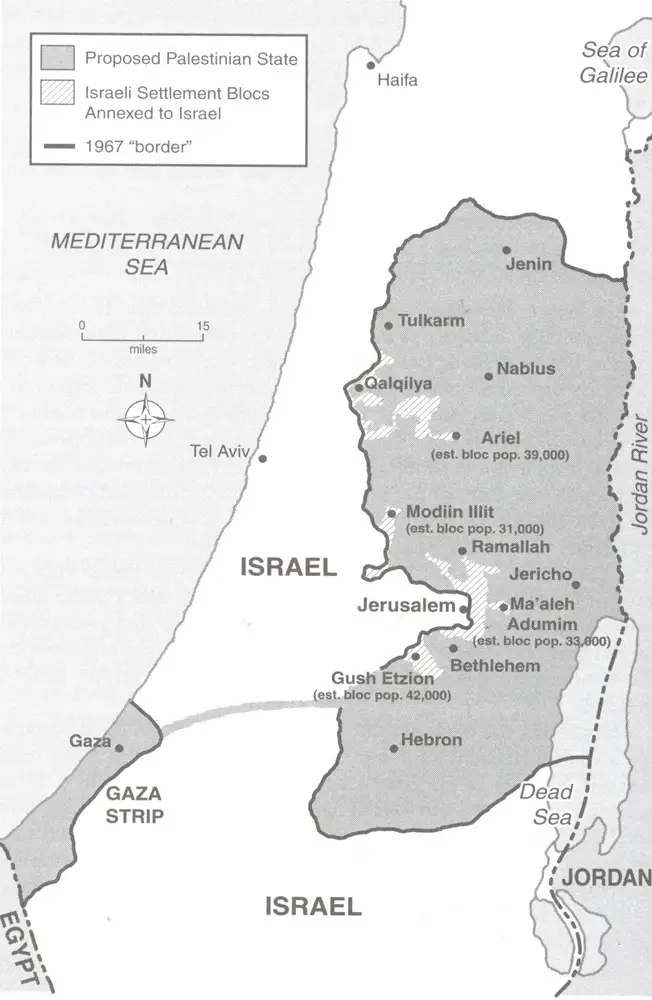 |
Clinton
Parameters (2001)
[click on map to enlarge] |
Critics of the E1 plan complain that it would kill the two-state
solution to the Israeli-Palestinian
dispute by making it impossible for the Palestinians to have
a contiguous state. This is untrue because the Palestinian state
would be contiguous around the eastern side of the city.
The other complaint is that linking Ma’ale
Adumim to Jerusalem would cut off east Jerusalem from a Palestinian
state, but Israel has proposed constructing a four-lane underpass
to guarantee free passage between the West
Bank and the Arab sections of Jerusalem that would actually reduce the time for Palestinian drivers traveling
in a north-south direction. In addition, “access to Jerusalem through Abu Dis, Eizariya, Hizma and Anata is not prevented by the
proposed neighborhood, nor would it be precluded by a string of
neighborhoods connecting Ma’aleh
Adumim to Jerusalem.” 277
Curiously, none of the critics of E1, who express
such concern for the contiguity of a future Palestinian state, are
disturbed by the fact that the failure to complete the project would
preclude Israel from having contiguous
borders as Ma’ale
Adumim would become an island in the middle of the Palestinian
state. Incidentally, this one-sided concern about contiguity is
also evident in discussions regarding linking the Gaza
Strip and the West Bank,
which are not contiguous either, and would require some rail or
auto link that would break up the continuity of Israel in the Negev.
The hypocrisy toward the E1 project is further exemplified by the
international silence over the illegal Palestinian Arab building
in the area. The Palestinians want to prevent Israel from linking Ma’ale
Adumim with Jerusalem by filling the area with their own homes and they also hope to surround
Jewish neighborhoods built after 1967. If the Palestinians succeed,
they can threaten Jerusalem from the east and block the city’s development while also
threatening the Jerusalem-Jericho road, a strategically vital passage
for the movement of troops and equipment through the Jordan
Valley. The illegal construction has already reduced the area
for building Israeli homes and narrowed the corridor to Jerusalem from about one mile to six-tenths of a mile.
|
[click
on map to enlarge]
|
According to the Oslo II
agreement, Israel retained
control over the area around E1 and therefore has the right to build
in the area, but the Palestinians do not. Israel has built a police station and the infrastructure for completing
construction in the area but has refrained from moving ahead on
the project. In fact, every time a prime minister announces plans
to begin work on E1, they mysteriously reverse course, usually within
24 hours, apparently after being threatened by the United
States. This occurred in the most recent case when Prime
Minister Netanyahu announced the project would move forward
and then almost immediately backtracked after being condemned by
the United States and many other
Western nations.278
The two-state solution is not threatened by the
E1 project; it is in danger from the continuing
terrorism from Gaza and the refusal of Mahmoud
Abbas to engage in peace
negotiations. While settlement
construction is controversial in Israel,
there is broad consensus that Ma’ale
Adumim will be part of Israel after any agreement with the Palestinians and that it should be
linked to Jerusalem. After
years of planning, the time to complete the E1 project is overdue
and should no longer be held hostage to the specious complaints
of the Palestinians and their supporters.
Israeli policies are obstructing peace.
In the Orwellian world of Middle East politics:
- The country that is bombarded
for years by rockets and has half its population at risk has
no interest in peace while the terrorists
behind the bombardment are viewed as partners for peace negotiations.
- The leader who has called for negotiations without preconditions
is pilloried for an alleged disinterest in peace while the leader
who has refused to talk for four years is hailed as a moderate
partner for peace.
- The leader who said in his last speech before his assassination
that he did not support the establishment of a Palestinian
state is remembered as a great peace maker while the prime
minister who has called for the creation of a Palestinian state
living beside Israel is a hardliner
standing in the way of Palestinian independence.
- The “moderate” Palestinians wish to unite with
Islamic extremists who openly call for Israel’s destruction.
- The United
Nations, which adopted a resolution calling for negotiations to bring about peace for all nations
with “secure and recognized boundaries free from threats
or acts of force” undermines its longstanding position by
voting to unilaterally recognize a Palestinian state with borders
that impinge on the rights of another state, are not secure and
would be inhabited by people who threaten and carry out acts of
force.
Perhaps it is worth reminding the inhabitants of this Orwellian world
of the following facts:
- Israel is the country that
is targeted by Palestinian
terrorists who openly call for its destruction.
- Prime Minister Benjamin
Netanyahu is the leader who has called for negotiations without
preconditions and it is Mahmoud
Abbas who has set conditions and refused to discuss peace
since 2008.
- It is also Netanyahu who has said he would accept a two-state
solution while Yitzhak
Rabin, rightly recognized as a peacemaker, said he would not
accept a Palestinian state.
- Mahmoud Abbas,
supposedly a moderate, continues to spew vitriol and oversee the Palestinian Authority,
at least in the West Bank,
where terrorists continue to infiltrate Israel and incitement against Israel regularly appears in the Palestinian media. Abbas now wants to
unite with Hamas,
whose leader, Khaled
Meshal said during his first visit to Gaza:
“Palestine from the river to the sea, from the north to
the south, is our land and we [Hamas]
will never give up one inch or any part of it.”279
- UN Security Council Resolution
242 has been the basis for peace talks since 1967. It does
not mention the Palestinians nor does it require Israel to withdraw to the 1967
borders as specified in the non-binding General Assembly resolution
unilaterally imposing terms on Israel. Resolution 242 does, however,
explicitly say that every state in the region has the “right
to live in peace within secure and recognized boundaries.”280
While the Orwellians continue to insist that the Palestinians desire peace
and a two-state solution while Israelis oppose this outcome, it is worth remembering the facts about the many
opportunities the Palestinians have squandered to establish a state
and the repeated peace offers made by Israel:
- In 1937, the Peel Commission proposed the partition of Palestine and the creation of an Arab
state.
- In 1939, the British
White Paper proposed the creation of a unitary Arab state.
- In 1947, the UN would
have created an even larger Arab state as part of its partition
plan.
- From 1949 until 1967, it was Jordan that occupied the West Bank and Egypt that controlled the Gaza
Strip and the Palestinians never sought the creation of a Palestinian state in those territories.
- The 1979 Egypt-Israel
peace negotiations offered the Palestinians autonomy, which
would almost certainly have led to full independence.
- The Oslo agreements
of the 1990s laid out a path for Palestinian independence,
but the process was derailed by terrorism.
- In 2000, Yasser
Arafat rejected Prime Minister Ehud
Barak’s offer to create a Palestinian state in all of Gaza and 97
percent of the West Bank.
- Over the course of 35 meetings in 2008, Prime Minister Ehud
Olmert offered to withdraw from almost the entire West
Bank and partition Jerusalem on a demographic basis, but Abbas did not accept the proposal.
- From 2009 until today, Prime Minister Netanyahu has invited Abbas to sit down without preconditions to negotiate a two-state solution
to the dispute and Abbas has refused to discuss peace.
We are long past 1984 and it is time for Israel’s
critics to face reality and the facts.
If Iran has a bomb, it can be deterred the
way the U.S. deterred the Soviet Union.
In the debate about Iran,
it is sometimes suggested that Iran is irrational and that is why it should not be allowed to have a nuclear
weapon. Others then argue that calling Iranians irrational reflects
a Western bias. The truth is that Iranians are rational, but they may be acting according to a different rationale
than people in the West.
The Islamic regime’s logic is rooted in a potentially lethal
cocktail of history, religion and politics. It is the religious aspect,
in particular, that differentiates Iran from the Soviet Union and other
nuclear powers. The Iranian president, Mahmoud
Ahmadinejad, believes the most important task of the Iranian
Revolution was to prepare the way for the return of the Twelfth
Imam, who disappeared in 874, bringing an end to Muhammad’s
lineage. This imam, the Mahdi or “divinely guided one,” Shiites believe, will return in an apocalyptic battle in which the forces
of righteousness will defeat the forces of evil and bring about a
new era in which Islam ultimately becomes the dominant religion throughout the world. While
Shiites have been waiting patiently for the Twelfth
Imam for more than a thousand years, Ahmadinejad may believe he can hasten the Mahdi’s
return through a nuclear war. It is this apocalyptic world view,
Middle East scholar Bernard
Lewis notes, that distinguishes Iran from other governments with nuclear weapons.281
Lewis quotes a
passage from Ayatollah
Khomeini cited in an 11th grade Iranian schoolbook, “I am
decisively announcing to the whole world that if the world-devourers
[the infidel powers] wish to stand against our religion, we will stand
against the whole world and will not cease until the annihilation
of all of them. Either we all become free, or we will go to the greater
freedom, which is martyrdom. Either we shake one another’s hands
in joy at the victory of Islam in the world, or all of us will turn to eternal life and martyrdom.
In both cases, victory and success are ours.”282
Would leaders who did not hesitate to use children as cannon fodder
in the war with Iraq, or
who send suicide bombers to kill the innocent, be reticent about using
nuclear weapons? How can the idea of Mutual
Assured Destruction that prevented a superpower clash apply to
people who believe the end of the world will lead to “eternal
life and martyrdom?”
Some might argue they don’t mean what they say and when the
time came, the Iranians would “love their children too” and back down from the nuclear brink, but would
you be willing to take that chance with your children?
MYTH:
The Israeli settlements are an obstacle to Middle East peace.
FACT
Paradoxically, perhaps the most prevalent myth about the Arab-Israeli
conflict is the easiest to disprove both rhetorically and empirically.
Consider the following facts:
-
From 1949�67, when Jews were forbidden
to live on the West Bank, the Arabs refused to make peace with
Israel.
-
From 1967�77, the Labor Party established
only a few strategic settlements in the territories, yet the
Arabs were unwilling to negotiate peace with Israel.
-
In 1977, months after a Likud government
committed to greater settlement activity took power, Egyptian
President Sadat went to Jerusalem and later signed a peace treaty
with Israel. Incidentally, Israeli settlements existed in the
Sinai and those were removed as part of the agreement with Egypt.
-
One year later, Israel froze settlement
building for three months, hoping the gesture would entice other
Arabs to join the Camp David peace process, but none would.
The Palestinians also rejected an offer of autonomy that most
likely would have led to statehood.
-
In 1994, Jordan signed a peace agreement
with Israel and settlements were not an issue; if anything,
the number of Jews living in the territories was growing.
-
Between June 1992 and June 1996, under Labor-led
governments, the Jewish population in the territories grew by
approximately 50 percent. This rapid growth did not prevent
the Palestinians from signing the Oslo accords in September
1993 or the Oslo 2 agreement in September 1995.
-
In 2000, Prime Minister Ehud Barak offered
to dismantle dozens of settlements and withdraw from 97 percent
of the West Bank, but the Palestinians still would not agree
to end the conflict.
-
In August 2005, Israel evacuated all of
the settlements in the Gaza Strip and four in Northern Samaria,
but terror attacks continued.
-
In 2008, Prime Minister Ehud Olmert offered
to withdraw from approximately 94 percent of the West Bank,
but the deal was rejected.
-
In 2010, Prime Minister Benjamin Netanyahu
froze settlement construction for 10 months and the Palestinians
refused to engage in negotiations until the period was nearly
over. After agreeing to talk, they walked out when Netanyahu
refused to prolong the freeze.
On the last point, President Obama�s special envoy for
Mideast peace, George Mitchell noted that the Palestinians were
unwilling to accept the settlement freeze offered by Netanyahu
because they said it was �useless.� Mitchell added,
�They refused to enter into the negotiations until nine
months of the 10 had elapsed. Once they entered, they then said
[the freeze] was indispensable. What had been worse than useless
a few months before then became indispensable and they said they
would not remain in the talks unless that indispensable element
was extended.�283
In late 2012, the myth took on absurd proportions following the
Palestinian decision to seek statehood recognition at the UN General
Assembly and Israel�s retaliatory announcement of the intention
to build more homes for Jews in existing settlements and in Jerusalem.
As a Washington Post editorial noted, the hysterical international
reaction to Israel�s moves was �counterproductive
because it reinforces two mistaken but widely held notions: that
the settlements are the principal obstacle to a deal and that
further construction will make a Palestinian state impossible.�284
The Post added that �Mr. Netanyahu�s government,
like several before it, has limited building almost entirely to
areas that both sides expect Israel to annex through territorial
swaps in an eventual settlement. For example, the Jerusalem neighborhoods
where construction was announced last month were conceded to Israel
by Palestinian negotiators in 2008 [emphasis in original].285
The biggest uproar, the Post observed, was over Netanyahu�s
decision to plan for construction in a four-mile strip known as
E-1 that would connect Jerusalem with the suburb of Ma�ale
Adumim. The Palestinians, and many media outlets including the
New York Times, claimed this project would make it impossible
to establish a contiguous Palestinian state. The Post correctly
reported that Israel will undoubtedly annex Ma�ale Adumim
� a city of 40,000 � in any peace deal so the E-1
project is essential to ensure that it does not become an island
in the middle of a Palestinian state.286
While UN Secretary General Ban Ki-moon called Israel�s
actions an �almost fatal blow� to the two-state solution
and British Foreign Secretary William Hague said new building
would make it �very difficult to achieve,� the Post
called the rhetoric �offensive at a time the Security Council
is refusing to take action to stop the slaughter of tens of thousands
of civilians � including many Palestinians � by the
Syrian regime. Like Obama�s initial call for a settlement
freeze, the rhetoric also encourages Mahmoud Abbas to continue
to insist on a freeze before negotiating. �If Security Council
members are really interested in progress toward Palestinian statehood,�
the Post concluded, �they will press Mr. Abbas to stop using
settlements as an excuse for intransigence � and cool their
own overheated rhetoric.�287
Even though settlements have not impeded peace, many Israelis
still have concerns about the expansion of settlements. Some consider
them provocative, others worry that the settlers are particularly
vulnerable, and note they have been targets of repeated Palestinian
terrorist attacks. To defend them, large numbers of soldiers are
deployed who would otherwise be training and preparing for a possible
future conflict with an Arab army. Some Israelis also object to
the amount of money that goes to communities beyond the Green
Line, and special subsidies that have been provided to make housing
there more affordable. Still others feel the settlers are providing
a first line of defense and developing land that rightfully belongs
to Israel.
The disposition of settlements is a matter for the final status
negotiations. The question of where the final border will be between
Israel and a Palestinian entity will likely be influenced by the
distribution of these Jewish towns in Judea and Samaria (the border
with Gaza was unofficially defined following Israel�s withdrawal).
Israel wants to incorporate as many settlers as possible within
its borders while the Palestinians want to expel all Jews from
the territory they control.
If Israel withdraws toward the 1949 armistice line unilaterally,
or as part of a political settlement including land swaps (i.e.,
in exchange for more territory in the West Bank, Israel would
cede land in the Negev or elsewhere to the Palestinians) many
settlers will face one or more options: remain in the territories
(the disengagement from Gaza suggests this may not be possible),
expulsion from their homes, or voluntary resettlement in Israel
(with financial compensation).
The impediment to peace is not the existence of Jewish communities
in the disputed territories; it is the Palestinians� unwillingness
to accept a state next to Israel instead of one replacing Israel.
MYTH:
The Palestinians are now ready to make peace with Israel.
FACT
In his first comments as America�s
new Secretary of State, John
Kerry said that pursuing Israeli-Palestinian
peace would be one of his top priorities. "So
much of what we aspire to achieve and what we need to
do globally, what we need to do in the Maghreb and South
Asia, South Central Asia, throughout the Gulf, all of
this is tied to what can or doesn't happen with respect
to Israel-Palestine. And in some places it's used as an
excuse. In other places it's a genuine, deeply felt challenge."290
Kerry's statement was alarming because
it represented the long discredited State Department view
that the Palestinian issue is the root of all Middle East
problems and ignored the turmoil in the region unrelated
to the Palestinian issue, including threats from al-Qaeda,
unrest in Iraq, ongoing fighting with the Taliban in Afghanistan,
new terror threats in North Africa,
Syria in flames, Egypt
on the verge of chaos, and most important, Iran
nearing the ability to build a nuclear weapon.
The timing also was dubious because
of the public pronouncements of the Palestinians. Just
a few months ago at the United
Nations, Mahmoud
Abbas gave a vitriolic speech accusing Israel
of �one of the most dreadful campaigns of ethnic
cleansing and dispossession in modern history;�
of unprovoked �aggression� in Gaza;
and of �an apartheid system of colonial occupation,
which institutionalizes the plague of racism.�291
Are these the words of a leader interested in peace?
Similarly, in December 2012, Hamas
leader Khaled
Mashaal used his first visit to Gaza
to declare: �From the sea to the river, from north
to south, we will not give up any part of Palestine �
it is our country, our right and our homeland.�
He added that Palestinians are �all united in the
way of resistance.�292
The situation is even worse given that
Abbas wants to reconcile with Hamas,
which has repeatedly stated it will not accept a Palestinian
state alongside Israel, and the Palestinian public opinion
supports Hamas.
In a December 2012 poll, for example, 41% of the Palestinians
think that armed attacks on army and settlers can force
Israel to withdraw
from the territories; while 24% think peaceful non-violent
resistance can force Israelis to withdraw and 30% think
that negotiations with Israel can bring it to withdraw.293
When Palestinians were asked, given the outcome of the
war between Hamas and Israel and the UN
recognition of a Palestinian state, whose way is the
best to end the Israeli occupation and build a Palestinian
state: Hamas� way or Abbas�s way, 60% say
Hamas� way and 28% Abbas� way. By contrast,
more than 60% of Israelis said they were willing to give
up some or all of the West Bank.294
Everyone in Israel longs for peace, so the Secretary
will not be turned away or discouraged; nevertheless,
he should not be blind to regional realities and recent
history. Israeli nerves still raw from absorbing thousands
of Palestinian terror rockets and seeing half their
population forced to be on constant alert. Even the most
dovish Israelis are unwilling to make concessions in the
West Bank unless
they have security guarantees that will prevent the territory
from becoming another Hamistan terror base.
Nevertheless, Prime Minister Benjamin
Netanyahu has repeatedly invited Abbas
for negotiations, and Abbas
has spent the last four years rejecting the overtures,
doing everything in his power to subvert a negotiated
settlement and trying to convince the international community
to impose Palestinian terms on Israel.
Secretary
Kerry needs to make clear to the Palestinians that
their only chance for statehood is through direct
talks with Israel; that Hamas
cannot be a part of the Palestinian leadership; that the
Palestinian Authority
must cease incitement, and demonstrate through words and
deeds a commitment to the two-state solution; and that
the United States will
not accept excuses or preconditions to negotiations.
Kerry
should also reassure Israelis that he understands the
Gaza precedent, the new strategic dangers they face from
their neighbors, and the necessity of eliminating the
Iranian threat
before Israelis can be expected to take new risks for
peace.
MYTH:
Attacking Iran will create more instability in the Middle East.
FACT
More instability?! Have the proponents of this idea been following the news for the last two years?
Even in the best of times, the Middle East is an unstable region because of ongoing disputes between various Arab states. Now, an increased level of chaos has spread across the region as a result of upheavals in North Africa, Yemen and the Persian Gulf, continuing unrest in Iraq and Afghanistan, and a bloody civil war in Syria.
Among the possible worst case scenarios, it is conceivable that a military strike on Iran would cause a backlash among peoples in the region angered by an attack on a Muslim nation; it may unite the Iranian people in defense of their country; or, current rulers of conservative regimes may come under attack for complicity in the attack.
The consequences of a strike could, however, have positive consequences for the region. The Israeli military strikes on nuclear facilities in Iraq (1981) and Syria (2007), for example, did not provoke greater instability in the Middle East despite lacking any international consensus. Both attacks eliminated potentially destabilizing nuclear weapons programs and discouraged a nuclear arms race in the region. Arab leaders now are petrified of a nuclear Iran and will, at least tacitly, support measures that would eliminate Iran�s nuclear threat.295
While the negative scenario envisions the Iranian population rallying around its leaders in the event of a military strike, it is also possible that, when liberated from the intimidation of the mullahs, the Iranian people will launch a �Persian Spring� demanding freedom and democracy from their government. Iran�s Supreme Leader Ayatollah Khamenei is obviously nervous about this possibility, noting in April 2012 that he believes Libya�s abandonment of its nuclear program in 2003 eventually hastened the overthrow of Qaddafi.296
In the short-term, an attack on Iran might have a deleterious impact on oil prices as speculators react to the possibility of reduced supplies; however, in the long-term, an attack could actually help stabilize the oil market as it would hamper Iran�s ability to threaten global oil supplies and weaken its position within OPEC, where it has advocated stricter quotas to drive up prices.
A successful strike on Iran could also help free two countries that have been under its thumb for three decades. Without the support of the radical Shiite leaders in Iran, Syrian President Bashar al-Assad will lose his principal patron in the region and Syria will no longer serve as a forward Iranian base for harboring terrorists and interfering in the affairs of Lebanon. The fall of Iran�s leadership would also put an end to its support for Hezbollah in Lebanon, effectively thwarting the organization�s ability to terrorize Israel and control Lebanese affairs.
Furthermore, destroying the Iranian nuclear program would eliminate the threat of Iranian sponsored nuclear terrorism and proliferation, and would signal to the rest of the region that nuclear weapons programs will not be tolerated. This outcome is especially important in light of nuclear agreements signed by more than a dozen Arab countries in response to Iran�s continued nuclear developments.
It is easy for opponents of military action to construct nightmare scenarios that will scare the public and sway world leaders away from confrontation with Iran. However, military planners and statesmen must analyze the current situation objectively and weigh the risk of a negative outcome, as well as the danger posed by inaction, against the potential benefits of a proactive strike against Iran.
MYTH:
If the Israeli-Palestinian conflict was solved, the Middle East would be at peace.
FACT
A cardinal view of Arabists is that the Israeli-Palestinian conflict is the core of all Middle East problems. According to Middle East scholar Martin Kramer, this " linkage" theory holds that the Israeli-Palestinian issue, practically alone, prompts the rise of terrorists, weakens friendly governments, and makes it impossible for the United States to win Arabs and Muslims over to the good cause.297 Though this doctrine has been proven erroneous, President Obama�s nominee for Secretary of Defense, Chuck Hagel, continues to adhere to this discredited viewpoint.
"The core of all challenges in the Middle East remains the underlying Arab-Israeli conflict," Hagel said in 2006. "The failure to address this root cause will allow Hezbollah, Hamas, and other terrorists to continue to sustain popular Muslim and Arab support."298 In 2008, Hagel took this view even further, noting that the Israeli-Palestinian conflict "cannot be looked at in isolation. Like a stone dropped into a placid lake, its ripples extend out father and father. Egypt, Syria, Jordan, and Lebanon feel the effects most noticeably. Farther still, Afghanistan and Pakistan; anything that impacts their political stability also affects the two emerging economic superpowers, India and China."299
As events across the Middle East have shown, however, the Israeli-Palestinian conflict is but one of many ethnic, religious and nationalist feuds plaguing the region, most of which are independent of each other. Here is but a partial list of conflicts that have occurred in the Middle East over the past two and a half decades: the Iran-Iraq War (1980-88); the First Gulf War (1991); the Lebanese Civil War (1975-90); the Sudanese Civil War (1983-2000); the "Arab Spring" upheavals (2011- ); and the ongoing Syrian Civil War (2011- ). None of these are connected to the Palestinian issue.
"Almost every border in that part of the world, from Libya to Pakistan, from Turkey to Yemen, is either ill-defined or in dispute," scholar Daniel Pipes notes in his book The Long Shadow, "But Americans tend to know only about Israel�s border problems and do not realize that these fit into a pattern that recurs across the Middle East."300
If the Israeli-Palestinian problem was solved, it would have either minimal or no impact on the many intra-Arab rivalries or the Iranian nuclear threat to the region. Sunnis and Shiites would still be competing for influence, as will secularists and fundamentalists, and a host of other conflicts would remain unaffected by a change in relations between Israelis and Palestinians. Moreover, espousing linkage may have a deleterious impact on the Middle East, as it could "lead to panicked overreaction whenever Israelis and Arabs do exchange blows."301
The achievement of a peace agreement will also have little impact on regional disputes. Israel will still have to remain vigilant to ensure that a Palestinian state does not become a threat or the first stage of the policy of liberating "greater" Palestine over time. Peace with the Palestinians may be a catalyst for regional peace, but it is no guarantee that Syria or Lebanon will change their policies toward Israel, especially if Iran continues to influence their behavior and Hezbollah remains in power and committed to Israel�s destruction. Furthermore, a treaty with the Palestinians would not satisfy the Iranians� desire to "wipe Israel off the map."
�Our leaders should have a realistic - as opposed to a 'realist' - understanding of the root causes of Middle East strife. How can they protect us from threats if they don�t understand the causes of these threats? Decades of dictatorship, [not the Arab-Israeli conflict], brought the Middle East to its current condition, along with misogyny, poor education, corruption, the politicizing of Islam and sectarian hatred.�
Jeffrey Goldberg 302 |
MYTH:
Israel has created separate bus lines to segregate Jews and Palestinians.
FACT
Leave it to the Palestinians to turn an Israeli accommodation to make their lives better into a political attack. The latest example relates to Israel�s decision to create a bus line exclusively for Palestinians to expedite their travel into Israel to work, which some Palestinians and their supporters are now claiming to be a policy of segregation.
The need for the new bus line was created because Israel has significantly increased the number of work permits given to Palestinians and the existing bus lines have become overcrowded. After years of being prevented from working in Israel because of the Palestinian War (2000-2005) and the wave of terrorist attacks, Israel has been gradually easing restrictions on Arabs in the West Bank, and the number of Palestinians now allowed to work in Israel is at or near the prewar levels. While Israel�s detractors accuse Israel of mistreating Palestinians, nearly 40,000 now go to work each day in Israel. Many others, paradoxically, work in the Jewish settlements that their leaders castigate.
Before establishing the new lines, Palestinian workers had no direct line from their communities to the border crossing. They had a choice of traveling to an Israeli settlement and taking a bus from there into Israel or using �pirate� driving services that have been transporting Palestinian workers by circuitous routes �at exorbitant prices.� Thanks to the new buses, the cost of traveling to Tel Aviv will be reduced by nearly 75 percent.303
While Israel maintains the new bus lines are a goodwill gesture, critics have called it an example of Israeli racism. In fact, the buses pick up Palestinians in Arab communities and have different endpoints than the buses they used to take. Furthermore, no Palestinians are prevented from using the old buses, which most disliked because they had to travel with Jewish settlers. The settlers also had complained about what they viewed as a security threat from riding with Palestinians from the West Bank.
Palestinian workers agree with Israeli officials that the new buses make their lives much easier. The Times of Israel reported: �Hundreds of laborers gathered at the Eyal checkpoint before dawn to take advantage of the new service. Outside of some overcrowding from heavier-than-expected demand, few problems were reported, and riders seemed pleased with the new arrangement.�304
Not only did Israeli officials discover there weren�t enough buses to meet the demand, but Palestinian workers requested additional buses to run on Fridays so they would not have to pay �pirates.�305 The attitudes of Palestinian workers might best be summarized by Naim Liftawi, a 40-year-old employee at an upholstery factory in Kfar Sava, �the [critics] can say what they want, as long as I'm safe on the bus. I just want to put bread on the table for my children.306
Unfortunately, the buses have already come under attack. Unknown assailants set fire to two buses on the new line on March 5, 2013.307
MYTH:
The European Union has no reason to name Hezbollah a terrorist organization.
FACT
For decades, the Europeans have taken a �head in the sand� approach to recognizing the obvious � that Hezbollah is a terrorist organization. If Hezbollah�s terror attacks were limited to the Middle East, European leaders might have cause to suggest the group does not threaten them, but the truth is that Hezbollah is engaged in terror on an international scale and has also killed internationals in Lebanon.
In February 2013, after an exhaustive investigation, the Bulgarian government announced that it believed Hezbollah was responsible for a July 2012 attack in the resort town of Burgas that killed five Israeli tourists and a Bulgarian bus driver and injured dozens more. As U.S. National Security Adviser Thomas E. Donilon observed, �This report is significant because a European Union member state, Bulgaria, explicitly pointed a finger at Hezbollah and lifted the veil on the group�s continued terrorist activities. Europe can no longer ignore the threat that this group poses to the Continent and to the world.�308
Most people forget that, excluding the terrible events of 9/11, more Americans have been killed by Hezbollah than any other terrorist group. In 1983, Hezbollah bombed the United States Embassy in Beirut, killing 63 people. Then the group bombed the American and French Marine Barracks in Beirut, killing 241 Americans and 58 French service members. In 1996, Hezbollah assisted in the Khobar Towers attack in Saudi Arabia, which killed 19 Americans. Subsequently, in 1997, Hezbollah became one of the first groups added to the State Department�s list of foreign terrorist organizations.
Even before the Bulgaria attack, Hezbollah had a bloody record of international terror marked by kidnappings, airplane hijackings, bombings in Paris and an attempted bombing in Bangkok. Two of the group�s most heinous attacks occurred thousands of miles from the Middle East, in Buenos Aires. In 1992, Hezbollah detonated a car bomb outside the Israeli Embassy, killing 29 people and injured more than 250 others. Among the victims were Israeli diplomats, children, clergy from a local church and other innocent bystanders. Two years later, Hezbollah struck again, bombing the Asociaci�n Mutual Israelita Argentina (AMIA) Jewish community center in Buenos Aires - 87 people were killed and more than 100 people were injured.
With the help of Iran and Syria, Hezbollah has terrorized Lebanon and essentially taken over the country. Currently, at fear of losing the patronage of Bashar al-Assad and the Syrian arms smuggling routes, Hezbollah fighters have even joined in the defense of the dictatorial regime.
Given its indisputable record of terror and the fact that United States, Israel, Canada, the UK, Egypt and Bahrain all consider it a terrorist organization, it is hard to understand the reluctance of the European community to do the same. A number of excuses can be manufactured, such as the traditional European fear of doing anything that might alienate the Arabs; the concern that European nationals serving in the peacekeeping force in Lebanon could become targets; the desire not to complicate relations with Hezbollah�s sponsor, Iran; the fear of the French, in particular, of jeopardizing their historic role in Lebanon; the specious argument that because Hezbollah has a �political wing,� it is not a terror organization; or, the desire to keep channels of communication open.
Hezbollah�s freedom of action would be severely restricted if the EU labeled it a terrorist organization; however, this requires all 27 member states to agree on the designation.
U.S. Secretary of State John Kerry called on the EU to act, as have more than 100 members of the U.S. Congress. Donilon called on the Europeans to respond swiftly to ensure no other attacks occur in Europe. He said they �must disrupt [Hezbollah�s] operational networks, stop flows of financial assistance to the group, crack down on Hezbollah-linked criminal enterprises and condemn the organization�s leaders for their continued pursuit of terrorism.� 309
Following the Bulgarian report on the Burgas bombing, British Foreign Secretary William Hague said �It is important that the EU respond robustly to an attack on European soil.� Hague promised to discuss with his European colleagues �measures we can now take to continue to make our citizens safer.�310
MYTH:
Non-lethal Palestinian rocket attacks have no impact on Israel's civilian population.
FACT
The years of rocket attacks from Hamas terrorists in Gaza have given researchers an opportunity to study their impact on the Israeli population that has come under fire. While apologists for Hamas have downplayed the severity of the thousands of rockets and mortars that have been fired into Israel because of the low number of casualties, the damage caused is far more serious and widespread than news reports at the time of the attacks suggest.
The latest research finding to document the severity of these terror attacks found that women in Sderot had significantly more miscarriages than those who are not exposed to warning sirens and missile barrages. In an article published in Psychosomatic Medicine Journal of Bio-Behavioral Medicine, Tamar Wainstock and Professor Ilana Shoham-Vardi of Ben-Gurion University's Department of Epidemiology, suggested the increased number of miscarriages was most likely attributable to the stress of living with the threat of a rocket attack.311
After eight years of rocket attacks, health officials are also reporting that �many residents have to be treated for hearing loss, dizziness, tinnitus, and/or central auditory processing disorders.� 312
Not surprisingly, children have been especially traumatized by the anxiety and fear provoked by the attacks. It takes months of treatment to recover and a single rocket attack during the therapy period can send the whole process back to square one. According to a 2008 study conducted by Natal, the Israel Center for Victims of Terror and War, between 75 percent and 94 percent of Sderot children aged 4-18 exhibit symptoms of post-traumatic stress, and 28 percent of adults and 30 percent of children in Sderot have post-traumatic stress disorder (PTSD). The distinction between post-traumatic stress symptoms, such as problems sleeping and concentrating, and PTSD itself, is that the latter can interfere seriously with daily life. One of the goals of therapists is to try to prevent stress disorders before any rocket attacks by teaching adults and children how to reduce anxiety in a place that is under ongoing danger.313
What do these statistics mean for the lives of children living under fire? Here are a few examples:
In Sderot it is now normal practice to take showers in under a minute for fear that a siren will sound while they are washing up. Music is seldom played as it may block out the sound of the red alert, and even seat belts are no longer worn in cars because they can restrict a quick exit. When rocket fire is more constant, entire families will often live in bomb shelter for days on end.314
Palestinian terrorism poses not only a physical threat to Israelis, but also a psychological one. The years of attacks are now taking a toll, especially on women and children.
MYTH:
Israelis overreact to harmless rock-throwing by Palestinians.
FACT
Of the many �David versus Goliath� images that are portrayed in the media to dramatize the Israeli-Palestinian conflict, the most common may be that of the helpless Palestinian throwing rocks at heavily armed Israeli soldiers. These images are powerful but also frequently misleading, failing to distinguish between the aggressor and the victim.
While the media is often drawn to rock-throwing riots against IDF troops (often staged by Palestinian instigators), many of these incidents occur beyond the glare of media lights and are directed not at soldiers, but Jewish men, women and children, often innocently driving along a roadway.
The �David vs. Goliath� imagery is typically used to illustrate an underdog battling against a much greater power, yet those applying this analogy to the Palestinians ignore the fact that David�s rock actually killed Goliath and marked the beginning of the end to the rule of the Philistines in Biblical Israel. Over the years, Palestinian �Davids� have killed many Jews with their stones - but none of them were �Goliaths.�
The media typically ignores these near-daily terror attacks against Jews, or significantly downplays their lethality. A March 2013 cover article in the New York Times� Sunday Magazine, for example, called Palestinian rock throwers �unarmed� resisters.315 Christian Science Monitor referred to the tactic as "peaceful palestinian resistance" while the Los Angeles Times labelled rock throwers as �Palestinians who see nonviolence as their weapon.�316
The incidents of March 14, 2013, however dispel the false notion that rock-throwing is nonviolent or harmless. That day, a woman was driving with her three young daughters past the city of Ariel when a group of Palestinians threw rocks at a truck coming in the other direction. The truck swerved and collided with the family�s car, injuring the mother and the two older daughters. The youngest, a three-year-old child, was critically injured, and doctors are still trying to save her life.317 Later that same night, on the same highway, a 10-month-old baby was injured when rocks thrown at his parents� car shattered the windshield. 318
These are but two examples, but many more can be cited in which Palestinian rock throwers have murdered, or attempted to murder, innocent Jews. For example:
November 2012: Ziona Kalla, wife of Israeli singer Itzik Kalla, sustained serious injuries as a result of stones hurled at her car by Palestinians near Beitar Illit.
September 2011: Asher Palmer and his 1-year-old son were killed in a stone-throwing attack near Kiryat Arba. Two Palestinians from the nearby village of Halhul admitted to instigating the attack. Waal al-Araja � a member of the Palestinian security forces -- was convicted of murder in the case in March 2013.319
June 2001: Five-month-old Yehuda Haim Shoham�s family was returning from visiting relatives in Ra'anana when a Palestinian threw a rock at the front windshield that hit and killed baby Yehuda in the back seat.320
May 2001: Koby Mandell (13) and Yosef Ishran (14) were beaten to death with rocks when they were hiking on the outskirts of Tekoa. Their bodies were found in a cave, covered with stones. The perpetrators have still not been found.321
October 2000: Bachor Jean (54) was killed by rocks thrown at his vehicle while he was travelling from Haifa to Rishon Lezion. The rocks shattered the windshield and struck his chest. His brother, who was driving the car, sped to the hospital but was too late. The perpetrators were found to be from the nearby Arab village Jisar a-Zarka.322
January 1983: Esther Ohana (21) was killed by a rock thrown at her car that hit her in the head while driving near the Palestinian village Dahariya.
In 2013 alone, the IDF has already recorded 1,195 rock throwing incidents in the West Bank.323 No one should be fooled into believing stone-throwing is harmless or a form of non-violent protest; rocks are weapons used by Palestinians to injure and kill Israeli Jews.
MYTH:
The Palestinian Authority is committed to reforming Palestinian society.
FACT
At the end of March 2013, Palestinian Authority President Mahmoud Abbas signed the PA�s 2013 fiscal year budget, which totals $3.9 billion in spending. Despite persistent complaints of insufficient funds to meet the PA�s obligations, economic stagnation, the failure of Arab donors to make good on their aid pledges, and a recurring debt of more than $1 billion, Abbas increased the budget by nearly $400 million over 2012.324
Beyond the increase in expenditures and the over-reliance on foreign aid to cover spending, the 2013 budget also reveals the priorities of the Palestinian government. A whopping 28 percent is allocated for defense, more than the sums budgeted for education (16 percent) and medical services (10 percent) combined.325 By comparison, Israel allocates 19% of its budget on defense, Britain 5.8%, Germany 3.6%, Jordan 14.8%, Egypt 6.3%, Iran 7.9% and Turkey 3.7%.326
The PA lacks a formal army, does not maintain an official state of war with any country- including Israel, and faces no military threats except from internal political rivals.327 So where does the PA plan to spend nearly one-third of its budget? Much of the money will go to buy the loyalty of 65,000 �defense workers�� 41 percent of all the PA�s civil servants � despite the fact that more than half of these workers live in the Hamas-ruled Gaza Strip and pay no taxes to the Ramallah-based Palestinian Authority.328
How does this budget reflect an interest in peace with Israel? The PA might justify some of the cost if it was allocated for preventing terror and incitement, but, instead, 4 percent of the budget actually goes to pay �salaries� of convicted terrorists who are currently incarcerated in Israeli jails. Payments to these convicts range from roughly $1,100 to $3,300 depending on the length of their sentence.329
Meanwhile, it is Israel that carries most of the burden of preventing Palestinian terror.
Curiously, though Abbas is a vocal advocate toward the plight of Palestinian refugees, no money was allocated in the budget to build permanent housing for the nearly 800,000 Palestinians living in 19 refugee camps under the PA�s control in the West Bank.330 Even after being responsible for the welfare of these people for almost 40 years, Palestinian leaders still prefer to use them as pawns to exemplify victimization and to be encouraged by their environment to become terrorists.
Perhaps more outrageous than the PA budget is the fact that it is almost completely dependent on foreign aid from Western donors whose values the Palestinians� reject. U.S. taxpayers have contributed more than $4 billion to subsidize people who are engaged in terror and have killed Americans; who do not believe in freedom of speech, religion, the press or assembly, and routinely abuse the rights of women and gays. Is there any other government in the world that so clearly rejects our values and interferes with our interests that receives this level of financial aid? If you answered, Egypt, you correctly identified the only other example.
How much longer will Western nations be expected to financially and politically support a Palestinian leader who drafts a budget based on money he doesn�t have, and devotes nearly a third of its resources to defense rather than meeting the social needs of his people? How much longer will Western nations prop up a leader who refuses to negotiate with Israel and has only dragged the Palestinians further down the road to perpetual conflict?
MYTH:
Now is a good time to revive the Arab peace initiative.
FACT
U.S. Secretary of State John Kerry has made no secret of his desire to jumpstart the Israeli-Palestinian peace process. Press reports have suggested that to do so he may attempt to convince the parties in the region to reconsider the so-called Arab peace initiative.
However, with all of the necessary parties focused on regional turmoil and threats - from the instability in Egypt to the civil war in Syria to the Iranian nuclear program - this does not seem to be a propitious time to push Israel to make dangerous concessions to neighbors who show no new interest in peace. In fact, rather than expanding peace, the greater fear at the moment is that the Israeli-Egyptian peace treaty might unravel.
Beyond the current atmosphere, the substance of the Arab peace proposal is problematic.
When the plan was originally announced in 2002, Israel said it was prepared to negotiate with the Arab states but that many of their demands were simply unacceptable.
It is worth remembering that Saudi Crown Prince Abdullah presented a vision of peace at a time when the Saudis were under scrutiny for their involvement in the 9/11 attacks and were desperate to project themselves globally as peacemakers not supporters of terror. Abdullah�s plan was subsequently revised and adopted by the Arab League as a peace initiative that offered Israel "normal relations" in exchange for a withdrawal to the pre-1967 �Green Line� and a resolution of the Palestinian refugee issue.
The "new" initiative was actually a restatement of the Arab interpretation of UN Resolution 242, namely that Israel must withdraw from �all� territories captured during the Six Day War of1967. The resolution, however, only calls on Israel to withdraw from territories, not "all" the territories, in exchange for peace.
Additionally, Resolution 242 states that every nations has the right to live within "secure and recognizable boundaries," which military analysts have understood to mean the pre-1967 armistice lines, with modifications, to guarantee Israel' security. Incidentally, the resolution does not put precedence for one or the other, rather holds them as equal principles. Israel, therefore, is under no legal obligation to withdraw before the Arabs agree to live in peace.
The Arab plan calls for Israel to withdraw specifically from the Golan Heights. In the past, Israel expressed a willingness to do so, but now that rockets are being fired across the border and the Syrian army has lost control of the surrounding area, no Israeli government would contemplate withdrawing from the strategic high ground.
The plan�s demand that Israel withdraw from "the remaining occupied Lebanese territories in the south of Lebanon" is not only ingenuous, but at odds with the UN conclusion that Israel has completely fulfilled its obligation to withdraw from Lebanese territory.
The Arab initiative also calls for a just solution to the Palestinian refugee problem based on UN General Assembly Resolution 194, a resolution the Arab states all voted against. The Arabs interpret the resolution as requiring Israel to allow all of the nearly five million Palestinians who claim refugee status to move to Israel. In fact, the UN recognized that Israel could not be expected to repatriate a hostile population that might endanger its security. The solution to the problem, like all previous refugee problems, would require at least some Palestinians to be resettled in Arab lands.
Israel has agreed to allow some Palestinian refugees to move to Israel on a humanitarian basis and as part of family reunification. Thousands have already been admitted this way.
The refugee issue was not part of Abdullah's original proposal and was added later under pressure from other Arab delegations. Also, it is important to note that Resolution 242 says nothing about the Palestinians and the reference to refugees can also be applied to the Jews who fled and were driven from their homes in Arab countries.
Another change from Abdullah's previously stated vision was a retreat from a promise of full normalization of relations with Israel to an even vaguer pledge of "normal relations."
The Arab demand that Israel accept the establishment of a Palestinian State in the West Bank and Gaza with East Jerusalem as its capital has been part of the negotiations since Oslo. Israel's leaders have accepted the idea of creating a Palestinian state in part of those territories and offered to evacuate as much as 97 percent of the West Bank in exchange for peace; however, the Palestinians have rejected all of Israel�s compromises.
It is also worth noting that most of the Arab League nations have no reason not to be at peace with Israel now. Israel holds none of their territory and is more than willing to make peace with the members of the League.
If the Arab proponents of the plan were sincere, the response should be that they are prepared to sit down with Israel�s leaders and discuss how to overcome the disagreements. But this has not been the Arab response. Rather than accept an Israeli invitation to come to Jerusalem to negotiate or exploit the willingness of Israel�s leaders to go to an Arab capital for talks, the Arabs have told Israel it must accept the plan or face the threat of war.
Peace plans are not worth the paper they are printed on if the proponents continue to talk about war and pursue policies such as supporting terrorists, arming radical Muslims, inciting their populations with anti-Semitic propaganda and enforcing boycotts that promote conflict.
Progress toward real peace requires the Arab states to show by words and deeds that they are committed to finding a formula for coexisting with Israel. The only ultimatum should be that if the first efforts to reach an understanding do not succeed, they will try and try again.
MYTH:
Syria�s chemical weapons pose no threat outside of Syria.
FACT
While the world rightly focuses on the dangers posed by Iran�s nuclear program, the threat from other radical countries that possess weapons of mass destruction (WMDs) � namely, chemical and biological weapons � has largely been ignored.
Aside from those who monitor the proliferation and storage of these weapons, most people are likely unaware that a number of Middle East countries possess these deadly agents. Saddam Hussein was the only Middle Eastern leader known to have used chemical weapons - against his own people � until April 2013, when intelligence reports confirmed that Bashar Assad�s Syrian regime used sarin gas against rebel forces.331 This nerve agent, which interferes with the functioning of glands and muscles in the body, is potentially lethal.
Syria has one of the largest chemical weapons caches in the region. These agents include sarin, tabun, VX and mustard gas.332 Beyond the humanitarian concern for protecting innocent Syrians from contamination, international fears are growing that these weapons are not well guarded and could be acquired and used by rebel forces. Especially worrisome is the possibility that radical Muslim elements, such as rebels associated with al-Qaida, could get their hands on these WMD�s and use them against regime forces or as weapons of terror against Israel or other enemies.
Assuming that most, if not all, of these weapons remain in the country, the next leader of Syria will assume control over them. Until the current civil war, the Assad regime built up its stockpiles but never used them; however, there is no assurance a future leader will resist the temptation to use WMDs against foreign or domestic enemies.
Another fear is that Assad or his Iranian allies may try to transfer WMD�s to Hezbollah, or that Hezbollah fighters inside Syria could steal them. Israel has said this would be a threat to its security and that it would act to prevent Hezbollah from acquiring WMDs.333
Western countries and Syria�s Arab neighbors are also concerned about the security of Syria�s non-conventional weapons and their use against innocent people. In August 2012, U.S. President Barack Obama said the use or movement of chemical weapons would be �a redline for us and that there would be enormous consequences�.That would change my calculations significantly.�334 He reiterated in April 2013 that Syria�s use of chemical weapons would be �a game changer� because it meant more attacks could be launched against civilians and the probability that the weapons could fall into the wrong hands would increase.335
Now that British, French, Qatari, American and Israeli intelligence agencies have confirmed the use of chemical weapons in Syria, the world is waiting to see whether President Obama will act on his ultimatum. If Obama fails to act after setting the red line, it will send a message to Iran and other enemies of the United States that American threats need not be taken seriously.336
MYTH:
Israel has refused to compromise on the future of Jerusalem.
FACT
Jerusalem was never the capital of any Arab entity. Palestinians have no special claim to the city; they simply demand it as their capital. Nevertheless, Israel has recognized that the city has a large Palestinian population, that the city is important to Muslims, and that making concessions on the sovereignty of the city might help minimize the conflict with the Palestinians. The Palestinians, however, have shown no reciprocal appreciation for the Jewish majority in the city, the significance of Jerusalem to the Jewish people or the fact that it is already the nation’s capital.
The Israeli-Palestinian Declaration of Principles (DoP) signed in 1993 left open the status of Jerusalem. Article V said only that Jerusalem is one of the issues to be discussed in the permanent status negotiations.
“Anyone who relinquishes a single inch of Jerusalem is neither an Arab nor a Muslim.”
— Yasser Arafat 15 |
Most Israelis oppose dividing Jerusalem, still, efforts have been made to find some compromise that could satisfy Palestinian interests. For example, while the Labor Party was in power, Knesset Member Yossi Beilin reportedly reached a tentative agreement that would allow the Palestinians to claim the city as their capital without Israel sacrificing sovereignty over its capital. Beilin’s idea was to allow the Palestinians to set up their capital in a West Bank suburb of Jerusalem — Abu Dis. The PA subsequently constructed a building for its parliament in the city.
Prime Minister Ehud Barak offered dramatic concessions that would have allowed the Arab neighborhoods of East Jerusalem to become the capital of a Palestinian state, and given the Palestinians control over the Muslim holy places on the Temple Mount. These ideas were discussed at the White House Summit in December 2000, but rejected by Yasser Arafat.
In 2008, Prime Minister Ehud Olmert offered a peace plan that included the partitioning of Jerusalem on a demographic basis. Abbas rejected the offer.
MYTH:
'Nakba Day' has nothing to do with the peace process.
FACT
On May 15, 2014, Palestinians across the Middle East commemorated the 66th anniversary of “al-Nakba,” marking “the catastrophe” of Israel’s creation in 1948. Palestinians are understandably bitter about their national history over the last six and a half decades, but if the Palestinians and the Arab states had accepted the United Nations partition resolution in 1947, the State of Palestine would instead have celebrated its 66th birthday alongside Israel.
We are often told that Palestinian intransigence in the peace process is because they object to the “occupation” of territories - namely the West Bank and East Jerusalem - which Israel captured in the Six Day War of 1967. But if this is true, then why is ?Nakba Day? celebrated on the date that Israel gained independence in 1948 rather than in June on the anniversary of the Arab defeat in the Six Day War?
The simple answer is that the Palestinians consider the creation of Israel the original sin, and their focus on that event is indicative of a refusal - even today - to reconcile themselves with the Jewish State. While Palestinian rivals Fatah and Hamas have many other political disagreements, they equally value the importance of publizing ?Nakba Day.” As such, it should come as no surprise that Israelis find it difficult to be optimistic about the prospect of negotiating a two-state solution with a united Fatah-Hamas government that believes their country has no right to exist.
|
“Palestine means Palestine in its entirety - from the [Mediterranean] Sea to the [Jordan] River, from Ras Al-Naqura to Rafah. We cannot give up a single inch of it. Therefore, we will not recognize the Israeli enemy's [right] to a single inch.”
Hamas Leader Mahmoud Zahar 341 |
|
“The root of this conflict never was a Palestinian state, or lack thereof. The root of the conflict is, and always has been, [Palestinian] refusal to recognize the Jewish state. It is not a conflict over 1967, but over 1948, over the very existence of the State of Israel. [Nakba Day] events did not occur on June 5, the anniversary of the Six Day War. They occurred on May 15, the day the State of Israel was established. The Palestinians regard this day, the foundation of the State of Israel, [as] their nakba, their catastrophe.”
Israeli Prime Minister Benjamin Netanyahu 342 |
MYTH:
An Israeli attack on Iran would endanger U.S. interests in the Middle East.
FACT
Israel is doing everything possible to avoid the necessity of launching a self-defense operation to stop Iran’s nuclear program; nevertheless, it is conceivable that military action may be required if sanctions and negotiations continue to fail. Some, like former Defense Secretary Robert Gates, have warned that an attack on Iran will “haunt us for generations” in the Middle East.343 The truth is that U.S. interests are already threatened in the region, and will become more tenuous if Iran acquires a nuclear weapon.
This is not the first time that U.S. officials have feared dire consequences as a result of Israeli strikes against Arab threats. However, in the two prior examples of Israel attacking Arab nuclear sites – Iraq in 1981 and Syria in 2007 – the threats were eliminated without any harm to American interests. In fact, in the former case, Israel ensured the United States would not face the possibility of an Iraqi nuclear response during the 1991 Gulf War.
Some analysts have warned that Iran will attack U.S. targets if Israel acts against Iran. This would be counterproductive since no one expects an Israeli military strike to be as effective as an American one. If Iran were to retaliate against the United States for any Israeli operation it would only provoke American forces to respond to protect our interests and exponentially increase the punishment inflicted on Iran.
Some analysts have warned that Iran will attack U.S. targets if Israel acts against Iran. This would be counterproductive since no one expects an Israeli military strike to be as effective as an American one. If Iran were to retaliate against the United States for any Israeli operation it would only provoke American forces to respond to protect our interests and exponentially increase the punishment inflicted on Iran.
This is not to say that American interests in the Middle East are not in danger, but the threats are unrelated to any action against Iran. Radical Islamists already threaten U.S. interests in the region and will continue to do so regardless of how the Iranian nuclear issue is resolved because they are determined to drive America out of the Middle East and to restore the Muslim empire.
MYTH:
The United States helped Israel defeat the Arabs in six days in June 1967.
|
|
Maps of Battle for Sinai (l) & Battle for Jerusalem (r) - Click to Enlarge
|
FACT
The United States tried to prevent the war through negotiations, but it could not persuade Nasser or the other Arab states to cease their belligerent statements and actions. Still, right before the war, President Johnson warned: “Israel will not be alone unless it decides to go alone.” 344 Then, when the war began, the State Department announced: “Our position is neutral in thought, word and deed.” 345
Moreover, while the Arabs were falsely accusing the United States of airlifting supplies to Israel, Johnson imposed an arms embargo on the region (France, Israel’s other main arms supplier, also embargoed arms to Israel).
By contrast, the Soviets were supplying massive amounts of arms to the Arabs. Simultaneously, the armies of Kuwait, Algeria, Saudi Arabia and Iraq were contributing troops and arms to the Egyptian, Syrian and Jordanian fronts.346
MYTH:
The election of Hassan Rouhani eliminates the Iranian nuclear threat.
FACT
The Iranian regime has apparently succeeded in bamboozling the Western media by portraying newly elected Iranian President, Hassan Rouhani, as a moderate who could end the Islamic Republic’s showdown with the international community over its nuclear program. The Guardian, CNN, Reuters and Yahoo News all headlined stories about “Rouhani the Moderate” while The Washington Post went even further with the headline, “Rouhani seen as best hope for ending nuclear standoff with West.”347
The election of Rouhani, however, changes nothing in Iran’s strategic vision for its nuclear program and may even be a tactical victory for the Ayatollahs. As Iran’s chief nuclear negotiator in the early 2000s, Rouhani never agreed to any real compromise with the West and later admitted that the temporary suspension of certain elements of the program in 2003 was a ploy to enable Iran to build up its nuclear infrastructure. In 2004 he spoke of using a “calculated strategy” in negotiations with the EU3 – France, UK, and Germany – to buy time, and then finding “the most suitable time to do away with the suspension.”348 In his first press conference as president-elect, he firmly announced that “the era of suspension is gone.”349
Moderation is a relative term. Compared to the genocidal anti-Semite he will succeed, Rouhani may seem reasonable, but he has always been a staunch supporter of the Islamic Revolution and Ayatollah Khomeini. He became a close political ally of Supreme Leader Ayatollah Khamenei and served as his personal assistant to the Supreme National Security Council (SNSC). Rouhani also served as national security advisor to past presidents Khatami and Rafsanjani who oversaw the advancement of Iran’s nuclear program.350
Rouhani’s comparative restraint, however, is irrelevant to the nuclear question since Khamenei and the Revolutionary Guard control Iran’s nuclear policy.351 Rouhani has no mandate to modify Iran’s position toward its right to enrich uranium and has given no indication that he has any desire to do so anyways. Following his electoral victory, Rouhani pledged to continue to safeguard Iran’s “inalienable rights” to nuclear power.352
Rouhani’s election gives comfort to Iran’s apologists who now argue he should be given an opportunity to play his hand in negotiations. Some even argue that sanctions should be lifted and harsher measures delayed. That, however, would be an irreversible mistake that would give Iran more time to continue to advance toward the breakout point where it cannot be prevented from building a nuclear bomb. Already, Iran is closing in on this red line – in mid-June, International Atomic Energy Agency Chief Yukiya Amano reported that Iran has made a “steady increase in capacity and production” of its nuclear program despite punitive measures taken by the West.353
If Rouhani is willing and able to shift Iran’s policy to comply with United Nations resolutions, then he should act accordingly; otherwise, he is just Ahmadinejad in a more palatable package.
MYTH:
The United States must be involved in any successful peace process between Israel and her neighbors.
FACT
Less than 24 hours after President Obama’s
second inauguration, the first op-ed appeared suggesting he prioritize
pushing Israel into a peace
agreement with the Palestinians. This notion has become a familiar
refrain from people frustrated with the reality that the Palestinians
are divided and have demonstrated no interest in negotiating with Israel since Obama first took office.
Now, Secretary John Kerry is about to embark on his fifth trip to the Middle East in the last half-year with Israel's leaders continuing to say they are prepared to negotiate without preconditions. Meanwhile, the Palestinians persist in demanding that Israel make concessions (a settlement freeze and the release of convicted criminals) and agree to unacceptable terms (e.g., recognition of the 1967 border as the basis for negotiations) before they will sit with any Israeli officials. Given the intransigence of Mahmoud Abbas, and the outright hostility of Hamas, few people expect talks to occur or to achieve any breakthrough on the core issues that have bedeviled negotiators since 1993. Moreover, history shows American initiatives have not only been failures but sometimes make the situation worse by creating unreal expectations.354
While the United
States can play a valuable role as a mediator, the parties themselves must resolve
their differences.
The list of failed American initiatives to broker
peace between Israel and her
neighbors includes:
-
-
1967: President
Johnson outlined five
principles for peace. “The first and greatest principle,”
he said, “is that every nation in the area has a fundamental
right to live and to have this right respected by its neighbors.”
The Arab response came a few weeks later: “no peace with Israel, no recognition
of Israel, no negotiations with it ... ”
-
1969: President Nixon’s Secretary of
State, William Rogers, offered a plan that sought to “?balance?” U.S. policy,
but leaned on the Israelis to withdraw to the pre-1967
borders; to accept many Palestinian
refugees; and to allow Jordan a role in Jerusalem.
Israel deemed the plan completely unacceptable, and even though
Rogers’ plan tilted toward the Arab position, they too rejected
it.
-
1975: President Ford’s Secretary of
State, Henry Kissinger,
had a little more success in his shuttle diplomacy, arranging
the disengagement of
forces after the 1973
war, but he never put forward a peace plan, and failed to
move the parties beyond the cessation of hostilities to the formalization
of peace.
-
1978: Jimmy Carter was the model for presidential
engagement in the conflict. He wanted an international conference
at Geneva to produce a comprehensive peace. While Carter spun
his wheels trying to organize a conference, Egyptian President Anwar Sadat decided
to bypass the Americans and go directly to the Israeli people
and address the Knesset. Despite revisionist
history by Carter’s former advisers, the Israeli-Egyptian
peace agreement was negotiated largely despite Carter. Menachem Begin and Sadat had carried
on secret contacts long before Camp
David and had reached the basis for an agreement before Carter’s
intervention. Carter’s mediation helped seal the treaty,
but Sadat’s decision to go to Jerusalem was stimulated largely by his conviction that Carter’s policies
were misguided.
-
1982: President
Reagan announced a surprise peace
initiative that called for allowing the Palestinians self-rule
in the territories in association with Jordan. The plan rejected
both Israeli annexation and the creation of a Palestinian state.
Israel denounced the plan as endangering Israeli security. The
plan had been formulated largely to pacify the Arab states, which
had been angered by the expulsion of the PLO from Beirut, but they
also rejected the Reagan
Plan.
-
1991: George Bush's Administration succeeded
in convening a historic regional conference
in Madrid in 1991, but it ended without any agreements and
the multilateral tracks that were supposed to settle some of the
more contentious issues rarely met and failed to resolve anything.
Moreover, Bush’s perceived hostility toward Israel eroded
trust and made it difficult to convince Israelis to take risks
for peace.
-
1993: President
Clinton barely had time to get his vision of peace together
when he discovered the Israelis had secretly negotiated an agreement
with the Palestinians in Oslo.
The United States had nothing to do with the breakthrough at Oslo
and very little influence on the immediate aftermath. In fact,
the peace process became increasingly muddled as the United States
got more involved.
-
1994: Peace
with Jordan also required no real American involvement. The
Israelis and Jordanians already were agreed on the main terms
of peace, and the main obstacle had been King
Hussein’s unwillingness to sign a treaty before Israel
had reached an agreement with the Palestinians. After Oslo, he
felt safe to move forward and no American plan was needed.
-
2000: In a last ditch effort to save his presidential
legacy, Clinton put forward a peace
plan to establish a Palestinian state. Again, it was Prime
Minister Ehud Barak’s willingness to offer dramatic concessions that raised the prospects
for an agreement rather than the president’s initiative.
Even after Clinton was prepared to give the Palestinians a state
in virtually all the West
Bank and Gaza, and
to make east Jerusalem their capital, the Palestinians rejected the deal.
-
2002: President
George W. Bush also offered a plan,
but it was undercut by Yasser
Arafat, who obstructed the required reforms of the Palestinian
Authority, and refused to dismantle the terrorist infrastructure
and stop the violence. Bush’s plan morphed into the Road
Map, which drew the support of Great Britain, France, Russia,
and the United Nations, but was never implemented because of continuing
Palestinian violence. The peace process only began to move again
when Prime Minister Ariel
Sharon made his disengagement
proposal, a unilateral approach the State Department had long
opposed. Rather than try to capitalize on the momentum created
by Israel’s evacuation of the Gaza Strip, however, the Bush
Administration remained wedded to the Road Map.
-
2007: In his own last-ditch effort to bring
momentum to a stalled process toward peace, George W. Bush organized
the Annapolis Conference in Washington, D.C. While the conference did mark the first time
the two-state solution was agreed upon as a framework for eventually
ending the Israeli-Palestinian conflict, this abstract commitment
from both Israeli and Arab parties made no difference to the situation
in Israel or the West Bank; and terrorist organization Hamas had
been elected rulers of the all-Palestinian Gaza Strip just several
months prior.
-
2009: President
Obama tried in his first term to bring about a peace agreement
and not only failed, but was counterproductive and undermined
hope for negotiations during those four years. Rather than proposing
a peace plan, he began by focusing on a demand for a settlement
freeze in the West Bank and Jerusalem in 2009. This, combined
with other public comments and policies, caused the Israeli government
to doubt his commitment to Israeli security and created tension
in the U.S.-Israel relationship. Simultaneously, because Israel agreed only to a temporary 10-month freeze in the West Bank, Arab
leaders saw Obama as too weak to force Israel to make concessions,
and refused to respond positively to the administration’s
requests that they take steps to show their willingness to make
peace with Israel if a Palestinian state were established. Meanwhile,
the Palestinians, who had negotiated for years without insisting
on a settlement freeze, refused to talk to the Israelis unless
a total settlement freeze was imposed. After two years, Obama had succeeded in alienating all the parties and the Palestinians
refused all Israeli invitations to restart peace talks.
-
2013: On his fourth visit in six months to the region, Secretary of State John Kerry tried to convene a four-party summit in Amman between Israeli, Palestinian, Jordanian, and American negotiators before Israeli-Palestinian direct talks. Instead, the press conference to announce the summit was postponed and Kerry ended that trip claiming progress but that more work was needed. Since he took office, Kerry has been shuttling between that Palestinians and Israelis but no breakthrough has been achieved to date.
Secretary Kerry's determination is admirable, but that is insufficient to change the dynamics that have created a stalemate. Despite his best intentions, he will fail so long as the Palestinians refuse to recognize Israel as a Jewish state and accept that they will have to make compromises and agree to end the conflict. The Secretary would be wise to wait for conditions for negotiations to ripen and focus on the more urgent issues in the region: chaos in Egypt, civil war in Syria, the risk of civil war in Lebanon, and the Iranian nuclear threat.
MYTH:
Israel ?occupies? the West Bank.
FACT
In politics words matter and, unfortunately, the misuse of words applying to the Arab-Israeli conflict has shaped perceptions to Israel’s disadvantage. As in the case of the term “West Bank,” the word “occupation” has been hijacked by those who wish to paint Israel in the harshest possible light. It also gives apologists a way to try to explain away terrorism as “resistance to occupation,” as if the women and children killed by suicide bombers in buses, pizzerias, and shopping malls were responsible for the plight of the Palestinians.
Given the negative connotation of an “occupier,” it is not surprising that Israel’s detractors use the word or some variation as many times as possible when interviewed by the press. The more accurate description of the territories in Judea and Samaria, however, is “disputed” territories.
Nonetheless, the European Union has fallen for the propaganda and accepted the fallacious terminology. In July 2013, the EU published new guidelines severely limiting interaction with Israeli entities beyond the pre-1967 lines. The new rules enforce the union’s “long-held position that bilateral agreements with Israel do not cover the territory that came under Israel’s administration in June 1967,” the statement announcing the guidelines read. This means that the EU has banned any funding of and cooperation with Israeli institutions that operate beyond the “Green Line.” 355
This directive is another example of Israel being singled out for special treatment.
In fact, most other disputed territories around the world are not referred to as being occupied by the party that controls them. This is true, for example, of the hotly contested regions of Kashmir, Cyprus, and Tibet. Yet rarely does the international community make a fuss over these territories.356
Occupation typically refers to foreign control of an area that was under the previous sovereignty of another state. In the case of the West Bank, there was no legitimate sovereign because the territory had been illegally occupied by Jordan from 1948 to 1967. Only two countries—Britain and Pakistan—recognized Jordan’s action. The Palestinians never demanded an end to Jordanian occupation and the creation of a Palestinian state.
“For a Texan, a first visit to Israel is an eye-opener. At the narrowest point, it’s only 8 miles from the Mediterranean to the old Armistice line: That’s less than from the top to the bottom of Dallas-Ft. Worth Airport. The whole of pre-1967 Israel is only about six times the size of the King Ranch near Corpus Christi.” |
President George W. Bush357 |
It is also necessary to distinguish the acquisition of territory in a war of conquest as opposed to a war of self-defense. A nation that attacks another and then retains the territory it conquers is an occupier. One that gains territory in the course of defending itself is not in the same category. This is the situation with Israel, which specifically told King Hussein that if Jordan stayed out of the 1967 war, Israel would not fight against him. Hussein ignored the warning and attacked Israel. While fending off the assault and driving out the invading Jordanian troops, Israel came to control the West Bank.
By rejecting Arab demands that Israel be required to withdraw from all the territories won in 1967, UN Security Council Resolution 242 acknowledged that Israel was entitled to claim at least part of these lands for new defensible borders.
Since Oslo, the case for tagging Israel as an occupying power has been further weakened by the fact that Israel transferred virtually all civilian authority in the West Bank to the Palestinian Authority. Israel retained the power to control its own external security and that of its citizens, but 98 percent of the Palestinian population in the West Bank and 100 percent in Gaza came under the PA’s authority. The extent to which Israel has been forced to maintain a military presence in the territories has been governed by the Palestinians’ unwillingness to end violence against Israel. The only way to end the dispute over the territories is for the Palestinians to negotiate a final settlement. Until now, the intransigence of the Palestinian Authority’s leadership has been the only serious roadblock to serious talks, the only route to an agreement that will lead to a sustainable future for Israelis and Palestinians alike.
The EU action is especially ill-timed because it undermines the current peace efforts of Secretary John Kerry by creating the impression that the international community will pressure Israel to make concessions without the Palestinians having to negotiate or compromise.
MYTH:
Palestinian leaders enter peace talks with Israel sharing a common desire for democracy.
FACT
Since the creation of the Palestinian Authority by the Oslo agreements, the PA has been run as a dictatorship, first by Yasser Arafat and, since his death in 2004, by Mahmoud Abbas. The PA held one election, in which Hamas emerged victorious, and all subsequently scheduled elections have been cancelled for fear Hamas would dominate the results and take complete control over the PA.
Of course, Hamas does not need the ballot box to exert control; in 2007 the terrorists staged a coup to take over the entire Gaza Strip and now exercises their radical Islamic despotic rule over all 1.8 million Palestinians in Gaza and enjoys the support of many of the 2.7 million living in the West Bank.358 This means that Abbas enters negotiations representing only 60 percent of the population.
Hamas makes no secret of its opposition to the resumption of peace talks or the negotiation of any peace agreement with Israel. “Hamas rejects Kerry's announcement of a return to talks and considers the Palestinian Authority's return to negotiations with the occupation to be at odds with the national consensus,” said Hamas spokesman Sami Abu Zuhri.359
Abbas does not even have the support of the full PLO, which he chairs. At least two factions oppose talks: “The PFLP [Popular Front for the Liberation of Palestine] is against a return to negotiations,” said one of the party’s leaders, Khaleda Jarar. “It is an individual move,” she said, in allusion to Abbas. The Democratic Front for the Liberation of Palestine (DFLP) joined the PFLP in protest against the peace talks.360
The Arab Spring's deterioration into the Islamic Winter does not bode well for the future of ?Palestine.” Even today, the PA denies the Palestinian people basic rights, such as freedom of speech, freedom of the press, freedom of association, and provides scant protection for women’s rights and opposes gay rights. According to the U.S. State Department: ?The three most egregious human rights violations across the occupied territories were arbitrary arrest and associated torture and abuse ... restrictions on civil liberties; and the inability of residents of the Gaza Strip under Hamas to choose or hold to account their own government.” The report also noted the ongoing problem of corruption in the PA and terrorist attacks by Hamas, which included launching deadly rockets and mortars against civilian targets in Israel.361
The conditions are likely to worsen as extremists push for the adoption of Sharia law and the recognition of any new entity as an Islamic state. If the record of other Islamic states in the region is any indication, it is likely a future Palestinian government would not only limit the rights of its people but impose severe restrictions on non-Muslims, assuming any are allowed or choose to remain in such a state.
Even before negotiations have started, Palestinian officials have made clear they plan to conduct a policy of ethnic cleansing of Jews reminiscent of Nazi Germany. Abbas said in December 2010, “If there is an independent Palestinian state with Jerusalem as its capital, we won’t agree to the presence of one Israeli in it.”362 The PLO's ambassador to the United States, Maen Areikat, said on September 13, 2011, that a future Palestinian state should be free of Jews.363 These were not the first instances where Palestinian officials have suggested making “Palestine” judenrein and reflect an ugly undercurrent of anti-Semitism within the Palestinian Authority.
Lest anyone believe such remarks were anomalies, Abbas, the man often referred to as a ?moderate,? announced on the eve of the resumption of peace talks that “In a final resolution, we would not see the presence of a single Israeli - civilian or soldier - on our lands.”364
Such shocking racist and anti-Semitic views should provoke world condemnation, but the media ignores them, and peace activists are so desperate to reach some agreement that they make excuses for Abbas. This was the same mistake made following the Oslo Accords when Arafat was inexplicably portrayed as a man of peace even as he continued to foment incitement and terror.
The call for ethnic cleansing of Jews is especially outrageous given that more than 1 million Arabs, more than 20 percent of the population, live peacefully in Israel and enjoy the rights guaranteed by Israel’s democracy. In fact, Israeli Arabs are so afraid of what a Palestinian government would do to their freedom that they overwhelmingly tell pollsters they would prefer to stay in Israel to moving to “Palestine.” Many Palestinians in the West Bank have moved inside Israel’s security barrier in hopes of staying in Israel rather than becoming citizens under the corrupt and despotic Abbas regime.
Why doesn’t Secretary Kerry ask Abbas why Jews should be expelled from their homes? The same question could be asked of most Arab countries, but is particularly relevant in this case because the area likely to become Palestine incorporates territory that has been the home of Jews for centuries.
Imagine the uproar if any Israeli official suggested that no Arabs or Muslims should be allowed to live in Israel.
It is even more ironic that Abbas wants to expel all Jews from their homeland while simultaneously demanding that Palestinians should be allowed to move to Israel.
MYTH:
Israel must make concessions for the peace process to succeed.
FACT
The Palestinians, and their supporters worldwide, continue to operate under the impression that Israel must make “goodwill” gestures - such as prisoner releases, settlement freezes and checkpoint dismantlement – to get the peace process back on track. While Israel is routinely pressured by the United States and others to make such gestures, the Palestinians are not expected to make any corresponding goodwill gestures.
What seems to be forgotten, however, is that compromises and concessions are supposed to be the subject of peace talks, not a price Israel should be expected to pay just to bring the Palestinians to the negotiating table. If the Palestinians are truly committed to peace, as they claim, then they should be anxious to sit down and discuss all the outstanding issues without preconditions.
Nevertheless, Israel has made countless concessions in the past both to entice the Palestinians to start talks and during negotiations themselves. In late July 2013, the Israeli cabinet voted to release 103 Palestinian prisoners over the course of nine months to fulfill a precondition set by Palestinian Authority President Mahmoud Abbas before he would return to the negotiating table.365
The idea of releasing convicted prisoners is odious to Israelis and it is important to understand the magnitude of such a move. Not only does a prisoner release increase Israel’s immediate security concerns – recidivism to terror amongst released Palestinian prisoners is more than 60% - but it also takes a heavy emotional toll on the Israeli populace, which suffered at the hands of these terrorists and must now watch passively as they are set free.366
The prisoners slated for release are not political dissidents; they are hardened killers. All 26 set to be released in mid-August were convicted of murder or accessory to murder.367 To give just a few examples of the heinous crimes committed by prisoners to be freed: Abu-Musa Salam Ali Atia (of Abbas’ own Fatah party) murdered Holocaust survivor Isaac Rotenberg in 1994; Salah Ibrahim Ahmad Mugdad (also of Fatah) bludgeoned to death 72-year-old Israel Tenenbaum in 1993; also in 1993, Sha’at Azat Shaban Ata orchestrated the stabbing of 51-year-old Simcha Levi, a woman who made her living by transporting Palestinians day laborers to work; and, Maslah Abdullah Salama Salma (Hamas) murdered store owner Reuven David in 1991 by beating him death after tying up his arms and legs.368
Israel should not be expected to satisfy Palestinian demands before negotiations begin. Peace takes two willing parties, and by their latest painful sacrifice, Israel’s leaders have proven once again they will take risks for peace. Now the ball is in the Palestinians’ court. Will they finally seize the opportunity and make the necessary compromises to achieve independence and live in peace beside Israel, or will they demonstrate again, in the words of Israeli diplomat Abba Eban, their penchant “to never miss an opportunity to miss an opportunity.”
MYTH:
Christians are a protected minority in the Middle East.
FACT
“First the Saturday people, then the Sunday people” has been an adage in the Muslim world envisioning the extermination of the Jews followed by the Christians.369 As violence sweeps through the Middle East, transforming the Arab Spring into an Islamic Winter, the order has been reversed (few Jews live in the Arab World anymore) and Muslim anger and bigotry is now directed at the small Christian communities across the region - notably in Egypt, Lebanon, the Palestinian Authority and Syria. These ancient communities are facing existential threats to their survival that if left unchecked could drive away the remnants of Christianity in the Middle East. The only thriving Christian community in the region is in Israel, where the Christian community is protected, respected and growing.
The inferior status – dhimmitude - of Christians in lands under Islamic rule has been reinforced for centuries by systematic discrimination; however, even their status as “People of the Book,” has not protected them from the outburst of Islamist violence across the region.
In Egypt, where Coptic Christians are the largest minority group and account for approximately 10 percent of the population, they have been the target of frenzied assaults by Muslim Brotherhood loyalists since the military ouster of President Mohamed Morsi in July 2013.370 The Maspero Youth Union (MYU), a Coptic rights group, estimated that more than five dozen churches have been looted, vandalized or completely destroyed across at least nine Egyptian governorates and a number of Copts have been killed.371
In Syria, where Christians also account for roughly 10 percent of the population, the bloody civil war pitting the regime of Bashar Assad against a host of Islamist and non-Islamist rebels has left the Christian community caught in the middle.372 In Homs, Latakia and other areas, both rebel and government forces have killed Christians and burned churches.373 Vladimir Bulygin, head of the Constitutional Legislation Committee of Russia’s Federation Council, noted in late August 2013 that “Syria’s Christians are in serious danger, as the world ignores crimes committed against them.”374
Unfortunately, the experience of Christian minorities in Egypt and Syria is not unique to those countries.
In Saudi Arabia, Christians are barred from becoming citizens and laws make it illegal to import, print or own Christian religious materials.375 In Lebanon, the only Muslim country in the Middle East where Christians once formed a majority of the population, the steady radicalization of the government and the growth of Iranian-sponsored Hezbollah Shiite terror have led to a large-scale exodus of Christians over the years.376 Christians have also been the target of Islamists in Gaza since the violent coup that brought Hamas to power in 2007. The small remnant of Christians in Gaza has tried to flee, but many have been unable to leave and now suffer regular persecution. In Iraq and the PLO-controlled West Bank, Arab Christians have also been targets of discrimination and sometimes violence that has prompted many to leave. Cities with rich Christian history, such as Bethlehem, are now under control of a Muslim majority and almost completely devoid of Christians.377
The only place in the Middle East where Christians face no restrictions on the practice of their faith is Israel. Christians comprise a little more than two percent of Israel’s population, but the country assures them freedom of worship, grants them unfettered access to their holy sites and allows the Christian community to legislate their own religious affairs, such as marriage and divorce.378
Shockingly the world appears indifferent to Christian suffering in the Middle East. Groups such as the National Council of Churches, the World Council of Churches, Sabeel and the American Friends Service Committee are so obsessed with the behavior of Israeli Jews that they can’t muster even a modicum of indignation over the mistreatment of their brethren in Muslim countries. Arab-American organizations have no difficulty denouncing any alleged Israeli discrimination against Christians but are silent when Muslims persecute and kill them. Similarly, successive Popes have had a lot to say about the importance of Middle East peace but have been silent while Christians are abused and compelled to flee their homelands in the Arab world.
The Christian position in the Middle East is increasingly precarious; the old adage may yet come to fruition, and soon. In the words of Palestinian Christian journalist Samir Qumsiyeh, “If the situation continues, [Christians] won’t be here anymore in twenty years.”
MYTH:
Israeli Prime Minister Benjamin Netanyahu is disinterested in peace with the Palestinians.
FACT
With renewed attention on the restarting of Israeli-Palestinian peace negotiations, the international media continues to portray Israeli Prime Minister Benjamin Netanyahu as a hardliner who is unwilling to compromise with his Palestinian interlocutors. Since his election to lead Israel’s government in January 2013, however, Netanyahu has unwaveringly supported the two-state solution and repeatedly offered compromises and goodwill gestures to the Palestinians.
Though he had no obligation to do so, Netanyahu suspended settlement construction in East Jerusalem and outside the “consensus settlement blocs” in the West Bank just to get Palestinian Authority President Mahmoud Abbas to talk peace.379 He also authorized the release of more than 100 Palestinian terrorists from Israeli jails – most of whom are convicted murderers – to fulfill another of the Palestinians’ preconditions.380 Following the resumption of talks in September 2013, Netanyahu agreed to grant an additional 5,000 permits, to the 35,000 previously approved, allowing Palestinian laborers to work inside Israel.381
Abbas, on the other hand, has yet to compromise on any substantive issue and refused to return to the bargaining table before winning concessions from Israel. It is this intransigence of Abbas – not Netanyahu – that has stalled peace negotiations. Abbas has refused every step that would help build confidence and has allowed violence to spread in the territories and incitement to linger within his own government.382 Rather than display any interest in peace with Israel or a willingness to cooperate with Secretary Kerry’s renewed initiative, Abbas has said he wants to take Israel to the International Criminal Court if it does not capitulate to his demands. The Palestinian President has also reiterated his blatantly anti-Semitic refusal to accept “the presence of a single Israeli” in a future Palestinian state.383
Following the beginning of negotiations in September, both sides agreed to keep talks secret to allow negotiators the greatest possible flexibility; however, the Palestinians quickly leaked to the press what they claimed were unreasonable Israeli offers.384 This demonstrated, yet again, a lack of Palestinian credibility and exacerbated the mistrust Israelis already feel as a result of decades of terror attacks, incitement and intransigence.
While Netanyahu has never wavered from his commitment to Israel’s security, his views on the permanence of Israeli control over the whole of Judea and Samaria have evolved over time. He now actively campaigns for a permanent resolution to the conflict that would result in the creation of a Palestinian state beside Israel. This is the position of a statesman and peacemaker, terms the media should be using to portray Israel’s prime minister.
MYTH:
Palestinians support the boycott and divestment movement against Israel.
FACT
In an effort to delegitimize, isolate and ultimately destroy Israel, organizations around the world have called on universities, governments, labor unions and co-ops to boycott, divest from and sanction Israel (termed the BDS movement). Supporters claim that international pressure through the BDS movement will help the Palestinian people achieve independence.385 However, BDS advocates do not support a Palestinian state coexisting beside Israel, do not help individual Palestinian businesses and do not represent the views of the Palestinian Authority or even most Palestinians living in the territories.
Palestinians do not boycott the Jewish State; in fact, they actively engage in trade with the Israeli government. The Palestinian Authority shares a variety of cooperative agreements with Israel in nearly 40 spheres of activity, from joint security measures to environmental protection and conservation. In 2008, Israel’s Histadrut labor union signed an agreement with the Palestine General Federation of Trade Unions to advance common goals and build fraternity. In August 2012, then-PA Prime Minister Salam Fayyad and Israeli Finance Minister Yuval Steinitz signed a series of bilateral trade agreements that took effect January 2013 and marked an important step in bolstering economic ties between Israel and the PA.386 Overall, Israeli-Palestinian trade (import/export of goods & services) totals nearly $4 billion annually.387
Palestinians also work with Israelis in business and industry. In September 2013, Israeli Prime Minister Benjamin Netanyahu agreed to increase the number of work permits - to 40,000 - for Palestinians in the territories who work for various companies inside Israel proper.388 What is especially ironic is that while the PA’s leaders constantly complain about Israeli settlements, at least 30,000 Palestinians work in those settlements, helped construct them or supplied some of the building materials.389 A survey conducted by the Palestinian Central Bureau of Statistics found that Palestinians working for Israeli businesses are paid more than twice the salary that their peers receive from Palestinian employers.
Moreover, Palestinians invest in Israel. Statistical data from 2011 shows that private Palestinian investment in Israeli companies - notably hi-tech and industry - amounted to roughly $2.5 billion, more than double the Palestinian investment within the West Bank.390 For example, Hani Alami, a leader in the Palestinian telecommunications industry, bought 30 percent of the Israeli company Alvarion. Israeli Arab Hisham Adnan Raya, a construction magnate, was an angel investor in the Israeli web design company Webydo.391
Ironically, the founder of the BDS movement, Omar Barghouti, does not personally boycott Israel - he obtained a Master’s Degree and, since 2009, has been pursuing a Doctorate at Israel’s Tel Aviv University.392 He is just one of thousands of Palestinians who study at Israeli colleges and institutions.
While BDS advocates try to paint Israel as a demonic country practicing the type of discrimination associated with old South Africa, tens of thousands of Palestinians enjoy the benefits of working, studying and investing with Israelis. Which begs the question: If Palestinians don’t support BDS, who does the movement represent?
MYTH:
Iran Supreme Leader Khamenei issued a fatwa against producing nuclear weapons.
FACT
With its suspected nuclear weapons program under the close watch of the West and its economy struggling under the pressure of economic sanctions, the Islamic Republic of Iran continues to insist that it is uninterested and morally opposed to developing weapons of mass destruction. For nearly a decade, Iran has attempted to convince world leaders that the head of its government, Supreme Leader Ayatollah Ali Khamenei, issued an official religious edict, a fatwa, opposing the development of nuclear weapons and calling them a sin. “Khamenei has been consistently saying at least for the past seven or eight years,” according to Iranian journalist Muhammad Sahimi, “that the production of nuclear weapons is against Islamic teaching and therefore Iran will never pursue such a path.” 393
Even President Barack Obama, in his 2013 address to the United Nations General Assembly, repeated the canard. “The Supreme Leader has issued a fatwa against the development of nuclear weapons,” Obama said. In a press conference, Obama said a diplomatic solution can be achieved regarding Iran’s nuclear program because of this fatwa.394
The problem, however, is that Khamenei has never issued such an edict – nor has any other leading Iranian cleric. Suspicion grew when Iranian officials gave various dates for when it was supposed to have been issued - 2004, 2005 and 2012. Even Western organizations couldn’t agree on the date of Khamenei’s fatwa; for example, the Washington Institute said it was 2003 while Newsweek claimed it was 2004. 395
To clear up the confusion, the Middle East Media Research Institute (MEMRI) examined Khamenei’s fatwas dating back to 2004. MEMRI found no evidence that Khamenei had ever said Islam did not allow Iran to produce nuclear arms. 396 Michael Rubin, a scholar at the American Enterprise Institute, similarly noted: “Khamenei lists all of his fatwas on his webpage, but the nuclear fatwa isn’t among them.” 397
“There is no such fatwa. It is a lie from the Iranians, a deception, and it is tragic that President Obama has endorsed it,” MEMRI Founder and President Yigal Carmon said. 398
If Khameini did issue a religious edict on the subject, it has obviously been ignored and is irrelevant so long as Iran continues to violate UN resolutions, enriches uranium and, according to the IAEA, continues its steady progress toward building a nuclear weapon. 399
MYTH:
Iran is isolated because of the international sanctions regime.
FACT
International sanctions were imposed on Iran to isolate the regime and pressure Iran's leaders to give up their nuclear weapons program. Iran, however, was never completely isolated and now Western countries are even beginning to restore diplomatic ties with Tehran before any agreement is reached.
Perhaps the most dramatic example of the failure to isolate Iran occurred when Iran hosted the summit meeting of the Non-Aligned Movement in August 2012. Despite U.S. efforts to discourage attendance, representatives of 120 nations attended, including several heads of state. The U.N. Secretary-General also attended.400
In October 2013, after Iranian President Hassan Rouhani swooned world leaders with his speech at the United Nations General Assembly, several European nations began thawing their relations with Iran. British Foreign Minister William Hague announced that the United Kingdom and Iran would resume diplomatic ties at the nonresident charge d’affaires level, one step below ambassador, while Germany and the Netherlands both assigned new ambassadors to Iran.401 Additionally, French parliamentarians met with their Iranian counterparts to discuss opening a new chapter in bilateral relations, Japanese Foreign Minister Fumio Kishida scheduled a visit to Tehran to discuss issues of mutual benefit and Tajikistan okayed an official visit from President Rouhani.401a
The sanctions are meant to isolate Iran economically, but this too has largely failed as many countries have continued to trade with the Islamic Republic. In June 2013, the Obama Administration exempted a number of countries, including China, India, South Korea and Singapore, from fully complying with the terms of U.S. sanctions.402 China, for example, even went as far as to abuse the exemption and increase its imports of Iranian oil, showing an 18% increase over the previous year.403 Meanwhile, other nations, such as Turkey, Iraq and the United Arab Emirates, have strengthened their own bilateral trade ties with Iran during the 2013 summer months.404
Isolating Iran and forcing its leaders to dismantle the nuclear weapons program -- without a military confrontation – necessitates the enforcement and commitment to sanctions until Iran fully complies with UN resolutions.
MYTH:
Israel is responsible for expelling the Arabs of Palestine during the 1948 War of Independence.
FACT
One of the greatest canards associated with the history of the Arab-Israeli conflict is that all the Arabs living in Palestine were expelled by the Jews. A plethora of evidence, however, demonstrates that the Palestinian refugees were told to leave their homes by their own leaders. Contemporary press reports do not mention forcible expulsions, but they do frequently describe the Arabs as “fleeing” or “evacuating.” Moreover, in recent years, many Arab leaders - including PA President Mahmoud Abbas - have candidly admitted this truth.
According to historian Benny Morris, as early as December 1947, “Arab officers ordered the complete evacuation of specific villages in certain areas, lest their inhabitants ‘treacherously’ acquiesce in Israeli rule or hamper Arab military deployments ... There can be no exaggerating the importance of these early Arab-initiated evacuations in the demoralization, and eventual exodus, of the remaining rural and urban populations.” 405
In March 1948, the Arab National Committee in Jerusalem, following the instructions of the Arab Higher Committee, ordered women, children and the elderly in various parts of Jerusalem to leave their homes: “Any opposition to this order ... is an obstacle to the holy war ... and will hamper the operations of the fighters in these districts.” The Arab Higher Committee also ordered the evacuation of “several dozen villages, as well as the removal of dependents from dozens more” from April to July 1948.406
Time Magazine, in their May 1948 report on the battle for Haifa, noted: ?The mass evacuation, prompted partly by fear, partly by orders of Arab leaders, left the Arab quarter of Haifa a ghost city.” 407
In August 1948, John Bagot Glubb, the commander of Jordan’s Arab Legion, said: “[Arab] villages were frequently abandoned even before they were threatened by the progress of war.”408
The Economist, a frequent outspoken critic of the Zionists, issued a similar report in October 1948: “Of the 62,000 Arabs who formerly lived in Haifa not more than 5,000 or 6,000 remained. Various factors influenced their decision to seek safety in flight. There is but little doubt that the most potent of the factors were the announcements made over the air by the Higher Arab Executive, urging the Arabs to quit.”
The Secretary of the Arab League Office in London, Edward Atiyah, would later write: “This wholesale exodus was due partly to the belief of the Arabs, encouraged by the boastings of an unrealistic Arabic press and the irresponsible utterances of some of the Arab leaders, that it could be only a matter of weeks before the Jews were defeated by the armies of the Arab States and the Palestinian Arabs enabled to re-enter and retake possession of their country.” 409
“The refugees were confident their absence would not last long, and that they would return within a week or two,” Monsignor George Hakim, a Greek Orthodox Catholic Bishop of Galilee told the Beirut newspaper, Sada al-Janub on August 16, 1948. “Their leaders had promised them that the Arab Armies would crush the ’Zionist gangs’ very quickly and that there was no need for panic or fear of a long exile.”
“The Arab States encouraged the Palestine Arabs to leave their homes temporarily in order to be out of the way of the Arab invasion armies,” wrote the Jordanian newspaper Filastin in February 1949.
These historical accounts are bolstered by more recent statements from Palestinian and Arab leaders confirming that the Jews' role in the Palestinian exodus of 1948 is exaggerated.
Dr. Walid al-Qamhawi, a former member of the Executive Committee of the PLO, noted in the 1970's that “it was collective fear, moral disintegration and chaos in every field that exiled the Arabs of Tiberias, Haifa and dozens of towns and villages.” 410
Haled al Azm, the Syrian Prime Minister in 1948, admitted the Arab role in persuading the refugees to leave in his memoirs written in 1973:
“Since 1948 we have been demanding the return of the refugees to their homes. But we ourselves are the ones who encouraged them to leave. Only a few months separated our call to them to leave and our appeal to the United Nations to resolve on their return.” 411
Similarly, Jordan’s King Hussein blamed Palestinian leaders for the refugee problem:
?The tragedy of the Palestinians was that most of their leaders had paralyzed them with false and unsubstantiated promises that they were not alone; that 80 million Arabs and 400 million Muslims would instantly and miraculously come to their rescue.” 412
In December 2006, Palestinian journalist Mahmoud Al-Habbash wrote in the PA’s official newspaper Al-Hayat al-Jadida:
?The leaders and the elites promised us at the beginning of the 'catastrophe' in 1948, that the duration of the exile will not be long, and that it will not last more than a few days or months, and afterwards the refugees will return to their homes, which most of them did not leave only until they put their trust in those 'Arkuvian' promises made by the leaders and the political elites.” 413 [Arkuvian is a reference to Arkuv, a figure from Arab tradition known for breaking promises and lying.]
PA President Mahmoud Abbas, explained what happened in his home town of Safed in an interview with PA-TV in January 2013:
?The [Arab] Liberation Army retreated from [Safed], causing the people to begin emigrating. In Safed, just like Hebron, people were afraid that the Jews would take revenge for the massacre in 1929 ... The people were overcome with fear, and it caused the people to leave the city in a disorderly way.” 414
The truth, confirmed by historians, contemporaneous documents and accounts, and recent research and statements by Palestinians, is that the overwhelming majority of Arabs who became refugees fled their homes. They did so for a variety of reasons: their leaders told them to; their leaders and troops abandoned their towns; Arab propaganda spoke of massacres that frightened many Arabs; evacuations by Arabs demoralized many who stayed behind; and noncombatants wanted to get out of a war zone and find safety in neighboring countries.
It is also true that thousands of wealthy Palestinians left before the fighting began and that during the war Jewish forces did expel a small number of Palestinians who were usually in villages behind their lines making them a strategic threat.
As Morris notes, “In general, Haganah and IDF commanders were not forced to confront the moral dilemma posed by expulsion; most Arabs fled before and during the battle, before the Israeli troops reached their homes….” 415
MYTH:
The Palestinians have made concessions to advance the peace process; Israel has remained uncompromising.
FACT
With renewed attention on Israeli-Palestinian peace negotiations, the international media continues to portray Israeli Prime Minister Benjamin Netanyahu as a hardliner, unwilling to compromise with his Palestinian interlocutors. For example, The Independent beat on the overused canard that Netanyahu approving settlement projects impedes peace prospects while The Guardian wrote that Netanyahu’s negotiation tactics are “hardline” and “uncompromising.” 416
Palestinian officials, not surprisingly, have echoed these sentiments while continuing to stick to their policy of insisting that all their demands be met without any concessions on their part. In fact, the Palestinians refuse to even soften their bargaining position - a Palestinian official involved with the negotiations leaked that the PA insists on a full right-of-return, the release of all prisoners in Israeli jails, the ability to sign agreements without Israeli intervention, control over water and border crossings with Israel.417 As Maen Rashid Areikat, the PLO’s chief representative to the United States, said in early October 2013, “We cannot accept a compromise [on Jerusalem as capital] … it would undermine the creation of a Palestinian state.”418
Meanwhile, Netanyahu has repeated his commitment to a two-state solution, and made goodwill gestures to the Palestinians in hopes of achieving peace. In particular, after saying he would not do so, Netanyahu defied members of his own government and instituted a quiet freeze of settlement construction in the West Bank.379 Netanyahu has done even more to help individual Palestinians and their families - in September 2013, he agreed to grant 5,000 permits, in addition to the 35,000 previously approved, to allow Palestinian laborers to work inside Israel.381
In August 2013, Netanyahu authorized the first phase in a four-stage release of more than 100 Palestinian terrorists from Israeli jails to satisfy a Palestinians demands to begin negotiations.419 Two months later, despite strong opposition from members of his ruling coalition, Netanyahu approved the release of 26 prisoners in the second phase.420 All of those released were convicted for murder, or attempted murder. Families who lost loved ones murdered by those released are understandably upset, nevertheless, Netanyahu said he must “honor government decisions, even if it is difficult and unpleasant” - hardly the stance of a hardline leader trying to obstruct the peace process.421
What has Israel received in return for these confidence-building measures?
Nothing. Not peace, not direct talks with Palestinian leaders, not a cessation of violence and not any reciprocal concessions. In fact, incitement continues to grow within the PA, there has been a dramatic upsurge in terror incidents emanating from the West Bank and rocket attacks have renewed from Gaza.422 The only statements coming from the Palestinian side are the well-worn belligerent expressions of intransigence, such as the message PA President Mahmoud Abbas gave during the ceremony welcoming back the released prisoners on October 29.”There will never be a deal with Israel if even just one prisoner remains behind bars,? said Abbas.”We are obligated to continue using any measure to free all prisoners until they return home.”423
The discussions between the two parties have involved key officials but neither leader. To jumpstart the talks Netanyahu has called for face-to-face talks with Abbas. As of the end of October 2013, Abbas remained unwilling to sit with the one person who ultimately must be persuaded that an agreement can be reached that recognizes Israel as a Jewish state and provides the security Israelis need.
MYTH:
A third intifada will erupt if Israel does not satisfy Palestinian demands.
FACT
With the Palestinian economy stagnant and the peace process with Israel stalemated, many Palestinians are understandably frustrated. Their leaders are ineffectual, their diplomatic tactics are losing support internationally and the media is focused on Syria, Iran and Egypt. The combination of exasperation and the unalterable commitment of some Palestinians to destroy Israel have led to a surge in terror attacks from the West Bank and Gaza throughout September and October 2013. In addition, after months of relative quiet, Hamas and Islamic Jihad are calling for renewed violence against Israel.424
Terrorism and the threat of violence has always been a tool of Palestinian leaders to blackmail and coerce others. Hamas official Mousa Abu Marzouk, for example, said “We are on the verge of a third intifada and the talks between the [Palestinian] Authority and Israel will blow up in their faces.”425 Fatah leader Abu Jihad, meanwhile, told Al-Jazeera, “I can tell you with a high degree of certitude that an intifada is coming.”426
Israelis have heard it all before. Even as they open their borders to tens of thousands of Palestinian workers, release convicted murders from jail and attempt to negotiate a settlement of the conflict, the Palestinian reaction to getting anything less than everything they demand is to threaten violence.
Renewed terrorism on the scale of a widespread uprising, however, would sabotage negotiations, further destabilize the region and undermine the peace efforts of the Obama Administration. And despite the calls for violence, the Palestinian public is actually opposed to a return to “armed struggle,” in part because of its history of failure and also because the standard of living has improved in recent years in the West Bank. According to a November 2013 Arab World for Research & Development (AWRAD) poll, only 29 percent of Palestinians in the West Bank and Gaza support a third intifada.427 This number is already down from the 35 percent of Palestinians who said they would support a new intifada in February 2013.428
“Overall the Palestinian reality is not ripe for the outbreak of a new uprising,” said Nayef Rajoub, a former minister in the Palestinian Authority.429 Walid Suleiman, editor of the Akbar al-Khalil newspaper, concurs with that sentiment and adds that “Palestinians must always look before they leap, especially in light of the bitter experience of the past two uprisings.”430
Despite the surge of terrorism, Israeli Defense Minister Moshe Ya’alon said, “There is no sign of a popular uprising or so-called third intifada … There is no motivation for it, and we see no organization of it.”431
PA President Mahmoud Abbas warned of “explosive” and “catastrophic” repercussions should the Kerry-led round of peace talks with Israel fail. His “constituents,” however, appear reluctant to follow the senseless path of violence yet again, especially at a time when Israel is offering concessions and openly talking about the establishment of a Palestinian state living in peace.
MYTH:
The negotiated compromise with Iran removes Tehran's nuclear weapons threat.
FACT
On November 23, 2013, the United States and other Western powers (P5+1) struck a negotiated compromise with Iran over its nuclear program. The agreement offers Iran limited sanctions relief that could be worth between $10 and $40 billion if fully implemented and tacit recognition of Iran’s right to enrich uranium for peaceful purposes in exchange for the Islamic Republic taking concrete steps to freeze its nuclear program. 432
Critics argue that allowing Iran to continue uranium enrichment, even with limits on scope and capacity level, without forcing the mullahs to turn over all previously enriched material, remove its centrifuges and completely dismantle the Arak heavy water reactor will not prevent Iran from pursuing a nuclear weapon.
As of November 2013, Iran had already amassed 7,150 kg of uranium hexafluoride (UF6) enriched to 5% U-235 and nearly 200kg of UF6 enriched to 20% U-235.433 Though creating a nuclear bomb requires more highly enriched uranium (HEU), both totals are near the figure needed to produce enough fissile material for a nuclear device.434 Iran also has nearly 18,000 centrifuges already installed and spinning at its Fordow and Natanz plants, which the interim deal does not address. The agreement also does not address Iran’s continued refusal to allow inspectors to assess whether the Parchin facility was used for nuclear testing and ignores the possibility that Iran may have already established secret facilities for its nuclear program.
Israeli Prime Minister Benjamin Netanyahu said the deal with Iran “is not an historic agreement, it is an historic mistake … the world has become a much more dangerous place because the most dangerous regime in the world has taken a significant step toward attaining the most dangerous weapon in the world.”435
Though Netanyahu has been pilloried for campaigning against the arrangement - which he believes leaves Israel vulnerable - plenty of others have also questioned the wisdom of the deal with Iran.
French President Francoise Hollande walked away from the first round of negotiations with Iran after effectively vetoing the deal that the Obama Administration wanted to sign.436 Canadian Foreign Affairs Minister John Baird noted he was "deeply skeptical" of the interim deal with Iran and said that "Iran has not earned the right to have the benefit of the doubt." 436a
Saudi Arabia has made no secret of its anger toward the Obama administration for its overtures to Iran. Intelligence Chief Prince Bandar bin Sultan told diplomats in October 2013 that the Kingdom is considering a “major shift” in relations with the U.S. so as not to be “dependent” on Obama’s handling of Iran.437 The Prince’s statement only adds to prior Saudi declarations that it would build a bomb in the event of an Iranian nuclear breakout, and new revelations suggest the Saudis may have already paid Pakistan to produce bombs for delivery to Riyadh.438
The U.S. Congress is also dissatisfied and wants to impose tougher sanctions against Iran. The White House, however, lobbied for a delay in proposing new sanctions legislation for fear of giving Iran an excuse to renege on the agreement and break off negotiations. Still, many members of Congress believe that Iran only came to the negotiating table as a result of the impact of sanctions and that therefore the sanctions regime must be tightened to keep the pressure on Iran and ensure that a final agreement completely eliminates Iran’s capacity to build a bomb.
Congressional action may not be sufficient to prevent European and Asian states from rushing to reestablish ties with Iran, reinforcing the Islamic Republic’s belief that it can weather the sanctions storm, retain the right to enrich uranium and, thus, maintain its ability to develop nuclear weapons in the future. Furthermore, the resumption of relations with Iran undermines the remaining sanctions and makes it more difficult to reverse those being eased if Iran reneges on the agreement or refuses to accept the terms proposed in future rounds of talks.
The only way to remove Iran’s nuclear weapons threat, without resorting to force, is to intensify the pressure on Tehran and insist that the final agreement eliminates its nuclear program. This requires the cessation of enrichment, the removal of centrifuges and the destruction of the Arak reactor. Any deal that falls short of these objectives represents a victory for Iran that will leave it with the capability to build nuclear weapons in the future.
MYTH:
The Iranian government is committed to fulfilling the terms it agreed to in the Geneva nuclear deal.
FACT
The agreement negotiated on November 24, 2013, between Iran and the P5+1 (United States, UK, Russia, France & China) is not scheduled to go into effect until sometime in early 2014 and the U.S. State Department admitted that all of the details have yet to be worked out.439 The United States, however, is behaving as though the agreement was completed and Iran has begun to implement its obligations. The agreement is controversial, but even if it were not, the fact that the United States is already delivering on its promises while Iran is backtracking on theirs is not a good sign.
The Geneva agreement calls on Iran to make limited concessions to slow down its nuclear program, but falls short of requiring Iran to end all enrichment activites, as stipulated by six U.N. Security Council resolutions. Nevertheless, the P5+1 agreed to unfreeze a limited amount of Iranian assets and loosen some economic sanctions. Iranian government Spokesman Mohammad Baqer Nobakht confirmed that the United States has already released to Iran $8 billion in frozen assets.440
Iran, however, has not taken any reciprocal steps to implement the agreement. On the contrary, the Iranian government is already declaring victory and claiming it has no intention of eliminating its weapons program. In fact, Iranian leaders won’t even acknowledge agreeing to the terms of the deal. Iran’s Foreign Ministry, for example, issued a statement critical of the U.S. for its “one-sided interpretation of the agreed text.”441 Tehran then released its own version of the agreement, which contradicted a number of key points in the version released by the Obama Administration relating to Iran’s commitment not to install more centrifuges or continue work on the Arak Heavy Water Reactor.442
Iranian Foreign Minister Mohammad Javad Zarif fed doubts about Iran’s commitment to the deal when he announced that, “Iran will decide the level of enrichment according to its needs for different purposes.” According to the Geneva deal, however, the enrichment level was to be agreed upon by both sides, not unilaterally by Iran, and was meant to ensure the Islamic Republic’s stockpile of enriched uranium remains below the level required to build a nuclear weapon.443
Iranian Deputy Foreign Minister Abbas Araqchi declared that Iran does not consider the deal legally binding and retains the right to nullify it. “The moment we feel the opposite side is not meeting its obligations or its actions fall short, we will revert to our previous position and cease the process,” said Araqchi. “[And] we are in no way optimistic about the other side.”444
Even more alarming were comments made by Iranian President Hassan Rouhani after agreeing to the Geneva deal. Rouhani said that Iran has no intention of dismantling its nuclear facilities; insead, Tehran plans to intensify its nuclear activities by building a second nuclear reactor near the existing Bushehr facility. When asked by The Financial Times if dismantling Iran’s nuclear facilities was a “red line,” Rouhani replied, “100 percent.” He added that Iran would continue to enrich uranium according “to our needs for nuclear fuel.”445
Another indication that Iran has not dramatically changed its policy was Tehran’s response to the prospect of Israel participating in future talks between Iran and the six world powers. “Such a thing will never happen and we definitely will not be in the room in which representatives from the Zionist regime will have [a] presence,” Zarif declared.446
Rouhani said the Geneva talks were a first step to see if mutual trust could be established with the United States. Based on their words and deeds so far, however, the Iranians have failed to build that trust while reinforcing the suspicions of the agreement’s critics.
Sources:
1CNN.com,
(January 10, 2005).
2Aljazeera.Net,
(January 11, 2005).
3CNN.com
(January 10, 2005); Herb Keinon, “Observer teams validate PA elections,”
Jerusalem Post,
(January 11, 2005).
4 Herb Keinon,
“Sharansky: PA election not ‘truly free,’” Jerusalem
Post, (January 11, 2005).
5Aljazeera.Net,
(January 15, 2005); Jerusalem
Post, (January 16, 2005).
6 Herb Keinon,
“Sharansky: PA election not ‘truly free,’” Jerusalem
Post, (January 11, 2005).
7WEST
BANK/GAZA DEMOGRAPHY STUDY: THE 1.5 Million POPULATION GAP, American
Research Initiative, (January 23, 2005)
8What
is the True Demographic Picture in the West Bank and Gaza? - A Presentation
and a Critique, Jerusalem Center for Public Affairs, (March 10, 2005);
Yair Ettinger, “Critics slam report debunking demographic threat,”
Haaretz,
(January 10, 2005).
9 Jewish
Telegraphic Agency, (April 5, 2005; March 9, 2007).
10 CNN,
(April 17, 2002).
11
Al-Hayat Al-Jadeeda, (May 15, 1997).
12Jerusalem
Post, (May 23, 2001).
13Palestine
News Agency WAFA, (April 28, 2005).
14
Al-Quds, (April 27, 2005).
15Endwave
Corporation and SafeView,
Inc.
16Muslim
Women’s League; About.com
17 Chris
McGreal, "Murdered in name of family honor," Guardian,
(June 23, 2005).
18 Palestinian
Center for Public Opinion, (June 14-19, 2005).
19Jerusalem
Post, (July 4, 2005).
20
Jerusalem Post, (July
4- 5,
September 7, 2005); Ha'aretz, (September 6, 2005).
21 Akiva
Eldar, “Oslo said it: Hamas and elections don't go together,”
Ha'aretz,
(July 19, 2005).
22 Glenn
Kessler, “If Hamas Participates, Sharon Says Israel
Won't Aid Palestinian Elections,”
Washington Post, ((September 17, 2005).
23 Yossi
Beilin, “Recognizing Hamas is irresponsible,” Bitterlemons.org,
(September 26, 2005).
24 Glenn
Kessler, “If Hamas Participates, Sharon Says Israel Won't Aid
Palestinian Elections,”Washington
Post, (September 17, 2005).
25 Office
of the Secretary-General, United
Nations.
26 Khaled
Abu Toameh, “A Palestinian Verdict: Terror Worked: Fatah and Hamas
both claim it was 'our' fighters who beat Israel,” The
Jewish Journal of Greater Los Angeles, (August 26, 2005).
27Jerusalem
Post, (August 4, 2004).
28 Daniel
Pipes, “Palestinian Responses to an Israeli Withdrawal from Gaza,”
Danielpipes.org,
(September 6, 2005).
29Al-Manar
TV, (January 25, 2006).
30Wall
Street Journal editorial, (February 20, 2006).
31Palestinian
National Authority, (December 13, 2005).
32 Aaron
Klein, “Israeli dig to spark Temple Mount violence?” WorldNetDaily.com,
(October 24, 2005).
33Palestinian
National Authority, (December 13, 2005).
34 Joshua
Brilliant, “ ‘Israel
digging under Al-Aksa,’ or not,” UPI, (January 3, 2006).
35“
Iran's Khameini says Israel behind Danish cartoons of Muhammad,”
Al
Bawaba, (February 7, 2006).
36Jyllands
Posten Muhammed Cartoons.
37Jerusalem
Post, (January 2, February 20, 2006).
38Jerusalem
Post, (February 3, 2006).
39Jerusalem
Post, (February 19, 2006).
40Ynet.com,
(February 20, 2006).
41
Haaretz, (February 21, 2006).
42 Margot
Dudkevitch, "Kassam-weary residents vow change," Jerusalem
Post, (February 24, 2006).
43Jerusalem
Post, (January 10, 2006).
44Jerusalem
Media & Communication Centre, (February 2006).
46New
York Times editorial, (March 4, 2006).
47Trade
Information Center, International Trade Administration; Arab News,
(December 31, 2005).
48 John
Zarocostas, "Saudi meeting eyed for WTO violation," Washington
Times, (March 9, 2006); Michael Freund, "S. Arabia to host Israel
boycott event," Jerusalem
Post, (March 7, 2006).
48a
Michael Freund, "Saudis continue to boycott Israel," Jerusalem
Post, (April 16, 2007).
49 Ehud
Ya'ari, “O Jerusalem: The Next Chapter,” The
Jerusalem Report, (March 20, 2006).
50 “Jordan
arrests Hamas terror suspects,” Jerusalem
Post, (April 25, 2006); Detainee’s confession televised,
AP,
(May 11, 2006).
51 Jamal
Halaby, “Jordan Accuses Hamas of Smuggling Weapons,” AP,
(April 18, 2006).
52 Alia
A. Toukan, “Jordan warns Hamas members in Kingdom against inciting
violence,” Jordan
Times, (November 2, 1998).
53 P.R.
Kumaraswamy, “The Jordan-Hamas Divorce,” Middle
East Intelligence Bulletin, (August/September 2001).
54 “Jordan
Strikes at Hamas,” Middle
East Intelligence Bulletin, (September 1999).
55 P.R.
Kumaraswamy, “The Jordan-Hamas Divorce,” Middle
East Intelligence Bulletin, (August/September 2001).
56Jerusalem Post, (August 19, 2002).
57 State
Department. Human Rights Report for the Occupied Territories, 1997,
1998.
58 Caroline
Glick, "Why is Muhammad Abu al-Hawa dead?" Jerusalem
Post, (April 18, 2006).
58a Khaled
Abu Toameh, “PA: Death penalty for those who sell land to Jews,”
Jerusalem Post, (April 1, 2009).
58b Khaled
Abu Toameh, "PA court: Death to man who sold land to Jews,"
Jerusalem
Post, (April 29, 2009).
59 Nazir
Majali, "Philosophy of death," Haaretz, (April 23, 2006).
60 “Suicide
Rhetoric,” Washington
Post, (April 19, 2006).
61Ha'aretz,
(February 11, 2001).
62
Al-Watan [Kuwait], (June 7, 2002).
63Jerusalem
Post, (July 21, 2002).
64Jewish
Telegraphic Agency, (June 11, 2002).
65 “Israel
To Bypass Hamas With Aid Funds,” UPI, (May 11, 2006).
66Jerusalem
Post, (June 13, 2006); Embassy
of Israel.
67Prime
Minister Olmert Addresses Joint Session of Congress, (May 24, 2006).
68 “Palestinian
university president comes out against boycott of Israeli academics,”
Associated
Press, (June 18, 2006).
69 Editorial,
Chicago
Sun Times, (June 27, 2006).
70 Editorial,
Washington
Post, (July 1, 2006).
71Jerusalem
Post, (July 18, 2006).
72London
Times, (August 1, 2006).
73 Barbara
Sofer, "The Human Spirit: Palestinian women in Israeli jails," Jerusalem
Post, (July 6, 2006).
73a
“Lebanon hails militants freed in prisoner swap,” CNN (July
16, 2008).
73b Barzak,
Ibrahim, “Hamas hints it will raise stakes for captured Israel
sodier,” AP (July 1, 2008)
74CNN,
(July 23, 2006). Also, corrected transcripts from broadcast.
75CNN,
(August 8, 2006).
76 Tom
Gross, “The media war against Israel: The Jewish state is fighting
not one enemy but two: Hizballah, and those who peddle its propaganda,”
National Post, (August 2, 2006).
77CNN,
(August 6, 2006).
78CNN,
(August 7, 2006).
79 Reuven
Koret, Hezbollywood Horror: “Civil Defense Worker” doubles
as Traveling Mortician,” Israelinsider.com,
(August 3, 2006) and “Hezbollywood? Evidence mounts that Qana
collapse and deaths were staged,” Israelinsider.com,
(July 31, 2006); EU Referendum, (July
31, August.
1, August
5, 2006).
80 AP,
(August 8, 2006).
81 Tom
Gross, “The media war against Israel: The Jewish state is fighting
not one enemy but two: Hizballah, and those who peddle its propaganda,”
National Post, (August 2, 2006).
82 “A
Canadian soldier's report from South Lebanon,” CTV.ca,
(August 6, 2006).
83 AP,
(August 7, 2006).
84 Human
Rights Watch, “Fatal
Strikes: Israel's Indiscriminate Attacks Against Civilians in Lebanon,”
(August 3, 2006).
85 Joshua
Muravchik, “Human Rights Watch vs. Human Rights: The cynical manipulation
of a worthy cause has a history,” The
Weekly Standard, (September 11, 2006).
86 Alan
Dershowitz, “What Are They Watching?” New
York Sun, (August 23, 2006).
87 Human
Rights Watch, “Israel/Lebanon:
Hezbollah Must End Attacks on Civilians,” (August 5, 2006).
88 Aluf
Benn, “Haniyeh: I won't head a government that recognizes Israel,”
Haaretz,
(September 23, 2006); Herb Keinon, “Haniyeh: Rice trying to weaken
region,” Jerusalem
Post, (September 21 & October 3, 2006).
89 Khaled
Abu Toameh, “Palestinian violence down,
rhetoric up,” Jerusalem
Post, (October 3, 2006).
90 Reuters,
(October 4, 2006).
91Jewish
Telegraphic Agency, (February 6, 2002).
92 Dror
Etkes & Hagit Ofran, "Breaking
the Law in the West Bank - One Violation Leads to Another: Israeli Settlement
Building on Private Palestinian Property," (Jerusalem: Peace Now,
October 2006).
93 Steven
Erlanger, "Israeli Map Says West Bank Posts Sit on Arab Land," (New
York Times, November 21, 2006).
94 "Response
of the Civil Administration - Judea and Samaria - to the "Peace Now"
Report," Civil Administration, (November 21, 2006).
94a "Military
database released to Peace Now shows little land seized from Palestinians
to build largest West Bank settlement," Associated
Press, (March 14, 2007).
95 "Instransigent
Hamas," Washington
Post, (October 11, 2006).
96Lebanese
Higher Relief Council, (December 6, 2006).
97 Con
Coughlin, "Teheran fund pays war compensation to Hizbollah families,"
Daily
Telegraph, (August 4, 2006).
98Kuwait
Times, (August 30, 2006).
99 John
Keegan, "Why Israel will go to war again - soon," Daily
Telegraph, (November 3, 2006).
100
UPI, (September 7, 2006).
101
Washington Times, (September 27, 2006); Steven Stotsky, “Questioning
the Number of Civilian Casualties in Lebanon,” CAMERA,
(September 27, 2006); Wikipedia.
102AP,
(December 7, 2006).
103Washington
Post, (December 16, 2006).
104
Ronny Sofer, “Peres: Syria deceiving, focus on Palestinians,”
Ynet
News.com, (December 21, 2006).
105
Anthony H. Cordesman, "Escalating to Nowhere: The Israeli-Palestinian
War - The Actors in the Conflict: The Palestinian Factions That Challenge
Peace and the Palestinian Authority," (DC: CSIS, September 12, 2003),
p. 35; Khaled Abu Toameh, “ Palestinian Affairs: Guns and Poses,”
Jerusalem
Post, (November 25, 2006).
106
Khaled Abu Toameh, “ Palestinian Affairs: Guns and Poses,”
Jerusalem
Post, (November 25, 2006).
107
Israel Radio, (August 1, 2002).
108
Khaled Abu Toameh, “Abbas: Aim guns against occupation, Jerusalem
Post, (January 11, 2007); Aaron Klein, “Abbas urges: ‘Raise
rifles against Israel,’” WorldnetDaily.com,
(January 11, 2007).
109
Uzi Arad and Gal Alon, “Patriotism
and Israel's National Security - Herzliya Patriotism Survey 2006,”
Herzliya: Institute for Policy and Strategy, 2006.
110
Mira Tzoreff, “The Palestinian Shahida: National Patriotism, Islamic
Feminism, or Social Crisis,” in Yoram Schweitzer, Ed. Female
Suicide Bombers: Dying for Equality? (Jaffee Center for Strategic
Studies, August 2006), pp. 13-24.
111
Yoram Schweitzer, “Palestinian Female Suicide Bombers: Reality
vs. Myth,”in Yoram Schweitzer, Ed. Female
Suicide Bombers: Dying for Equality? (Jaffee Center for Strategic
Studies, August 2006), pp. 25-42.
112
“For Palestinians, a new low,” National
Post, (November 25, 2006).
113
Avi Issacharoff, Aluf Benn and Jack Khoury, “Israel, PA agree
on cease-fire starting today,” Haaretz,
(November 26, 2006).
114
Shmuel Rosner, “EU slams Eilat bombing, calls it bid to derail
peace,” Haaretz,
(January 30, 2007).
115
“Militants demand Abbas apology for condemning Tel Aviv attack,”
Haaretz,
(January 29, 2007).
116Haaretz,
(February 11, 2007).
116aJerusalem
Post, (March 13, 2007).
117Jerusalem
Post, (February 8, 2007).
118
“We will not betray promises we made to God to continue the path
of Jihad and resistance until the liberation of Palestine, all of Palestine,”
Reuters,
(March 12, 2007).
119“General
Monthly Survey,” Near East Consulting, (February 2007).
120
David Blair, “Accept peace plan or face war, Israel told,”
Telegraph,
(March 28, 2007).
121
Roee Nahmias, “Syria: Without peace, resistance will liberate
Golan Heights,” Ynet
News, (April 16, 2007).
122
“Arabs won't wait decades for Israeli response to Arab Peace Initiative:
GCC,” Kuwait
News Agency, (May 3, 2007).
123
“ISRAEL-OPT: More Palestinians entering Israel on health grounds,”
IRIN,
(February 15, 2007).
124
Corinne Heller, “Palestinians learn emergency medicine in Isrel,
Reuters, (November 22, 2006).
125
Khaled Abu Toameh, "Gaza's Christians fear for their lives," Jerusalem
Post, (June 19, 2007); “Catholic
compound ransacked in Gaza,” AP,
(June 19, 2007)
126
Aaron Klein, “‘Christians must accept Islamic rule,’”
WorldNetDaily,
(June 19, 2007).
127
Lebanonwire, Independent
Border Assesment Team Report, (June 2007).
128
Lebanonwire, Independent
Border Assesment Team Report, (June 2007).
129
Uzi Mahnaimi Zarit,
“Hezbollah 'has stockpiled rockets' on Israeli border,”
Timesonline. The Sunday Times. (June 10, 2007).
130
Khaled Abu Toameh, “Fatwa forbids PA Muslims to emigrate,”
Jerusalem
Post, (June 10, 2007); Mark Mackinnon, “Heavy-hearted
Palestinians taking their chances abroad,” The
Globe and Mail,
(November 20, 2006); Sarah El Deeb, “More Palestinians Flee Homelands,”
AP,
(December 9, 2006).
131
Larry Derfner, “Jerusalem Undivided” U.S.News & World
Report, (June 3, 2007).
132
Khaled Abu Toameh, “Fatwa forbids PA Muslims to emigrate,”
Jerusalem
Post, (June 10, 2007).
133
Stuart A. Cohen, “Why is the IDF crying wolf?” Jerusalem
Post, (July 30, 2007).
134
“Does Iran have something in store?” Wall Street Journal,
(December 26, 2006).
135
Iran Press Service, (December 14, 2001).
136
See, for example, “Egypt to build nuclear power plants,”
AP,
(October 29, 2007); “Analysis: Yemen, Jordan hope for nuclear,”
UPI,
(October 1, 2007); “Six Arab states join rush to go nuclear,”
[London] Times
Online, (November 4, 2006).
136a Al-Hayat
(London), May 16, 2008.
137
Giles Whittell, “Bahrain accuses Iran of nuclear weapons lie,”
TimesOnline,
(November 2, 2007).
138
Giles Whittell, “Bahrain accuses Iran of nuclear weapons lie,”
TimesOnline,
(November 2, 2007).
139
David Jackson, “Iran, Iraq top agendas for meetings with allies,”
USA
Today, (November 1, 2007).
140Associated
Press, (October 23, 2007).
141
Matt Spetalnick, "Bush: Threat of World War III if Iran goes nuclear,"
Reuters,
(October 17, 2007).
142
Richard Cohen, "Bush's Legacy of Cynicism," Washington
Post, (October 30, 2007).
143
"Erekat: Palestinians will not accept Israel as 'Jewish State'," Barak
Ravid, Haaretz,
(November 12, 2007).
1442006
Report on International Religious Freedom.
145
Herb Keinon, "Behind the scenes at Annapolis," Jerusalem
Post, (November 28, 2007).
146
Herb Keinon, "FM's complaints of Arab conduct denied," Jerusalem
Post, (November 29, 2007).
147
KEEVOON Research, Strategy and Communications, (December 26, 2007).
148
Ronny Shaked, “Thousands of Palestinians apply for Israeli citizenship,”
Ynetnews.com,
November 7, 2007).
149
Joshua Mitnick, “Better the Devil You Know,” The Jerusalem
Report, (November 12, 2007).
150
Joshua Mitnick, “Better the Devil You Know,” The Jerusalem
Report, (November 12, 2007).
151
Eetta Prince-Gibson, “Land (Swap) for Peace?” The Jerusalem
Report, (November 26, 2007).
152Near
East Consulting, Bulletin # II-12, (December 2007).
153
For example, demilitarization was one of several prequisites to ensure
Israel’s security after the establishment of a Palestinian state
according to a study group that explored Israel’s options for
peace in 1989. The West Bank and Gaza: Israel's Options for Peace,
Tel Aviv: The Jaffee Center for Strategic Studies, 1989, p. 104.
154
Khaled Abu Toameh, "PA does not want demilitarized Palestine," Jerusalem
Post, (January 4, 2008).
155
Jonathan Pearlman, “Fruitless Enterprise,” The Jerusalem
Report, (August 7, 2006).
156
Lara Sukhtian, “Palestinians loot greenhouses; Pumps, hoses taken;
Abbas appeals for order,” The Boston Globe, (September
14, 2005).
157
Khaled Abu Toameh, “Gaza: Gunmen raze Morag hothouses,”
Jerusalem Post, (May 14, 2006).
158
Arnon Regular, “Palestinian militants ransack former Gush Katif
greenhouses,” Ha'aretz, (October 2, 2006).
159
Khaled Abu Toameh, “Gaza: Gunmen raze Morag hothouses,”
Jerusalem Post, (May 14, 2006).
160
Aaron Klein, “Ex-Jewish cities now for Hamas terror training,”
World Net Daily, (March 20, 2007).
161
Will Rasmussen, “Gaza's greenhouses become hot property in Egypt,”
Reuters, (January 31, 2008).
161a
Raz, Noa. “Blair sister-in-law: Gaza world’s largest concentration
camp.” Ynetnews.com
(September 11, 2008)
162
Shelly Paz and Rebecca Anna Stoil, “Gaza human chain a few links
short,” Jerusalem Post, (February 25, 2008).
162a
Alhomayed, Tariq. “Hamas’s Gluttony.” Asharq
Al-Awsat (September 7, 2008).
163
Khaled Abu Toameh, “Arab editor blames Hamas for Gaza crisis,”
Jerusalem Post, (January 21, 2008).
164
“Palestinians refuse to receive fuel from Israel,” Xinhua,
(December 2, 2007).
165
Jpost.com Staff, “PA: Hamas stealing Gaza hospitals’ fuel,”
Jerusalem Post, December 6, 2007).
166
Jpost.com Staff, “Defense sources: Gaza blackout a Hamas trick,”
Jerusalem Post,(January 20, 2008).
167
Amos Harel and Yuval Azoulay, “Gaza power plant shuts down due
to fuel blockade,” Haaretz, (January 21, 2008).
168
Ellen Knickmeyer, “Gazans feeling recoil of attacks on Israel,”
Washington Post, (February 19, 2008).
169
Eyad al-Sarraj and Sara Roy, “Ending the stranglehold on Gaza,”
Boston Globe, (January 26, 2008).
170
Martin Kramer, “Gaza buried in flour,” Martin Kramer’s
Sandbox, weblog, (January 28, 2008).
171
Ellen Knickmeyer, “Egyptians Reseal Border, Cutting Access From
Gaza,” Washington Post, (February 4, 2008).
172
Near East Report, (May 22, 2006).
173
Matthew Krieger and Tovah Lazaroff, “Hamas bans Israeli produce
from Gaza,” Jerusalem Post, (July 10, 2007) .
174Wikipedia,
“List of Qassam Rocket Attacks”.
175
Matan Tzuri,“‘We Didn't Think They Would Get to Us’,”
Yediot Achronot, (March 2, 2008,) pg 8 (Hebrew).
176Israel
Central Bureau of Statistics, “Population of Localities Numbering
Above 1,000 Residents and Other Rural Population on 30/09/2007."
177
Mijal Grinberg and Yuval Azoulay, “5 Hurt in Ashkelon as Close
to 50 Rockets Hit Southern Israel,” Haaretz,
(March 2, 2008).
178
Ofra Edelman and Yuval Azoulay, “Student Killed in Negev College
as Qassam Barrage Intensifies,”
Haaretz, (February 28, 2008).
179
Shelly Paz and Judy Siegel, ‘I Screamed as Loud as I could So
They Could Hear Me,’
Jerusalem Post, (February 11, 2008).
180
Ron Ben Yishai, “Givati Officers: Lessons from Lebanon Implemented
in Gaza,”
YNET News, (March 4, 2008).
181
Ibid.
182
Tani Goldstein, “Rocket Hits Ashkelon House; Qassams Land in Sderot,”
YNET
News, (March 3, 2008).
198
Roee Nahmias, “Report: Abbas Does Not Rule Out Resuming Armed
Conflict with Israel,”YNET
News, (February 28, 2008).
199
Abba Eban, “The Saudi Text,” The New York Times,
(November 18, 1981).
200
Interview with Jerusalem District Police Chief Aryeh Amit by Eetta Prince
Gibson, “The Back Page,” The Jerusalem Report,
(March 31, 2008).
201 Jitka
Maleckova and Alan Kreuger, “Education, Poverty, Political Violence
and Terrorism: Is There a Causal Connection?” (July 2002), quoted
in the Daily Star [Lebanon], (August 6, 2002).
202Washington
Post, (December 5, 2001).
203
“Without Distinction - Attacks On Civilians by Palestinian Armed
Groups,” Amnesty International, (July 11, 2002).
204Jerusalem
Post, (January 15, 2003).
205
Staff and AP, “Haniyeh: Hamas Will Weigh Ceasefire,” Jerusalem
Post, (March 28, 2008).
206
Khaled Abu Toameh, “Palestinian Affairs: Abbas's latest headaches,”
Jerusalem
Post, (March 27, 2008).
207Jewish
Telegraphic Agency, (June 11, 2002).
208
The Associated Press, “Palestinian Resigns Over Smuggling,”
Washington Post, (April 7, 2008).
208aThe
Associated Press, “Palestinian Anti-Corruption Chief: Aide of
Late Leader Arafat Suspected of Stealing Millions,” Washington
Post, (May 16, 2012).
209
The Associated Press, “Hezbollah agrees to remove Lebanon roadblocks,”
International Herald Tribune (May 15, 2008).
210
The Associated Press, “Hizbullah wins veto right in government,”
The Jerusalem Post (May 21, 2008).
211
Robert F. Worth and Nada Bakri, “Hezbollah Begins to Withdraw
Gunmen in Beirut,” The New York Times (May 11, 2008).
212Palestine
Chronicle, (July 6, 2003); Embassy
of Israel (USA), (June 27, 2003).
213Washington
Institute for Near East Policy, (June 2, 2003).
214Jerusalem
Post, (July 17, 2003); Ha'aretz,
(July 7 and 14, 2003); Israel Radio, (July 10, 2003).
215IMRA.
216The
State Department, (June 20, 2003).
217
Khaled Abu Toameh, “Truce doesn’t mean end of resistance,”
The Jerusalem Post (May 20, 2008).
218
“Israeli Cabinet debates evacuation pay,” JTA (September
14, 2008).
219
“Olmert sees land swaps in deal with Palestinians,” JTA
(August 12, 2008); Leslie Susser, “Olmert’s Last Hurrah,”
Jerusalem Report (September 15, 2008).
220“Lobby
For Human Rights In Jerusalem, ” (October 7, 1998).
221
Kirchick, James, “Palestine and Gay Rights,” The
Advocate, (July 11, 2006).
222
AP, “Israel’s Supreme Court Approves Same-Sex Marriages
Performed Abroad,” International
Herald Tribune, (November 21, 2006).
223
“First openly gay MK submits bill to legalize civil marriages,”
Haaretz, (February 23, 2009).
224
Al-Sharq Al-Awsat, (November 16, 2008).
225
“Hamas announces ceasefire in Gaza,” BBCNews,
(January 18, 2009).
226
Ibid.
227
“A surge in the number of rockets and mortar shells fired at Israel,”
IICC,
(March 1, 2009).
228
“Gaza rocket hits Ashkelon, Israel files complaint with UN,”
Haaretz,
(March 3, 2009).
229
“Increased humanitarian aid to Gaza after IDF operation,”
Israel
Ministry of Foreign Affairs, (March 2, 2009).
230
Steinberg, Gerald. “Arab Peace or Durban War?” Jerusalem
Post, (November 25, 2008).
231
Lazaroff, Tovah and Abe Selig. “Durban II draft document
‘getting worse’,” Jerusalem
Post,
(February 23, 2009).
232
U.S. Department of State, Press
Release (February 27, 2009)
233
Steinberg, Gerald. “Analysis: Will the conference be delegitimized?”
Jerusalem
Post, (March 3, 2009).
234
Isikoff, Michael and Mark Hosenball, “The Intel Czar Stumbles,”
Newsweek, (March 10, 2009).
235
Ibid.
236
“Blame ‘the Lobby’,” The
Washington Post, (March 12, 2009).
237
Ibid.
238
Frank R. Wolf, “Charles Freeman Orchestrated His Own Fall,”
The
Washington Post, (March 14, 2009).
239
“Blame ‘the Lobby’,” The
Washington Post, (March 12, 2009).
240
Ibid.
241
“AIP calls on Iran to respect int’l treaties relevant to
Bahrain, UAE,” Gulf
in the Media, (March 23, 2009); “Arab League slams Iran’s
‘provocation’,” The
Jerusalem Post, (March 22, 2009).
242
“AIP calls on Iran to respect int’l treaties relevant to
Bahrain, UAE,” Gulf
in the Media, (March 23, 2009); “Abu Musa Island,” GlobalSecurity.org,
(October 15, 2008).
243
“AIP calls on Iran to respect int’l treaties relevant to
Bahrain, UAE,” Gulf
in the Media, (March 23, 2009).
244
“Arab League slams Iran’s ‘provocation’,”
The
Jerusalem Post, (March 22, 2009).
245
“Morocco severs relations with Iran,” aljazeera.net,
(March 7, 2009).
246
“Iran ‘angered’ by Morocco severing ties,” The
Jerusalem Post, (March 8, 2009).
24 7“Netanyahu
‘will be peace partner,’” BBC,
(March 25, 2009).
248
“Chronological Review of Events Related to the Question of Palestine,”
United
Nations, (January 31, 1997).
249
“The Wye River Memorandum,” US
Department of State, (October 23, 1998).
250
Raphael Ahren, “Netanyahu: Economics, not politics, is the key
to peace,” Haaretz,
(November 21, 2008).
251
Raphael Ahren, “Netanyahu promises peace talks,” Haaretz,
(March 27, 2009).
252
Herb Keinon, “Netanyahu refused to nix two state solution,”
Jerusalem
Post, (March 28, 2009).
253
Shahar Ilan, “Netanyahu vows ‘every effort to reach viable
peace,’” Haaretz,
(March 30, 2009).
254
“Obama defends boycott of UN racism meeting,” AFP,
(April 19, 2009).
255
Edward Cody, “Iranian: Israel Is a Racist State,” The
Washington Post, (April 21, 2009).
256
“UN Chief: Ahmadinejad ‘misused’ Durban II for political
purposes,” Haaretz,
(April 21, 2009).
257
Edward Cody, “Iranian: Israel Is a Racist State,” The
Washington Post, (April 21, 2009).
258
Bruno Waterfields, “Britain isolated amid UN racism summit boycott,”
Telegraph.co.uk.,
(April 20, 2009).
259
Itamar Marcus and Barbara Crook, “Mahmoud Abbas: ‘I do not
accept the Jewish State, call it what you will,’” Palestinian
Media Watch, (April 28, 2009).
260
Ari Shavit, “The two nation-state solution,” Haaretz,
(April 24, 2009).
261
“Sari Nusseibeh: Palestinians should waive right of return,”
Ynet,
(July 30, 2008).
262
“Abbas Calls Israel ‘Zionist Enemy’,” CBS
News, (January 5, 2005).
263
“Abu Mazen: Little Jihad is Over, Big Jihad Starts,” IsraelNN,
(January 5, 2005).
264
Itamar Marcus and Barbara Crook, “Abbas mocks idea of Jewish state,”
Palestinian
Media Watch, (May 4, 2009).
265
Tagreed El Khodary and Ethan Bronner, “Addressing U.S., Hamas
Says It Grounded Rockets,” New
York Times,
(May 4, 2009)
266
Ibid.
267
Address to “The Decline of the Zionist Regime” conference,
Tehran University, Press TV, (May 27, 2008).
268
Special Dispatch 2137, MEMRI,
(December 3, 2008).
269
Uri Bialer, Cross on the Star of David, Bloomington: Indiana
University Press, 2005, p. 3.
270
Tony Johnson, “Vatican-Israel Relations,” Council
on Foreign Relations, (May 12, 2009).
271
“Pope: Holocaust victims’ cry still echoes in our hearts,”
Haaretz,
(May 11, 2009).
272
Rachel Donaido, “Vatican-Israel Tensions Rise Over Pius,”
New
York Times, (October 19, 2008).
273
Richard Owen, “Dismay as Pope welcomes back Holocaust bishop Richard
Williamson,” Times
Online, (January 26, 2009).
274
Rachel Donaido and Alan Cowell, “In Bethlehem, Pope Urges Lifting
of Gaza Embargo,” New
York Times, (May 13, 2009).
275
Ibid.
276
Only about 5% of the Security Fence is a wall. “Pope: West Bank
fence is symbol of ‘stalemate’,” Haaretz,
(May 13, 2009).
277
Sheryl Gay Stolberg, “Obama Tells Netanyahu He Has an Iran Timetable,”
The
New York Times, (May 18, 2009).
278
“Remarks by President Obama and Prime Minister Netanyahu of Israel,”
White
House Office of the Press Secretary, (May 18, 2009).
279
Ibid.
280
Ibid.
281
Hadad, “Qassam lands near house in Sderot,” Ynet
News, (May 19, 2009).
282
“Remarks by President Obama and Prime Minister Netanyahu of Israel,”
White
House Office of the Press Secretary, (May 18, 2009).
283
Herb Keinon, “PM: No new West Bank settlements,” Jerusalem
Post, (May 24, 2009).
284
Isabel Kershner, “Israel Removes Illegal Settler Outpost in West
Bank,” New
York Times, (May 21, 2009).
285
“Middle East Peace Report, Vol. 10, Issue 35,” Americans
for Peace Now, (May 26, 2009).
286
Barak Ravid, “Lieberman to Haaretz: Israel ready for mutual peace
moves,” Haaretz,
(April 2, 2009).
287
Glenn Kessler and Howard Schneider, “U.S. Urges Israel to End
Expansion,” Washington
Post, (May 24, 2009).
288
“Remarks by President Obama and Prime Minister Netanyahu of Israel,”
White
House Office of the Press Secretary, (May 18, 2009).
289
White House Press Release (May 28, 2009).
290
Tovah Lazaroff, “Channel 2: Olmert Offers PA 98.1% of West Bank,”
The
Jerusalem Post (September 15, 2008).
291
Jackson Diehl, “Abbas’s Waiting Game,” The
Washington Post (May 29, 2009).
292
Ibid.
293
Marty Peretz,
“The Spine,” The
New Republic (May 29, 2009).
294
Jackson Diehl, “Abbas’s Waiting Game,” The
Washington Post (May 29, 2009).
295
White House Press Release (May 28, 2009).
296
“Prime Minister's Speech at the Begin-Sadat Center at Bar-Ilan
University,” Prime
Minister’s Office, (June 14, 2009).
297
“Statement from Press Secretary Robert Gibbs on Prime Minister
Netanyahu’s speech,” The
White House, (June 14, 2009).
298
Khaled Abu Toameh, “Palestinians: Netanyahu has buried peace process,”
Jerusalem
Post, (June 14, 2009).
299
Jackson Diehl, “Abbas’s Waiting Game,” The
Washington Post (May 29, 2009).
300
Avi Issacharoff and Jack Khoury, “Abbas: We Choose Peace, but
Rreserve Right to Resistance,” Haaretz,
(August 4, 2009).
301
Mohammed Assadi, “Fatah Congress to Keep ‘Armed Struggle’
Option,” Reuters,
(August 3, 2009).
302
C. Jacob and B. Chernitsky, “Fatah: We Never Relinquished the
Right to Armed Struggle,” MEMRI,
(September 3, 2009).
303
Mohammed Assadi, “Fatah Congress to Keep ‘Armed Struggle’
Option,” Reuters,
(August 3, 2009).
304
Mohammad Yaghi, “Fatah Congress: Will New Resolutions Mean a New
Direction?” The
Washington Institute for Near East Policy, (August 14, 2009).
305
Mohammed Assadi, “Fatah Congress to Keep ‘Armed Struggle’
Option,” Reuters,
(August 3, 2009).
306
Michael Freund, “Forget Normalization – Saudi Arabia Steps
Up Boycott of Israel,” Jerusalem
Post, (September 13, 2009).
307
Ibid.
308
Ibid.
309
“Excerpts from Interview with U.N. Ambassador Susan E. Rice,”
Washington
Post, (September 22, 2009) and “Israel's Bombardment
of Gaza is Not Self-Defen ce - It's a War Crime,” The
Sunday Times, (January 11, 2009).
310
Bernard Josephs, “Dispute Over ‘Biased’ Gaza
Inquiry Professor,” thejc.com,
(August 27, 2009).
311
“Israel’s Initial Reaction to the Report of the Goldstone
Fact Findin Mission,” Israel
Ministry of Foreign Affairs, (September 15, 2009).
312
“UN Smears Israeli Self-Defense as War Crimes,” Gerald M.
Steinberg, Wall
Street Journal, September 16, 2009.
313
Ibid.
313 a“Israel's
Analysis and Comments on the Gaza Fact-Finding Mission Report,”
Israel
Ministry of Foreign Affairs, (September 15, 2009).
314
Ibid.
315
“Analysis: Blocking the Truth Behind the Gaza War,” Jonathan
D. Halevi, Jerusalem
Post, September 21, 2009.
316
Ibid.
317
Eli Lake, “EXLUSIVE: Israel Makes Secret Offer on Settlements.”
Washington
Times, September 22, 2009.
318
Edward Cody, “Wrong Man for Top Job at UNESCO?” The
Washington Post, (September 9, 2009).
319
Itamar Eichner, “Egyptian Culture Minister: I Would Burn Israeli
Books Myself,” Ynet
News, (May 14, 2008).
320
Edward Cody, “Wrong Man for Top Job at UNESCO?” The
Washington Post, (September 9, 2009).
321
Barak Ravid, “Netanyahu Lifts Objection to Anti-Israel Egyptian
Minister as Head of UNESCO,” Haaretz,
(May 26, 2009).
322
Edward Cody, “Wrong Man for Top Job at UNESCO?” The
Washington Post, (September 9, 2009).
323
Ibid.
324
Raymond Stock, “Very, Very Lost in Translation,” Foreign
Policy,
(September-October 2009).
325
Associated Press, “Egyptian Minister Loses UNESCO Race,”
Ynet
News, (September 22, 2009).
326
Steven Erlanger, “After Uproar, UNESCO Rejects Egyptian,”
New
York Times, (September 22, 2009).
327
Roee Nahmias, “Egyptian Minister Declares ‘Culture War’
on Israel,” Ynet
News, (Sept 26, 2009).
328
Uriel Heilman, “In Do-Over on Goldstone. Human Rights Council
Ignores Hamas,” JTA,
(October 16, 2009).
329
Ibid.
330
“U.K. Commander Tells UN Council ‘IDF Took More Precautions
Than Any Military in History of Warfare’,” UNWatch,
(October 16, 2009).
331
Ibid.
332
“Human Rights Council,” UNWatch.
333
Uriel Heilman, “In Do-Over on Goldstone. Human Rights Council
Ignores Hamas,” JTA,
(October 16, 2009).
334
Ehud Zion Waldoks, “Water Authority Blasts Amnesty Report,”
Jerusalem
Post, (October 27,2009).
335
Ibid.
336
“Snapshots: A Camera Blog,” Camera.org,
(October 28, 2009).
337
Bard, Mitchell, Will
Israel Survive?, Palgrave Macmillan, New York, 2007, p. 95.
338
Ehud Zion Waldoks, “Water Authority Blasts Amnesty Report,”
Jerusalem
Post, (October 27,2009).
339
Bard, Mitchell, Will
Israel Survive?, Palgrave Macmillan, New York, 2007, p. 95.
340
“Response to Amnesty International's Report on Israeli-Palestinian
Water Issues,” Ministry
of Foreign Affairs, (October 27, 2009).
341
Ehud Zion Waldoks, “Water Authority Blasts Amnesty Report,”
Jerusalem
Post, (October 27,2009).
342
“Israel Turns Over Gaza Water Processing Facility to Palestinians,”
IMRA,
(November 21, 2005).
343
Jonathan Lis, “IDF Chief: Hezbollah Has Rockets Capable of Hitting
Tel Aviv,” Haaretz,
(November 10, 2009).
344
Ibid.
345
Aron Heller, “Israel: Commandos Seize Huge Iranian Arms Shipment,”
Associated
Press, (November 5, 2009).
346
Yaakov Katz, “The haul: 320 tons of Katyushas, other rockets,
shells and bullets,” Jerusalem
Post, (November 5, 2009).
347
United Nations Security
Council Resolution 1747, (March 24, 2007).
348
Aron Heller, “Israel: Commandos Seize Huge Iranian Arms Shipment,”
Associated
Press, (November 5, 2009).
349
Tovah Lazaroff and AP, “Assad Rejects Direct Talks with Israel,”
Jerusalem
Post, (November 15, 2009).
350
Anna Fifield, “Israel has Choice on Peace, Says Assad,”
Financial
Times, (March 9, 2009).
351
Matthew RJ Brodsky, “Why Syrian-Israeli Peace Deals Fail,”
inFocus,
(Spring 2009).
352
Barak Ravid, “Netanyahu Declares 10-Month Settlement Freeze ‘to
Restart Peace Talks’,” Haaretz,
(November 25, 2009).
353
Paul Martin, “In the Tunnels of Gaza, Smugglers Risk Death for
Weapons and Profit,” Times
Online, (June 28, 2008).
354
Agence France Presse, “Leading Egypt Clerics Back Gaza Tunnel
Barrier: Report,” Yahoo
News, (January 1, 2010).
355
Herb Keinon, “Comment: Sip a Diet Coke and Take a Breathe,”
Jerusalem
Post, (January 11, 2010).
356
“George Mitchell, U.S. Special Envoy to the Middle East,”
Charlie
Rose, (January 6, 2010), (VIDEO).
357
“An Arab Lament,” Jerusalem
Post, (January 11, 2010).
358
Yakovee, Rehavia. “Arms for Oil-Oil for Arms: An Analysis
of President Carter's 1978 Planes 'Package Deal' Sale to Egypt, Israel
and Saudi Arabia,” Claremont, Ph.D. Diss., 1983, pp. 75-76,
86.
359
Barak Ravid and Aluf Benn, “Bush Sold Arab States Arms in Violation
of Deal with Israel,” Jerusalem
Post, (January 10, 2010).
360
Ibid.
361
Joe Klein, “Q&A: Obama on His First Year in Office,”
Time,
(January 21, 2010).
362
Ibid.
363
An Arab Lament,” Jerusalem
Post, (January 11, 2010).
364
Barak Ravid, Associated Press, “Netanyahu on Mitchell-Abbas Meet:
Stop Wasting Time,” Haaretz,
(January 22, 2010).
365
“Israel to include West Bank shrines in heritage plan,”
Reuters,
(February 21, 2010).
366
Barak Ravid, “Netanyahu: Abbas Remarks on Heritage Sites are Lies,
Hypocrisy,” Haaretz,
(February 23, 2010).
367
“Israel to include West Bank shrines in heritage plan,”
Reuters,
(February 21, 2010).
368
Ibid.
369
“President Peres meets with UN Special Coordinator Serry,”
Israel
Ministry of Foreign Affairs, (Feb. 24, 2010).
370
“Palestinians Riot to Protest Synagogue Reopening,” CNN,
(March 16, 2010).
371 Abe
Selig and Hilary Leila Krieger, “Hurva Is Again a House of Prayer,”
Jerusalem
Post, (March 16, 2010).
372
“The Hurva’s Symbolism,” Jerusalem
Post, (March 14, 2010).
373
Itamar Marcus and Nan Jacques Zilberdik, “Abbas Supports PA’s
Naming Square After Terrorist Killer,” Palestinan
Media Watch, (January 19, 2010).
374
Itamar Marcus and Nan Jacques Zilberdik, “Fayyad and Abbas Preach
Non-Violence While Repeatedly Honoring Terrorists,” Palestinan
Media Watch, (April 7, 2010).
375
Ibid.
376
Itamar Marcus and Barbara Cook, “Abbas Promotes Terrorist Killer
to the Rank of Major-General,” Palestinian
Media Watch, (March 28, 2010).
377
Roni Sofer, “Yahya Ayyash Building ‘Shocking Incitement’,”
Ynet
News, (April 7, 2010).
377a
Khaled Abu Toamed, "Fatah has Never Recognized Israel", Jerusalem
Post, (July 22, 2009).
378Palestine
Today, (November 26, 2009).
379
“Behind The Headlines: The Seizure of the Gaza Flotilla,”
Israel
Ministry of Foreign Affairs, (May 31, 2010).
380
“The Gaza Flotilla Incident,” Jewish
Virtual Library.
381
Ron Ben Yishai, “A Brutal Ambush At Sea,” Ynet
News, (May 31, 2010).
382
“MEMRI TV Clips on the Gaza Flotilla: Activists On Board Chant
Songs of Martyrdom at Departure,” MEMRI,
(May 31, 2010).
383
“Behind The Headlines: The Seizure of the Gaza Flotilla,”
Israel
Ministry of Foreign Affairs, (May 31, 2010).
384
“Law Expert Dr Robbie Sabel IDF Action in International Waters
Legal,” IMRA,
(May 31, 2010).
385
JPost Staff, “Congress Shows Israel Support,” Jerusalem
Post (June 9, 2010).
386
Amy Teibel, “Yuval Diskin Warns Against Lifting the Blockade,”
The
Huffington Post, (June 15, 2010).
387
Herb Keinon, “Don’t Undo Blockade, It Weakens Hamas,”
Jerusalem
Post, (June 14, 2010).
388
Barak Ravid, “Abbas to Obama: I’m Against Lifting The Gaza
Naval Blockade,” Haaretz,
June 13, 2010.
389UN
Security Council Resolution 425.
390UN
Security Council Resolution 1701.
391
AFP, “US Discusses Peacekeeping Force for Lebanon, Rules Out US
Troops,” Space
War, (July 22, 2006).
392
Eli Ashkenazi, The Associated Press and Anshel Pfeffer, “Lebanon
Army Dismantles 4 Rockets Aimed at Israel,” Haaretz,
(October 27, 2010).
393
Natasha Mozgovaya, “Gates: Hezbollah Has More Rockets Than Most
Governments in the World,” Haaretz,
(April 27, 2010).
394
“Villagers Disarm UN Patrol in South Lebanon: Army,”
AFP,
(July 3, 2010).
395
Khaled Abu Toameh, “Abbas &Fayyad: Do They Have a Mandate?”
Hudson
NY, (August 24, 2010).
396
Poll No.170, Palestinian
Center for Public Opinion, (January 1, 2010).
397
Khaled Abu Toameh, “Abbas &Fayyad: Do They Have a Mandate?”
Hudson
NY, (August 24, 2010).
398
Khaled Abu Toameh, “Abbas &Fayyad: Do They Have a Mandate?”
Hudson
NY, (August 24, 2010).
399
Matthew Lee and Robert Burns, “Israelis, Palestinians Agree to
Second Round of Talks,” Huffington
Post, (September 2, 2010).
400
Reuters and Aluf Benn, "PA Rejects Olmert's Offer to Withdraw From
93% of West Bank", Haaretz,
(August 12, 2008).
401
Herb Keinon, “Loyalty Oath to 'Jewish State' Set to be Approved”,
Jerusalem
Post, (October 6, 2010).
402
Dani Izenberg, "Ruth Gavison: Loyalty Declaration Bill is Bad Legislation",
Jerusalem
Post, (October 15, 2010).
403
2009 Report on International Religious Freedom, “Israel and the
Occupied Territories”, US
Department of State (October 26, 2009)
404 Jerusalem
Post Staff, “Zoabi: 'Israel has Reached the Height of Fascism”,
Jerusalem
Post (October 7, 2010).
405
“2002 Basic Law”, The
Palestinian Basic Law (2002).
406
Dani Izenberg, "Ruth Gavison: Loyalty Declaration Bill is Bad Legislation",
Jerusalem
Post, (October 15, 2010).
407
Attila Somfalvi, "Netanyahu Orders Change to Loyalty Oath",
Jerusalem
Post, (October 18, 2010).
408
Khaled Abu Toameh, "Palestinians May Ask UN to Recognize State
in '67 Borders", Jerusalem
Post, (October 16, 2010).
409 Herb
Keinon, "Israel: PA Threat to Declare State Unilaterally a 'Mirage'",
Jerusalem
Post, (October 10, 2010).
410
Tal Becker, "International Recognition of Unilaterally Declared
Palestinian State: Legal and Policy Dilemma's", Jerusalem
Center for Public Affairs, (2000).
411
Dan Izenberg, "Does the PA Fulfill the Criteria for an Independent
State?", Jerusalem
Post, (October 18, 2010).
412
Hillary Rodham Clinton, "Remarks to the American Task Force on
Palestine", US
Department of State, (October 20, 2010).
413
Douglas J. Feith, "Can Israel Be Both Jewish and Democratic",
Wall
Street Journal, (October 25, 2010).
414
JPOST Editorial, "No Contradiction Between 'Jewish' and 'Democratic'",
Jerusalem
Post, (October 19, 2010).
415
Tzvi Ben Gedalyahu, "Modern Israel at 62: Tiny Country and Huge
Success", Arutz
Sheva, (April 19, 2010).
416
Associated Press, "Israel Slams 'absurd' UNESCO Decision on Jerusalem,
West Bank Holy Sites", Haaretz,
(October 29, 2010).
417
Barak Ravid, "Netanyahu: Abbas Remarks on Heritage Sites are Lies,
Hypocrisy", Haaretz,
(February 23, 2010).
418
News Agencies, "UN: Israel 'Heritage Sites' are on Palestinian
Land", Haaretz,
(February 22, 2010).
419
United Nations Educational, Scientific, Cultural Organization, "Decisions
Adopted by the Executive Board At Its 160th Session", UNESCO,
(Nov 22, 2000).
420
JPost Staff, "PM Slams UNESCO's Classification of Rachel's Tomb
as Mosque", Jerusalem
Post, (October 29, 2010).
421
JPost Staff, "Ottoman Imperial Decrees Debunk Erdogan's Claims",
Jerusalem
Post, (November 8, 2010).
422
"Abbas Talks Peace Process at Arafat Memorial", Ma'an
News Agency, (November 12, 2010).
423
Tani Goldstein, "Rocket Hits Ashkelon House; Qassams Land in Sderot",
YNET
News, (March 3, 2008).
424
"A Conversation with Mahmoud Abbas", The
Washington Post, (September 30, 2007).
425
Khaled Abu Toameh, "Abbas Vows to Walk in Arafat's Footsteps in
Palestine", The
Jerusalem Post, (November 12, 2010).
426
AP Story, (January 1, 2005).
427
"Erekat Delivers Message from President Abbas to Quarter",
Independent
Media Review Analysis, (August 22, 2010).
428
Ali Waked, "Abbas: We Won't Waive Right of Return", YNET
News, (July 12, 2009).
429
AP Story, (January 1, 2005).
429a
Khaled Abu Toameh, "Fatah: No to Israel as Jewish State, No Land
Swaps'", Jerusalem
Post, (November 28, 2010).
430
"Abbas Scorns 'Jewish State'", Palestinian
Media Watch, (April 27, 2009).
431
Ynet, "Abbas: We Won't Recognize Israel as Jewish State",
YNET
News, (October 15, 2010).
432
Itamar Marcus and Nan Jacques Zilberdik, "Mahmoud Abbas: 'If all
of you will fight Israel, we are in favor'", Palestinian
Media Watch, (July 7, 2010).
433
Itamar Marcus and Barbara Crook, "Abbas Honors Hezbollah Spiritual
Leader", Palestinian
Media Watch, (July 11, 2010).
434
Tzvi Ben Gedalyahu, "Abbas Eulogizes Munich Massacre Mastermind",
Arutz
Sheva, (July 4, 2010).
435
"Palestinian Authority Holocaust Denial and Distortion", Palestinian
Media Watch.
435
Speech
Marking Anniversary of Arafats Death, (November 2006).
437
Jeffrey Fleishman, “WikiLeaks Cables Highlight Arab Contempt for
Iran”, Los
Angeles Times, (December 1, 2010)
438
Lee Smith, “Deadly Fictions”, Tablet
Online Magazine, (November 29, 2010).
439
Ross Colvin, “Saudis Urged Action at Meeting with Top US General”,
Reuters,
(November 28, 2010).
440
US Embassy Cable, “Emirati Crown Prince Broaches Invasion of Iran”,
The
Guardian, (November 28, 2010).
441
US Embassy Cable, “Jordan Wary of US Engagement with Iran”,
The
Guardian, (November 28, 2010).
442Roee
Nahmias, “Egypt: Iran Tried Smuggling Arms to Gaza”, Ynet
News, (November 30, 2010).
443
Janine Zacharia, “Netanyahu says WikiLeaks cables show Arab states
share Israeli concerns”, Washington
Post, (November 29, 2010).
444
Ibid.
445
US Embassy Cable, “Bahrain King Says Iranian Nuclear Programme
Must be Stopped”, The
Guardian, (November 28, 2010).
446
US Embassy Cables, "Hillary Clinton Says Saudi Arabia 'A Critical
Source of Terrorist Funding'", The
Guardian, (December 5, 2010).
447
Mitchell Bard, The
Arab Lobby, HarperCollins Publishers: New York (2010); page 165.
448
Mitchell Bard, The
Arab Lobby, HarperCollins Publishers: New York (2010); page 166.
449
Dore Gold, Hatred's
Kingdom: How Saudi Arabia Supports the New Global Terrorism, Regnery
Publishing: Washington DC (2003); page 204.
450
Declan Walsh, "WikiLeaks Cables Portray Saudi Arabia as a Cash
Machine for Terrorists", The
Guardian, (December 5, 2010).
451
Eric Lichtblau, Cash Flow to Terrorists Evades U.S. Efforts", The
New York Times, (December 5, 2010).
452
Brian Ross, "U.S.: Saudis Still Filling Al-Qaeda's Coffers",
ABC
News Blotter, (September 11, 2007).
453
Jonathan Lis, “Netanyahu: Israel agreed to new settlement freeze”,
Haaretz,
(January 3, 2011).
454
Editorial Staff, “Little Room for Optimism about Middle East Peace”,
Baltimore
Sun, (December 27, 2010).
455
Tovah Lazaroff, “Frontlines: Is Settlement Growth Booming?”,
Jerusalem
Post, (December 30, 2010).
456
Ibid
457
Jeffrey Helmreich, “Jerusalem Issue Brief: Diplomatic & Legal
Aspects of the Settlement Issue”, Jerusalem
Center for Public Affairs, (January 19, 2003).
458
Eric Rozenman, “Israel is not expanding settlement areas”,
Baltimore
Sun, (December 30, 2010).
459
Tovah Lazaroff, “Frontlines: Is Settlement Growth Booming?”,
Jerusalem
Post, (December 30, 2010).
460
Danny Ayalon, “Who’s Stopping the Peace Process?”,
Los Angeles Times, (December 14, 2010).
461
Melanie Lidman, "Clinton Criticizes East Jeruslaem Shepherd Hotel
Demolition", Jerusalem
Post, (January 10, 2011)
462
Ronen Medzini, "Mufti's Descendents: Shepherd Hotel Ours",
Ynet
News, (January 10, 2011).
463
"Background Information from the Municipality of Jerusalem Regarding
the Shepherd Hotel", Israel
Ministry of Foreign Affairs, (July 19, 2009).
464
Gven Ackerman, "Israel Says East Jerusalem Building Demolition
Legal", Bloomberg
News, (January 10, 2011).
465
Benjamin Netanyahu, "Statement on the Shepherd Hotel", Prime
Ministers Office, (January 10, 2011).
466
AFP, "Israel Slams Criticism of Hotel Demolition", European
Jewish Press, (January 11, 2011).
467
CNN Wire Staff, "Netanyahu: Talks Should Focus on 'Core Issues',
not Settlements", CNN,
(December 13, 2010).
468
Patricia Sullivan, "Strategist Caused Stir for Accusing Saudis
of Supporting Terror", Washington
Post, (October 14, 2009).
469
Committee for National Responsibility, "The
Kinneret Agreement", (January 11, 2002).
470
Section II, "San Remo Manual on International Law Applicable to
Armed Concflicts at Sea", International
Humanitarian Law, (June 12, 1994).
471
"Beyond the Headlines: The Israeli Humanitarian Lifeline to Gaza",
Israel
Ministry of Foreign Affairs, (May 25, 2010).
472
Article 50 - Section III, "Military Authority over the Territory
of the Hostile State", The
Hague Convention (IV), (October 18, 1907).
473
Abraham Bell, “International Law and Gaza: The Assault on Israel’s
Right to Self-Defense,” (January 28, 2008) and “Is Israel
Bound by International Law to Supply Utilities, Goods, and Services
to Gaza?”, Jerusalem: Institute of Contemporary Affairs, (February
28, 2008).
474
Dan Izenberg, "Mandelbilt: Gaza Blockade is Legal", Jerusalem
Post, (August 27, 2010).
475
Justice Jacob Turkel, "The Public Commission to Examine the Maritime
Incident of May 31, 2010- Part One", The
Turkel Commission, (January 2011).
476
Saeb Erekat, "The Returning Issue of Palestine's Refugees",
The
Guardian, (December 10, 2010).
477
The Palestine Papers, "Abbas Admits Refugee Return 'Illogical'",
The
Guardian, (January 24, 2010).
478
The Palestine Papers, "PA Relinquished Right of Return", Al-Jazeera,
(January 24, 2010).
479
Matti Friedman, "Israeli PM
Says Ties With Egypt Must
Be Preserved", The
Washington Post, (January 30, 2011).
480
Yossi Klein HaLevi, "Israel, Alone Again?", New
York Times, (February 1, 2011).
481
"Sports Show on Egyptian TV Turns into Platform for Spreading Anti-Semitism",
MEMRI-TV,
(March-April 2010).
482
Adrian Blomfeld, "King Abdullah II of Jordan Sacks Government Amid
Street Protests", The
Telegraph, (February 1, 2011).
483
Richard Cohen, "A Democratic Egypt or a State of Hate?", The
Washington Post, (February 1, 2011).
484
Helene Cooper, "US Scrambles to Size Up ElBaradei", New
York Times, (January 31, 2011).
485
Barry Rubin, "Obama Must Back Egypt's Regime, or Face a Disaster
like US did in Iran", Christian
Science Monitor, (January 31, 2011).
486
Herb Keinon, "Jones: Israeli-Palestinian Strife Still Core of ME
ills", Jerusalem
Post, (February 8, 2011).
487
Interview with Melissa Bell, "Amr Moussa: Secretary General of
the Arab League", France
24, (April 14, 2010).
488
Daniel Pipes, The
Long Shadow: Culture and Politics in the Middle East, (NJ:
Transaction Publishers, 1990), pp. 273-74.
489
Hilary Leila Krieger, "US Vetoes UN Resolution Condemning Settlements
as Illegal", Jerusalem
Post, (February 19, 2011).
490
Ian Black, "Israel Spurned Palestinian Offer of 'Biggest Yerushalayim
in History'", The
Guardian, (January 23, 2011).
491
Herb Keinon, "Israel has Shown Genuine Desire to Renew Negotiations",
Jerusalem
Post, (February 22, 2011).
492
Ambassador Meron Reuben, "The Situation in the Middle East Including
the Palestinian Question", Permanent Mission of Israel to the United
Nations, (February 18, 2011).
493
Dore Gold, "The Hidden Agenda Behind 'Israel Apartheid Week'",
Jerusalem
Post, (March 6, 2010).
494
"Israel Apartheid Week Comes To Town", Honest
Reporting, (March 5, 2010).
495
Michael Ignatieff, "Statement by Liberal Leader Michael Ignatieff
on Israeli Apartheid Week", Canadian
Liberal Party, (March 7, 2011).
496
Apartheid Week: A Campaign Against Human Rights, "The Truth About
Israel", CAMERA,
(March 2011).
497
Ishmael Khalidi, "Lost in the Blur of Slogans", San
Francisco Chronicle, (March 4, 2009).
498
Benjamin Pogrund, "Israel is a Democracy in which Arabs Vote",
Focus
Magazine (Helen Suzman Foundation), (December 2005).
499
Editorial Staff, "A Fatal Israeli-Palestinian Flaw", Los
Angeles Times, (March 14, 2011).
500
CNN Wire Staff, "Israel Approves Settlement Increase After Family
Killed", CNN,
(March 14, 2011).
501
Richard C. Holbrooke, To
End a War, Random House Publishers, New York, (1999).
502
Israeli
Ministry of Strategic Affairs, "Incitement and Culture
of Peace Index", (October - December 2010).
503
Itamar Marcus, "Let's Stop Pretending", Jerusalem
Post, (March 13, 2011).
504
Itamar Marcus, "PA-TV Glorified Terrorist who Killed 3 in Itamar
in 2002", Palestinian
Media Watch, (March 13, 2011).
505
Attila Somfalvi, "Palestinian Incitement: Jews Receive 'Der Sturmer"
Depiction", Ynet
News, (March 13, 2011).
506
Benjamin Netanyahu, "Remarks in Response to the Terrorist Attack
in Itamar", Prime
Minister's Office, (March 12, 2011).
507
Coordinator of Government Activities in the Territories, "Developments
in Policy Towards the West Bank
and Gaza in 2010", Israel
Defense Forces, (March 17, 2011).
508
Ibid
509
Ibid
510
"Emergency Treatment Center Opens at Erez Crossing", Israel
Ministry of Foreign Affairs, (January 18, 2009).
511
Israel Ministry of Foreign Affairs, "Heart to Heart", YouTube
Video, (January 21, 2009).
512
Ben Hartman, "Shock and Fear Returns to Beersheba", Jerusalem
Post, (March 24, 2011).
513
"Rocket Attacks Towards Israel", Israel
Defense Forces, (October 2010).
514
Map, "Distance From Gaza: Warning Time Before Rocket Falls",
Israel
Defense Forces, (October 2010).
515
"Gaza: Stop Rocket Attacks Against Israeli Civilians", Human
Rights Watch, (March 1, 2011).
516
Ewen MacAskill, "Obama Advisor Aligns with White House in Criticism
of Rocket Attacks on Israel", The
Guardian, (December 29, 2008).
517
Richard Goldstone, "Reconsidering the Goldstone Report on Israel
and War Crimes", Washington
Post, (April 1, 2011).
518
Ibid
519
Editorial, "Mr. Goldstone Recants", Wall
Street Journal, (April 5, 2011).
520
Richard Goldstone, "Reconsidering the Goldstone Report on Israel
and War Crimes", Washington
Post, (April 1, 2011).
521
Colonel Richard Kemp, "Goldstone Gaza Report", UN
Watch,
(October 16, 2009).
522
David Harris, "Hamas Admits Up to 700 Fighters Killed in Operation
Cast Lead", The
Israel Project, (November 1, 2010).
523
Richard Goldstone, "Reconsidering the Goldstone Report on Israel
and War Crimes", Washington
Post, (April 1, 2011).
524
Ibid
525
Barak Ravid, "Netanyahu to UN: Retract Gaza War Report in wake
of Goldstone's Comments", Haaretz,
(April 2, 2011).
526
Haaretz Service, "Barak: Goldstone should retract Gaza report in
International Forum", Haaretz,
(April 3, 2011).
527
"Escalation in the South", IDF
Spokesperson, (April 10, 2011).
528
Anshel Pfeffer, "Head to Head: Expert Ofir Shoham", Haaretz,
(April 11, 2011).
529
Tech Talk, "Israel Deploys Unique, Controversial Missile System",
CBS
News, (March 31, 2011).
530
News Wire, "Israel's Military Ordering More Iron Dome Defense Systems",
JTA,
(April 11, 2011).
531
Conal Urquhart, "Israel Warns Iron Dome Still at Experimental Stage",
The
Guardian, (April 11, 2011).
532
Yaakov Katz, "Boy, 16, Badly Hurt After Hamas Fires Missile at
School Bus", Jerusalem
Post, (April 8, 2011).
533
Matti Friedman, "New Israeli System Alters War Against Gaza Rockets",
Associated
Press, (April 10, 2011).
534
Conal Urquhart, "Israel Warns Iron Dome Still at Experimental Stage",
The
Guardian, (April 11, 2011).
535
Dan Williams, "Analysis: Rocket Shield Reprieves Israeli Frontiers,
For Now", Reuters,
(April 14, 2011).
536
Ibid.
537
Mark Mazzetti, "Behind the Hunt for Bin Laden", New
York Times, (May 2, 2011).
538
A.E. Stahl, "Targeted Killings Work", Infinity
Journal, (Winter 2010).
539
"IDF Strike Kills Hamas Leader Ahmed Yassin", Israel
Ministry of Foreign Affairs, (March 22, 2004).
540
Associated Press, "Hamas to Call Truce", The
Guardian, (December 3, 2004).
541
Barack Obama, "Osama Bin Laden is Dead: Full Transcript",
The
Telegraph, (May 1, 2011).
542
Daniel Byman, "Do Targeted Killings Work?", Foreign
Affairs, (March/April 2006).
543
Jimmy Carter, "Support the Palestinian Unity Government",
Washington
Post, (May 3, 2011).
544
Tzvi Ben Gedalyahu, "Advisor to Abbas: Hamas has No Need to Recognize
Israel", Arutz
Sheva, (May 4, 2011).
545
Ethan Bronner, "Accord Brings New Sense of Urgency to Israeli-Palestinian
Conflict", The
New York Times, (May 5, 2011).
546
Elliott Abrams, "The End of the 'Peace Process'", Council
on Foreign Relations, (May 6, 2011).
547
Avi Issacharoff, "Gaps Between Hamas, Fatah Loom Large Despite
Unity Deal", HaAretz,
(May 4, 2011).
548
Tovah Lazaroff, "Netanyahu: Fatah-Hamas Unity a Blow to Peace",
Jerusalem
Post, (May 4, 2011).
549
Ethan Bronner, "Hamas Leader Calls for Two State Solution, but
Refuses to Renounce Violence", The
New York Times, (May 5, 2011).
550
Jennifer Rubin, "Interview with Rep. Ileana Ros-Lehtinen (Part
1)", Washington
Post, (May 4, 2011).
551
Wire Staff, "Half of Democratic Senators Urge PA Aid Cut Off",
JTA,
(May 8, 2011).
552
Reuters, "UN Condemns Israeli Fire at Lebanon Border Protest",
Jerusalem
Post, (May 16, 2011).
553
Ariel Zirulnick, "Nakba Protests Bring Arab Spring to Israel's
Doorstep", The
Christian Science Monitor, (May 16, 2011).
554
Lenny Ben David, "One If By Land, and Two If By Sea", I*Consult,
(May 16, 2011).
555
"Prime Minister's Response to Events in North", IMRA,
(May 15, 2011).
556
"Letters of Complaint Regarding Demonstrations on Israel's Borders",
Israel
Ministry of Foreign Affairs, (May 16, 2011).
557
Jennifer Rubin, "Foggy Bottom's Hazy Rhetoric on Israeli Border
Incursions", Washington
Post, (May 17, 2011).
558
Associated Press, "Hamas Leader on Nakba Day: The Zionist Project
Must End", HaAretz,
(May 15, 2011).
559
"PM Netanyahu's Address at the Knesset: Herzl Day", Prime
Minister's Office, (May 16, 2011).
560
"Remarks by President Obama and PM Netanyahu After Meeting",
Israel
Ministry of Foreign Affairs, (May 20, 2011)
561
David Bedein, "Abba Eban: The June 1967 Map", Israel
Behind the News, (November 17, 2002).
562
"Defensible Borders for a Lasting Peace", Jerusalem
Center for Public Affairs, (2008).
563
David Frum, "Obama Pushing Wrong Way in Middle East", CNN,
(May 24, 2011).
564
Map, "Israel's Airspace Vulnerabilities", Jerusalem
Center for Public Affairs.
565
Map, "Israel's Narrow Waistline", Israel
Ministry of Foreign Affairs.
566
Map, "Israel's Geographic and Topographic Vulnerabilities",
Jerusalem
Center for Public Affairs.
567
George W. Bush, "Letter from President Bush to PM Sharon",
CNN,
(April 14, 2004).
568
Barak H. Obama, "AIPAC Policy Conference 2011 Speech", AIPAC,
(May 22, 2011).
569
Benjamin Netanyahu, "Speech to a Joint Session of the U.S. Congress",
Israel
Ministry of Foreign Affairs, (May 24, 2011).
570
Dore Gold, "The Debate Over Defensible Borders in the Era of Missiles",
Mid-East
Strategy Blog, (January 26, 2011).
571
Dan Izenberg, "Analysis: Is There a Humanitarian Crisis in Gaza",
Jerusalem
Post, (March 22, 2010).
572
Rotem Caro Weizman, "Red Cross Official: There is No Humanitarian
Crisis in Gaza", Israel
Defense Forces, (April 20, 2011).
573
Yaakov Lappin, "Red Cross: There is No Humanitarian Crisis in Gaza",
Jerusalem
Post, (April 21, 2011).
574
Coordinator of Government Activities, "Developments in Policy Towards
the West Bank and Gaza in 2010", Israel
Defense Forces, (March 17, 2011).
575
Yaakov Lappin, "Syrian TV: 18 Killed, 277 Hurt in Naksa Day Border
Protest", Jerusalem
Post, (June 5, 2011).
576
IDF Website, "IDF Prevents Breach of Syria Border", Israel
Defense Forces, (June 5, 2011).
577
"Warning Issued by the IDF to Rioters Near Majdal Shams",
IDF
Youtube, (June 5, 2011).
578
Israel News, "IDC Cuts Ceasefire Short When Protesters Climb Border
Fence", Ynet
News, (June 5, 2011).
579
Benjamin Netanyahu, "Comments About the Threats to Breach Israel's
Borders", Prime
Minister's Office, (June 2, 2011).
580
Andrew Quinn, "Syria 'Clearly' Inciting Israel Border Protests:
US", Reuters,
(June 6, 2011).
581
"RPS Statement Concerning the Stompers of the Golan Heights",
Reform
Party of Syria, (June 5, 2011).
582
Barak Ravid, "Netanyahu: Syria Provoking Israel to Divert Attention
from Internal Bloodshed", HaAretz,
(June 6, 2011).
583
Wire Staff, "US Warns Against New Gaza Flotilla Plans", Reuters,
(June 24, 2011).
584
Editorial Staff, "The Floating Gaza Strip Show", Washington
Times, (June 27, 2011).
585
Reuters Wire, "Cyprus Bans All Sailings to Gaza Ahead of Flotilla
Plan", Reuters
Canada, (June 23, 2011).
586
Barak Ravid, "Israel Fears Gaza Flotilla Activists May Try to Kill
IDF Soldiers", HaAretz,
(June 27, 2011).
587
Yousef al-Helou, "Miles of Smiles Aid Convoy Enters Gaza",
PressTV,
(June 19, 2011).
588
Factsheets, "Government Officials Against the Flotilla", NGO
Monitor, (May 29, 2011).
589
Neil MacFarquhar and Ethan Bronner, "Report Finds Naval Blockade
by Israel Legal but Faults Raid", The
New York Times, (September 1, 2011).
590 Prime
Minister's Office, "Prime Minister's Office accouncement following
publication of Palmer Report by UN Secretary General," Israel
Ministry of Foreign Affairs, (September 3, 2011).
591 Sir
Geoffrey Palmer, President Alvaro Uribe, Joseph Ciechanover Itzhar,
Suleyman Ozdem Sanberk, "Report of the Secretary-General's Panel
of Inquiry on the 31 May 2010 Flotilla Incident," The
United Nations, (September 2011).
592
Khaled Abu Toameh, “Abbas: Israel’s ‘intransigence’
forcing us to the UN,” The
Jerusalem Post, (September 7, 2011).
593
AFP, “EU may 'draft own resolution on Palestinian UN bid',”
Yahoo
News, (September 3, 2011).
594 Steven
Rosen, “The Palestinians' Imaginary State,” Foreign
Policy, (August 3, 2011).
595
Larry Grossman, “AJC Briefing: The Perils of UDI,” The
American Jewish Committee, (September 2011).
596
Irwin Cotler, “The time isn't right for statehood bid,”
The Montreal Gazette, (September 8, 2011).
597
DPA, “U.S.: We will stop aid to Palestinians if UN bid proceeds,”
Haaretz,
(August 26, 2011).
598 Associated
Press Staff, “EU: Palestinian state vote could be 'dangerous',”
Cnsnews.com,
(June 14, 2011).
599
Oren Dorell, “PLO ambassador says Palestinian state should be
free of Jews,” USA
TODAY, (September 14, 2011).
600
Khaled Abu Toameh, “Abbas Vows: No Room for Israelis in Palestinian
state,” The
Jerusalem Post, December 25, 2010.
601
Alan Dershowitz, “Push for Palestinian state at UN must be rejected:
It will hurt Arabs and Jews alike,” New
York Daily News, September 21, 2011.
602
VOA News, “Israel Considers Response to UNESCO Vote,” Voice
of America, November 1, 2011.
603
Democratic
Underground, “PA Official: Abbas expects US pressure
to push out Netanyahu,” May 29, 2009.
604
Jeffrey Heller and John Irish, “I sraeli settlement freeze ends,
peace talks in balance,” Reuters,
September 27, 2010.
605
Condoleezza Rice, “No Higher Honor: A Memoir of My Time in Washington,”
Crown Publishers: 2011.
606
Condoleezza Rice, “Best. Deal. Ever,” The
Daily Beast, October 23, 2011.
607
Israel Harel, “The IDF, now part of Mahmoud Abbas’ fan club,”
Haaretz,
October 27, 2011.
608
Itamar Marcus and Nan Jaques Zilberdik, “Abbas glorifies terrorist
prisoners,” Palestinian
Media Watch, November 1, 2011.
609
Mark Landler, “Obama and Abbas: From Speed Dial to Not Talking,”
New
York Times, September 9, 2011.
610
Yoel Marcus, “Abbas must choose to seek peace deal with Israel,”
Haaretz,
October 28, 2011.
611
Director General, “Implementation of the NPT Safeguards Agreement
and relevant provisions of Security Council resolutions in the Islamic
Republic of Iran,” International
Atomic Energy Agency,
November 8, 2011.
612
David E. Sanger, “America’s Deadly Dynamics with Iran,”
New
York Times, November 5, 2011.
613
Susan Rosenbluth, “Good News in Israel: Best Economy in the West,
Energy Independence, and Maybe Future Exports,” The
Jewish Voice and Opinion, January 13, 2011.
614
Zachary A. Goldfarb, “S&P Downgrades U.S. credit rating for
first time," Washington
Post, August 6, 2011.
615
Nadav Shemer, “S&P raises Israel’s credit rating from
A to A+,” Jerusalem
Post, Sept. 9, 2011.
616
Organization
for Economic Cooperation and Development,“History of
the OECD,” 2011.
617
“Economic Highlights: 3rd Quarter 2011,” State of Israel
Ministry of Finance International
Affairs Department, September 2011.
618
World
Economic Forum, “The Global Competitiveness Index 2011-2012
rankings,” 2011.
1 Dan Izenberg, "Analysis: Is There a Humanitarian Crisis in Gaza", Jerusalem
Post, (March 22, 2010).
2 Rotem Caro
Weizman, "Red Cross Official: There is No Humanitarian Crisis in
Gaza", Israel
Defense Forces, (April 20, 2011).
3 Yaakov
Lappin, "Red Cross: There is No Humanitarian Crisis in Gaza", Jerusalem
Post, (April 21, 2011).
4 Coordinator
of Government Activities, "Developments in Policy Towards the West
Bank and Gaza in 2010", Israel
Defense Forces, (March 17, 2011).
5 Wire Staff,
"US Warns Against New Gaza Flotilla Plans", Reuters,
(June 24, 2011).
6 Editorial
Staff, "The Floating Gaza Strip Show", Washington
Times, (June 27, 2011).
7 Reuters
Wire, "Cyprus Bans All Sailings to Gaza Ahead of Flotilla Plan", Reuters
Canada, (June 23, 2011).
8 Barak Ravid,
"Israel Fears Gaza Flotilla Activists May Try to Kill IDF Soldiers", HaAretz,
(June 27, 2011).
9 Yousef
al-Helou, "Miles of Smiles Aid Convoy Enters Gaza", PressTV,
(June 19, 2011).
10 Factsheets,
"Government Officials Against the Flotilla", NGO
Monitor, (May 29, 2011).
11 Neil
MacFarquhar and Ethan Bronner, "Report Finds Naval Blockade by
Israel Legal but Faults Raid", The
New York Times, (September 1, 2011).
12 Prime
Minister's Office, "Prime Minister's Office accouncement following
publication of Palmer Report by UN Secretary General," Israel
Ministry of Foreign Affairs, (September 3, 2011).
13 Sir
Geoffrey Palmer, President Alvaro Uribe, Joseph Ciechanover Itzhar,
Suleyman Ozdem Sanberk, "Report of the Secretary-General's Panel
of Inquiry on the 31 May 2010 Flotilla Incident," The
United Nations, (September 2011).
14 Khaled
Abu Toameh, “Abbas: Israel’s ‘intransigence’
forcing us to the UN,” The
Jerusalem Post, (September 7, 2011).
15 AFP,
“EU may 'draft own resolution on Palestinian UN bid',” Yahoo
News, (September 3, 2011).
16 Steven
Rosen, “The Palestinians' Imaginary State,” Foreign
Policy, (August 3, 2011).
17 Larry
Grossman, “AJC Briefing: The Perils of UDI,” The
American Jewish Committee, (September 2011).
18 Irwin
Cotler, “The time isn't right for statehood bid,” The Montreal Gazette, (September 8, 2011).
19 DPA,
“U.S.: We will stop aid to Palestinians if UN bid proceeds,” Haaretz,
(August 26, 2011).
20 Associated
Press Staff, “EU: Palestinian state vote could be 'dangerous',” Cnsnews.com,
(June 14, 2011).
21 Oren
Dorell, “PLO ambassador says Palestinian state should be free
of Jews,” USA
TODAY, (September 14, 2011).
22 Khaled
Abu Toameh, “Abbas Vows: No Room for Israelis in Palestinian state,” The
Jerusalem Post, December 25, 2010).
23 Alan
Dershowitz, “Push for Palestinian state at UN must be rejected:
It will hurt Arabs and Jews alike,” New
York Daily News, (September 21, 2011.
24 VOA
News, “Israel Considers Response to UNESCO Vote,” Voice
of America, (November 1, 2011.
25 Democratic
Underground, “PA Official: Abbas expects US pressure
to push out Netanyahu,” May 29, 2009).
26 Jeffrey
Heller and John Irish, “I sraeli settlement freeze ends, peace
talks in balance,” Reuters, (September 27, 2010).
27 Condoleezza
Rice, “No Higher Honor: A Memoir of My Time in Washington,”
Crown Publishers: 2011.
28 Condoleezza
Rice, “Best. Deal. Ever,” The
Daily Beast, (October 23, 2011.
29 Israel
Harel, “The IDF, now part of Mahmoud Abbas’ fan club,” Haaretz, (October 27, 2011.
30 Itamar
Marcus and Nan Jaques Zilberdik, “Abbas glorifies terrorist prisoners,” Palestinian
Media Watch, (November 1, 2011.
31 Associated
Press, “Palestinian leader meets woman who aided 2001 killing
of Israeli teen; Israel irked,” Washington
Post, December 21, 2011.
32 Mark
Landler, “Obama and Abbas: From Speed Dial to Not Talking,” New
York Times, (September 9, 2011.
33 Yoel
Marcus, “Abbas must choose to seek peace deal with Israel,” Haaretz, (October 28, 2011.
34 Director
General, “Implementation of the NPT Safeguards Agreement and relevant
provisions of Security Council resolutions in the Islamic Republic of
Iran,” International
Atomic Energy Agency, (November 8, 2011.
35 David
E. Sanger, “America’s Deadly Dynamics with Iran,” New
York Times, (November 5, 2011.
36 Susan
Rosenbluth, “Good News in Israel: Best Economy in the West, Energy
Independence, and Maybe Future Exports,” The
Jewish Voice and Opinion, (January 13, 2011.
37 Zachary
A. Goldfarb, “S&P Downgrades U.S. credit rating for first
time," Washington
Post, August 6, 2011.
38 Nadav
Shemer, “S&P raises Israel’s credit rating from A to
A+,” Jerusalem
Post, Sept. 9, 2011.
39 Organization
for Economic Cooperation and Development,“History of
the OECD,” 2011.
40 “Economic
Highlights: 3rd Quarter 2011,” State of Israel Ministry of Finance International
Affairs Department, (September 2011.
41 World
Economic Forum, “The Global Competitiveness Index 2011-2012
rankings,” 2011.
42 Reuters,
“Gaza: Luxury hotel hosts freed terrorists,” YNet, (October 19, 2011.
43 Yaniv
Kubovich, Avi Issacharoff, Nir Hasson, Gili Cohen and Eli Ashkenazi,
“Palestinian prisoners return to heroes’ welcome,” Haaretz, (October 19, 2011.
44 Editorial,
“Israeli-Palestinian Prisoner Swap Offers Little New Hope for
Peace,” Washington
Post, (October 19, 2011.
45 Nidal
al-Mughrabi, “Would-be bomber tells Gaza children to be like her,” Reuters, (October 19, 2011.
46 Adrian
Blomfield, “Freed Palestinian Prisoner Vows to “Sacrifice”
Her Life,” Telegraph, (October 19, 2011.
47 IPT
News, “Released Hamas Terrorists Pledge More Violence,”
October 27, 2011.
48 Middle
East Media Research Institute, “Released Terrorist Muhammad
Abu Ataya, Sentenced to 16 Life Terms in Prison, Brandishes Gun and
Says: Netanyahu ‘Will Not Deter Us from Continuing the Journey
of Resistance,’” MEMRI video clip, (October 20, 2011.
49 Stephen
Farrell, “On the Day After, Moving Ahead and Looking Back,” New
York Times, (October 19, 2011.
50 Malkah
Fleisher, “Hamas: Temple Mount Gate Closure is ‘Declaration
of War,’” The
Jewish Press, December 13, 2011.
51Matti
Friedman, “Citing public safety, Israel orders closure of controversial
walkway in Jerusalem’s Old City,” Associated
Press, December 12, 2011.
52 Palestinian
Center for Human Rights, “In the Context of Efforts to
Create a Jewish Majority in Occupied East Jerusalem, IOF Close Bab al-Maghariba
in Anticipation of Altering the City’s Non Jewish Features,”
December 13, 2011.
53 Khaled
Abu Toameh, “Bethlehem mayor calls for cultural boycott of Israel,” Jerusalem
Post, December 16, 2011.
54 Khaled
Abu Toameh, “Fatah declares ‘war’ on normalization
with Israel,” Jerusalem
Post, December 17, 2011.
55 Khaled
Abu Toameh, "Protest again thwart Israeli-Palestinian meeting," Jerusalem
Post, December 21, 2011.
56 Nelson
Mandela, “Mandela in his own words,” CNN, (June 26, 2008.
57 Attila
Somfalvi, “Erekat: No negotiations yet,” YNet, (January 2, 2012).
58 Greg
Sheridan, “Ehud Olmert still dreams of peace,” The
Australian, (November 28, 2009).
59 Christine
Parrish, “Sen. George Mitchell on Mid-East Peace Process,” The
Free Press, (November 17, 2011.
60 Barry
Rubin, “Hamas Openly Joins Brotherhood; Brotherhood Openly Joins
Hamas’s War on Israel,” GLORIA
Center, (January 3, 2012).
61 Israel
Ministry of Foreign Affairs, “Palestinian ceasefire violations
since the end of Operation Cast Lead,” MFA, (January 4, 2012; DPA, “Hamas calls Israeli-Palestinian meeting
a ‘farce,’ Haaretz, (January 4, 2012).
62 Barak
Ravid, Avi Assacharoff and Natasha Mozgovaya, “Palestinians plan
diplomatic steps to put Israel under ‘international siege,’” Haaretz, (January 2, 2012).
63 Ibid.
64 Israel
Hayom Staff, “Abbas appoints terrorist released in Shalit deal
as adviser,” Israel
Hayom, (January 2, 2012).
65 Barak
Ravid, Natasha Mozgovaya and the Associated Press, “Israeli, Palestinian
envoys agree to meet in Jordan again next week,” Haaretz, (January 3, 2012).
66 Israel
Ministry of Foreign Affairs, “107 Israel-PLO Mutual Recognition-
Letters and Speeches- 10 September 1993,” MFA, (September 10, 1993.
67 Israel
Ministry of Foreign Affairs, “Fogel family stabbed to death in
Itamar,” MFA, (March 11, 2011.
68 AFP,
“British tourist killed by Jerusalem bomb,” AFP, (March 24, 2011.
69 Yair
Altman, “Livnat: My nephew murdered by terrorists masked as policemen,” YNet,
April 24, 2011.
70 Ben
Hartman and Jpost.com staff, “Defense Ministry: Asher Palmer,
son were terror victims,” Jerusalem
Post, (September 28, 2011.
71 Yaakov
Katz, “Border Police thwart major terror attack near Jenin,” Jerusalem
Post, (January 8, 2012).
72 Israel
Ministry of Foreign Affairs, “Palestinian ceasefire violations
since the end of Operation Cast Lead,” MFA, (January 4, 2012).
73 Haaretz
Service, “Boy hurt in Gaza rocket attack on Israeli bus dies of
his wounds,” Haaretz,
April 17, 2011.
74 Israel
Ministry of Foreign Affairs, “Eight killed, over 30 wounded in
terror attacks in southern Israel,” MFA,
August 18, 2011.
75 Yaakov
Lappin, “Man killed by Beersheba rocket named: Yossi Shoshan,
38,” Jerusalem
Post, August 21, 2011.
76 Israel
Ministry of Foreign Affairs, “Eliyahu Naim,” MFA, (September 4, 2011.
77 Israel
Ministry of Foreign Affairs, “Moshe Ami,” MFA, (October 29, 2011.
78 Yaakov
Katz, “Analysis: A boiling pot waiting to explode,” Jerusalem
Post, December 29, 2011.
79 Walter
Reich, “Saving Shalit, Encouraging Terror,” New
York Times, (October 18, 2011.
80 Yaakov
Katz, “IDF preparing for major Gaza action within months,” Jerusalem
Post, (January 16, 2012).
81 Ibid;
Israel Ministry of Foreign Affairs, “Palestinian ceasefire violations
since the end of Operation Cast Lead,” MFA, (January 4, 2012).
82 AFP,
“Israel raises alarm over Sinai-Gaza cooperation,” AFP, (January 16, 2012; Roee Nahmias, “Blast hits Israel-Egypt gas pipeline
for 7th time,” YNet, (November 10, 2011.
83 Nasouh
Nazzal, “Palestine women’s ministry staff go on hunger strike,” Gulf
News, (January 18, 2012).
84 Ibid.
85 U.S.
Department of State, “2009 Human Rights Report: Israel and the
occupied territories,” Bureau
of Democracy, Human Rights, and Labor, (March 11, 2010; U.S.
Department of State, “2010 Human Rights Report: Israel and the
occupied territories,” Bureau
of Democracy, Human Rights, and Labor, April 8, 2011.
86 U.S.
Department of State, “2010 Human Rights Report: Israel and the
occupied territories,” Bureau
of Democracy, Human Rights, and Labor, April 8, 2011.
87 U.S.
Department of State, “2009 Human Rights Report: Israel and the
occupied territories,” Bureau
of Democracy, Human Rights, and Labor, (March 11, 2010).
88 U.S.
Department of State, “2010 Human Rights Report: Israel and the
occupied territories,” Bureau
of Democracy, Human Rights, and Labor, April 8, 2011.
89 U.S.
Department of State, “2009 Human Rights Report: Israel and the
occupied territories,” Bureau
of Democracy, Human Rights, and Labor, (March 11, 2010; U.S.
Department of State, “2010 Human Rights Report: Israel and the
occupied territories,” Bureau
of Democracy, Human Rights, and Labor, April 8, 2011.
90 Khaled
Abu Toameh, “Gaza cops use ‘beatings, stun guns’ on
women reporters,” Jerusalem
Post, (March 28, 2011.
91 Israel
Ministry of Foreign Affairs, “Hamas Exploitation of Civilians,” MFA, (January 13, 2009).
92 United
Nations Entity for Gender Equality and the Empowerment of Women, “UN
Women Brochure,” UN
Women, (February 18, 2011.
93 Karin
Laub, “Palestinian leader: Talks with Israel over,” AP, (January 25, 2012).
94 Evelyn
Gordon, “So, You Think the Palestinians Are Interested in Negotiating?” Commentary, (January 30, 2012).
95 Avi
Issacharoff, “PA to demand Barghouti release as part of renewed
negotiations with Israel,” Haaretz, (October 25, 2011.
96 United
Nations Department of Public Information, “Statement by Middle
East Quartet,” United
Nations, (September 23, 2011.
97 Israel
Ministry of Foreign Affairs, “Behind the headlines: The Palestinian
refusal to negotiate peace,” MFA, (January 4, 2010; Avi Issacharoff and Jack Khoury, “Abbas to lead
Palestinian unity cabinet, following Hamas-Fatah deal,” Haaretz, (February 6, 2012).
98 Roi
Kais, “PM: Probe Jerusalem mufti who encouraged killing of Jews,” YNet, (January 22, 2012).
99 Dan
Williams, “Israel condemns Palestinian cleric over sermon,” Ma’an
News Agency, (January 22, 2012).
100 AFP, “Hezbollah has 50,000 rockets, report,” AFP,
December 7, 2010; Ethan Bronner, “Unity Deal Brings Risks for
Abbas and Israel,” New
York Times, (February 6, 2012).
101 JTA, “Netanyahu blames Iran for attacks on diplomats in India,
Georgia,” JTA, (February 13, 2012; Panarat Thepgumpanat, “US Embassy warns of
terrorist attack, Thai police arrest Hezbollah suspect,” Christian
Science Monitor, (February 13, 2012).
102 Jpost.com Staff, Herb Keinon and Reuters, “Thai officials: Attacks
in Bangkok aimed at Israelis,” Jerusalem
Post, (February 14, 2012).
103 Eli Shvidler, “Azerbaijan thwarts terror attack against Israeli,
Jewish targets,” Haaretz, (January 23, 2012).
104 JTA, “Israeli diplomat’s wife injured by car bomb in New
Delhi,” JTA, (February 13, 2012).
105 Israel Ministry of Foreign Affairs, “Major Terror Attacks against
Israeli Embassies and Representatives Abroad,” MFA, (February 2012).
106 JTA, “Jewish Agency gathers in Buenos Aires,” JTA, (November 14, 2011).
107 Jpost.com Staff, "FM: World must respond decisively to Iran attacks," Jerusalem
Post, (February 15, 2012).
108 Roger Cohen, “The Dilemmas of Israeli Power,” New
York Times, (February 13, 2012).
109 Knesset, “Basic Law: Human Dignity and Liberty,” Knesset, (March 17, 1992.
110 Gerald Steinberg, “Israel’s Vibrant Democracy,” The
Times of Israel, (February 19, 2012).
111 Consultado General De Israel Los Angeles, “Israel in the Community,” Consulate
General of Israel Los Angeles, December 7, 2011).
112 Gerald Steinberg, “Israel’s Vibrant Democracy,” The
Times of Israel, (February 19, 2012).
113 Daniella Cheslow, “Poster Child,” Tablet
Magazine, (January 9, 2012).
114 Ruth Wisse, Jews and Power, Schocken and Nextbook: New York, 2007, p.
184.
115 Jason Burke, “Riyadh will build nuclear weapons if Iran gets them,
Saudi prince warns,” The
Guardian, (June 29, 2011).
116 Summer Said, “Saudi Arabia, China Sign Nuclear Cooperation Pact,” Wall
Street Journal, (January 16, 2012).
117 ESI-Africa.com, “Egypt’s el-Dabaa nuclear power station
will go ahead,” ESI-Africa.com, (January 20, 2012).
118 BBC, “South Korea awarded UAE nuclear power contract,” BBC,
December 27, 2009).
119 World Nuclear Association, “Emerging Nuclear Energy Countries,” World
Nuclear News, (February 2012).
120 Federation
of American Scientists, Israel's Strike against the Iraqi Nuclear
Reactor 7 June, 1981, Jerusalem: Menachem Begin Heritage Center, 2003.
121 Seymour M. Hersh, “A Strike in the Dark: Why did Israel bomb Syria?” The
New Yorker, (February 11, 2008.
122 Jeffrey Goldberg, “Obama to Iran and Israel:
‘As President of the United States, I Don’t Bluff,” The
Atlantic, (March 2, 2012).
123 Gavriel Queenann, “Report: Arab Nations Pressing for Iran Strike,” Arutz
Sheva, (November 18, 2011).
124 Israel Ministry of Foreign Affairs, “Declaration of Establishment
of state of Israel,” MFA, (May 14, 1948; Sarah Trister, “Women’s Rights in the Middle
East and North Africa: Supporting the Fight for Freedom and Equality,” Huffington
Post, (March 10, 2010).
125 “Golda Meir,” Encyclopedia Judaica, Keter, Jerusalem, 1972,
pp. 1242–44.
126 Knesset website, “Women Knesset Members,” Knesset, (March 8, 2012); Jennifer E. Manning and Colleen J. Shogan, “Women
in the United States Congress: 1917-2012,” Congressional
Research Service, (March 7, 2012).
127 Knesset website, “Eighteenth Knesset: Government 32,” Knesset, (March 8, 2012).
128 Knesset website, “Tzipi Livni: Kadima,” Knesset,
(March 8, 2012); Shelly Yachimovich, “About Shelly,” Shelly
Yachimovich website, (January 16, 2009).
129 Raday, Frances, “Law in Israel,” Jewish
Women: A Comprehensive Historical Encyclopedia, Jewish Women's Archive, (March 8, 2012
130 The Israel Project, “Women Now Majority in Israeli Justice System,” The
Israel Project, (March 8, 2012).
131 Anat Maor, “Women in Israel,” Israel
Studies: An Anthology, (March 2010).
132 Ibid.
133 Israeli Central Bureau of Statistics, “Statistical Abstract of
Israel 2011: Employment Rate of Persons Aged 15 and Over, by Sex,” CBS,
2011).
134 Israel Ministry of Foreign Affairs, “Integration of women in the
IDF,” MFA, (March 8, 2009).
135 Israel Defense Forces Blog, “163rd IAF Flight Course Graduates,” Israel
Defense Forces, December 22, 2011).
136 Anat Maor, “Women in Israel,” Israel
Studies: An Anthology, (March 2010).
137 Israel Diplomatic Network, “Our Training Extensions: MCTC,” MASHAV, (March 8, 2012).
138 Sarah Trister, “Women’s Rights in the Middle East and North
Africa: Supporting the Fight for Freedom and Equality,” Huffington
Post, (March 10, 2010).
139 David Horovitz, "Gaza's strategic repercussions," The
Times of Israel, (March 13, 2012).
140 Hirsh Goodman, “A Lesson Learned,” Jerusalem Report, (September
19, 2005.
141 Ronald Reagan, “Ronald Reagan on Libya,” Ronald Reagan.com, (June 5, 2004.
142 “Drones are Lynchpin of Obama’s War on Terror,” Der
Spiegel, (March 12, 2010; Scott Wilson, Craig Whitlock and William
Branigin, “Osama bin Laden killed in U.S. raid, buried at sea,” Washington
Post, (May 2, 2011).
143 Jonah Mandel, “Israeli targeted killings called into question,” The
China Post, (March 14, 2012).
144 Aviram Zino, “High Court: Targeted killing permissible,” YNet,
December 14, 2006.
145 Amos Yadlin, “Ethical Dilemmas in Fighting Terrorism,” Vol.
4, No. 8, Jerusalem
Center for Public Affairs, (November 25, 2004.
146 Israel Ministry of Foreign Affairs, “Measures Taken by Israel
in Support of Developing the Palestinian Economy and Socio-Economic
Structure”, MFA, (March 18, 2012).
147 Israel Defense Forces Blog, “Developments in Policy Towards the
West Bank and Gaza in 2010,” IDF, (March 17, 2011.
148 Israel Defense Forces Blog, “Israeli Cooperation with the Palestinians,” IDF,
accessed March 20, 2012).
149 Ehud Rosen, “The Global March to Jerusalem: Part of the International
Campaign to Delegitimize Israel,” Jerusalem
Center for Public Affairs, (March-April 2012).
150 JPost.com staff, “Abbas urges Arabs to fight Judaization of J’lem,” Jerusalem
Post, (February 26, 2012).
151 Palestinian Media Watch, “‘Judaization of Jerusalem,’” PMW, (March 28, 2012).
152 The Israel Project, “Jerusalem Tip Kit,” TIP, (March 28, 2012).
153 Israel Ministry of Foreign Affairs, “Behind the Headlines: Background
information from the Municipality of Jerusalem regarding the Shepherd
Hotel building,” MFA,
July 19, 2009).
154 Gil Ronen, “Jerusalem Planning Over 5,000 New Arab Housing Units,” Arutz
Sheva, (November 18, 2009).
155 Israel Ministry of Foreign Affairs, “14 Protection of Holy Places
Law,” MFA, (June 27, 1967.
156 The Israel Project, “Jerusalem Tip Kit,” TIP, (March 28, 2012).
157 Pechter Polls, “Detailed November 2012 East Jerusalem Survey Results—The
Palestinians of East Jerusalem: What Do They Really Want?” Pechter
Polls, (January 13, 2011; David Pollock, “What Do the
Arabs of East Jerusalem Really Want?” JCPA, (September 7, 2011.
158 Victoria Nuland, “Daily Press Briefing,” U.S.
Department of State, (March 28, 2012).
159 Churches for Middle East Peace, “CMEP to Sec. Clinton on Palestinian
Christian Issues,” CMEP, (May 5, 2009).
160 Bob Simon, Harry Radliffe, "Christians of the Holy Land," CBS,
April 22, 2012).
161 Rania Al Qass Collings, Rifat Kassis, and Mitri Raheb (Eds.), “Palestinian
Christians: Facts, Figures and Trends,” DIYAR,
2008.
162 Ibid.
163 Jewish Council for Public Affairs, “JCPA Background Paper: The
Palestinian Christian Population,” JCPA,
p.5.
164 Pajamas Media, “Christians Suffer Under Palestinian Authority, PJ
Media, (November 15, 2009).
165 Stand with Us, “Christians in the Holy Land: persecuted under
the Palestinian Authority,” SWU
166 Jonathan Adelman and Agota Kuperman, “The Christian Exodus from
the Middle East,” Jewish
Virtual Library.
167 Associated Press, “Palestinian area churches attacked,” YNet
News, (September 16, 2006.
168 Michael Oren, “Israel and the Plight of Mideast Christians,” Wall
Street Journal, (March 9, 2012).
169 Israel Central Bureau of Statistics, “Statistical Abstract of
Israel, 2010: Population, by Religion,” CBS,
2010).
170 Israel Ministry of Foreign Affairs, “Jerusalem: the Holy City,” MFA.
171 Adam Garfinkle, Politics and Society in Modern Israel: Myths and Realities,
(NY: M.E. Sharpe, 1997), pp. 108 & 110.
172 “2008 President Candidates Views on the Middle East – Barack
Obama,” Jewish Virtual
Library.
173“Remarks
by President Obama at AIPAC Policy Conference,”The
White House, (March 4, 2012).
174Michael
McAuliff, “Senators Offer License to Strike Iran Nuclear Program,” Huffington
Post, (February 29, 2012).
175“Uranium
Production: Enriching Uranium,” Federation
of American Scientists.
176“Implementation
of the NPT Safeguards Agreement and relevant provisions of Security
Council Resolutions in the Islamic Republic of Iran,”IAEA,(February
24, 2012).
177“IAEA
to Press Iran Over Nuclear Concerns,” Reuters,(January
19, 2012).
178“Security
Council Resolution 1696,” United
Nations, (July 31, 2006).
179Borzou
Daragahi, “Efforts on Iran ‘a failure,'” Los
Angeles Times, (December 6, 2008).
180Paul
Richter, “US Signals Major Shift on Iran Nuclear Program,” Los
Angeles Times, (April 27, 2012).
181Steven
Slivnick, “Questions & Answers About Iran’s Nuclear
Proliferation,” Jewish
United Fund, (Summer 2011).
182Tovah
Lazaroff, "PM Calls on Abbas to Return to Negotiating Table," Jerusalem
Post, (May 8, 2012).
183avid
Shyovitz, "Camp David 2000," Jewish
Virtual Library.
184"The
Mofaz Plan: A Permanent Palestinian State In Temporary Borders In Advance
of Final Status Talks," Israel
Policy Forum, (November 16, 2009).
185Reuters,
"Abbas Says Ready to Engage with Netanyahu on Middle East Peace
Process," Haaretz,
(May 9, 2012).
186 Edmund Sanders, "Palestinians Clash with Israeli Soldiers in Nakba
Day Protests," Los
Angeles Times, (May 15, 2012)
187 Hamas Foreign Minister Mahmoud Zahar, “I dream of hanging a huge
map of the world on the wall at my Gaza home which does not show Israel
on it,” Xinhua, (April 1, 2006).
188 Jerusalem
Post, (May 15, 2005).
189 "Palestinian Public Opinion Poll #43," Palestinian
Center for Policy and Survey Research, (April 3, 2012).
190 Al-Manar
TV, (January 25, 2006).
191 "PM Netanyahu's Address at the Knesset: Herzl Day", Prime
Minister's Office, (May 16, 2011)
192 “Bush Pitches Palestinian State,” ABC
News, (June 24, 2002).
193 Khaled Abu Toameh, “The Main Goal of the Palestinian Government,” Gatestone
Institute, (May 16, 2012).
194 Gabe Kahn, “PA Corruption Probe: Maybe, Maybe Not,” Arutz
Sheva, (December 21, 2011).
195 "Press Briefing on the West Bank and Gaza, IMF Middle Eastern Department," International
Monetary Fund, (September 20, 2003).
196 Khaled Abu Toameh, "Palestinian Affairs: Abbas's Latest Headaches," Jerusalem
Post, (March 27, 2008).
197 The Associated Press, “Palestinian Resigns Over Smuggling,” Washington
Post, (April 7, 2008).
198 Amira Hass, “What Happens When a Palestinian Journalist Dares
Criticize the Palestinian Authority?” Haaretz,
(April 2, 2012).
199 Gabe Kahn, “Second PA Minister Indicted in Corruption Probe,” Arutz
Sheva, (November 29, 2011).
200 The Associated Press, “Late Yasser Arafat’s Moneyman Targeted
in Corruption Probe, Accused of Stealing Millions,” Washington
Post, (May 16, 2012).
201 “Palestinian Public Opinion Poll #43,” Palestinian
Center for Policy and Survey Research, (April 3, 2012).
202 Jonathan Schanzer, “Reining in Abbas: How America Should Punish
the Palestinian Leader,” The
National Interest, (October 18, 2011).
203 Reuters, "Muslim Brotherhood Vows Not to Recognize Israel," Jerusalem
Post, (January 1, 2012).
204 The Debate, "Egypt: Who's in Charge?," France24,
(June 26, 2012).
205 Steve Frank, "Muslim Brotherhood 'Against Violence'," CNN,
(February 3, 2011).
206 JPost Staff, "New Egypt Leader Morsi Vows to Keep International
Accords," Jerusalem
Post, (June 25, 2012).
207 "Egyptian Presidency Denies Mursi Gave Interview on Stronger Ties
With Iran," Al-Arabiya
News, (June 25, 2012).
208 Political Desk, "Newly Elected Egyptian President to Travel to
Iran: Report," Tehran
Times, (July 3, 2012).
209 Richard Cohen, "Palestinians' Destructive Veneration of Terrorists," Washington
Post, (March 16, 2010).
210"Abbas
Greets Newly Released Palestinian Prisoners: You Are Freedom Fighters," Haaretz,
(October 18, 2011).
211 "List of Palestinian Prisoners Released in First Stage
of 'Shalit Exchange Deal'," Jewish
Virtual Library, (October 18, 2011).
212 Itamar Marcus, "Palestinian Authority Funding Glorification of
Terrorists," FrontPage
Magazine, (July 29, 2011).
213 "PA Children Taught to Hate Jews and Christians,"
Palestinian Media Watch, (June 17, 2012).
214 "Israel is Monster that Eats Palestinian Children, in
Palestinian Art on PA-TV," Palestinian
Media Watch, (July 23, 2012).
215 Elior Levy, "Gaza Kindgergartners Want to 'Blow Up Zionists'," YNet
News, (June 12, 2012).
216 Ron Friedman, "Kerem Shalom Attack has Already led to Better Security
Cooperation, Says Deputy FM," Times
of Israel, (August 7, 2012).
217"IDF
Thwarts Major Infiltration Attempt by Terrorists at Israel-Egypt Border," IDF
Spokesperson, (August 6, 2012).
218 Frida Ghitis, "World Citizen: Egypt's Ties with Israel, Hamas to
be Forged in Sinai," World
Politics Review, (August 9, 2012).
219 Kareem Fahim, "Egyptian Officials Fired Over Soldiers' Killings
in Sinai," New
York Times, (August 8, 2012).
220 Amos Harel & Avi Issacharoff, "Israel-Egypt Security Cooperation
at One of Highest Levels Since Peace Deal," Haaretz,
(August 9, 2012).
221 Gabe Fisher & Stuart Winer, "Since Egypt Isn't Talking to Us,
We Don't Know What It's Planning," Times
of Israel, (August 13, 2012).
222 "Sinai Attack Shows Egypt Needs Israel," The
Algemeiner, (August 8, 2012).
223 Diaa Hadid, “Israeli Court Rejects US Activists’ Family
Lawsuit,” Yahoo
News, (August 28, 2012).
224 Harriet Sherwood, “Rachel Corrie’s Death was Accident, Israeli
Judge Rules,” The
Guardian, (August 28, 2012).
225 Editorial, "The Corrie Verdict," Jerusalem
Post (August 28, 2012).
226“About
the International Solidarity Movement,” ISM
Official Website.
227 “International Solidarity Movement Culpable in the Death of Rachel
Corrie,” NGO
Monitor, (August 27, 2012).
228 Toby Harnden, “The ‘Peace’ Group that Embraces Violence,” The
Telegraph, (January 15, 2004).
229 Adam Levick, “Put ISM on Trial for Rachel Corrie’s Death,” The
Jewish Press, (August 28, 2012).
230 Elad Benari, “UN Recognizes Hamas-Supporting Organization,” Arutz
Sheva, (April 12, 2011).
231 “ISM’s Response to the Rachel Corrie Verdict,” ISM
Official Website, (August 28, 2012).
232 David E. Sanger and William J. Broad, "U.N. Says Iran Has Fuel
for 2 Nuclear Weapons," New
York Times, (May 31, 2010).
233 Fredrik Dahl, "Iran doubles underground nuclear capacity: U.N.
agency," Reuters,
(August 30, 2012).
234 Walter Pincus, "Slick Iranian move puts U.S. in precarious place," Washington
Post, (September 11, 2012).
235 Interview, Piers
Morgan Tonight: One-on-One with Bill Clinton, (September 25,
2012).
236 Ibid.
237 Thomas Erdbrink and Glenn Kessler, "Ahmadinejad makes nuclear claims,
stifles protests on revolution's anniversary, Washington
Post, (February 11, 2010).
239 Interview, Piers
Morgan Tonight, (September 25, 2012).
240 Jason Burke, “Riyadh will build nuclear weapons if Iran gets them,
Saudi prince warns,” The
Guardian, (June 29, 2011).
241 “Dear Colleague Letter,” Russlyn Ali - Assistant Secretary
for Civil Rights, U.S.
Department of Education, (October 26, 2010).
242 Colum Lynch, “Ahmadinejad tells U.N. ‘uncivilized Zionists’
are threat to Iran; U.S. boycotts address,” Washington
Post, (September 26, 2012).
243 Remarks by Obama and Middle East Leaders on the Resumption of Direct
Negotiations, Jewish
Virtual Library, (September 1, 2010).
244 Remarks by US Secretary Hillary Clinton, PM Netanyahu and PA President
Abbas, Jewish
Virtual Library, (September 2, 2010).
245 European Public Opinion Polls, Jewish
Virtual Library, 2012).
246 ADL Anti-Semitism Audit, Jewish
Virtual Library, 2010).
247 United Nations General Assembly Resolution 623, Jewish
Virtual Library, (December 9, 1998).
248 Myths and Facts, Jewish
Virtual Library, 2010).
249 Jerusalem Report, (March 11, 2002.
250 Hashemi Rafsanjani, “Qods Day Speech (Jerusalem Day),” GlobalSecurity.org, (December 14, 2001).
251 AP, “UN nuclear chief: Iran not cooperating with probe of suspected
secret work on nuclear weapons,” Washington
Post, (November 5, 2012); Michael Segall, “Iran: Sanctions
Biting, Nuclear Program Progressing,” Jerusalem
Center for Public Affairs, (November 4, 2012).
252 AP, “Iran offers nuclear technology to Islamic states,” NBC
News, (September 15, 2005.
253 Interview, Piers
Morgan Tonight: One-on-One with Bill Clinton, (September 25,
2012).
254 Richard Landes, “Pallywood, ‘According to Palestinian Sources…’” Augean
Stables Blog, accessed (November 20, 2012).
255 Screenshot from Algemeiner, (November 18, 2012).
256 Jodi Rudoren and Fares Akram, “Mistaken Lull, Simple Errand, Death
in Gaza,” New
York Times, (November 16, 2012).
257 AP, “Gaza kids risk in crowded urban battle zone,” USA
News, (November 16, 2012; Elder
of Ziyon, “Dead child cradled by Egypt PM was killed
by Hamas! (UPDATED),” (November 17, 2012); Algemeiner,
“Shocking: Evidence Indicates Child Whose Death Was Blamed on
Israel, Was Actually Killed by Hamas Rocket (VIDEO),” (November
18, 2012).
258 Pheobe Greenwood, Damien McElroy, and Nick Meo, “Israeli forces
prepare for war as troops mass on Gaza border,” The
Telegraph, (November 17, 2012).
259 Billy Hallowell, “Gaza Man Caught Faking Injuries to Create Anti-Israel
Media Bias? Here’s the Video Evidence,” The
Blaze, (November 15, 2012).
260 The
Algemeiner, (November 19, 2012; Lahav Harkov, “Hamas co-opts
photos of injured Syrians,” Jerusalem
Post, (November 18, 2012).
261 Israel Ministry of Foreign Affairs, “Operation Pillar of Defense
- IDF Updates,” MFA, (November 21, 2012
262 Jodi
Rudoren’s Facebook
page post, (November 18, 2012).
263 Lahav
Harkov, “Foreign journalists freely cover Gaza operation,” Jerusalem
Post, (November 19, 2012.
264 The Israel Project, "Hamas's War On Journalists," TIP, (November 18, 2012.
265 Israel Ministry of Foreign Affairs, “Hamas detains foreign journalists
in the Gaza Strip,” MFA, (November 17, 2012
266 Elad Benari, “Israel Pushing Ahead with Next Anti-Missile System,” Israel
National News, (November 25, 2012.
267 JPost.com staff, “Home Front Command launches bomb shelter awareness
campaign,” Jerusalem
Post, (October 3, 2010
268 Jeffrey Goldberg, "The Strange Obsession With Proportional Body
Counts," The
Atlantic, (November 20, 2012.
269 Richard Kemp, "British Commander: The IDF Tried to Safeguard Civilians," Middle
East Quarterly, Winter 2010.
270 Danny Brom, Ruth Pat-Horenczyk, “The influence
of war and terrorism on post-traumatic distress among Israeli children,” International
Psychiatry, (November 2011).
271 Israel Ministry of Foreign Affairs, “Hamas exploitation of civilians
as human shields: Photographic evidence,” MFA, (March 6, 2008
272 IDF, “Why Is the Number of Israeli Casualties
So Low?” IDF
Blog, (November 20, 2012; Israel MFA,
"Israel under fire," MFA, (November 22, 2012).
273 Israel Defense Forces, "Operation Pillar of Defense: Summary of
Events," IDF
Blog, (November 22, 2012).
274 Nira Lee, "What I Saw During Operation Pillar of Defense," American
Thinker, (November 27, 2012).
275 George S. Patton, “General Patton’s Address to the Troops,” Patton
HQ, accessed November 27, 2012).
276 Nadav Shragai, “Protecting the Contiguity of Israel: The E-1 Area
and the Link Between Jerusalem and Maale Adumim,” JCPA,
(May 24, 2009).
277 "The logic of E1," Jerusalem
Post, (December 2, 2012.
278 Jeffrey Heller, “Israel says it will stick with settlement plan
despite condemnation,” Reuters,
(December 3, 2012).
279 Khaled Abu Toameh, “Hashaal vows Hamas will not concede land” Jerusalem
Post, (December 8, 2012).
280 Israel Ministry of Foreign Affairs, “UN Security Council Resolution
242,” MFA,
(November 22, 1967).
281 Yaakov Lappin, “Bernard Lewis: Iran in apocalyptic mood,” YNet,
(January 29, 2007).
282 Mitchell Bard, “Will
Israel Survive?” NY: Palgrave Macmillan, 2007, pp. 76-77.
341 Al-Manar TV (January 25, 2006).
342 Benjamin Netanyahu, "Speech at the Opening of the Knesset Summer Session," Israel Ministry of Foreign Affairs (May 16, 2011).
343 ?Gates: No blank check from US to Israel on Iran,? Jerusalem Post (October 5, 2012).
344 Eban, Abba. Abba Eban. NY: Random House, 1977, p. 358.
345 Lyndon B. Johnson, The Vantage Point: Perspectives of the Presidency 1963–1969, (NY: Holt, Rinehart and Winston, 1971), p. 299.
346 Sachar, Howard. A History of Israel: From the Rise of Zionism to Our Time. NY: Alfred A. Knopf, 1998, p. 629.
347 Shirad Bozorgmehr, “Rouhani is Iran’s Next President After Appealing to Tradition, Reform,” CNN (June 15, 2013); “Iranian President-elect Hassan Rouhani Pledges Path of Moderation,” The Guardian (June 17, 2013); Max Fisher, “Iran’s Next President, Hassan Rouhani, Seen as Best Hope for Ending Nuclear Standoff with West,” Washington Post (June 15, 2013).
348 Louis Charbonneau, “Rohani Once Appoved of Hiding Iran Atomic Work,” Reuters (June 19, 2013).
349 “President-elect’s First Press Conference,” Rouhani.Ir (June 18, 2013).
350 “Rafsanjani and Iran’s Nuclear Program,” Iran Affairs (February 5, 2010).
351 Avi Issacharoff, “The Regime Wanted Him to Win,” The Tower (June 16, 2013).
352 “Nukes are Iran’s ‘Inalienable rights,’ its New President Says,” JTA (June 18, 2013).
353 Fredrik Dahl, “Iran Nuclear Program Advances Despite Sanctions: IAEA Chief,” Reuters (June 17, 2013).
354 Michal Shmulovich, “Kerry’s peace plan includes ‘settlement freeze outside major blocs,’” Times of Israel (July 6, 2013).
355 Herb Keinon, “EU officially publishes settlement guidelines despite Israeli objections,” Jerusalem Post (July 19, 2013).
356 Douglas Murray, “’Occupied Territories’: What About Cyprus, Kashmir, Tibet?” Gatestone Intitute (July 23, 2013).
357 George W. Bush, ?Speech to the American Jewish Committee,? (May 3, 2001).
358 “Gaza Strip,” CIA Word Factbook 2013; “West Bank,” CIA Word Factbook 2013.
359 AFP, “Hamas rejects return to Mideast peace talks,” Al Arabiya (July 20, 2013).
360 AFP, “Palestinian party rejects Mideast peace talks,” YNet (July 29, 2013); ?Nablus: Elements of the left demonstrating against negotiations,? Palestine Press News Agency (July 30, 2013).
361 ?Report on Human Rights Practices for 2011: Occupied Palestinian Territories,? United States Department of State (May 2012).
362 Khaled Abu Toameh, “Abbas Vows: No Room for Israelis in Palestinian state,” The Jerusalem Post, December 25, 2010).
363 Oren Dorell, “PLO ambassador says Palestinian state should be free of Jews,” USA TODAY (September 18, 2011).
364 Noah Browning, “Abbas wants ‘not a single Israeli’ in future Palestinian state,” Reuters (July 29, 2013).
365 Yaron Druckman, ?Identities of prisoners up for release revealed,? YNet, July 27, 2013.
366 Yoram Ettinger, ?Water or fuel to the fire?? Israel Hayom, August 2, 2013.
367 Prisoner Release List (Hebrew), Israel Prison Service (Shabas), August 13, 2013 (in Hebrew).
368 Haviv Rettig and Aaron Kalman, ?Among the terrorists to be released, the murderer of a Holocaust survivor,? Times of Israel, August 12, 2013.
369 Ali Salim, “Begin on Saturday, Finish on Sunday,” Gatestone Institute (August 21, 2013).
370 ?Egypt: Mass Attacks on Churches,? Human Rights Watch (August 22, 2013).
371 Kareem Fahim, “Islamists Step Up Attacks on Christians,” New York Times (August 20, 2013).
372 “Christians Killed in Syria,” The Tablet (August 23, 2013).
373 Staff, “For Arab World’s Christians, An Uncertain Fate,” NPR (August 25, 2013).
374 Mideast News, “Russian Official Urges Defense of Christians in Syria,” Christian Post (August 21, 2013).
375 International Religious Freedom Report for 2012 – Saudi Arabia,” U.S. State Department
376 “Guide: Christians in the Middle East,” BBC News (October 11, 2011).
377 Yoram Ettinger, “Bethlehem Will Become Town of Churches Devoid of Christians,” IsraPundit (December 29, 2007).
378 “International Religious Freedom Report for 2012 – Israel,” U.S. State Department
379 ?Benjamin Netanyahu Signals Willingness to Freeze Settlements,? Reuters (June 10, 2013).
380 Yarom Druckman, ?Identities of Prisoners Up for Release Revealed,? YNet News (July 27, 2013).
381 Herb Keinon, ?Israel Approves 5,000 More Palestinian Work Permits,? Jerusalem Post (September 8, 2013).
382 Avi Issacharoff, ?Abbas Rejected Netanyahu Offer to Free 50 Pre-Oslo Prisoners for New Talks,? Times of Israel (June 10, 2013).
383 Sharona Shwartz, ?As Obama Pushes for Peace Process, Abbas Vows No Israeli n Palestine,? The Blaze (July 30, 2013).
384 Daniel Estrin, ?Israel Complains to US Over Palestinian Leaks,? Associated Press (September 8, 2013).
385 "Introducing the BDS Movement," BDS Movement
386 Moti Bassok, "Israel, Palestinian Authority Sign Bilateral Trade Agreements," Haaretz (August 1, 2012).
387 "Israel Foreign Trade Data," Israel Central Bureau of Statistics (2012).
388 Herb Keinon, "Israel Approves 5,000 More Palestinian Work Permits," Jerusalem Post (September 8, 2013).
389 Khaled Abu Toameh, "20,000 Palestinians Working in Settlements, Survey Finds," Jerusalem Post (August 15, 2013).
390 Amira Hass, "Study: Palestinians Invest Twice as Much in Israel as They Do in West Bank," Haaretz (November 22, 2011).
391 Richard Behar, "An Israeli Special Forces Commando, an Arab Investor, A Religious Zionist - And a Hot Start-Up Called Webydo," Forbes (July 28, 2013).
392 Philip Weiss, "Omar Barghouti, Tel Aviv Student, on the University's Refusal to Expel Him," Mondoweiss (May 9, 2009).
393 Mike Shuster, “Iran’s Nuclear Fatwa: A Policy Or A Ploy?,” NPR (June 14, 2012).
394 “Remarks by President Obama in Address to the United Nations General Assembly,” White House (September 24, 2013); ?MEMRI: Iranian fatwa against nuclear weapons not real, despite Obama claim,? JNS (September 30, 2013)
395 Michael Eisenstadt, “Nuclear Fatwa,” Washington Institute (September 2011); Fareed Zakaria, “They May or May Not Want the Bomb,” Newsweek (May 22, 2009).
396 “Special Dispatch: Report #5461,” MEMRI (September 29, 2013).
397 Patrick Goodenough, “Iranian Nuclear ‘Fatwa’ Cited by Obama May Not Exist,” CNS News (October 1, 2013).
398 “Phony Fatwa? Group Claims Iranian anti-nuke edict cited by Obama a hoax,” FOX News (September 30, 2013).
399 “Board Report: GOV/2013/40,” International Atomic Energy Agency (August 2013).
400 Saeed Kamali Dehghan, "Non-Aligned Movement Summit: 'You'd Think Iran was Hosting the Olympics'," The Guardian (August 30, 2012).
401 Steven Erlanger, "Britain and Iran Move to Repair Diplomatic Relations," New York Times (October 8, 2013).
401a Iran Daily Briefs (October 25, 2013; October 25, 2013; October 25, 2013)
402 Steven Lee Meyers, "Obama Exempts Japan & 10 European Nations from Iran Sanctions Law," New York Times (March 20, 2012).
403 FARS News Agency (September 26, 2013).
404 Con Coughlin, "Rouhani Won't Decide on Nuclear Iran," Wall Street Journal (October 1, 2013).
405 Benny Morris, The Birth of the Palestinian Refugee Problem Revisited, (MA: Cambridge University Press, 2004), p. 590.
406 Middle East Studies, (January 1986); See also, Morris, pp. 263, 590–2.
407 “International: On the Eve?,” Time Magazine, (May 3, 1948).
408 London Daily Mail, (August 12, 1948) cited in Shmuel Katz, Battleground: Fact and Fantasy in Palestine, (Taylor Publications Ltd: 2002), p. 13.
409 Edward Atiyah, The Arabs, (London: Penguin Books, 1955), p. 183.
410 Yehoshofat Harkabi, Arab Attitudes to Israel, (Jerusalem: Israel Universities Press, 1972), p. 364.
411 The Memoirs of Haled al Azm, (Beirut, 1973), Part 1, pp. 386–7.
412 King Abdallah, My Memoirs Completed, (London: Longman Group, Ltd., 1978), p. xvi
413 Al-Hayat al-Jadida, (December 13, 2006), quoted in Itamar Marcus and Barbara Cook, “The Evolving Palestinian Narrative: Arabs Caused the Refugee Problem,” Palestinian Media Watch, (May 20, 2008).
414 Itamar Marcus, ?Abbas' UN Speech Contradicts his 'Refugee' History,? Palestinian Media Watch (October 10, 2013).
415 Morris, p. 592.
416 Harriet Sherwood, "Netanyahu: Occupation is not Cause of Conflict," The Guardian (October 7, 2013); and, Alistair Dawber, "Middle East Peace Process Hits Stumbling Block," The Independent (July 31, 2013).
417 Ilan Ben-Zion, "Palestinians Make Stiff Land Demands for Peace," Times of Israel (October 27, 2013).
418 Jacob Donnelly, "PLO Representative Areikat: Palestine Must Stop Concessions to Israel," The Daily Princeton (October 7, 2013).
419 Ben Harris, "Who Israel Released," JTA (August 14, 2013).
420 Jodi Rudoren, "Prisoner Release Stirs Anger in Israeli Coalition," New York Times (October 28, 2013).
421 "Netanyahu on Prisoner Release: Promises Must be Kept," Jerusalem Post (October 27, 2013).
422 "West Bank Seeing 'Infectious Wave of Attack'," Jerusalem Post (October 22, 2013)
423 "Abu Mazen Greets the Prisoners," Yediot Ahronoth (October 30, 2013).
424 Khaled Abu Toameh, "Hamas, Islamic Jihad Call for a Third Intifada," Jerusalem Post (September 26, 2013).
425 Shlomi Eldar, "Only Palestinian Authority Can Prevent Third Intifada," Al-Monitor (September 23, 2013).
426 Khalid Amayreh, "Is a Third Intifada in the Offing?", Al-Jazeera (October 1, 2013).
427 "AWRAD Poll: West Bankers Oppose Intifada," IMRA (November 5, 2013).
428 "Results of an Opinion Poll," AWRAD (February 21, 2013).
429 Khalid Amayreh, "Is a Third Intifada in the Offing?", Al-Jazeera (October 1, 2013).
430 Ibid.
431 Spencer Ho, "Ya'alon Says Third Intifada Not in the Offing," Times of Israel (October 22, 2013).
432 Maayan Lubell, "Sanctions Relief Worth up to $40 Billion to Iran: Israel," Reuters (November 13, 2013).
433 "Board of Governors Report," International Atomic Energy Agency (November 2013).
434 "Fissile Material Basics," Institute for Energy & Environmental Research (April 2012).
435 "Remarks at Start of Weekly Cabinet Meeting," Prime Minister's Office (November 24, 2013).
436 Herve Asquin, "France Firm on Iran Nuclear Issue, Hollande Tells Israel," Agence France-Presse (November 17, 2013).
436a Barrie McKenna, "Canada 'Deeply Skeptical' Iran Will Follow Through on Nuclear Deal," Globe and Mail (November 24, 2013).
437 Amena Bakr, "Saudi Arabia Warns of Shift Away from U.S. Over Syria, Iran," Reuters (October 22, 2013).
438 Mark Urban, "Saudi Nuclear Weapons 'On Order' from Pakistan," BBC News (November 6, 2013).
439 Rebecca Shimoni Stoil, "US Now Indicates Iran Interim Deal Wasn't Quite Finalizes," Times of Israel (November 27, 2013).
440 "Spokesman Confirms US Release of $8bln of Iran's Frozen Assets," FARS News Agency (November 25, 2013).
441 Lazar Berman, "Iran Rejects US's 'One-Sided' Version of Nuclear Deal," Times of Israel (November 26, 2013).
442 "Iranian News Agency Publishes Alleged Text of Nuclear Deal," Times of Israel (November 24, 2013).
443 AFP, "Iran Has Final Say on Nuclear Enrichment, Says Zarif," Yahoo News (November 29, 2013).
444 "Iran, Powers to Meet Next Week on Carrying Out Nuclear Deal," Reuters (December 1, 2013).
445 "Rouhani Says Iran will Intensify Nuclear Work," Israel Hayom (December 1, 2013).
446 AP, "Report: Iran FM Says Country Won't Talk to Israel," Washington Post (November 29, 2013).
447 American Studies Association, "ASA Turpie Award Winners in Opposition to Israeli Boycott Resolution," ASA (January 5, 2014).
448 William A. Jacobson, "List of Universities rejecting academic boycott of Israel (Update -- Over 150)" Legal Insurrection (December 22, 2013).
449 Yoel Goldman, "Abbas: Don't boycott Israel," Times of Israel (December 13, 2013.)
450 President of Harvard University, "Statement on ASA Resolution" Harvard University, Office of the President (December 20, 2013).
|